
Why is the Right Promoting Idleness?
We need to discuss why Zack Polanski and Elon Musk are both selling essentially the same dangerously utopian dream. Call these fantasies what you like: universal basic income (UBI), hyperabundance, MMT (unlimited borrowing), work as merely an option – they all boil down to the same idea, that there’s a magic wand available that will wish all our problems away.
For those of you not familiar with UBI I suggest a visit to UBI.org where you can watch interesting videos from Barack Obama, Yanis Varoufakis John McDonnell, Ed Miliband and many others talking about its merits. The site even links to an Economist article by Nicola Sturgeon encouraging us all to take a second look at UBI. And, for those of you not familiar with Elon Musk’s claim that robots and AI will render human work an option, this link is just one of many that will take you to where he makes out the case.
All these ideas offer a siren call that has the potential to lead millions into purposeless lives. As John Lennon memorably said, “Life’s what happens while you’re busy making other plans.” At least the lives John Lennon had in mind were filled with family, work, personal achievements and satisfaction. The reality of UBI and hyperabundance, as we saw during the lockdowns, all too often results in countless hours spent watching Netflix and eating takeaways while lounging on the sofa. A far cry from the UBI ideal where we all indulge our creative urges, learn a foreign language or study 18th century poetry.
We mustn’t allow these utopian dreams to take root to the extent that people can simply opt out of work in the expectation that they’ll find fulfilment, or that some magical technological breakthrough is about to make us all rich. We can envisage life imitating art as millions sit, Vladimir and Estragon like, waiting for Godot!
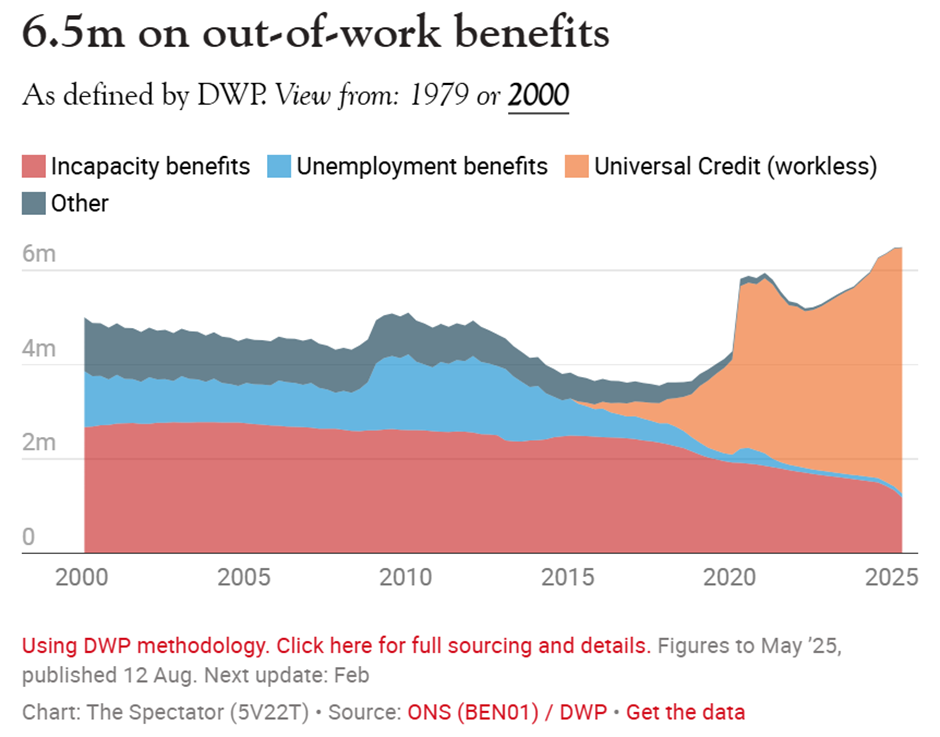
However, we seem to have managed just that, as thousands of young people appear to be joining the 6.5 million working age people who appear to have already opted out of work. Once out of work, or worse still, never acquiring the work habit, it becomes increasingly difficult to ever get into long-term productive employment.
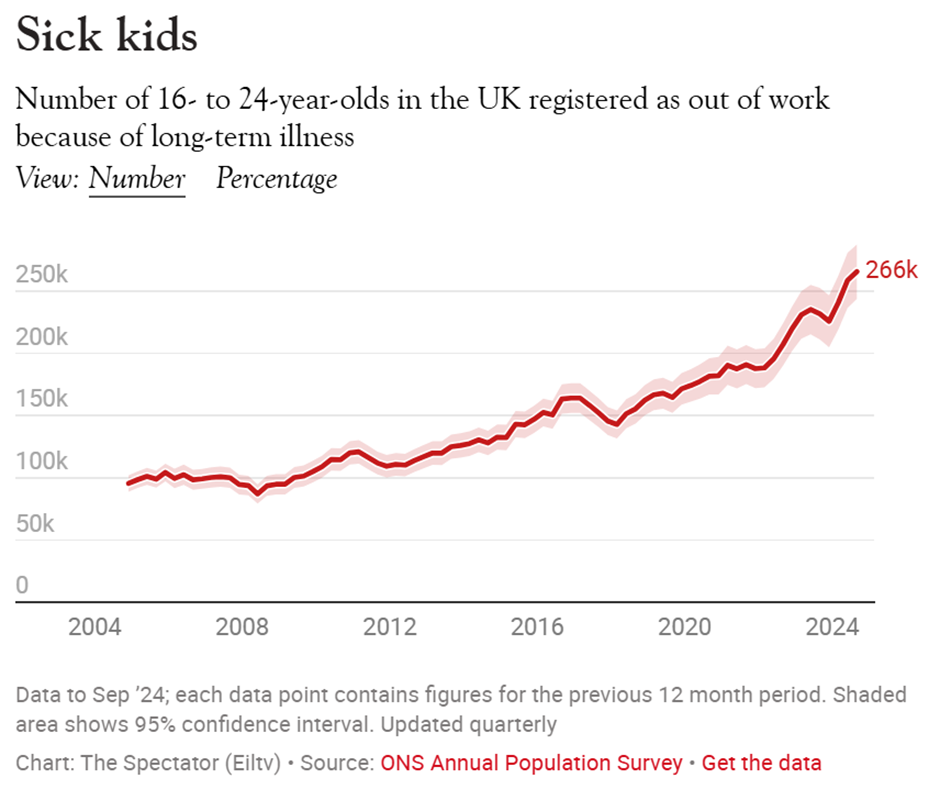
It’s perhaps worth briefly looking at how this thinking has evolved. Due to a combination of globalisation and immigration the British working classes have been trapped by a pincer movement that’s led to a loss of both their jobs and cultural status. The availability of benefits, with no requirement to seek work and the absence of meaningful in-person assessments, has meant that worklessness has become a viable option.
With the arrival of AI and robotics, middle class and many residual working class roles also look set to disappear.
Unemployed people represent an available economic resource. Traditional economic theory assumes that Adam Smith’s ‘invisible hand’ would soon find alternative work for these idle hands to do, albeit at a lower wage than they could previously command.
But what happens when those idle hands don’t suffer a material disbenefit in becoming idle? What happens when they find themselves on ‘benefits’ enjoying much the same standard of living as when they were employed? Will market forces work when the market’s been rigged?
This is the position in which we increasingly find ourselves, and as AI and robotics muscle in we face a fork in the road. Which way to turn? Do we carry on tipping an ever increasing number of people down the one-way chute into the black-hole of ‘welfare dependency’, or do we get governments out of the way and put our faith in the invisible hand of the market?
Surely, some will say, as with the advent of the seed-drill, steam engines, electricity and the internet, capitalism will work its magic and utilise the new technology to create new jobs.
Until recently, this looked like a conventional argument between ‘Left’ and ‘Right’, welfarism versus the free market. But now I’m not so sure. Some prominent and persuasive people on the Right seem to be throwing their weight in the same direction as the Left. Perhaps the world’s greatest salesman, Elon Musk, along with most of the other ‘tech bros’ seem to be siding with the ‘work as an option‘ movement.
I don’t buy it for the simple reason that the idle don’t live satisfying lives. I think the Devil finds work for idle hands to do. A coalition of those on the Left promoting UBI and those on the Right promoting hyperabundance – allegedly a consequence from the widespread adoption of AI and robotics – are offering false promises.
Admittedly, there’s a difference between the philosophical underpinning of the two offers. For the Left, UBI is a political choice, a kind of ‘Eden’, a place where there’s no stigma associated with not working, where people can indulge their creative and artistic proclivities, all paid for by the ‘rich’, a group they assume to be perfectly happy to oblige when Rachel Reeves asks them to “contribute” their fair share.
Conversely, the ‘tech bros’ are selling a dream, a vision, science fiction. In the same way that Musk talks about colonising Mars and making humans a multiplanetary species, so the workless future should be seen, at least for the foreseeable future, as a pipedream, an end goal way in the future.
For the Left, UBI is effectively the end state within a capitalist system: “From each according to his ability, to each according to his need.” Theoretically UBI doesn’t require any particular technological or social development, we could introduce it tomorrow. It simply requires massive redistribution of wealth, and the continued acquiescence of those with the ability to generate wealth to merrily pass it on to those whose ‘needs’ include idle self-indulgence.
It doesn’t take a genius to see us already quietly sliding into something approximating UBI. We’ve all seen the headlines that followed on from Ms Reeves latest budget: ‘Families on benefits £18,000 better off than working neighbours‘, ‘Reeves raises taxes by £30 billion‘. We’re taxing those working while at the same time allowing thousands a week to give up work and fall into welfare-dependence.
My concern is that whether non-working comes about due to a belief in a Polanskiesque or Muskite route, the result will be the same: purposelessness, despair and social dislocation.
Musk needs to change his sales pitch. Idleness shouldn’t be an end goal. If we look at the ONS’s long term employment rates (see figure 3) it’s clear that regardless of whatever new technology comes along, Adam Smith’s invisible hand is at work. Employment is found, and with employment comes lives worth living.
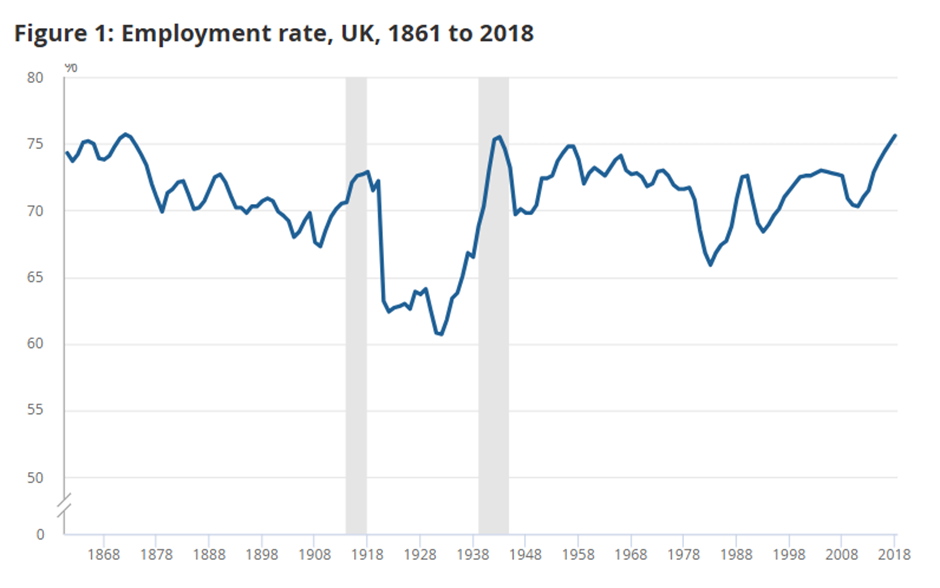
However, governments need to allow the employment market to work as it always has. Differentials between those working and not working need to be maintained, not eroded. People need to be encouraged to take responsibility for their own lives and those of their dependents. Children are the responsibility of the parents not the state.
Elon and his mates should start talking about AI and robotics as enabling technologies, tools to allow new jobs to be created that we haven’t yet thought of. In the 1860s no one knew we’d soon need thousands of railway workers. In the 1910s it would have been regarded as bonkers to think we’d soon need millions to work in car factories. In the 1950s we needed workers to meet the boom in consumer goods. In the 1960s the travel and entertainment industries really took off. In more recent decades jobs in computer programming, IT support and personal services have soaked up those let go by declining sectors. It will be just the same with robotics.
AI and robotics will inevitably cause short to medium term dislocation as employment profiles change, but the response needs to be flexibility, retraining, open markets. The very worst thing we can do is to continue down the current path of welfarism and creeping UBI. As a society we need to provide help for those whose jobs disappear to retrain and look for the new opportunities that will arise. The very worst thing we could do is what we’re currently doing: betraying their futures by pushing them onto the scrap heap, destined for a life of dependency.
To join in with the discussion please make a donation to The Daily Sceptic.
Profanity and abuse will be removed and may lead to a permanent ban.
As new technologies and practices emerge, there is a strong tendency for people to imagine what the world will be like. That is true. When I went into the computer industry in 1982, the paperless office was only a few years away. All you can say with any certainty is that ‘the future will be different to today’. The Luddites fight it with their heart and soul, and the progressives march forward to a bright new day. I’d say, keep what is good, and allow the market to define the rest.
I agree, though I do worry that work seems to be increasingly seen as something undesirable, to be avoided.
The only markets left will be between the billionaires who have looted everything we own apart from TVs and stuck us on UBI watching AI made documentaries about football legends. I fear we are staring at a dystopia full of useless meat sack human drones who can be put to death by the State if they’re a burden but are always handy for organ harvesting. I believe it’s called Agenda 2030.
I really and truly hope I’m wrong.
I am not sure Musk effectively talking his book is enough to say that “the right is promoting idleness”. For all the many good things he has recently done, Musk seems to me like a bit of a technocrat nutcase so I don’t take everything he says seriously.
I agree. He seemls to have a very engineer mindset thinking that every problem can be solved with the right technical approach.
Humans need a purpose for living. If these people get their way, I predict a massive collapse in the human population.
There is something about the struggle for survival that seems essential to reproduction and if we don’t feel we need to fight to survive we’ll lose our ability to reproduce.
It’s the practicalities of UBI that seem improbable to me. Paying people to do nothing works when less than 10% of the population is doing it, bit how can it possibly work for 100%? As the article suggests, the wealthy are not going to sit around and let Reeves or whoever take all their money. And a lot of money comes into this country from overseas – this would obviously stop as we stop producing anything that anyone else wants. And people still have to eat – the USA can probably produce all the food it needs but we certainly can’t. How would a UBI population be able to buy a pineapple from Sierra Leone? Why would the Sierra Leoneans even want to send us a pineapple? Perhaps Musk and the tech bros are looking forward to a future one world government where everyone is allotted exactly the same UBI…
Worry less about what Mr. musk does and wants to do. He is in the USA, and we are thrilled he is. Worry more about the collapse of the UK if it continues on its path of destruction. I have now lived here for 28 yrs. rather than going forward, the UK is going backwards. So many on welfare, empty shops, business rates sky high, cost of living sky high, education, healthcare a mess, roads undrivable, joy? Limited. What is left?
And when all the people with enough mental to leave the country have gone; what then?