
Civil Servants Demand to Work From Home Because of Iran War
Civil servants are demanding to work from home and for mandatory office working to be scrapped to protect them from higher living costs brought on by the Iran war. The Telegraph has the story.
The largest union for Whitehall staff urged Ministers to end rules requiring them to go into the office for at least three days a week.
The Public and Commercial Services Union (PCS) said the conflict was “pushing up costs for workers who are already struggling to make ends meet”.
It described office working as “out of step” with worsening financial pressures and said it placed more strain on public sector workers amid higher prices and low pay.
The Middle East crisis has led to increases in petrol and diesel prices, with energy bills forecast to go up by 20% along with higher food prices, the union said.
It pointed to advice from the International Energy Agency (IEA), an international treaty organisation, that recommended a fortnight ago countries reduce their energy consumption through home working to limit the impact of higher fuel costs.
The IEA’s recommendations for businesses and individuals also included using public transport instead of cars, driving slowly, avoiding air travel and switching to electric (rather than gas) stoves.
The recommendations were rejected by Labour with the Prime Minister’s official spokesman telling the public: “We [Britain] have a diverse and resilient supply. People in the UK should continue to go about their days in normal fashion.”
Fran Heathcote, the General Secretary of the PCS, said the Government “must prepare to adapt its approach in response to events like this and scrap the 60% mandate which would provide immediate relief to our members and help reduce costs”.
It is understood that Labour does not plan to change the policy that asks civil servants to spend at least 60% of their time working in an official building.
The mandate was set by the previous Conservative government and has been kept by Labour, despite fears standards would slip under Sir Keir Starmer.
Worth reading in full.
To join in with the discussion please make a donation to The Daily Sceptic.
Profanity and abuse will be removed and may lead to a permanent ban.
Work from home is out of step with basic decency and honesty and a sense of responsibility for doing a proper job.
Disagree completely, speaking for myself and those other of my colleagues who work from home 100% of the time and still do an excellent job – better than some of our colleagues who go to the office every day. In my experience the quality of your work depends on your work ethic, aptitude, interest in the job, not on where you are when you do it.
Cheers, tof 🤝
When it comes to Civil Servants, however, work from home should not be an option.
Why not? What is different? Because they work for the state not for the private sector? It’s just a job – their managers should be managing them and the big bosses should be holding the managers to account and the big bosses should be accountable to the politicians. Anyway, did people think they did a fantastic job when they were all in the office? This just seems like Civil Servant bashing to me – perhaps they deserve it but that’s a different issue.
I know a Civil Servant who works from home and he has a tremendous work ethic.
I don’t disagree with what you say. I also believe it’s perfectly possible to be as productive or even more so working from home than going into an office. But I just don’t think most people have what it needs to do that. The discipline, the integrity, the temperament. And to me the giveaway is when people fight for it aggressively. If you are an employee and your employer requires you to work at an office, even if it isn’t your preference, you just do it. Surely, an employer should have a right to decide how he would like you to carry out the work he pays for. And if it turns out that an employer is wrong and it’s less efficient, well that’s his loss. To me battling with an employer where the employee works is no different to arguing with an employer aboit how any other aspect of how an employer wants a job done. Employer: ok, this is your desk at the reception, these are the phones, people come in through that door, here are the sign in sheets…. Receptionist employee: Uh, sorry, I don’t want to sit here, it doesn’tlook very appealing, I’d like to sit… Read more »
I think some people have what it needs to do that, clearly not all. But to be honest, I am not sure how many would be much better working in an office. The people we have trouble with are the same people we had trouble with in the office. Maybe it’s a bit easier to skive when at home, but it’s down to me to manage that with my team and if don’t (and managing includes getting rid of them, which I have done in one or two cases) then it’s on me.
Ultimately employer decides, yes, but I don’t think there’s anything fundamentally wrong with a bit of back and forth where each side discovers their limits. If one of our employees is not happy, I would rather them tell me about it and then I can decide if what they are asking for is reasonable or not.
FWIW, the “Iran war” excuse quoted in this story seems like bollocks to me and they do themselves no favours with it – I mean, don’t most of them travel most of the way by train anyway, assuming it’s mainly London based people we are talking about.
Depending on the nature of the work done, there are many problems with working remotely from the dedicated office, ranging from planning permission to health & safety. Then there are loads that end up shooting themselves in the foot by working for nothing, financially – in effect, doing some free work, unless they are well organised.
Health and safety – so for example I might fall off my chair at home, but not in the office? Since “covid” my firm has done 80% of its work from home. I can’t recall any “health and safety” incidents in that time…
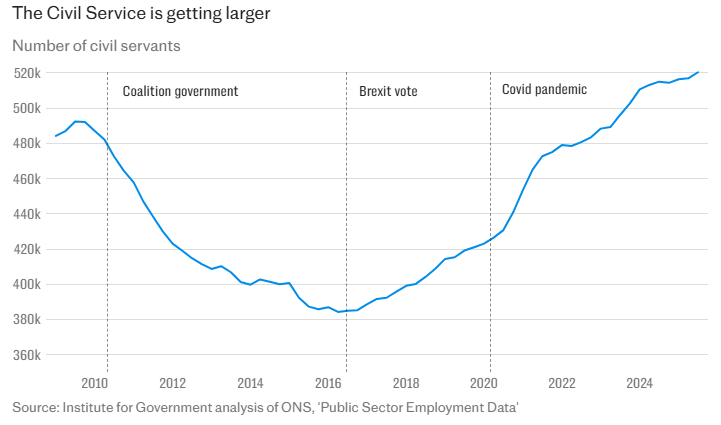
Notice the umbers grew during the infamous 14 years.
Just the usual snowflake leftoid wet wipes – sadly dragging all of us down.
The risk of ‘working from home’ or ‘working from the beach’ is that there are many people who insist on doing so, expecting their salaries to be paid un-changed. There are too many mediochre bureaucratic appointees whose job could be done by someone similarly qualified on a fraction of their salary in other places such as India.
And to a growing extent AI.
Some of our staff are not UK based but they paid on the same basis as everyone else, based on what they contribute not what their living costs are. Lots of our clients have outsourced to India and other places and it has not gone well – communication is difficult, quality has gone down, knowledge is lost, the mindset doesn’t appear to be right. You get what you pay for. Not saying that there are not crap staff in the UK or that there are not some great staff in India, but if you make cost your only focus, quality will suffer. So yes there is that danger, but that has been the case for a long time, since long before working from home, and it’s not as simple as all that.
I agree. I have built and run companies where we did not outsourced anything, Software, Design and Manufacture, for both the reasons you state but also control and security of the IPR in the systems, developed and manufactured. But I see 3rd world outsourcing now rife in one; an international Corporate Group-acquired company, where product cost-saving trumps everything and WFH has definitely become out of control since 2020. some days only 20% -30% staff in the office and no-one even answering the main company phone.
Well yes but you seem to conflate working from home with other things. Perhaps this firm does not manage it very well – that’s a failure of management.
We did without a main company phone for years during “covid” – but we have a tiny client base (less than 20).
Why would their salaries not be paid unchanged, if they produce the same work? Actually their salaries should increase as they are costing the firm less, saving expensive office space.
You have a point here. Add to that the marginal savings from employees boiling their own kettles at home for hot drinks, heating their own food, charging their phones and laptops themselves etc.
We give employees an allowance for equipment at home but we also have a very nice office that is somewhat under used but those staff who like that kind of thing do use it. It’s a compromise that seems to work well for everyone. The business is employee owned so we all share in the expenses and the profits
If Labour goes ahead and bans the use of VPN’s in their strictest sense, not just a device to get round country restrictions, there will be no working from home as it will no longer be possible.