
Doubling Cash for NHS “Had No Impact” on Health
NHS spending has doubled in 17 years with “no impact” on the nation’s health, former health minister Lord Bethell has admitted, with deteriorating clinical outcomes and flatlining life expectancy. The Telegraph has the story.
Lord Bethell, a Conservative minister under Boris Johnson, said Britain was facing “a social, moral and economic disaster” because billions of pounds were being wasted.
The peer made the comments to the Telegraph during a joint interview with Prof Sir Jonathan Van-Tam, the former deputy chief medical officer (CMO), who warned of a “demographic time bomb” that the health service was failing to address.
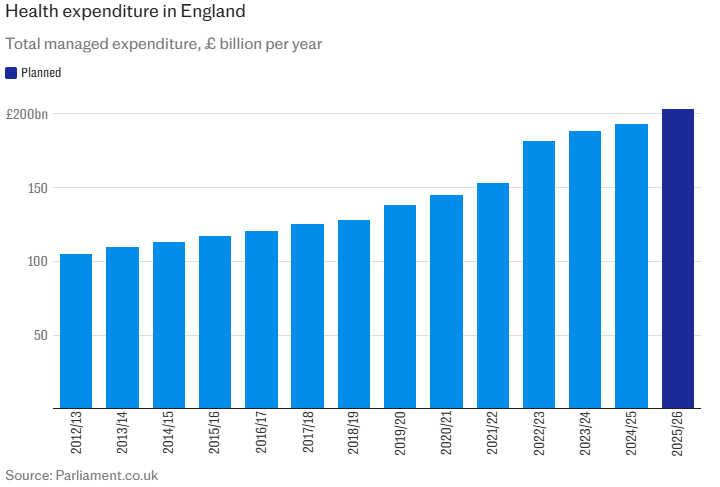
Lord Bethell said that a doubling in NHS spending in the past 17 years, from about £100 billion to £200 billion, had had “no impact” on the nation’s health, with outcomes getting worse for many and life expectancy flatlining.
Governments have repeatedly pumped extra cash into the NHS in an attempt to cut waiting lists and improve the care. However, critics have claimed that much of this money is wasted or spent on pay rises.
Pay for resident doctors has increased by 28.9% in the past three years, the biggest increase of any profession, after years of strike action.
Meanwhile, the nation’s health is showing signs of worsening.
Today’s pensioners can expect to spend around a decade in ill health, but that figure is expected to double for those born now, without a gain in life expectancy, meaning that around a quarter of their life will be spent in ill health, at vast cost to the NHS.
Lord Bethell, who was a health minister during the pandemic, said the figures were “troubling” and “frustrating” – and pointed out they were more stark in poorer parts of the country.
“That’s a social, moral and economic disaster for the country,” he said. “We’re putting the financial future of our nation in jeopardy. Our children are not going to be able to afford the schools and hospitals that they deserve.”
Worth reading in full.
To join in with the discussion please make a donation to The Daily Sceptic.
Profanity and abuse will be removed and may lead to a permanent ban.
The high rates of inflation which the Bank of England failked to prevent accounts for some of that huge rise. It is not clear why anyone finds this surprising or even news worthy.
Any attempt to use the NHS will show you that the system is not working well. The astaff are generally bored or disinterested, the procedures are clunky and the buildings are depressing; where once there were impressive spirit lifting buildings there are now steel and cladding boxes. Corridors seem the main thing the NHS specialises in alongside queues.
BoE inflation calculator shows inflation since 2009 to be 61.1%. That’s still a large increase in costs with nothing to show for it.
Say what you like, just don’t mention the jabs.
…flatlining life expectancy… Of course. Life Expectancy is a mathematical model – a prediction. Better metrics are Average Age at Death (AAD) and Most Common Age at Death (MCAD); they’re based on actual measurements. Up until 1951 the MCAD for females was under 1 year and for males it was not until 1968 that under 1 was not the most common age at death. Similarly Child deaths (1-9 years) declined from next most common in the mid-1800s to the current rare levels. Infant and child mortality dragged the average down such that in 1841 the AAD was 28.1 years for males and 30.6 years for females, but the MCAD excluding infants and children was 71 for males and 74 for females – pretty much the well-known three score years and ten. The MCAD is recently (2022) 84 years for males and 90 years for females. It’s barely changed in the last few decades. What has reduced is the spread of ages around those most common values. Fewer are dying much younger and this drives up the average closer to the most common value. However, what has increased is the proportion dying of dementia. Think about it: It’s a diagnosis by… Read more »
One of the worst things I was shown recently was to take a tape measure, run out out to 84 inches and put your finger on where you are, to see what’s left… it’s quite sobering.
But can you put your finger on when you met your spouse and when you had your kids (if any of either) or any other notable, hopefully happy, events or achievements?
You can prepare for running out of tape measure by looking into ‘your’ inheritance tax liability and trying to make it easier for your executors to work out what to pay Reeves’ successors. That may boost your blood pressure but there are probably worse ways to go.
Not sure why the state is so determined to increase life expectancy. Seems to me as if that causes more problems than anything else.
Let people worry aboit increasing their own life expectancy.
Unfortunately most people seem to trust the state to look after them and have been educated to believe in the magic money tree. The perpetrators of this myth are now in charge and the tree is no longer working to their model. It happened in the Communist countries, they went cold turkey on communism and it fell apart after 30 years after creaking at the seams for most of its existence. In the west we were drip fed the commie poison over 50 years and it’s now killing the patient. Collapse is on the cards.
Like everything else the state attempts to do it’s a dismal, expensive failure.
NHS is a bottomless money pit.
There was a national health service go8,g back to Victorian time, which in 1048 the Marxist-Socialist Labour Government nationalised along with most of the economy.
Return it to what it was: a successful mix of private, voluntary, community funded.
1948
Yes. I like to point people to https://peopleshistorynhs.org/encyclopaedia/pre-nhs-healthcare-reforms/
The only change at the time was how it was paid for (taxation). Trouble is, since then the definition of ‘healthcare’ has expanded into chopping bits off trans people and helping couples who are infertile have babies and far too much else.
Edited fr speling.
Including treating foreigners who turn up here and refused to pay or are not even asked to by Far Left doctors who should be force to pay for their treatment themselves.
Should be 1948.
I overheard a conversation the other day, someone who worked within the NHS. He was moaning that every time the hospital gets given more budget they spend it all on more people. However with more people to manage, productivity reduces, so the expected improvement never materialises. He was frustrated that they never put any money towards efficiency improvements, which would not only improve the service but would probably save money in the long term.
Because they aren’t measured or rewarded on efficiency – they are measured by how many people are in their departments, bigger = better = more budget…
I’ve been told many times by many learned medics ie those whose livelihoods don’t depend on their compliance with the narrative, that the nation’s health would improve dramatically if 90% of prescription drugs just ceased to ever be given.
Where’s the money going then?
As if we couldn’t guess…
What a shame we never get the good bits of Europe like the German or French insurance based healthcare systems instead of the NHS.