Covid Rates Were Falling Across Europe Before Lockdowns, Study Finds
Covid infections were falling across Europe before lockdowns, new research shows, making the Covid Inquiry’s claim that locking down a week earlier could have saved 23,000 lives “complete hokum”. The Telegraph has the story.
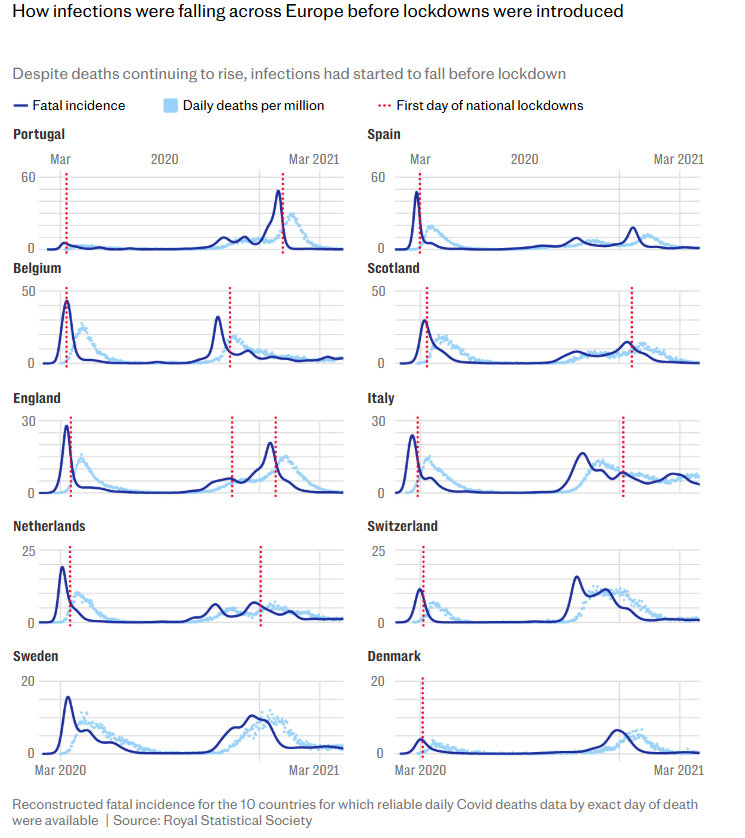
Statisticians at the University of Edinburgh compiled figures from 10 countries where accurate daily death numbers were available, and calculated when those people must have become infected.
Out of 17 lockdowns introduced between March 2020 and March 2022, only the first Belgian restriction, and the second Italian, preceded a fall in infections.
For all the others – including England’s three lockdowns – infections had already peaked before the country was ordered into isolation, raising questions about whether such harsh restrictions were required.
The study found people had already begun to voluntarily change their behaviour before lockdowns were introduced.
Prof Simon Wood, of Edinburgh’s School of Mathematics, said it challenged claims that locking down sooner could have saved thousands of lives.
“People had already restricted their activity quite a bit, and they were altering their behaviour because they were worried about the disease.
“It’s not that lockdown wasn’t doing anything, it was squishing things down further, but in retrospect looking at the figures, full lockdowns were largely unnecessary for turning around the waves of infections.
“They were an overreaction and a political response to what people were clamouring for, in spite of the data.”
The new figures were calculated by looking at the average time from an infection to symptoms – roughly 5.8 days – and then on to death, which tended to occur about 15 days later.
Although death rates all peaked after lockdowns, infections had begun to slump weeks earlier, in countries including England, Portugal, Spain, Scotland, Italy, the Netherlands, Switzerland and Denmark.
In Sweden, which did not lock down, the figures showed that cases peaked at roughly the same time as the countries that did isolate their populations.
The paper, which was published in the Journal of the Royal Statistical Society Series A, also criticised the government for “intentionally distorting” the risk of Covid for healthy young people.
One widely-displayed government poster pictured a healthy woman in her mid-20s wearing a mask with the slogan ‘I wear this to protect you. Please wear yours to protect me.”
But researchers said it was clear early on that young, healthy people were not in danger from the virus.
Of course, even this overstates the case for restrictions, as it still implies that the pre-lockdown restrictions were necessary for “turning around the waves of infections”. When it’s clear from every wave of flu-like viruses that’s ever been recorded that they naturally peak and subside after only a fraction of the population (somewhere between 10 and 20%) has been infected – probably due to variations in individual susceptibility. But this study does at least move the dial in the right direction.
To join in with the discussion please make a donation to The Daily Sceptic.
Profanity and abuse will be removed and may lead to a permanent ban.
28 Comments
Oldest
NewestMost Voted
Inline Feedbacks
View all comments
robnicholson
2 months ago
This isn’t a surprise. It was visible at the time. Before every lockdown, the infection curve was clearly flattening and went over the top before lockdowns could have made any significant difference. I recall a near shouting match with a friend when I showed him the clear Gompertz curve – he refused to believe it outright because of that near impossible to fight fearmongering by the media and government.
They tried it again with superflu before Christmas but gloriously embarrassing that the curve top was reached almost the day the media went into overdrive. About the only positive I drew from this was that many more just ignored it this time.
What rates? Based on what? Fake PCR Tests? Coughing?
Case-demic based on fraudulent tests. Once the PCR was no longer free the idiots stopped self testing and cases collapsed.
There was no SARS II virus. There was no pandemic. There was a Plandemic, CIA-NATO and 80% of the half wits in our society played along and happily supported a Medical Nazism. Case closed.
mrbu
2 months ago
I’m interested by the Swiss and Danish charts. Did they not have a second national lockdown, even though the infection rate was higher than for the first wave? Or had they realised by then that lockdowns were doing more harm than good?
I think Switzerland never had a hard lockdown but had a wishy washy lockdown the rules of which changed about every week, and which was never really fully enforced by the authorities, outside of a few heavy-handed cases designed to make martyrs of a few brave individuals, and spread fear and loathing everywhere else. The then healthcare minister was a clown with an uncanny resemblance to Hitler who struggled with elementary grammar and proclaimed that the curve “peaking” was a bad thing and needed to be prevented.
Almost certainly what happened, we just can’t prove
it!
JAMSTER
2 months ago
This is NOT news. The data has been known for YEARS that shows infections were falling before the first lockdown. I cannot remember who first showed this to be the case but it was someone like Smalley or Kirsch or the TTE boys (Heneghan & Jefferson) or someone of similar ilk with data analytical impeccable credentials. The Daily Telegraph and the statisticians at Edinburgh University must all have been fast asleep for the past three or four years if they believe this to be some startling new discovery !!
Very true, but everything that challenges the official narrative helps, and a few more people might see it and become awake!
We should applaud everything that supports what most on here right from the very start!
Lockdowns were and are an inappropriate response. If we needed to do anything at all, it was along the lines of the Great Barrington Declaration, directed care.
Historically this has been the case for most diseases. Smallpox and polio were already in retreat when the vaccines were launched. But of course the pharma industry celebrates these as great successes.
soundofreason
2 months ago
Not only were infections reducing by the time of the UK lockdown so was the rate of increase in the excess death rate – it was flattening out, which meant new infections had peaked some time before. No dodgy PCR tests required, not ‘dead from new mystery illness’ – just ‘dead’ as in not living any more as a diagnosis. This was detectable in the weekly data that was being published by the ONS before 23 March 2020. One would hope that with such a momentous decision hanging on it The Scientists might have been analysing the data before ONS decided to post it on their website.
Northern hemisphere trajectory of certain respiratory viruses – such as coronaviruses and influenza: starting point is October/November, low level until end of December, exponential increase through January to leak in early February then, fairy quick decline from peak through March to low level by April.
This was KNOWN! It happens every year! We have had two centuries of observation of seasonal respiratory viruses to figure it out.
The SARS Coronavirus 2 could have been expected to follow this trajectory and did, which was evident by death rates peaking in early March. Since infection to death is about 21 to 28 days, and allowing for delays in reporting, those peak deaths correspond to peak infection rates about four weeks earlier – so early February as was to be expected.
Ivor Cummins was showing this in his videos in 2020/21.
Keencook
1 month ago
DS or LS as it was then – published this fact in 2020. I know because – in the early days – a close family member wrote exactly that. (Mind you he’s good with data – so few people understand numbers) 😩 good to see it “officially recognised”. Such a waste of those years for so many.
Shouldn’t this sort of headline be in a history section called ‘What we were talking about 6 years ago’?
anbak
1 month ago
Still worth reminding and confirming this truth, from that short era of hysteria, but this isn’t really news. It was well reported and acknowledged by anyone who would listen at the time.
In real time, for instance, Tim Spector’s ZOE app (accurate during 2020) showed reported symptoms dropping from January 1st 2021, 5 days before the repeat lockdown started on January 6th.
I suspected at the time that it may have influenced the decision to start another lockdown, with the government and public health co-conspirators able to use the time lag to give the illusion of efficacy for the insane policy.
Jessica Hockett
1 month ago
Thanks for reporting on this, Will. Because I’ve been invested in studying this time period and topic for so long (as you know), I trust you’ll indulge this lengthy comment graciously. I am pleased to see Dr Wood and colleagues finally come to a similar conclusion that my -e-colleague U.S. analyst John Khademi reached in April 2020 — and explained VERY well in this video he published at the time https://www.youtube.com/watch?v=5EppELuO4T0 Although I contend there was no sudden-spreading, novel, disease-causing SARS-related virus that came on the scene in late 2019/early 2020, even those who disagree need to be made aware of contemporaneous insights like John’s, as well as those published in journals and on blog platforms long ago. Take New York: There was no clear sign or signal of a spreading pathogen adding risk of severe illness or death in New York until the federal government announced, “15 Days to Slow the Spread” and the rapid expansion of mass testing for SARS-CoV-2. [1,2] Researchers from metro-area Northwell Health system acknowledged this temporal mismatch in an early study, writing, “Our [testing] data reveal that SARS-CoV-2 incidence emerged rapidly and almost simultaneously across a broad demographic population in the region. These findings… Read more »
In summary, it was a manufactured pandemic designed to cause mass hysteria, compliance and acceptance of an untested medical product. Further enrichment of the elites was also achieved.
Pandemics ARE manufactured events — not biological phenomena. Illness is real; pinning illness on viruses that spread from person to person in “waves” is part of decades-old lies. Assumptions about flu season such as those at the end of Will’s piece above need to be challenged.
Until the nonsensical “virus from afar” storyline is confronted, and the tests that aid and abet the fraud rejected by the public, the pandemic preparedness and vaccine industries are very much winning.
coulie45
1 month ago
The 2020 UK lockdown was even more risable as it coincided in England with the finest spring in living memory (April and May). Infection and death rates for those living in overcrowded accommodation with no outside space would have been much reduced if people had been encouraged to spend time outside in public parks and commons, persistent warm sunshine being the historic enemy of flu-like viruses.
This is old news. At the time there were several articles making exactly this point. Not sure why it is making headlines now? I suppose it may help stop this from ever happening again?
New Covid cases were manufactured using manipulated PCR tests designed to produced positive results. This is now common knowledge. It was a scamdemic used to justify the dangerous injections that killed and injured millions globally.
Peter W
1 month ago
Even I knew that rates were falling before the first Lockdown(tm, HM government). Anyone vaguely paying attention in March 2020 knew that the whole Covid(tm, Pfizer) thing was a money and power scam.
JayGeeCee
1 month ago
The chances of any sensible analysis influencing the Covid Enquiry is zero.
That total waste of money has a predetermined goal to justify and reinforce the actions of the New Aristocrats.
It is, however, good to see academics putting their head above the parapet and carrying out more fact based analysis.
It was totally obvious at the time that almost all deaths were amongst the over 70’s and the under 30’s were at minimal risk of death.
Robert Liddell
1 month ago
This was well recognised within the first few weeks-lots of articles in Lockdown Sceptics at the time.
I guess any new analyses showing the same thing are worthwhile, given the idiotic inquiry still underway.
NickC
1 month ago
This is part of a letter I sent to my MP in November 2020:
Of course, the first lockdown didn’t “work” either, as anyone can see by looking at the covid19 death toll graph from the ONS. But let’s assume the first lockdown “worked” – then the 10th April inflexion (the peak) shouldn’t be there, an inflexion around 20th April (the “correct” rollover date) is missing, and the inflexion (death increase) around mid June is also missing. That’s three facts which contradict your narrative.
Why these dates? The covid cycle mean time from infection to death was almost 4 weeks (it may be longer now due to better treatments). So adding four weeks to the lockdown date of 24th March gives 20th April; and adding four weeks to the relaxation date of mid May gives mid June. Conclusion? The ONS evidence itself shows the government is wrong.
wryobserver
1 month ago
How about sending this to the Hallett Inquiry, as it demolishes the “23000 died because of lockdowns being too little to late” conclusion?

To join in with the discussion please make a donation to The Daily Sceptic.
Profanity and abuse will be removed and may lead to a permanent ban.
This isn’t a surprise. It was visible at the time. Before every lockdown, the infection curve was clearly flattening and went over the top before lockdowns could have made any significant difference. I recall a near shouting match with a friend when I showed him the clear Gompertz curve – he refused to believe it outright because of that near impossible to fight fearmongering by the media and government.
They tried it again with superflu before Christmas but gloriously embarrassing that the curve top was reached almost the day the media went into overdrive. About the only positive I drew from this was that many more just ignored it this time.
What rates? Based on what? Fake PCR Tests? Coughing?
Case-demic based on fraudulent tests. Once the PCR was no longer free the idiots stopped self testing and cases collapsed.
There was no SARS II virus. There was no pandemic. There was a Plandemic, CIA-NATO and 80% of the half wits in our society played along and happily supported a Medical Nazism. Case closed.
I’m interested by the Swiss and Danish charts. Did they not have a second national lockdown, even though the infection rate was higher than for the first wave? Or had they realised by then that lockdowns were doing more harm than good?
I think Switzerland never had a hard lockdown but had a wishy washy lockdown the rules of which changed about every week, and which was never really fully enforced by the authorities, outside of a few heavy-handed cases designed to make martyrs of a few brave individuals, and spread fear and loathing everywhere else. The then healthcare minister was a clown with an uncanny resemblance to Hitler who struggled with elementary grammar and proclaimed that the curve “peaking” was a bad thing and needed to be prevented.
I seem to remember that “cases” in Sweden dropped after one of our “lockdowns” – that’s how effective they were.
UK’s invisible exports? 😁
It’s almost as if they all waited until they knew “cases” were going to fall, declared a lockdown to make it look like they worked.
Good point, hadn’t thought of that one.
Almost certainly what happened, we just can’t prove
it!
This is NOT news. The data has been known for YEARS that shows infections were falling before the first lockdown. I cannot remember who first showed this to be the case but it was someone like Smalley or Kirsch or the TTE boys (Heneghan & Jefferson) or someone of similar ilk with data analytical impeccable credentials. The Daily Telegraph and the statisticians at Edinburgh University must all have been fast asleep for the past three or four years if they believe this to be some startling new discovery !!
Very true, but everything that challenges the official narrative helps, and a few more people might see it and become awake!
We should applaud everything that supports what most on here right from the very start!
Lockdowns were and are an inappropriate response. If we needed to do anything at all, it was along the lines of the Great Barrington Declaration, directed care.
Historically this has been the case for most diseases. Smallpox and polio were already in retreat when the vaccines were launched. But of course the pharma industry celebrates these as great successes.
Not only were infections reducing by the time of the UK lockdown so was the rate of increase in the excess death rate – it was flattening out, which meant new infections had peaked some time before. No dodgy PCR tests required, not ‘dead from new mystery illness’ – just ‘dead’ as in not living any more as a diagnosis. This was detectable in the weekly data that was being published by the ONS before 23 March 2020. One would hope that with such a momentous decision hanging on it The Scientists might have been analysing the data before ONS decided to post it on their website.
Hope? Ha!
Northern hemisphere trajectory of certain respiratory viruses – such as coronaviruses and influenza: starting point is October/November, low level until end of December, exponential increase through January to leak in early February then, fairy quick decline from peak through March to low level by April.
This was KNOWN! It happens every year! We have had two centuries of observation of seasonal respiratory viruses to figure it out.
The SARS Coronavirus 2 could have been expected to follow this trajectory and did, which was evident by death rates peaking in early March. Since infection to death is about 21 to 28 days, and allowing for delays in reporting, those peak deaths correspond to peak infection rates about four weeks earlier – so early February as was to be expected.
Ivor Cummins was showing this in his videos in 2020/21.
DS or LS as it was then – published this fact in 2020. I know because – in the early days – a close family member wrote exactly that. (Mind you he’s good with data – so few people understand numbers) 😩 good to see it “officially recognised”. Such a waste of those years for so many.
Shouldn’t this sort of headline be in a history section called ‘What we were talking about 6 years ago’?
Still worth reminding and confirming this truth, from that short era of hysteria, but this isn’t really news. It was well reported and acknowledged by anyone who would listen at the time.
In real time, for instance, Tim Spector’s ZOE app (accurate during 2020) showed reported symptoms dropping from January 1st 2021, 5 days before the repeat lockdown started on January 6th.
I suspected at the time that it may have influenced the decision to start another lockdown, with the government and public health co-conspirators able to use the time lag to give the illusion of efficacy for the insane policy.
Thanks for reporting on this, Will. Because I’ve been invested in studying this time period and topic for so long (as you know), I trust you’ll indulge this lengthy comment graciously. I am pleased to see Dr Wood and colleagues finally come to a similar conclusion that my -e-colleague U.S. analyst John Khademi reached in April 2020 — and explained VERY well in this video he published at the time https://www.youtube.com/watch?v=5EppELuO4T0 Although I contend there was no sudden-spreading, novel, disease-causing SARS-related virus that came on the scene in late 2019/early 2020, even those who disagree need to be made aware of contemporaneous insights like John’s, as well as those published in journals and on blog platforms long ago. Take New York: There was no clear sign or signal of a spreading pathogen adding risk of severe illness or death in New York until the federal government announced, “15 Days to Slow the Spread” and the rapid expansion of mass testing for SARS-CoV-2. [1,2] Researchers from metro-area Northwell Health system acknowledged this temporal mismatch in an early study, writing, “Our [testing] data reveal that SARS-CoV-2 incidence emerged rapidly and almost simultaneously across a broad demographic population in the region. These findings… Read more »
In summary, it was a manufactured pandemic designed to cause mass hysteria, compliance and acceptance of an untested medical product. Further enrichment of the elites was also achieved.
Sure, that and more apply
Pandemics ARE manufactured events — not biological phenomena. Illness is real; pinning illness on viruses that spread from person to person in “waves” is part of decades-old lies. Assumptions about flu season such as those at the end of Will’s piece above need to be challenged.
Until the nonsensical “virus from afar” storyline is confronted, and the tests that aid and abet the fraud rejected by the public, the pandemic preparedness and vaccine industries are very much winning.
The 2020 UK lockdown was even more risable as it coincided in England with the finest spring in living memory (April and May). Infection and death rates for those living in overcrowded accommodation with no outside space would have been much reduced if people had been encouraged to spend time outside in public parks and commons, persistent warm sunshine being the historic enemy of flu-like viruses.
This is old news. At the time there were several articles making exactly this point. Not sure why it is making headlines now? I suppose it may help stop this from ever happening again?
New Covid cases were manufactured using manipulated PCR tests designed to produced positive results. This is now common knowledge. It was a scamdemic used to justify the dangerous injections that killed and injured millions globally.
Even I knew that rates were falling before the first Lockdown(tm, HM government). Anyone vaguely paying attention in March 2020 knew that the whole Covid(tm, Pfizer) thing was a money and power scam.
The chances of any sensible analysis influencing the Covid Enquiry is zero.
That total waste of money has a predetermined goal to justify and reinforce the actions of the New Aristocrats.
It is, however, good to see academics putting their head above the parapet and carrying out more fact based analysis.
It was totally obvious at the time that almost all deaths were amongst the over 70’s and the under 30’s were at minimal risk of death.
This was well recognised within the first few weeks-lots of articles in Lockdown Sceptics at the time.
I guess any new analyses showing the same thing are worthwhile, given the idiotic inquiry still underway.
This is part of a letter I sent to my MP in November 2020:
Of course, the first lockdown didn’t “work” either, as anyone can see by looking at the covid19 death toll graph from the ONS. But let’s assume the first lockdown “worked” – then the 10th April inflexion (the peak) shouldn’t be there, an inflexion around 20th April (the “correct” rollover date) is missing, and the inflexion (death increase) around mid June is also missing. That’s three facts which contradict your narrative.
Why these dates? The covid cycle mean time from infection to death was almost 4 weeks (it may be longer now due to better treatments). So adding four weeks to the lockdown date of 24th March gives 20th April; and adding four weeks to the relaxation date of mid May gives mid June. Conclusion? The ONS evidence itself shows the government is wrong.
How about sending this to the Hallett Inquiry, as it demolishes the “23000 died because of lockdowns being too little to late” conclusion?