
Guardian: Floodplain Homes Next to River in Rainy Welsh Valley Abandoned “Due to Climate Change”
Sixteen small terraced houses sitting on a floodplain next to fast-flowing water in one of the rainiest parts of Britain are to be bought and demolished because the cost of protecting them from regular flooding far outweighs the value of the properties. A few years ago, this item would not warrant national attention. But in an era where mass climate panic is stoked by mainstream media, the story is too good to pass. According to the desperate Guardian, residents can no longer be protected from flooding “caused by the climate crisis”. The local council chips in with the claim that it is believed to be the first time a local authority has bought a large number of houses due to flooding caused by the “climate emergency”.
The row of houses is in the Welsh Clydach Valley in the former mining village of Ynysybwl (pronounced ‘an-is-abull’). The houses are to be bought for around £2.5 million in total since this a much cheaper option than the £9 million needed to raise a defensive wall in the area known as Nant Clydach. The Guardian reports “relief and delight” among the residents at the buyout scheme – hardly surprising since they are sitting on a well-documented floodplain subject to considerable natural inundation.
Two recent storms have caused bad flooding, but records from Natural Resources Wales indicate periodic inundation in the “very constrained section of the valley” stretching back to 1955.
Rainfall appears to have increased across Wales in recent years, but the amounts involved are unlikely to be noticed by the already sodden Welsh.
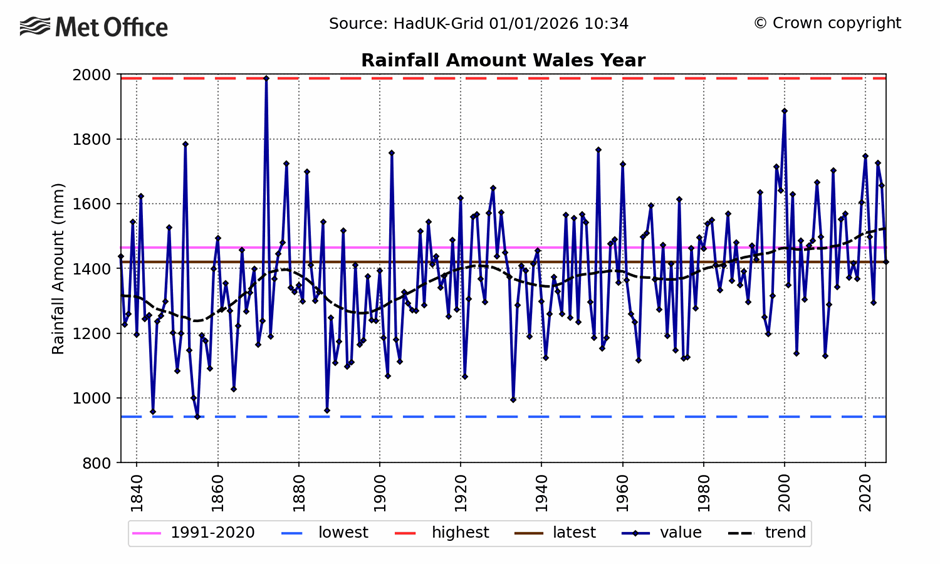
As the graph above shows, rainfall is cyclical in the country but any gently rising trend started before the Guardian went into full bedwetting mode about the climate and the need for the Net Zero fantasy. Individual years of extra heavy rainfall can be seen throughout the record. Periods of substantial rainfall downturn, such as that seen during Victorian times, can be attributed to natural variation, but these days that explanation is ignored when rainfall is making small gains and political needs are paramount. It need hardly be pointed out that there is not a scintilla of solid proof that humans using hydrocarbons are primarily responsible for small cyclical changes in rainfall in one small, rain-prone, coastal country in the northern hemisphere.
It’s winter in the UK so the climate botherers are giving ‘heat’ a rest and turning their attention to pluvial pickings. In its story on the Ynysybwl homes, the Guardian also noted that western Britain has recently been battered by repeated pulses of heavy rain and strong winds. It is claimed that this has led some politicians and “experts” to warn that more homes “will have to be abandoned because of the climate breakdown”.
Left-wing author and former editor of the Observer Will Hutton had this take on a rainy start to 2026.
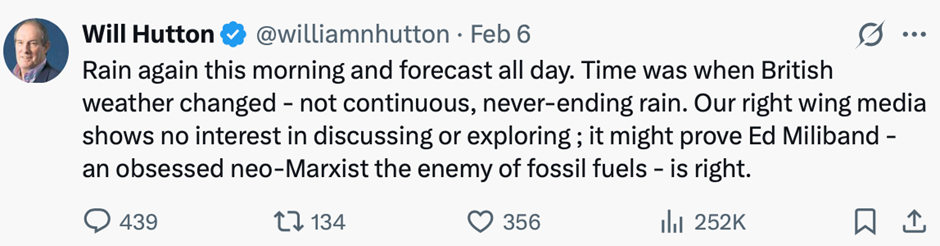
It doesn’t get dumber than this. A rainy month turned into a Right-wing media conspiracy and the obvious suggestion that we should ban hydrocarbons. To stop Will getting wet, society needs to divest itself of hydrocarbon use with all the devastating consequences from inevitable societal and economic collapse. Crop yields will halve without hydrocarbon-produced fertilisers and hunger will stalk the land – and all because Will can’t adapt to the seasonal British weather and provide himself with decent walking shoes and a good umbrella.
Around four decades of relentless invented climate catastrophising and the demonising of trace atmospheric gases have pushed many countries to the brink of a Net Zero calamity. Many of the scares have been effectively debunked – coral growth at recent record levels on the Great Barrier Reef, Arctic sea ice extent paused for 20 years and, recently, growing numbers of polar bears getting fatter on Svalbard – but the search for misinformation and lies about the complexities of climate and the atmosphere continues. Almost all of this is orchestrated by political forces seeking to capture the commanding heights of the economy by controlling the vital resource of hydrocarbons. Needless to say, Left-wing media such as the Guardian and the BBC are at the forefront of producing agitprop that is promoted as science and climate reporting.
Demonising bad weather without any reference to past data trends is incoherent stupidity on stilts. Flood risk is right up there in the Jim Dale word-salad playbook. Given how much rain also falls in neighbouring England, the common practice of building on floodplains and the declining state of protection measures (often driven by environmental lobbying), it is surprising how few properties are flooded each year.
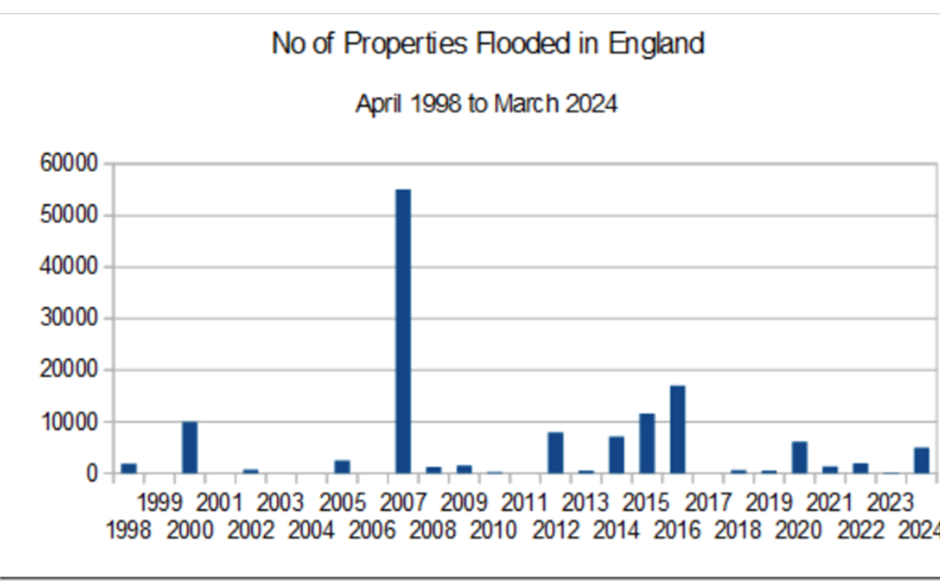
There are over 26 million dwellings in the country, but according to the Environment Agency, only 5,000 properties have been flooded on average every year since the turn of the century. Over this period, no trend out of the ordinary can be discerned.
Chris Morrison is the Daily Sceptic’s Environment Editor. Follow him on X.
To join in with the discussion please make a donation to The Daily Sceptic.
Profanity and abuse will be removed and may lead to a permanent ban.
If it saves just one house….
“…No house is safe until all houses are safe.”
“Ah, but for the children and grandchildren”
When were the houses built? We know they are described as being on a flood-plain but what has changed upstream or downstream since? I’ve lived for 45 years near water meadows which have been reduced in scope by building housing upstream and the HS2 works downstream – they flood far more often and for longer these days. The town has grown by at least a third since we first set up home in the area.
Edited for speling 🙂
Most likely Victorian, following the coal mining industry. One of the largest changes has of course been the abandonment of the collieries. Then there’s all the development in the Cardiff area, which is downstream of that river, so maybe other protection against local floods have an effect upstream.
Lack of dredging, rewinding, new housing developments, these can all have a massive impact on local river flows, but of course it’s none of those things, it’s climate breakdown, and handing back your car keys, and turning your heating off will cure it. No more bad weather if we do that.
My mother is old enough to remember the days when the countryside was maintained by agricultural workers, of whom there were many. In the spring, summer and autumn they worked on the land, growing crops, producing food. In the winter they were assigned to “hedging and ditching”, ensuring ditches and small watercourses were clear to provide proper drainage.
So much has changed since then, with mechanisation reducing the number of workers. At the same time, there’s been a reduction in the amount of work done to keep drainage channels clear. Whether that’s because there’s no longer a need to find work for the workers outside the growing season, or whether it’s because there aren’t the workers available, I don’t know.
Changes in land use have also had an effect. We have more hard surfaces now, with new housing, new roads, front gardens being paved over, and increasing numbers of solar panels in the countryside. These all contribute to the rapid run-off of rainwater. This, coupled with the lack of drainage maintenance work, increases the risk of flooding in flood-prone areas.
Even without any change in rainfall trends we’re going to see more flooding.
Of all the moronic combinations of words I have come across “climate breakdown” takes the gold medal. How the F can climate break down? Climate just is. Climate and breakdown can never have any affinity whatsoever.
Anybody, absolutely anybody using this expression immediately defines themselves as a complete moron.
You are correct. The river was previously dredged by a local business, no longer operating. It is eco-friendly to not dredge. We should support that. I daresay the houses could be protected quite cheaply, if the road were sacrificed to occasional flooding – and the residents should park up the side of the valley nearby.
What has changed since? The EA( Environment Agency) came up with the brilliant wheeze in 80’s to declare that river beds are habitats and must not therefore be disturbed. Silt and stones have been washed downstream since rivers began and in heavy rainfall upstream the quantity is much higher. Deposition makes rivers shallower and successively likely to flood following heavy rain. In Victorian and earlier times stone was removed by locals and even travellers ( towards their keep) to build flood walls and lessen the problem. Councils and Authorities later had to shoulder the burden of this work so attaching the blame to ‘Climate Change(TM) is the ready excuse to do nothing. EA is now part of NRW ( Natural Resources Wales) and has a small army of useless Environmental degree recruits to continue to develop the narrative following the Welsh Government’s Climate Emergency declaration nearly 10 years ago.
A convenient cop out, and a fear porn headline in one.
I’ve just looked this place up on the map, the houses in question are on a street called
Clydach Terrace and are extremely close to the river. In fact there is a curve in the road taking these houses closer than the norm for this road.
So it does look like the road line was deliberately built to bring the properties closer to the river, and it appears that the river defences were put there to allow the houses to be built on what was previously waste land. It would be interesting to look into the planning history to find out the exact circumstances surrounding these buildings. But looking at the lie of the land it is very suspicious.
Another aspect not considered regarding these houses is the possible affects of subsidence. It would be interesting to know if there has ever been coal mining in this Welsh valley. Close to where I live in Rotherham there is a small lake. My dad used to tell me that was once the village cricket pitch. For a long time you could still see the top of the abandoned grass roller, now under water as the result of mining subsidence.
A quick google search and surprise surprise yes, coal mining was the central industry, and the reason that the houses were built, and close to where the pit was sunk. Give me a break climate breakdown, these people think we are stupid.
Meanwhile, even in England, we have adverts from Scottish Water telling people to reduce water use this Winter to allow the reservoirs to refill! You couldn’t make it up.
Probably because no new reservoirs have been built in this country for thirty five years.
As a friend said when the pictures of flooding of our local Axe Valley floodplain were on TV recently, “The clue is in the name.”
Why is this the taxpayers’ problem?
You bought a house on a sodding flood plain. The clue is in the name.
I don’t want to knock farmers, they’ve got enough on their plates as it is, but arable farmers who work fields on slopes used to plough across the slope. This would create a whole series of mini dams down the slope. Machinery today is so large it is easier to plough up and down the slope, creating expressways for the water to flow down to the bottom of the valleys and into the main watercourses.
And to wash the soil away
Great! They can use the space to provide parking for the residents around there. Oh, wait – the Welsh Far Left government hates cars owners and drivers.
With every flooding story the first question is – what has changed? Let us have a full survey of the watershed of that area to look both upstream and downstream to see if anything has delivered water to that section quicker or has made it slower for water to leave that section. Watercourse management – or most likely neglect – should be examined. And then you can make a sensible decision on those houses.
Presumably the tax payer will bear the cost.
So the council buying houses that flood due to alleged rainfall increase due to climate change is acceptable but buying houses that fall into the sea due to alleged increase in coastal erosion due to climate change (Hemsby) is not.
Down here in rural Dorset we’ve had a great deal of rain over the last month. It was reported in the local news recently that Caundle Marsh was flooded.
Let me see ….. Marsh ….. um……
Notice on the BBC Weather web site it generally predicts rain continuously for up to two weeks ahead. Except for the very odd day. However, there is a reasonable amount of sunshine and dry weather here in northern Bournemouth making their reports laughable. What is going on there?
“Climate Change” ——The gift to eco socialists that keeps on giving. Nothing can ever be their fault, it was “climate change wot done it guv”. ——No mattter what happens, whether it is rain, snow, drought, flood or storm it is all “climate change” and the politicians can just cop out
For 10 years, I was part of a small planning committee and over that period, I determined about 2500 applications. Quite a number of applications were from developers wanting to build on flood plains because it is flat and easy to construct housing. We mostly turned them down but 20 years later, houses are going up on those very flood plains and housing has been flooded.
One of the reasons is that the developers know that the Government wants housing and another is that Councils use planning officer determinations rather than Committee and those officers do not want the hassle of continuous arguing with developers or dealing with appeals. There are too few planning officers and also Councils have few funds to fight lengthy application battles or legislative combat at appeals and developers know that.