
Why Did So Many Rich and Powerful People Continue to Pay Court to Jeffrey Epstein After His Conviction?
Editors’ note: We discovered this essay in the latest batch of the Epstein Files and are republishing it with the kind permission of Michael Wolff, its author. The redacted sections were redacted by the US Department of Justice. Some parts of the essay are incomplete, or are missing names, and these are indicated by the letters ‘TK’, a custom in American journalism meaning ‘to come’. Interestingly, there’s an earlier, shorter version of the essay in the Epstein Files, suggesting Wolff sent two drafts to Epstein. This longer one is the better version, not least because it contains more detail about Epstein’s prosecution in 2008.
Note from Michael Wolff: The piece was written in 2014 or 2015. This draft was shown to Epstein as part of a negotiation with him to get Bill Gates to speak on the record for the piece. This was Epstein’s implicit promise, but it kept slipping further and further away and then didn’t happen, so I shelved the piece. Some of this material then appears in an essay I wrote called ‘The Last Days of Jeffrey Epstein’, which is in my book Too Famous.
It’s an absurdly vast house, among the largest in Manhattan, but the dining room is windowless, creating a hermetic or stop-time sense, broken only by the household help ferrying in time-of-day-appropriate foods and beverages.
In sweatshirt, draw-string pants, Palm Beach slippers and half glasses, Jeffrey Epstein sits at the head of the table. He spends most of his day in the dining room, remote from the world, in front of a laptop and beside a row of reading glasses (there are a lot of them in case, apparently, he misplaces a pair, but being quite meticulous he never does) advising, or instructing, a startling collection of the rich and powerful, slotted in on an hourly basis.
The apartness of Epstein’s dining room might seem to offer some buffer in this levelled, angry age for a super-rich man who attends to even more fabulously rich men (and the occasional extremely rich woman). On the other hand, with the paparazzi often posted nearby, the outside world seems dangerously close too. (Once I arrived for a visit and found several police cars blocking the street and thought the worst – they’d come for Jeffrey. But it was a security detail for a controversial head of state, also visiting him.)
His subject for the morning is “hyper-wealth”. His subject is always wealth – how capital should react to the given global political, economic and cultural moment. The otherwise baronial dining room is disturbed by an ever-present whiteboard, on which he scribbles calculations and notes, conducting perhaps the world’s most rarified economics class, often to many of the world’s finance ministers and foremost economists.
Epstein’s apartness, or parallel life, reflects much of the other-worldly characteristics of the wealth revolution that began in the late 1970s and continued through the Wall Street boom of the Eighties, the tech boom of the Nineties – surviving, to often bitter attack, the banking crisis – and that has now seen the emergence of the international billionaire and oligarch class. He has quite turned himself into a hyperbolic representation of this wealth and hence, in a way, become accountable for it.
His own way to riches was to become a canny student of the new money, as well as one of its larger-than-life characters, as it grew to an unanticipated and disruptive scale. His stock in trade is not precisely the making of money, but the issues that arise when money, at a heretofore unimaginable rate, makes itself, altering many basic economic, social and personal calculations.
He recounts a dinner he had two nights before. It is, like much of what he does, a conspiracist’s fantasy. The six men at this dinner, all technology entrepreneurs, represented, together, several hundred billion dollars.
“In the past, only governments had this kind of money,” says Epstein conversationally, but making a pedagogical point, “money of a reality-altering scale. In fact, it used to be that the rich, reaching a certain point of philanthropy, merely hoped to help make the world a better place; now they want to change the world. Rockefeller and Carnegie were, as examples of social-engineering philanthropy, unique. They alone had such resources and will. Now you have legions of people who have to give away vastly larger fortunes than Rockefeller or Carnegie had at their disposal, or might even have imagined.”
“Except that it’s actually hard to give away this kind of wealth without unintended consequences that can cause more problems than you’re solving.”
Epstein’s long-time business thesis is that the rich know very little about money. They may know about their own businesses, but the great sums that are the result are an ultimate afterthought and demand an entirely different sort of intellectual discipline. The Forbes 400, says Epstein, not immune to an amount of wonder, increased their wealth by $500 billion last year, meaning, in effect, that on average every Forbes-list billionaire makes more than another billion every year. And, points out the 62 year-old Epstein, they will almost all be dead in forty years, most well before that, meaning $4.2 trillion, compounding every day, will have to be given away.
“So, to understand the future, what you have to begin to do is follow the money – not in Watergate-like terms backwards, as in who has gotten it, but forwards to where it will go and who will get it.”
Epstein can find himself echoing aspects of Thomas Piketty on the inequities of the accumulation of wealth (“the divide is between people with assets, which appreciate, and people without assets, who fail to advance – that is, of course, the miracle of compounded interest”), except for the fact that Epstein, knowing the rich, understands a curious point that Piketty doesn’t: “Nobody, nobody, wants to give it all to their children. Everybody now has the modern appreciation that one of the curses of great wealth is that it can make your kids weird and fucked up.”
Epstein’s position in this private allotment of a decent fraction of the US gross domestic product is not as philanthropist but as a higher sort of banker or guru or brain – a rich whisperer – making him, in addition to being rich himself, arguably among the most influential people you’ve never heard of.
Though, likely, you have heard of him, but not for his prowess with high abstraction, but for a scandal of such luridness that he is, for a great many, the poster child of the lawlessness of privilege, and for a much smaller circle, the poster child for what can happen when you become the target of a resentful world. He is that Epstein, according to the Daily Mail – among his most frothing-at-the-mouth antagonists – “one of America’s most notorious sex offenders”.
And yet the mighty and powerful, apparently evaluating the nature of disgrace on their own terms, beat a path to his door. It’s a fantastic conclave of influence in his dining room: financiers, billionaires, heads of state, economic ministers.
He surely represents the kind of insiderism that is mostly just a figment in outsiders’ fantasies – except for the fact that, straining credulity, Epstein is real. His is an ultimate sort of fantasy of power, wealth and secrecy. (In 2004, when the then owners of this magazine put it up for sale, I was involved with a group trying to buy it – an effort in which Epstein volunteered to invest $20 million. New York was subsequently sold to another wealthy investor.) Were the international Jewish conspiracy to actually exist, it might be here in his dining room (while not everybody in his circle is Jewish, an obvious “think Yiddish” point of view prevails).
Without ever being asked to keep what I have heard here off the record, I’ve willingly done so, lest I not be invited back – and, too, to protect him. Who would understand Jeffrey? Who could explain him?
Certainly Epstein’s past encounters with the press (and in many ways with the entire outside world) have been about as disastrous as any could be, helping to open a Pandora’s box of lifestyle vulnerabilities that sent him to prison on a prostitution charge in 2008.
And yet here he is, in his 50,000 square foot mansion, dispensing advice to world leaders and business titans.
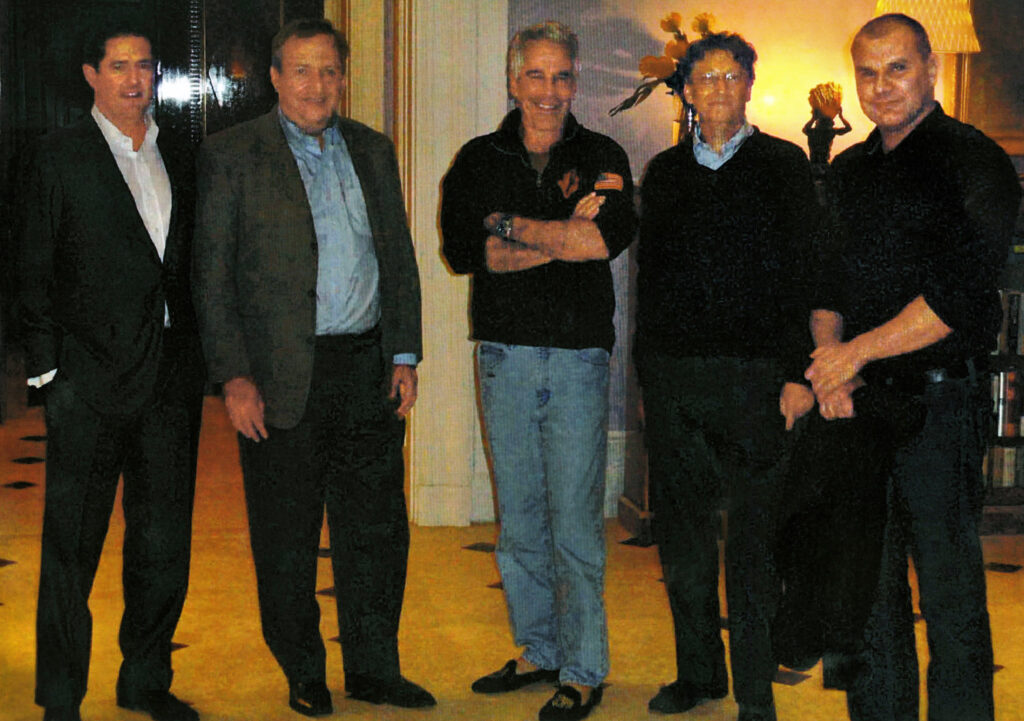
Indeed, Epstein has been advising Bill Gates on a new way to increase the already vast clout of the Gates Foundation by adding funds from other wealthy individuals that can use the Gates resources (the Gates Foundation now employs 1,200 people), but which can be directed to separate causes and goals. And it is Gates who, at the end of the summer, began prodding Epstein to begin a process of public rehabilitation.
Hence, as part of an effort to get “out in front” of the unfavourable notice that might greet Gates’s public association with him, Epstein agreed to several on-the-record conversations with me, in the hope, on his part, that after five years since his release from prison and relative peace he might be able to leaven his reputation – and with the hope on my part of learning more about how, and if, the rich are different from you and me (although we can fairly dispense with the if).
Then, just before the New Year, Epstein forwarded me a heads-up email that Alan Dershowitz, one of Epstein’s long-time friends – they have a bickering, brotherly relationship – and occasional legal advisers, had received from a reporter at Politico and forwarded to Epstein. The Politico reporter had been following Epstein-related court filings (there is a determined contingent of Epstein reporters) and had found a new one added to an old lawsuit with some rather jaw-dropping claims.
Eight years after the original suit, a Florida lawyer was now seeking to add new plaintiffs to the old case. This new filing was accompanied by allegations connecting a catch-all of bold-faced names associated with Epstein more than ten years ago, including Dershowitz and Britain’s Prince Andrew, to a “sex slave” ring – indeed, that Epstein’s purported sex slaves had had sex with Dershowitz and the Prince at Epstein’s command.
This seemed to me to be merely a desperate, even comic-book, filing – just a lawyer trying to revive a dead case. I responded to Epstein that I doubted this would be seen as credible by anyone.
Epstein, who sometimes seems to have an out-of-body attitude to his own fate and bad press, said he thought it might be “quite a show”.
Two days later, the Daily Mail, which has become the effective ground zero in the English language for anti-privilege and moral opprobrium (the more salacious the better), and whose editor, Paul Dacre, has a long-time feud with Prince Andrew, put the story on its front page. (Epstein also has a long relationship with the family of the disgraced press baron Robert Maxwell, another reliable target of the British press.) Flimsy and far-fetched court filings in the US by settlement-hungry plaintiffs might be discounted by sceptical US reporters, but the UK media, constrained by onerous rules about legal proceedings in Britain, promptly went into tabloid frenzy – even the normally sniffy Guardian, in full anti-royal and anti-billionaire fever, joined the show – and effectively exported the story back to the US, where Epstein’s connection to Bill Clinton, and hence as a shadow over Hillary, became the news.
“I told you,” said Epstein.
––––––––––
There is Epstein in his inner world, trying, quite ostrich-like, not to look out. Little beyond his strict realm seems palatable or even, in a sense, familiar to him. He’s a foreigner out here. Not too long ago, I met him for lunch in the West Village – the first time in more than 10 years, he said, that he’d been out to lunch in a restaurant (a not particularly pleasant experience for him, and we were done in 30 minutes).
Then there is the outside world, pressed to the glass, appalled and titillated by the monster inside the big house – a kind of Boo Radley of the Upper East Side. I have taken friends by the Epstein mansion, and the reaction to its other-worldly size in Manhattan is almost always the same: a gasp. Press accounts, seldom supplying new information, endlessly recycle and repeat the mysterious (and monstrous) billionaire mythology, with brief glimpses of him stepping out of the house – the same photos endlessly republished – and the assumption of depravity inside.
In fact, life in the house, without wife or children or conventional domestic demeanour, in some way conforms to the most scripted fantasies: a life somewhere between Daddy Warbucks and Eyes Wide Shut.
The domesticity of the house, and the background of Epstein’s problems, centres around a group of young women who act as his support staff and companions. Some have worked for him for many years, marrying, having children and continuing as part of his business and household infrastructure. One woman, on an afternoon when I was there, recently married, had just returned from an around-the-world honeymoon that Epstein had arranged for her. Some are his romantic interests. His present girlfriend is in dental school. One former girlfriend, Eva Andersson-Dubin, a Swedish model and Miss Universe finalist, became a doctor and married hedge-funder Glenn Dubin, and together they finance the Dubin Breast Center at Mount Sinai Hospital. Most, at one time or another, will travel with him to his other floating residences – the ranch in New Mexico, a vast apartment in Paris, the island in the Caribbean, the house in Palm Beach.
This is so outside conventional living, staffing or romantic relationships that it is hard to describe in a straightforward or straight-faced way. It sometimes seems part of Epstein’s implicit challenge: not just “look at me”, but “do you even believe what you see?” Or it seems he is simply oblivious to what others are thinking – a wilful and perhaps fatal tone-deafness.
But Hefnerian prurience can also be quite businesslike. Poised young women in a mansion on the Upper East Side with various office responsibilities are really not that different from those in any of the art galleries in the surrounding neighbourhood.
Epstein’s young women mingle freely with his powerful guests, not so much as hostesses or, in tabloid language, harem-like (or as “sex slaves”), but often as attentive students – that, of course, might be regarded as having its own fetish-like attraction.
Not long ago, Epstein invited me to sit in on a day of presentations to him in his dining room by various “quants”. Quant theory involves making investments based solely on mathematical and statistical models. This method can often have uncanny predictive powers, but the problem is that it doesn’t scale very well: the market, having discerned a pattern of successful investing, quickly copies and discounts the advantage. Epstein’s effort was to identify a dozen or so promising algorithms – each quant is effectively hawking his secret-sauce algorithm – and invest up to $5 million with each. I knew paltry little about this and so rather found myself identifying with the young women to whom Epstein was explaining the basic maths and mechanics – out of my league, but grateful for the lesson.
The Epstein house/office is, by careful design, exclusive and club-like, part hang-out, part secret society. Along with the difficulty in explaining why, even after his jail term, the rich and powerful continued to beat a path to his door, it’s also notable, in the fixed hierarchy of who comes to whose turf, that everybody, when they went to see Epstein, came to him.
A week in late September – UN week, as it happened – began, on Sunday, at Epstein’s house with a colloquial for billionaires: Gates, Mort Zuckerman and Peter Thiel [TK].
Epstein, preternaturally responsive to both the price of oil and the politics of the Middle East, entertained that evening a delegation from Qatar, including Sheikh Hamad bin Jassim, the foreign minister. Hamad, indeed, lives across the street in a similarly furnished house – he and Epstein have the same decorator. Epstein, in his relaxed and amused manner, kept prodding: “Why are you financing the bad guys? What do you get out of that?”
The Qataris, in some mild diplomatic discomfort, seemed most worried that their bid for the World Cup might be compromised by bribery allegations.
At 9:00 next morning, Epstein is joined for breakfast in the dining room by Reid Weingarten, who’s represented, among other fat cats in trouble, WorldCom’s Bernie Ebbers and Goldman Sachs’s Lloyd Blankfein, and is one of Attorney General Eric Holder’s closest friends. Weingarten, hoarse with a cold and dejected, is just back from a failed defence of former Connecticut Governor John Rowland.
After a blow-by-blow of the trial, there’s a discussion of the Qatari visit – Epstein is serving chocolate made from pistachios grown on the Sheikh’s farm – and speculation about who actually controls ISIS.
“Why,” I asked Weingarten, when Epstein briefly steps out of the room, “do so many people keep coming back here, everything considered?”
“Why do we camp out here? I guess because there’s no place like it.”
Epstein summons the next person cooling his heels in the anteroom. It’s a young man named Brock Pierce, a former child actor and dotcom high-flyer – a principal in a gaming company called DEN, a notorious dotcom burnout with its own sex scandal – who is now a leading investor in Bitcoin. He describes himself as “the most active investor in the field.”
And, indeed, is the first clear explanation I actually get about Bitcoin. It’s so good that Epstein stops him and checks to see if his next appointment is here. Seconds later, Larry Summers, the former Treasury Secretary and President of Harvard, enters the dining room. Summers, off Diet Coke, digs deep into the Sheikh’s chocolates and focuses in on the Bitcoin investor.
“Okay,” he says, after listening for a bit, “I have opportunities here. But an additional feature of my decision problem, roughly speaking, is that the worst that could happen to you is that you could lose all the money you put into it. Whereas I could go – I mean, I don’t look that great now – but I could go from being seen as a figure of some probity and some intelligence to being a figure of much less intelligence and much less probity…”
“Well,” says Pierce, in some dramatic understatement, “you are going to have some low-quality characters playing early in the space…”
That evening there is a small cocktail party, which includes the former Prime Minister of Australia, Kevin Rudd, and Thorbjørn Jagland, the head of the Nobel Peace Prize Committee, who offers an affable but generally scathing critique of U.S. diplomacy (and a brief defence of Obama’s Peace Prize award), and to whom Epstein offers a ride back to Europe on his jet.
The next morning it’s Ehud Barak, the former Israeli Prime Minister, for breakfast. Barak is, over his omelette, able to defend both Obama and Putin. Then Kathy Ruemmler, who has just left her job as White House Counsel, joins. She is already in the mix as a possible next Attorney General but will, in fact, withdraw from consideration in part to work with Epstein. [TK Ruemmler quotes…]
Larry Summers’s wife, Elisa New, drops by. She teaches American poetry at Harvard and is putting together a proposal for a series on poetry that WGBH in Boston may produce, and Epstein is advising on where she might go for added support – he also makes mincemeat of her budget.
There follows the former head of the UN Security Council, Hardeep Puri, and then the head of the central bank of Kazakhstan, Kairat Kelimbetov.
Then Nathan Myhrvold, the former chief technology officer at Microsoft. Then Martin Nowak, a Professor of Biology and Mathematics and Director of the Program for Evolutionary Dynamics at Harvard, the institute that Epstein has funded with $30 million. Part of Nowak’s research has to do with trying to “describe cancer mathematically”. Epstein pre-empts Nowak’s explanation, which I’m not quite getting. “Think of cancer the same way you think of a terrorist group. The NSA has been able to thwart a great number of terrorist acts by intercepting communication signals from one terrorist to another. That same dynamic – a form of signal intelligence – can be used to intercept communication between cancer cells. Cancer cells merely communicate in protean code rather than electronic code. If you can decode what the signals are saying, you can jam those signals between terrorist calls – essentially wipe out their cell phones. Likewise, if you can decode biological signals, you can jam them too. That’s the holy grail.”
Then Richard Axel, a Nobel Prize winner in physiology. Then Ron Baron, who, in his Baron Fund, has $26 billion under management. Then Josh Harris, the co-founder of Apollo Global Management ($164 billion under management) and owner of the New Jersey Devils and the Philadelphia 76ers.
Perhaps it’s just the ultimate feminist nightmare. Men – and a few opportunistic women – continue to come to Epstein’s because, no matter their public bows to modern manners, they simply don’t care that he offends every aspect of reconstructed gender and political sensibilities. In private, it remains a man’s world — a rich man’s world. Or it’s a guilty pleasure. People who know Jeffrey exchange “Jeffrey” stories.
“That’s Jeffrey,” says Mort Zuckerman, the real estate billionaire and publisher of the Daily News – ever vitriolic in its coverage of Epstein – with a twinkle in his eye and obvious enjoyment, in response to tales of Epstein escapades. It is an outreness that Epstein seems delighted to cultivate. In his Paris apartment – 10,000 square feet on the Avenue Foch, a neighbourhood otherwise occupied by foreign potentates – there is a stuffed baby elephant in his living room – that is, the elephant in the room. (Epstein says it’s also a reminder that elephants have 23 copies of tumour-suppressor genes and humans have only one.) The single book on his bedside table is Lolita – he is, beyond the joke, a great Nabokov fan.
Or, in a more sophisticated view, it’s a two-tier understanding of the world. There is a media version of the world, which most of us live in, largely accept and are certainly influenced by. And then there are those people who live in the media itself and therefore know that it’s mostly bunk. If the media says it, it’s likely that some version of the opposite is true. I might guess, too, that for many of his visitors there’s an order of identification: there but for the grace of God. Any hyper-prominent person might, at any time, run afoul of prosecutors, the political moment, the media, or the internet hoi polloi.
In this view, Epstein is a sort of Dreyfus of the rich.
And then there is the glue of wealth. Once, at lunch in the Epstein dining room with Bill Richardson, the former Governor of New Mexico and past presidential aspirant, when Epstein left the room for a few minutes, I asked the obvious question, the one everybody asks each other: “How did you meet Jeffrey?” Richardson seemed surprised. “Jeffrey,” he said, as though stating what should have been perfectly obvious, “is the biggest landowner in New Mexico.”
And then there is Epstein’s yet more structural explanation as to why, after prison and with continuing tabloid infamy, he can maintain his valued place. It comes back, not unexpectedly, to the nature and needs of money.
“At a certain level of finance, almost everyone is allied with an institutional interest. You are part of government, or you want to be in government, or you are connected to a bank or other portfolio, or you have key relationships with certain corporations or industries. Because of my situation, I have none of that. I have no institutional ties, which makes me, in some sense, one of the few wholly independent sources of information and actual honest brokers. That’s the usefulness of disgrace.”
And then there is, too, that he is right. Since I began working on this piece in September, Epstein’s predictions about the price of oil, the yen, the rouble and the euro have all borne out. (If I had invested $100,000 the way Epstein said I should in early September, by the end of January I would have made $TK million. Alas, I did not invest.)
And something else, which perhaps also accounts for Epstein’s continuing relationships with the rich and powerful: most everyone who is now of a certain age, ambition and status grew up in, and found they were temperamentally suited to, the new age of wealth that started in the late 1970s. A meritocracy on steroids, or, as Vanity Fair would baldly and ingratiatingly dub it, the New Establishment – an increasingly parallel world, a self-invented one, at further and further remove from the ordinary one. Epstein is just one version, albeit picaresque as well as louche, of this shared story.
––––––––––
He often tells, with some obvious marvel, his middle-class-to-riches tale: born in 1953 in Coney Island, father works for the city’s Parks Department, mother a housewife.
The captain of the maths team at Lafayette High School in Bensonhurst, he goes on to Cooper Union, where the tuition is free. He drops out after two years and begins taking classes at NYU’s Courant Institute of Mathematics. Then, without a college degree – hence by a sleight of hand – he gets a job teaching maths and physics at Dalton in 1974. (A few years ago, during a chance encounter with a former Dalton maths department chairman, Margo Gumport, I asked her about Epstein. She said he was the most brilliant maths teacher at Dalton in her fifty-year career and that she had often wondered what had become of him.)
It’s his first exposure to the wealthy. They have, he concludes, just as many problems as the people in Coney Island – just different ones, almost invariably involving divorce and money.
“I found it interesting as a science experiment,” he recalled recently as we chatted about his life. “It did not really involve me. I could just stand back and watch.”
Dalton fathers were attracted to him. Punch Sulzberger, the publisher of the New York Times and a Dalton father at the time, tried to recruit Epstein to come to the paper. (Epstein recounts a story of riding with Sulzberger in his wood-panelled station wagon to the family’s country estate, and Sulzberger talking to the chauffeur on a phone from the back seat to the front.)
In 1976, another Dalton father, asking, “Wouldn’t you rather be rich than be a teacher?”, introduced him to Bear Stearns’ chief, Ace Greenberg – a conversation Epstein recounts as follows:
Greenberg: “Everyone tells me you’re super-smart in maths and you’re Jewish and you’re hungry… so why don’t you start working here tomorrow?”
Epstein: “What?”
Greenberg: “If you’re supposed to be so fucking smart, don’t you understand English?”
Epstein: “OK. Count me in.”
Hence Epstein, like many in the late 1970s, arrives on Wall Street.
As will happen to a generation of others, by the fortuitous luck of being on Wall Street at that point in time, Epstein is transformed by a new, much faster form of upward mobility than has ever before existed. With a facility for mathematics as well as for getting along with rich men, he transforms at an even faster rate than so many others who are also being quickly transformed.
He moves into the penthouse of a new building at 66th Street and Second Avenue – still in the shadow of the Maxwell Plum era, when the 60s on Second was the glamour address – a building that was, he says as a fond memory, full of “actresses, models and Eurotrash”. (It would shortly become the Studio 54 era, where Epstein, who has never had a drink or taken any drugs, was a regular.)
If on one side of Wall Street there were the salesmen – the Wolf of Wall Street model – on the other side there was a new sort of finance type able to embrace a level of acute abstraction.
“In the past,” says Epstein, “investing was all about reputations and relationships. You invested in a company on the basis of who was running it. Did they have integrity? Were they married? Good family men? It was a Fifties mentality. But in the mid-Seventies options started to be traded – in essence, the first formal derivatives. The movement of this instrument is not directly attached to the stock price. The world of investing began turning from relationships to maths. In a sense, I didn’t really make money as much as I tried to create it. This was intellectual activity of a fairly high order.”
Intellectual activity aside, he meets Helen Gurley Brown, and she makes him Cosmopolitan magazine’s Bachelor of the Month in 1980.
“What,” I ask, “was your social life like?”
“Well, I was a playboy.”
“That’s all? Not looking to get married?”
“No. Never. I never wanted to get married. I enjoyed sex. I adore women. I wanted freedom. I was attracted to the rich because of their freedom. But I also wanted to avoid their burdens. And I didn’t want to hide. I didn’t want to be a hypocrite. I wanted to be free. I was not remotely ambivalent about what I wanted: to be free. That was the reason to make money.”
His rise at Bear Stearns was steep. He soon became the protégé of Jimmy Cayne (also hired by Ace Greenberg on a whim – they met at a bridge game – who would go on to run Bear and to lose his fortune in the firm’s 2006 collapse). Epstein’s departure or ouster from Bear is the result of politics, envy, overreaching, a securities violation, or something else – unclear. But no matter: he leaves in 1982 with billionaire clients, including Marvin Davis, the real estate developer who owned Twentieth Century Fox, and Herb Siegel, a major media investor in the 1980s. Epstein is dating 5g5g 5g5 5g5g5g 5g5g5 g5g5 g5g5g5g 5g5g5g5g5g5g5 g5g5g5g5g5g5g5g55 g5g5g5g5 g5g5 g5g5 g5g5 g5g5g5g5g 5g5g5g5g5g55g5g55g g5g5g
Now begins the Concorde phase of his life – and the Concorde phase of the 1980s. If the Eighties are happening pell-mell in New York, they’re happening at double time and catch-up speed in London. Epstein is thirty years old and living, in Lifestyles of the Rich and Famous fashion (he befriends the show’s star, Robin Leach), at English shooting parties at country estates with Saturday-night black-tie dinners, where he’s meeting the over-the-top families of Europe.

“I didn’t take it seriously,” Epstein recounts. “I was not caught up in it. I wasn’t trying to make a billion dollars. There was no ultimate goal. It was just fun to meet smart people, interesting people. But no long-range plans. Often no short-term plans either. I would head to Kennedy and, on the theory that most important events in one’s life are serendipitous, I wouldn’t decide where I was going until I got there.”
At the same time, he is developing a perception – or at least a market differentiation – that the hyper-wealthy had different problems from the very wealthy. Dealing with a billion dollars was different from dealing with $100 million.
“If you had a billion dollars, I would think the last thing you should be worried about was money. In truth, money was what you most worried about. How to make more of it, how to give away more of it, how to protect your children from it, how to hide it from your wife or husband, how to minimise your taxes on it. The traditional wealth service structure – an accountant, an investment adviser, a personal lawyer and an idiot brother-in-law – became hopelessly outdated as amounts exponentially increased.
“You can’t spend a billion dollars; you can just reallocate it to a different investment class. And you can’t give away a billion dollars without a vast staff – in effect, going into the business of giving away money, yet another business you are likely to know little about.”
At just about this point in the narrative, the questions – or the incredulity – begin in social circles and eventually in the media. He begins to acquire the major symbols of riches but does so without position, public holdings or obvious paper trails. How can a person have enough money to merit increasing attention but no clear way of having got it? Epstein gets stuck in that tautology. He may be rich, but he is without institutional protection or bona fides. He is a questionable substratum of wealth. He’s a freelancer.
That’s the rub: he doesn’t work for anyone. Without institutional credentials, he’s… well, nobody knows what.
For a period, one part of his activities, he says, is recovering monies for countries looted by exiled dictators or military strongmen. If early in his career he might seem like a sort of George Peppard in Breakfast at Tiffany’s – there’s a physical resemblance – a charming hustler, later he’s George Peppard in Banacek, a smart and astute operator.
Then, in his telling, he’s representing a series of vastly wealthy people and families. He’s not just doing their bidding or their investing; he’s helping them navigate the ambitions of their wealth. They’ve satisfied their business dreams. Now there are the separate challenges and possibilities of their actual wealth. If they had big dreams before, it’s nothing compared with what they can have now.
In essence, as Epstein becomes more of a public figure, the response to this description of his livelihood is, in the media and in high social circles, “bullshit”. True, there is no clear alternate narrative. No one is accusing him of anything, except sometimes guilt by association. (In addition to Robert Maxwell, later accused of fraud, there’s Steven Hoffenberg, briefly a New York high-flyer who went to jail for a Ponzi scheme, for whom Epstein acted as a consultant – along with, he points out, Paul Volcker.)
But the characterisation persists: if it’s not clear, it must be murky. Sure, Goldman Sachs partners and tech geniuses might have stratospheric wealth, but what to make of a Coney Island, Zelig-like no-namer?
In 1994, just at the moment when Prince Charles is on television acknowledging his love for Camilla Parker Bowles, Jeffrey Epstein is sitting with his arm around Princess Diana at a dinner at the Serpentine Gallery in London. (Diana is wearing her “revenge dress” that evening.) Graydon Carter, in his second year as editor of Vanity Fair, is also at the dinner.
Epstein’s rise and Carter’s rise are not, with a little critical interpretation, that different. Both are a function of the age of new money. Both are helped by strategic relationships with the exceptionally wealthy. Both men have made themselves up. To say that Epstein, in the company of the Princess, sticks in Carter’s craw would be a big understatement. Epstein becomes one of the “what do you know about him?” figures in Carter’s gossip trail – a story waiting to happen.
A variety of the gossip that begins to circulate about Epstein – for instance, that he secretly films his guests – is seeded by Carter, who once advised me not to go to Epstein’s house or accept a ride in his car lest I risk being blackmailed.
“For what?” I asked Carter.
“You can’t even begin to imagine,” said Carter.
Epstein is playing a cat-and-mouse game with his own growing wealth and influence. He is private and secretive, but grandly so. He joins the board of Rockefeller University. He’s suddenly on the Trilateral Commission, that cabal of business people who fancy themselves – and who are fancied by conspiracy buffs – as running the world. He buys from his client, Limited founder Les Wexner, the largest private house in Manhattan. (Rumours will continue for many years that Wexner owns the house and Epstein is just squatting in it – an eighteen-year squat.) He buys an aeroplane. He buys another. He expands his holdings in New Mexico. He begins a Xanadu refurbishment of his Caribbean island.
He befriends Bill Clinton in Clinton’s new after-office life.
And that’s quite the fatal pairing.
The post-Monica Clinton, now having pardoned the on-the-lam financier Marc Rich – at this point, before his own rehabilitation, Clinton really is the world’s ultimate sleazeball – is suddenly being ferried around in the jet of… who exactly?
The New York Post is the first to take formal media note of the Clinton–Epstein connection, hinting at a sex-and-money bromance. (“I suppose travel with Clinton changed the arc of my life,” Epstein tells me. “There were, I knew, lots of obvious reasons not to do it. But having the ability to spend 100 hours with a former president just doesn’t happen to many people.”)
The instinctively private Epstein is not just increasingly exposed, but clearly curious about the nature of exposure.
I met Epstein around this time. He had become a more active backer of advanced scientific research, and in 2002 he was taking a small group of scientists out to the TED conference in Monterey. The TED organisers invited various other participants, including me, to join the flight. A small group assembled at the private plane terminal, most of us unfamiliar with our benefactor, and as we headed towards the discreet private planes we were gently pointed to our ride: Epstein’s 727.
It was a thoroughly updated drawing-room set-up, all of us nervously ensconced in this luxury plane, waiting for our unknown host to arrive. Soon he does – tanned, relaxed, with a wide-open smile, accompanied by three young women.
It would be unlikely, outside a men’s-magazine fantasy of the luxe life, that you could locate this in reality. Epstein’s attentions, taking time with each of his passengers, seemed impossible to account for. The quiet of the plane, engineered into acoustic perfection, seemed spooky. Epstein’s three companions were witty, poised and helpful, as well as powerfully alluring – like stewardesses of bygone times.
(One more thing about this trip: Google founders Larry Page and Sergey Brin, with their company still in its infancy, came out to see the plane on the Monterey tarmac and, with a few other Googlers, literally ran whooping from one end of the plane to the other. Then they described to Epstein – in what I can no longer remember as either a put-on or an entrepreneurial brainstorm – a brand extension in which they would market a line of Google bras, with the Os as convenient cups. In fact, they said, the name Google was invented out of the belief that men would focus on a word with two Os in it.)
Not long after this trip, Epstein’s assistant called to invite me for tea at his house in New York, where Epstein, with what seemed to me little understanding of the subject, began to ask me about media – the upside, downside and nature of media coverage. New York magazine was then soliciting him for a profile, as was Vanity Fair, which had assigned the British tabloid reporter Vicki Ward to the job.
Both profiles – New York’s by Landon Thomas – pivot on the Clinton connection and detail the same quandary: how a man without clear institutional bona fides nevertheless achieves wealth and influence. Ward—who would more recently assert in the Daily Beast that she was barred by Vanity Fair from writing about under-age sex evidence (a fact that could be read the other way: Vanity Fair, even looking to take down Epstein, did not find the evidence credible or supportable) – follows a rabbit hole of questionable contacts who might or might not have been the source or sources for Epstein’s wealth, but gets no closer to an answer, beyond confirming her own sense of dubiousness.
Epstein, sensing that he might be exposing himself, tried to stop the process (Ward, often operatic about her journalistic exploits, says he threatened her), called Carter and said he was having second thoughts about being a public figure.
“Then you should live in a two-bedroom apartment in Queens,” responded Carter.
––––––––––
And then the troubles began.
Epstein, in man-who-can-have-everything fashion, and without the remotest sense of observance or propriety – as though a kind of cultural autism – has, for many years, ordered up a daily massage following his workout sessions.
“Often these were massage massages,” says Epstein matter-of-factly, “but sometimes these were happy-ending massages, especially in Palm Beach, where there are many massage parlours – ‘jack shacks’, they’re called – that do outcalls. There was no sex. And often there was no happy ending. Often I would be on the phone for the entire massage. There were, however, a lot of massages and a lot of girls, with one girl recommending others.”
It is after Epstein’s round of publicity and widely touted association with Clinton that the stepmother of one of the massage parlour girls, identified as “SG” in court documents, who went to Epstein’s house (most of the girls returned to Epstein’s house many times), calls the police. The police interview the girl, who then supplies names of other girls, some of whom are younger than 18.
In the end, the police track down 18 girls – nine who are under 18; the others in their 20s and 30s; one woman in her 60s – a number of whom give statements describing scenarios not terribly different from Epstein’s description above, except that each is laid out in clinical, lurid and near-identical detail. A cold and forceful Epstein demands that unwitting juveniles (though they have come here for this very purpose) perform repulsive (or at least repulsively described) acts on him. (Although the nature of the allegations will dramatically grow into threesomes and forced sexual encounters, nobody at this point alleges anything more than Epstein masturbating.)

Epstein vastly raises the stakes by calling Dershowitz, who flies into Palm Beach to put the local authorities in their place – alienating Palm Beach officialdom – and, doubling down on the profile of the case, brings in Roy Black, the famous criminal attorney who defended William Kennedy Smith in his rape trial in Palm Beach.
Here’s the narrative: the shadowy rich man, friend of the louche and disgraced President, at all times surrounded by a retinue of young and gorgeous female retainers doing his bidding, is now found to have gathered a network of wrong-side-of-the-tracks Palm Beach girls to provide him with weird sexual services. (It somehow reads weirder that he doesn’t have sex with them.) To boot, his former girlfriend, Ghislaine Maxwell – the daughter of the disgraced Robert Maxwell – encouraged at least one of the girls to come to Epstein’s home (and forevermore has become a fixture of further weird possibilities in this tale).
Palm Beach Police Chief Michael Reiter is reported to say: “This is bigger than Rush Limbaugh,” who, in a storm of publicity, has just been arrested in Palm Beach for possession of controlled drugs.
On one side are some of the nation’s most powerful defence attorneys (who, increasingly, seem more stumblebum than effective); on the other, a round-up of hapless girls with sensational tales of perversion and infamy (in the telling they are not so much sex workers as Dickensian victims), relatively speaking giving the Palm Beach authorities the choice between utter capitulation to the powerful or standing on the side of the seemingly exploited and powerless.
Still, with a cold eye, it also quite appears to be a straightforward tale of prostitution (however more or less kinky). And even though some of the girls are minors, age is not a distinguishing factor in a solicitation charge in Florida, nor in most places (in New York, for instance, at this time soliciting sex with anyone over the age of 14 is a class D misdemeanour calling for a $100 fine – the law has since been changed to TK).
In fact, “SG” tells the police that she lied about being 18 because otherwise she knew she would not have been admitted to the house (other girls will say they knew this is what they had to say, nevertheless not stopping them from saying it).
The local sex-crimes prosecutor, Lana Belhalevic, interviews all the girls and determines that the offence is solely related to prostitution – that there are no real victims here.
Dershowitz, with chest-pounding bravado, rejects a series of lower-level plea deals and Palm Beach District Attorney Barry Krischer takes the unusual step of empanelling a grand jury, which returns with a recommendation of a single count of soliciting a prostitute – a charge without jail time (and Epstein can apply to have his record expunged after a year).
At which point Reiter, the police chief, at odds with the District Attorney’s office, recruits the involvement of the FBI. This is, of course, the Bush-era FBI, and Epstein presents quite the Clinton-connected scandal. Still, solicitation, even of a minor, is not a federal crime. The FBI hits on the novel interpretation that if internet solicitation can be considered interstate commerce, so can telephone solicitation, permitting them to begin a deep-dive investigation into Epstein’s friends, many of whom receive subpoenas and are threatened with prosecution.
It is all quite in the eye of the beholder. On the one end, Epstein is paying for sex acts (Epstein paid $200 for a massage, with or without happy ending); on the other, he is abusing teenage girls. It is a catch-22: how can a girl not old enough to vote be a prostitute? And yet many girls not old enough to vote are prostitutes.
Compounding Epstein’s predicament, the world outside of his carefully constructed and controlled environment is someplace he seems not just ill-equipped to handle but in which he seems to be blindly groping about – totally tone deaf. I visited him once during this time and found him weighing the conflicting advice of some of the most vaunted and egomaniacal lawyers of the day – along with Dershowitz and Black, celebrity criminal attorney Gerald Lefcourt and Clinton prosecutor Ken Starr – anyone with new advice, Epstein seemed to hire, as well as a catch-all of leading crisis managers, all wrangling for fees and primacy.
Certainly, the upshot of his dealings with the Justice Department seems to involve a through-the-looking-glass logic. The government threatens to prosecute him (with the possibility of a 10-year sentence) and various friends, associates and lovers, or offers what seems to be an unprecedented deal in which Epstein’s lawyers – not federal prosecutors, but Epstein’s lawyers – have to go to the Palm Beach authorities and convince them to up the charges to an offence that will send him to jail and get him sex-offender status. Except that a solicitation charge will not produce that result. Therefore, he has to agree to a procurement or pimping charge (even though he has paid money, not received it – the sine qua non of pimping). What is more, in a unique, if not unprecedented arrangement, he has to agree to pay the legal fees of any of the girls who want to sue him – and not to defend himself from their suits – forcing him to settle with each of the girls for what are reportedly high six-figure sums or more.
He is sentenced to jail in 2008 for 18 months and serves 13 (while Epstein is now frequently accused of somehow managing to cut short his sentence, almost all Florida prisoners serve only 70% of their officially sentenced time).
Jail hardly ends the legal catch-all. Epstein’s butler, Alfredo Rodriguez, steals and tries to sell an alleged journal or calendar of Epstein’s activities – but tries to sell it to an undercover agent. Rodriguez is sentenced to 18 months in jail on a charge of theft and withholding evidence (it is not so much a journal as a list of phone numbers). Scott Rothstein, a lawyer whose firm represented additional girls in their suits against Epstein, also goes to jail for recruiting investors to pay for these suits on the fraudulent basis that settlements had already been reached. It is the largest fraud in Florida history and Rothstein receives a 50-year sentence.
Then Brad Edwards, Rothstein’s former partner, sues the federal government in 2008 for abridging the rights of two of the original complainants under the Crime Victims’ Rights Act regarding the Justice Department’s agreement not to prosecute in favour of state action. In 2014, Edwards tries to ad 5g5g5g5g5g5g, another of the original complainants, who has previously settled with Epstein, to the long-running suit. 5g5g5g5 who was paid a settlement under the original terms of Epstein’s agreement – that he would pay attorney’s fees and not oppose any law suits against him – is now trying to overturn the agreement under which she was paid, and, with Edwards, further suing Epstein for $50,000,000.
Indeed, 5g5g5g5 with the Daily Mail being her prime outlet, she emerges as the most vocal accuser – and, in fact, the sum total of the current story and attention.
That is, there is no story without her and what is being billed as her memoir of her “sex slavery” with Epstein, written ten years after the fact. Along with the Dershowitz and Prince Andrew charges, 5g5g5g5 puts, with rather some narrative detail, both Clinton and Al and Tipper Gore on the island – and in fact Clinton, apparently with the acquiescence of the Secret Service, flying in a helicopter piloted by Epstein’s girlfriend, an amateur pilot. Epstein’s lawyers say that not only have Clinton and the Gores never been to the Epstein Island, but that there is easy proof of this in secret service records, which would seem to make the memoir opportunistic or hallucinatory fiction.
The FBI, in a recent filing, has argued that 5g5g should not be party to the suit against the government because she refused to cooperate with the government in its investigation in 2007, hence has no standing as a victim (at the same time, the FBI included her on the list of 40 victims with whom it mandated Epstein reach a settlement).
It is hard to find a more hyperbolic intersection of media and lawyers than in Epstein’s case.
Edwards, over six years of his lawsuit, tries to depose Clinton, Donald Trump and Dershowitz – almost all of his targets coming directly from the original Vanity Fair and New York Magazine articles about Epstein.
In addition to Prince Andrew as a British hot-button, first connected Epstein through 5g5g5g5 interview with the Daily Mail in 2010, Clinton takes on a new role as Hillary spoiler through his connection, real or imagined, to Epstein and sex slaves.
Almost everybody identified in any story about Epstein is approached by other media seeking to write about Epstein, often with financial incentives.
No new stories or even new details emerge. Every aspect of the current story is based on court filings describing events that may or may not have taken place prior to 2007. It is as though a kind of Groundhog Day of moral opprobrium – a desire to repeat and savour anew the old details.
A recent Reuters story identified a charity that Epstein has not given money to in 15 years that said if he does give again, they would give it back.
The world cleanly divides, with Epstein (and friends) behind secure walls and the Mail, social media and upholders of new norms ever more incredulous and apoplectic that Epstein not only walks free but prospers too.
Although he has spent more than a year in jail and paid out what may be as much as $20 million, he yet seems somehow to have got away with it – that worst sin of all. He is the unrepentant catch-all of up-to-the-minute badness: the financier whose wealth is a product of Wall Street maths rather than work; a rich middle-aged white man who parades his wealth and entitlement; an insistent playboy in a correct and prudish world – someone who somehow did not get the memo about vast changes in mores and culture.
When I suggested recently that one obvious way to blunt the animus would be to get married, he said he would rather go back to jail.
He is Calvin Harris’s song It Was Acceptable in the 80s come to life.
This is all, of course, a Gatsby-like tale: an enigmatic and strangely appealing figure, able to invent and inhabit his own world, a mystery to decipher. Of course Gatsby, in New York Post and Daily Mail parlance, would likely be just a freaky financier too.
And this story is, in its way, about the limitations of journalism, in which the most compelling parts of the tale – Epstein’s ambitions and impulses – need to be sacrificed not just to moral certainty but to a rather preposterous fantasy of moral certainty.
Anyway, I hope I get invited back to Jeffrey’s house soon.
To join in with the discussion please make a donation to The Daily Sceptic.
Profanity and abuse will be removed and may lead to a permanent ban.
By some happy chance, it turns out that convicted fraudster and paedophile Carl Beech has been released from prison early, today.
Given the skeletons that continue to tumble out of Epstein’s closets, and the people already identified, are you more or less convinced by the findings of Operation Midland?
Only another eighty years before Dunblane is revealed.
I watched the recently released Epstein interview with Steve Bannon.
Anyone with a modicum of life experience and wit could quickly tell Epstein was a consumate bullshitter. He spoke authoritatively about big topics, sounding knowledgeable but ultimately saying nothing.
I kept asking myself, how did this man draw in so many seemingly powerful people, some of the even very accomplished.
I can only speculate but here are some possibilities.
The first is that many of the people “at the top” are very dim and are desperate to not appear it. Prince Andrew springs to mind.
The second is that some people “at the top” are extremely insecure and will latch on to anything or anyone that they think will help them get an edge and stay at the top.
In any case, it reinforced my long held view that most people are faking it some of the time, if not.most of the time. And the higher up socially, the more so.
Dim people are promoted through the hierarchy because they will readily do the bidding of their masters. DEI is one of the best ways to do this, people of low ability are promoted beyond their level of competence. When you listen to the level of debate in Parliament you find people who are really quite thick. They have good memories but low intelligence so they will just remember what’s been forced into their brains by an education system that teaches what to think rather than how to think. Many are selected for reasons such as race to represent minorities thereby creating division. if you look at the old books used for teaching, such as arithmetic, they had one thing which was paramount, teach kids to add, subtract and so on at the earliest stages. Books nowadays are total left wing crap that is more likely to confuse than educate. Since the Attlee government after the war the education system has been dumbed down and the other parties have been complicit. So it’s no wonder people are unable to work things out for themselves. They just swallow what they are told, hopefully that will change if we ever get a decent… Read more »
Speaking of the dreaded DEI, I thought this was a very good, clear explainer of the difference between equality and equity. I know most of us know on here but it’s shareworthy for those who might need enlightened. And it’s Thomas Sowell, so that’s a bonus.😇
https://x.com/i/status/2020885413305720883
Thomas Sowell talks sense, so it’s no wonder he doesn’t get nearly enough publicity. He’s always worth listening to.
Back in the early ‘eighties there was a degree of concern regarding multi-national corporations that had greater resource than the GDP of some developed (or developing) nations; having the power to destabilise a country – Malaysia for example – should they so desire. In many ways some of those multi-nationals have lost ground – increased share ownership and “more democratic” boards, perhaps. What we have seen since then is the rise of the Tech Billionaire, where such extreme wealth that was the preserve of the corporation is now in the hands of individuals. Whether that is in itself an issue is not my point, the issue is that politicians (of all persuasions) are attracted to such individuals as moths to a flame. In turn those individuals want to exert leverage over said politicians. Epstein’s role as a broker to both parties is what the piece reproduced here demonstrates. All that the piece shows is coming into the open (unlike Epstein’s dining room). What is missing is another piece – the shadowy world that facilitated these contacts – like the seas surrounding Epstein’s private island. We are able to see only where the lights have been switched on. Mandelson merely acting… Read more »
“What do you see, Jeremiah?” asked Western Firebrand.
“Well”, says Jeremiah, “I see this. The gifted author Michael Wolff may very well get his wish and be invited back again, to see Epstein alive & kicking, heavily disguised and laughing somewhere safe, waiting for Trump to pardon Grisly Maxwell.”
Epstein jail guards used ‘fake body’ to trick media waiting outside the prison while paedophile’s real corpse was loaded into van ‘unnoticed’, files claim | Daily Mail Online
Interesting public comment from the Daily Mail:
“A technical log from the Epstein files reveals that every surveillance system covering his cell “failed” in the days before his death, and an FBI agent was the one who removed the damaged drive, ensuring all prior footage was permanently destroyed. This happened under Trump and Bill Barr…”
Epstein’s role as a broker to both parties is what the piece reproduced here demonstrates.
It contains a lot of name-dropping but doesn’t really describe him doing anything. And the names it does drop seem to have been selected to make a certain group of reader sympathize with Epstein. Eg, there’s Billy the Gates these people will regard as a philantrophist and not as the guy who bought a home-written OS for cheap (QDOS) and made a fortune out of “exclusively” selling it to IBM as the OS which was supplied with the hugely successful IBM PC. Or the “Princess Diana” scene — on one side, adulterous Charles about to announce the end of his marriage, on the other, by coincidence, Epstein comforting the “queen of hearts”. This has decidedly dime novel qualities.
“As of early 2026, China has the second-highest number of billionaires in the world, with counts varying between 450 and 506”.
Does anyone know if Epstein knew any of them?
Good question. Answer just now in these Telegraph articles by Poppy Wood:
Revealed: Andrew and Epstein planned secret business in China
“Andrew Mountbatten-Windsor and Jeffrey Epstein secretly planned to launch a business together in China years after the financier was convicted of a child sex offence, The Telegraph can disclose…”
Andrew ‘passed Epstein confidential reports while British trade envoy’
“Andrew Mountbatten-Windsor passed on confidential information from his official work as UK trade envoy to Jeffrey Epstein, emails suggest…”
There are many Germans on the political left whose German vocabulary is seriously poor, presumably, because they never read anything written in German after school and didn’t read much during it. They do, however, spend a lot of time reading about American domestic policits and the associated squabbles on the internet. If they absolutely need to express themselves in German, they usually recourse to English words they’re trying to germanize by misspelling them. Eg, the verb to include – German einbinden – becomes inkludieren or diversity – Vielfalt or Mannigfaltigkeit – becomes Diversität. As their English is often not as good as they’re wont to believe, they’re sometimes making hiliarious mistakes, such as turning the phrase to commit suicide in the reflexive verb sich suizidieren which could be translated back into English as suicide oneself or commit suicide against oneself.
With this is introduction and considering that I don’t like this article at all but consider it a clevery constructed whitewash, I want to pose the following question:
Who suicided Epstein?
Additional remark: I have no real reason to distrust this text except that everything seems perfect. But it’s often lacking content in favour of hinting at something that’s never really spelled out. Further, the Diana reference is odd, to say the least. Lastly, it’s openly admitted that Epstein started his professional career as fraudster.
Answer: How do you say “Epstein Faked His Own Death, with a little help from his friends” in German?
Google translate says: “Epstein inszenierte seinen eigenen Tod, mit ein wenig Hilfe von seinen Freunden.”
This may be proper English but not proper German. This would rather be something like Mit Hilfe von Freunden inszenierte Epstein seinen Tod. The allusion to the Beatles song, if intentional, cannot work in German.
I don’t believe in this but consider it highly suspicious that both of the central characters of this drama are said to have committed suicide and one of them even in prison. Prisons employ people supposed to prevent inmates from committing suicide.
But that’s obviously just a wild speculation by me I don’t have any evidence for.
You said this article was “ a cleverly constructed whitewash”, and I think you are absolutely right.
Just read that 50% in telegram and 35% in X believe Epstein is alive, and so does Lady Victoria Harvey who claims that he is still alive.
It wouldn’t surprise me in the least to learn that his death was faked and he is still alive.
Epstein was a complex personality who will be ever known for facilitating sexual abuse.
But like satan, he was evil in the way he encouraged nice but dim people to corrupt themselves.
i would not have liked to meet him.
Take Virginia Guffre for instance. Her parents actually agreed to have her flown out to wherever Epstein thought there was a need. What sort of people do that?
This is not the same as the grooming gangs where the victims were unsophisticated children. This was a man taking delight in watching people going to hell in a hand basket under their own steam, with a little encouragement from him of course.
I’m wondering how long it will take the Daily Express to work the McCann affair into all this?
Glad I spent the best part of an hour reading this. Thanks for finding it and publishing it here.