
Carry On Camping in Auschwitz and Butlin’s: Gay Holidays and the Gay Academics Who Study Them
Today, January 27th, is annual Holocaust Memorial Day, and, as you may expect, the nation’s leading educational and historical institutions have organised events to commemorate it. The Imperial War Museum has a special Holocaust-themed concert, Lancaster University is holding a haunting display of victims’ personal possessions from the period, and the Society of Antiquaries of London is holding a talk called ‘Queering the British Holiday’.
Okay, it’s just an unfortunate coincidence, but you may have thought a major historical interest body would have other, more important things to focus on educating the general public about, on this day of all days, than gay men bumming one another in Bognor Regis beach-huts?
High-Camp Death-Camp
To many in today’s queer-captured academia, there simply is no more important subject than homosexuality anymore, though. As if to prove it, there is even now a ridiculous sub-field of Queer Studies focusing specifically upon ‘Queering the Holocaust’. Rainbow obsessives have scoured the archives to find examples of Jewish prisoners tut-tutting at lesbians amongst their number, before then high-handedly condemning the Jews of Auschwitz as being homophobic, from a contemporary privileged 2020s pink perspective.
According to one academic, being sent to a camp could even turn some lucky internees gay:
Queer desire in the Holocaust casts a new light on what we know about… sexuality in general. Some people already knew they were attracted to people of the same sex prior to their deportations, but did not have a name for it… others found out through relationships developed in the single-sex environment of the camps that they were, in fact, gay. Sexuality is not clear cut between gay or straight: it is fluid. The fact that even in the most extreme surroundings, people sought human proximity, intimacy, affection and sex shows how much sexuality is a key part of human behaviour to the very end. … One of the most important stories I was able to unearth belongs to Margot. Born in Germany, she was 14 years old when she was deported to Theresienstadt. There she met the person she described as “the love of her life” – a Viennese girl called Ditha. Margot was inconsolable when Ditha was deported to Auschwitz, and thus, when she and her family were deported there a few days later, reunited with her girlfriend, she was happy – in Auschwitz.
Holocaust denial now seems to mean denying the possibility Anne Frank might have been a lesbian. This may sound like an extreme, one-off example of contemporary Queer Studies solipsists managing to turn absolutely any subject under the sun – even genocide! – into being all about themselves as per usual. However, the line spouted above, that staying in foreign camps can be an innately queer experience, is essentially the same one due to be espoused by the talk being given this Holocaust Memorial Day about gay holidays at the Society of Antiqueeries, too: the only difference being that the main camp involved is not Sobibor or Ravensbrück, but Butlin’s.
Homo For the Holidays
The Society of Antiquaries talk will be delivered by a man named Matthew Roberts, a gay ex-Drama teacher turned playwright, performer and (very) adult PhD student at the University of Kent. In the past he has written or appeared in such genre-defining queer stage-works as Fuck 18 and Bitch Antigone, this latter coming from the producers of the equally (and possibly literally) seminal The Importance of Being Earnest As Performed By Three Fucking Queers and a Duck. According to the online write-up of his Society of Antiquaries lecture, it aims to answer the following profound historical conundrum:
2026 marks two tricentenaries: the publication of the iconic Gulliver’s Travels by Jonathan Swift and the death of the dramatist and architect John Vanbrugh. It also marks the 90th anniversary of the first holiday camp set up by Billy Butlin in Skegness. What connects these three men? What is passed on from 1726 to 1936 to 2026?
To which the only honest answer can be “Nothing. Absolutely nothing.” But that is not how the comprehensively rewired present-day Queer Studies mind works. As Roberts explains, “This lecture outlines the (in)visibility of LGBTQ+ people within the context of the British holiday, with a particular focus on male sexual identity and same-sex desire.”
Look at that phrase “the (in)visibility of LGBTQ+ people”. Prior to the 1960s, when sodomy finally became legalised, gays once had to hide themselves from both social prejudice and the law. So, in any given milieu of the past, it may not be immediately apparent there were any gays there at all. Thus, it becomes the sacred task of the 2020s Queer Studies scholar to use his magic gay dowsing-rod to spot these invisible beings, rendering them newly visible unto all, whether they were really there or not – a bit like the recently deceased Erich von Däniken did when delusionally spotting ‘aliens’ and ‘spaceships’ depicted in ancient Egyptian hieroglyphics, maybe. In practice, what this seems to mean is choosing any random aspect of the past you happen to be interested in – the Holocaust, say – and then pointing at its inhabitants and social practices, going ‘Gay, gay, straight, straight, gay, gay, trans, bi, lesbian’. And what Matthew Roberts is interested in above all else is the history of going on holiday.
According to his own account, Matthew was eagerly employed as a teenage tourist rep abroad as soon as he left school, having enjoyed family trips to places like Butlin’s as a child. One of the things he most enjoyed about holidays is how, when anyone goes on one, they are always in a position of being temporarily ‘other’ than their usual workaday home selves: an ordinarily staid bank-manager may briefly become a daring scuba-diver or safari-hunter, for example. Or, perhaps, within a specifically queer context, he may briefly become a holiday homosexual, visiting gay glory-holes in Amsterdam whilst his straight wife and kids are busily traipsing around the Rijksmuseum.
Fascinated by this notion, Roberts somehow managed to gain funding to pursue what he terms a “practice-based PhD” in the incredibly niche subject of ‘Queering the British Holiday’, a topic of immense interest to today’s Society of Antiquaries. What does “practice-based” in this context even mean, though? For an answer, I urge you to head to this podcast interview, and go about six minutes and 18 seconds in, where you can hear him describing a paper called ‘From Tourism to Whoreism’ which he delivered to a rapt audience at King’s College, London… via the medium of song. Hear Matthew warble out a new, queer version of ‘Oh, I Do Like To Be [Queer?] Beside the Seaside’, in which he inventively rhymes the word “cum” with “bum” and admires the smell of both, before equally cleverly changing the refrain “tiddly-um-pom-pom” to “titty-um-pom-pom” instead. Brilliant!
This is real. This man says he is in receipt of bursaries which, it would seem, allow him to travel up and down the country doing things a five year-old might consider too childish, and claiming it somehow counts as facilitating the advancement of human knowledge. How is such a thing possible?
Wish You Were Queer?
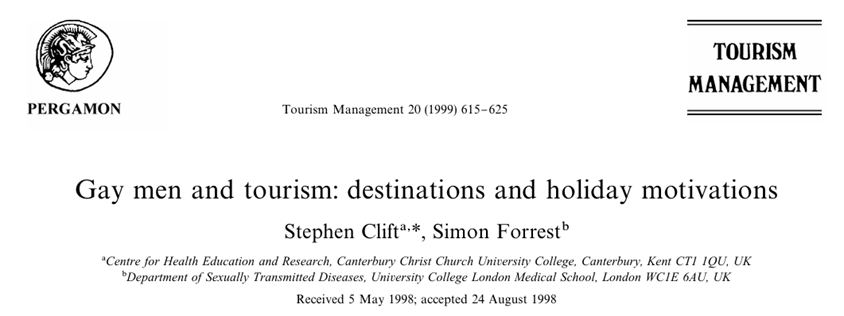
We first must consider the ridiculous fact that ‘Queer Holiday Studies’, just like ‘Queer Holocaust Studies’, is now an actual wider thing. Academic output began as legitimate medical-type papers investigating things like the spread of gay STDs during Greek-sex tours across the Greek islands and suchlike, as in this 1999 paper from the journal Tourism Management:
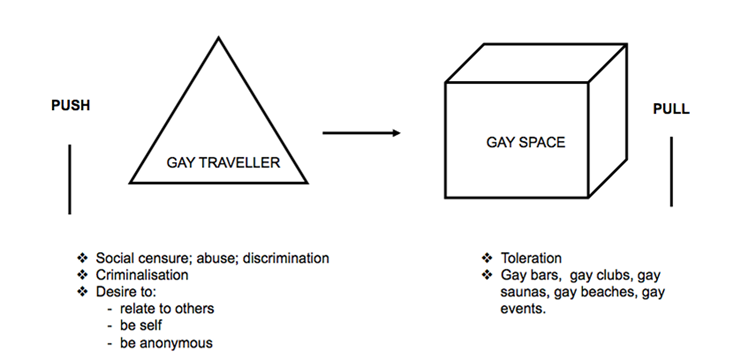
Some even featured what purport to be ‘scientific’ diagrams of gay platonic solids, as seen in this essay, ‘Salient factors Influencing Gay Travellers’ Holiday Motivations: A Push-Pull Approach’, published in the African Journal of Hospitality, Tourism and Leisure in 2017:
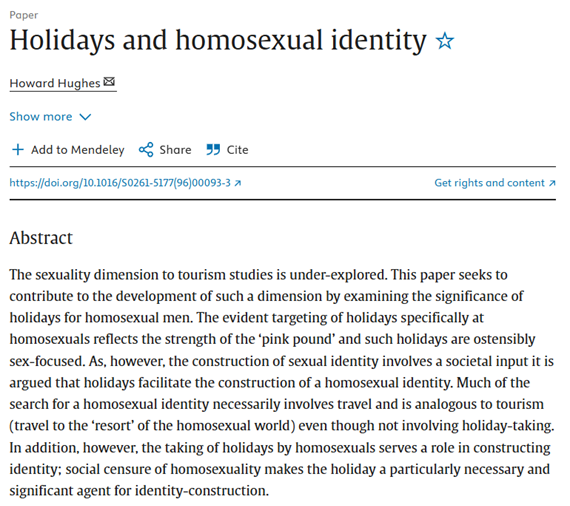
Yet at the same time, some Queer Holiday Studies papers also began to morph into less practical, more subjective and emotional, identitarian-type waffle, as with the following academic abstract about gay holidays supposedly facilitating “identity construction” amongst their patrons:
So, Matthew Roberts was pushing at an already open (back)door here: particularly at the University of Kent. Visit the Kent Academic Repository (KAR) database, type variants of ‘Queer Studies’ into the search-bar, and whilst Roberts’s own PhD doesn’t come up, various equally demented-sounding past studies produced by Kent staff and students do appear, with titles like the following:
- Graphic Approaches: A Theoretical and Artistic Exploration of Pornography
- How Do Team-Based Activities Affect Touching Behaviours in Male-to-Male Dyads?
- Popular Queerness On Vietnamese Prime-Time Television: Gender Ambiguity, Compliance and Compromises
- Motherly Oil-Industry: Governing the Desire For Climate-Action Through Petro-Feminine Spatial Imaginaries
- Three-Sided Football and the Alternative Soccerscape
- Vegan Witchcraft: Contemporary Magical Practice and Multispecies Social Change
- The Cock Lane Ghost and the Spectacle of Samuel Johnson’s Body
Some of the above works don’t really sound terribly queer at first sight – until you realise that, in current academic parlance, ‘queer’ can mean simply ‘odd’ or ‘non-normative’. This is certainly the opinion of Dr Declan Kavanagh, the author of that final essay about the Cock Lane Ghost (also known as ‘Scratching Fanny’ at the time, so possibly transgender), a Kent Humanities lecturer who is also currently acting as Matthew Roberts’ PhD supervisor. When it comes to PhDs to administer, Dr Declan explicitly says he is “interested in supervising or examining doctoral projects on queer histories and cultures”: projects just like Roberts’s in fact. He is also “pedagogically interested in the design of innovative assessments”: like students singing big gay songs during what are supposed to be academic talks, for example.
We now begin to see how it is potentially possible for a grown man to be funded to spend his days in the manner Matthew Roberts apparently does. Once persons of Dr Kavanagh’s own radical queer mindset get their foot in the door of academic tenure, they begin reproducing themselves through their chosen students’ work, replicating queer variations upon their own work at second-hand, thus to lend it some kind of wider lasting legacy.
At the start of his Society of Antiquaries lecture write-up, Roberts asks what connects Gulliver’s Travels, the Regency dramatist-cum-architect John Vanbrugh, and Billy Butlin. My initial answer was “Nothing”, but it turns out it should have been ‘Declan Kavanagh’.
Gullible’s Travels
Educated at Maynooth in Ireland, where they used to train Catholic priests, but now train a different kind of clerisy, this is how Kavanagh describes himself on the Kent website:
Declan Kavanagh (pronouns: he/him/his) is a Senior Lecturer in 18th Century Studies with research interests in the historiography of queerness (how can we read queerness in the past?), LGBTQIA+ Studies, 18th century literature and culture, disability in literature and culture (particularly physical impairment), masculinity and ‘far Right’ ideology, Irish literature in English, and contemporary representations and contestations of queerness in the Global North.
Judging by his publication history, Kavanagh’s speciality is studying 18th century books and history and spotting their many (in)visible gays, and aspects of queerness – which, when he defines ‘queer’ as often meaning simply ‘destabilising the normative’, he can spy just about anywhere. Consider his co-edited 2020 essay collection on what he calls “Swift’s Queerness”, the Swift here not being the genuinely camp Taylor Swift, but the 18th century Anglo-Irish satirist Jonathan Swift, author of Gulliver’s Travels. Kavanagh does not explicitly suggest Swift or Gulliver were gay, as such, but that, through his madcap ‘holiday’ travels, Gulliver is analogically queered: “It is precisely his own sense of identity as a rational, Protestant and English traveller that gets deconstructed through… the book.”
There being no actual gay sex in Swift’s book, Kavanagh has to settle for spying Gulliver being (in)visibly queered in a metaphorical sense, as when he encounters the primitive naked Yahoo tribe and Swift makes some jokes about their exposed hairy bums:
In first observing the male Yahoos, Gulliver curiously focuses his description on the anus: “They had no Tails, nor any Hair at all on their Buttocks, except about the Anus; which I presume Nature had placed there to defend them as they sat on the Ground.” … This initial attention to Yahoo anality has been entirely overlooked [by previous non-Queer Studies scholars]. … It is tempting to read anal eroticism into Gulliver’s account of his own “Contempt and Aversion” at the sight of the Yahoos. … If anal eroticism is implicit in his professed contempt for the Yahoo, such an erotic potential nevertheless gets “stifled”, when the Yahoos literally “discharge their Excrements” onto Gulliver’s head from the tree branches above.
Besides examining Jonathan’s Swift’s alleged (in)visible implicit attitudes towards fictional furred anuses, Dr Kavanagh also just happens to have published about John Vanbrugh and queerness, too – another curiously shared topic with Roberts’ PhD-related Society of Antiquaries lecture topics.
Echoes of Narcissus
Obviously, I am privy to no definite private information as to how these similarities came about. But, if I had to guess, the general hypothetical scenario I would devise is that Roberts has perhaps approached Kavanagh, told him he is interested in writing about Billy Butlin and gay holidays, and Kavanagh has pointed him in the general direction of his own published works and said “You’re a bit like Lemuel Gulliver – going abroad on holidays and getting queered. Write – or ideally sing! – your essays a bit more like that, and I’ll back your PhD application, chum.”
Queer Studies increasingly seems a mere excuse for narcissists to study themselves by proxy on the public dime. When researching this piece, I accidentally came across a 2022 book by a different scholar named Matthew Roberts, called Pride: Identity and the Worship of Self, a Religious Studies text which argues the whole cult of queerness is a form of self-worshipping pseudo-religion, an “idolatry of the self” facilitated via “the elevation of sexual identity” above all else in existence – delusionally seeing your own gayness in Gulliver, or your own anality in Auschwitz, for example.
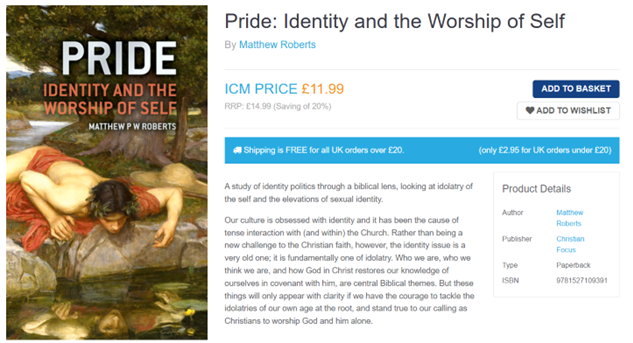
Something tells me this particular Matthew Roberts won’t be being invited to give any lectures to the Society of Antiqueeries any time soon. Carry On Camping? I’d really rather they all just stopped immediately.
To join in with the discussion please make a donation to The Daily Sceptic.
Profanity and abuse will be removed and may lead to a permanent ban.
Who’s funding this C-wrap? 🎲
Exactly what I wondered. A cursory look at their accounts 2022-3-accounts.pdf reveals some Arts Council funding but lots of other stuff too, mainly private looking stuff but then there’s no telling where those bodies got their money from without going down a rabbit hole. A job for Charlotte Gill. I think part of the reason all this stuff is so opaque is to hide the extent of the waste. DOGE found that out in the USA.
Tax payers, I expect. Why not – the elites think this is art.
That was my first question as well. Unfortunately, I expect “we are.”
A fascinating article. Thanks.
I see that the Hungarian Parliament has designated 25 November as Gulag Memorial Day. We should use this day to commemorate the 100 million people murdered by the leftwing “progressives” in the 20th century.
I certainly have noticed more gay and lesbian couples on some of my holidays than I would normally see where I live. As I live in “the provinces” perhaps that’s to be expected – don’t gays gravitate towards cities? Or maybe the relative anonymity of a holiday means that such couples feel they can be more open than they are at home. Perhaps I could apply for a grant to blog about this, which would cover the cost of my holidays.
I call BS.
If there were apparently no gays then there would have been no impetus to change the law.
Indeed – and no reason for the law to exist either
These ridiculous gay pseudo intellectuals and their potty mouthed yet childish obsessions with stiffing objects up their fundaments at taxpayers’ expence are starting seriously to get on my tits.
And this at the society of Antiqueeries, really?!!
I took you up, Steve, on your suggestion to listen to Roberts on that podcast talking about his wonderful ‘presentation’, including his song about going gay at the seaside. What utterly feeble shite these pathetic creatures mistake for intellectual insight! (May I emulate Roberts and say ‘inshite’?) Self-obsession taken to extremes. Such people take hours and hours to say absolutely nothing whatsoever.
I don’t understand how apparently intelligent people can become so fanatically self-obsessed and feel it is necessary to justify their existence. Most of us don’t give a 4X about their sexuality.
“I’ve known a few gays who thought they were pretty smart
But you’ve got being gay down to an art
You think you’re a genius, you drive me up the wall
You’re a tedious original, a know-it-all
Oh-oh, you think you’re special
Oh-oh, you think you’re something else
Okay, so you’re a gay academic.
That don’t impress me much”
And your starter for ten – on yesterday’s National Holocaust Day, what word beginning with ‘J’ was nowhere to be seen or heard on the BBC?