
This is How We Should Have Responded to COVID-19
Since March 2020 there has been an almost continuous refrain that the UK was not prepared for the COVID-19 pandemic – across the mainstream media, at the UK Covid Inquiry and most recently by Dominic Cummings in a Spectator interview. So much so that it seems to have become an accepted ‘truth’ regardless of the actual facts. Nevertheless there are facts, even in the postmodern dystopian world we now live in.
Firstly, we did have a detailed UK Influenza Pandemic Preparedness Strategy published in 2011 and it was explicit in saying that it could be adapted to respond to other respiratory virus pandemics, and gave as an example the first Severe Acute Respiratory Syndrome virus (SARS). Secondly, there was further national guidance in 2013 and 2017 to update the strategy. Thirdly, this national guidance helped all four nations and each local health board or authority to develop their own pandemic plans which were regularly reviewed and updated. Fourthly, we had many systematic reviews of the evidence for non-pharmaceutical interventions (NPIs) to minimise transmission, one published only a few months before the COVID-19 pandemic started. And finally, the UK scored second in a global assessment of countries’ pandemic preparedness in 2019.
So, the ‘unprepared’ mantra was not the whole truth and arguably we were comparatively well prepared. However, in the event all this preparation did prove to be useless – but only because we decided to abandon it all in March 2020. We binned our pandemic plans and ignored the careful reviews of the evidence and the experience gained responding to previous pandemics. No doubt the UK strategy will be updated, but whatever is produced could be just as easily discarded next time. So what can be done?
Perhaps what we need is something more accessible, something that reflects the ethical and democratic foundations of our country, and, given how important this is for the whole of society, something that is shared widely – well beyond public health departments, the office of the Chief Medical Officer (CMO), the Scientific Advisory Group for Emergencies (SAGE) and the NHS. Core principles on how we should respond to a pandemic that are shared, understood and agreed with the public, perhaps through their representatives in Parliament, might give us some scientific, ethical and governance guardrails. They might help to improve and protect accountability and also stand a better chance of surviving beyond a few weeks when the next pandemic hits.
If so, what might such principles contain? Here we offer some suggestions with commentary on how they were applied, or not, during the Covid-19 pandemic, grouped under four headings – epidemiological, medical, ethical, and democratic. Many of these principles don’t appear in the UK Strategy, or those of the four nations or local pandemic plans … and for very understandable reasons. Prior to 2020 they were taken for granted, they were so obvious that they did not need stating, they were the principles and codes that the public health specialty and the medical profession had followed for decades if not centuries, they were the way we conducted ourselves in our liberal democratic society. The Covid-19 pandemic response changed all that – we now clearly need to restate our commitment to core, indeed fundamental, principles.
Epidemiological principles
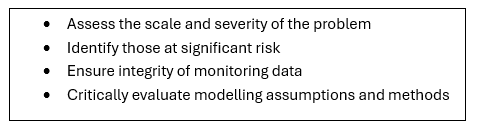
The first task in epidemiology is to assess the scale and severity of a new disease or health problem, examine how it varies by time, place and person (age, sex, occupation etc.), and compare it with other diseases. This helps to ensure that any response is proportionate and identifies those at greater and lower risk, as well generating hypotheses about potential causes.
In the context of a respiratory viral pandemic, data on case and infection fatality ratios are paramount. These were available early in the COVID-19 pandemic and before the first UK lockdown. Instead of these data being reported accurately, compared to previous pandemic data and carefully explained to the population (for example here), public messaging was alarmist and seemed designed to instil fear not reassure, and made little reference to those at lower risk (see Laura Dodsworth’s 2021 book A State of Fear). In a future pandemic the public should expect such data, the media should demand them, the CMO should have a responsibility to identify and collate them, and government responses should be calibrated based upon them.
Then to ensure accurate monitoring of the developing pandemic within the country and valid comparison to earlier pandemics the standard definitions for confirmed cases, hospitalisations and deaths should be employed. This did not happen in the COVID-19 pandemic with new definitions adopted, definitions that for all three exaggerated the statistics. This was compounded by inappropriate widespread testing using a PCR test insufficiently specific and using inappropriate cycle thresholds.
There was a further concern that arose during the pandemic response on the epidemiological front: the use and impact of modelling studies. Whilst such studies can be helpful they cannot be interpreted without understanding their underlying inputs, assumptions and methods. They are ‘what if’ studies – for example, what if we assume that the number of cases will grow exponentially without any seasonal effect, what if we assume no existing immunity in the population from other coronaviruses, etc. The Imperial College modelling study published in March 2020 seems to have had a significant impact on the push for the first lockdown, but it had not been peer-reviewed and seems to have been insufficiently debated and challenged; of course, it is now widely considered to have been flawed. Modelling studies are not reality, they are not facts, they are not evidence, they are better viewed as ‘what if’ scenarios and their assumptions and results should be rigorously challenged. Their presentation to politicians without critical analysis and careful interpretation amounts to professional negligence.
Medical principles
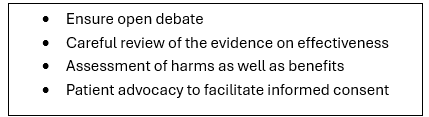
Science and medicine only develop through open debate and a willingness to consider alternative views, even if they are contrary to the current orthodoxy. This did not happen during the COVID-19 pandemic, as the oft repeated term ‘The Science’ demonstrates. There is no such thing: there is rarely a consensus and science is never settled, we only ever have the current disputed theories which remain until better ones come along. Any pandemic response should be open to challenge and wide debate so that we are not limited to the knowledge and experience of only a few prominent scientific and medical government advisors. The thoughtful and detailed letters addressed to the Medicines and Healthcare Products Regulatory Agency (MHRA) and Joint Committee on Vaccination and Immunisation (JCVI) from often in excess of 100 doctors and scientists on the merits or otherwise of Covid vaccination of children were a case in point, and were ignored or summarily dismissed. Public health messages to the population certainly need to be clear and if possible consistent to maximise understanding, but this does not preclude an open and vigorous debate within the medical and scientific community, something that is essential if we are to develop an optimal response.
In 1979 Archie Cochrane, widely regarded as the father of evidence-based medicine, made his famous comment that: “It is surely a great criticism of our profession that we have not organised a critical summary, by speciality or subspeciality, adapted periodically, of all relevant randomised controlled trials.” The international Cochrane Collaboration, named after him and designed to address this criticism, produced a series of systematic reviews on the effectiveness of physical interventions to interrupt or reduce the spread of respiratory viruses such as school and business closures, social distancing measures and restrictions on large gatherings. Despite the limited evidence for effectiveness and the relatively poor quality of the evidence from these reviews and similar conclusions from a WHO review published in September 2019, almost all these measures were applied to the whole population from March 2020, including a ‘lockdown’ of healthy people.
We copied the response of a totalitarian state despite a lack of evidence and despite the fact that these same systematic reviews drew attention to the widespread harms that would be caused by implementing these measures across the whole population. These harms are beginning to be appreciated across multiple areas – in terms of mortality and physical health particularly of older people, the social development of young children, the mental health and education of young people, businesses across the country as well as jobs, the economy and the benefits system.
An evidence-based approach also required a thorough review of the evidence on the benefits and harms for the prevention and treatment of COVID-19 in individuals. The limited data on the effectiveness of the novel gene technology ‘vaccines’ (and see Clare Craig’s 2025 book Spiked – A Shot in the Dark) and on their side-effects, with no data at all on long term harms, pointed clearly towards their use only in those at higher risk with full disclosure on what was known and what was not. In the event, of course, they were recommended and pushed on most of the population including those at insignificant risk. Furthermore, ‘safe and effective’ was far from a full disclosure of the evidence on benefits and risks.
By contrast, the use of re-purposed drugs such as ivermectin with known anti-viral and anti-inflammatory effects, extensive evidence on effectiveness and a well-documented safety profile, was actively discouraged.
In all these areas, doctors should be acting as advocates for their patients, informing them as best they can and helping them to make decisions on their treatment and care, as required by the General Medical Council’s guidance ‘Good Medical Practice‘. However, as already discussed, the informing was cursory and partial, and the contact often non-existent or via leaflet or video-call.
If they are to regain public trust the medical profession and public health authorities must do better next time, and patients and the public must demand better information and better discussion and engagement with medical staff to help them make decisions.
Ethical principles – informed consent for individuals
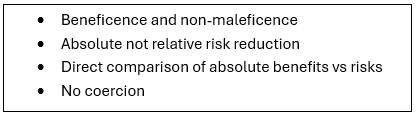
The Greek philosopher and physician Hippocrates developed his Oath around 400 BC. It urged doctors to act with beneficence – that is, to help their patients and prevent harm – and non-maleficence – that is to do no harm themselves or primum non nocere. The term appropriateness brings these two concepts together – an appropriate treatment is one that has been chosen because its benefits outweigh its harms in the particular patient.
As outlined above, evidence-based medicine involves the careful assessment of the evidence, ideally from randomised controlled trials, to quantify these benefits and harms. Whilst the patient advocacy role of doctors involves them in informing and supporting their patients to make informed decisions on their treatment and care.
Although this process sounds simple and straightforward, it is not. It seems to be taken more seriously in surgical practice, after notable legal cases, but less so in medical practice with the prescribing of drugs and vaccines. Certainly in the pandemic consenting practices for vaccination were cursory, to the point of being non-existent – public information heralding the ‘safe and effective’ vaccines was at best partial, and coercion was widespread via national advertising that deliberately sought to shame and manipulate, via vaccine mandates, and via bans from venues without proof of vaccination (or negative Covid antigen tests).
Large relative risk reductions of 70% for the Astra Zeneca ‘vaccine’ and 95% for the Pfizer ‘vaccine’ were trumpeted, but not the smaller, less convincing absolute risk reductions of around 1-2%. And there was no attempt to directly compare benefits and risks and harms, the key information a patient needs to give fully informed consent.
The wholesale abandonment of standard codes of practice for informed consent during the pandemic was truly shocking. To regain public trust the medical profession needs to take this key responsibility more seriously and particularly improve practice in relation to long term medications and vaccinations.
Democratic principles
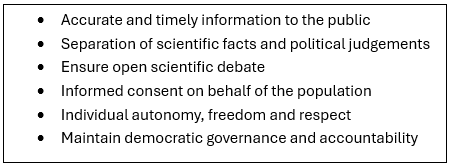
The UK Strategy of 2011 did emphasise the importance of accurate and timely information to the public, and stressed that uncertainty and any alarmist reporting in the media could create additional pressures on health services. Despite this, the early epidemiological data on the scale and severity of the COVID-19 pandemic, a comparison with previous pandemics and clear identification of those at higher and lower risk were not shared with the public and carefully explained. The data that were given were far vaguer and the messages seemed designed to raise anxiety rather than contain it and modulate it to appropriate levels. Government advisors seem to have entirely lost sight of these crucial epidemiological data that are so essential to enable the government to calibrate its response and ensure it was proportionate. Data reflecting reality seem to have been overshadowed by modelling data reflecting potential future scenarios – fiction rather than fact influenced key decisions.
Whatever national response is being contemplated to a pandemic, there needs to be a clear separation of the medical and scientific evidence on the benefits and risks of specific interventions on the one hand, and the political value judgements and decisions on the other. Governmental advisors must present options and their benefits, risks, harms and likely costs to ministers, and in a democracy it is for ministers to decide as they are accountable to the electorate. This relationship is akin to the doctor-patient relationship – the doctor informs the patient and supports him or her to make his or her own decision but does not lead or coerce. This line may have been blurred during the COVID-19 pandemic. Moreover, government advisors seemed reluctant to identify, and where possible quantify, the risks, harms and costs that might flow from the options they put to ministers despite some, like lockdowns, being unprecedented in their severity and scope.
In turn ministers and politicians more generally have a responsibility to ensure that their advisors present them with the epidemiological data and the data on the benefits, risks and costs of recommended options. Ministers also have a responsibility to ensure that differences of opinion on how best to respond within the medical and scientific community are fully aired and discussed. This is crucial to arrive at an optimal response and to avoid groupthink. Only if ministers do these things can they take decisions on behalf of their population and give fully informed consent.
Crucially ministers have a particular responsibility to protect the basic freedoms we enjoy in a democratic society – freedom of speech, association and movement and individual bodily autonomy when it comes to medical treatments. Any infringement of such basic freedoms demands a clear, unambiguous and overwhelming justification, must be subject to challenge in Cabinet and Parliament, and must be as least restrictive as possible to achieve the aim – in extent, impact and time. This is such a fundamental issue that we perhaps need to develop a framework to guide and constrain actions: defining the types of evidence and high thresholds that are required; limiting powers in terms of their impact, duration and the number of people affected; and outlining checks and balances, with perhaps an automatic independent review afterwards. We have such a clear and rigorous framework for compulsory detention under the Mental Health Acts when one individual is affected: we need at least as rigorous a framework when the freedom of millions is at stake.
There has also been considerable criticism of how the usual democratic governance systems were subverted and avoided during the pandemic, including the use of emergency legislation by the executive without appropriate challenge within Parliament. These governance systems are essential to enable questioning and challenge by MPs and select committees with the aim of improving decision making, and to ensure a clear justification for measures taken and transparency to facilitate accountability. This did not happen during the COVID-19 pandemic as clearly outlined in The Accountability Deficit by Kingsley, Skinner and Kingsley (2023).
In all of these four areas – epidemiological, medical, ethical and democratic – principles were violated during the COVID-19 pandemic with dire consequences for health, basic freedoms, quality of life, education, business and the economy, and for democracy and society itself. Before 2020 it would have seemed unnecessary to state such core principles. Now, having set a precedent when we abandoned them, it seems absolutely essential not only to restate them but to discuss them widely and if possible to reaffirm our commitment to uphold them before another pandemic hits.
Dr Alan Mordue is a retired consultant in public health medicine and Dr Greta Mushet is a retired consultant psychiatrist and psychotherapist.
To join in with the discussion please make a donation to The Daily Sceptic.
Profanity and abuse will be removed and may lead to a permanent ban.
This is a good article. A shame that no-one in government or public health will even look at it or even be bothered to learn from it. You did not have to be a medical expert to realise that much, if not most, of the government’s COVID response was completely wrong if not Indeed a criminal act that would have untold consequences for the well being of society. It’s all too late now and the same mistakes will be made again come the next fake pandemic because people in authority follow ‘the Science’.
‘It is therefore arguable that in the case of infections like coronavirus or rhinovirus colds, which are normally quickly self-limited, the best approach would be to relieve the patient’s discomfort and disability and leave their immune system to take care of the virus.’
The Common Cold Unit 1992
‘In people younger than 70 years, (Covid 19) infection fatality rates ranged from 0.00% to 0.31% with crude and corrected medians of 0.05%.’
NIH Oct 2020
The answer to ‘What should we have done?’ is ‘Not start from here’!
Britain should get the state sector out of health provision as quickly as possible:
‘Universal Healthcare without the NHS’ IEA Paper 2016
Pretty much everything run by government is inefficient and badly organised, expensive.
We know that this is the case with the NHS. The common cold coronavirus panic clearly demonstrated that.
Systemic reform, a reforming government, is required.
Completely agree.
“Pretty much everything run by government is inefficient and badly organised, expensive.”
and highly susceptible to gross $£corruption by those in power. E.g. in the UK., Sunak’s $500B investment in Moderna, all the way down to highly questionable (aka corrupt) contracts for useless PPE awarded to companies hurriedly set up by the cronies of politicians.
It’s also clear that many other countries didn’t do any better either so I would propose that what needs tackling is nothing medical at all but the way mainstream fearmongering feeds social media frenzy. Until that’s sorted, no amount of planning or change will make any difference.
“….,,principles on how we should respond to a pandemic that are shared, understood and agreed with the public, perhaps through their representatives in Parliament, might give us some scientific, ethical and governance guardrails. They might help to improve and protect accountability and also stand a better chance of surviving beyond a few weeks when the next pandemic hits.”
But this the point where this piece fails. The last “pandemic” was not a pandemic. Not by the evidence. It is clear it was for pre-planned objectives. And if there is a “next one” it will be the same. I think upwards of 15% of the population now know this, and won’t be duped and manipulated again. The globalist puppets who infest Parliament and enabled the 2020 travesty won’t somehow have this trust restored, whatever the authors – a pair of, no doubt, well meaning professionals – suggest.
I agree
The article somewhat assumes the state acting in good faith
Perhaps in some more ideal world having a state public health body that reacts to “pandemics” proportionately would be a good thing, but I think we are better off without a plan and without “public health”. Sorry but I have no faith left that it would not be corrupted.
Agree – next time, and there will be another attempt, the key will be in enough of a percentage of the population not playing along – this will give the sheep doubts and they won’t either… at that point, the madness will fail and end. However unless there are enough dissenters, we will be screwed again to extract vast sums of cash from the public purse
I tend to think that enough people realise that it was a scam, even though they won’t admit it openly. I think people were pretty tired of the restrictions in the end, and if there is a next time it will require more than a bad flu season to make it stick.
within the current framework of ‘government’ and governance, I would agree with you100%.
I am afraid I have lost faith completely in “government” and “governance” with regard to anything connected to the state. Sooner or later it gets corrupted.
I think you can see that the influence of China in government does not only apply to the Labour party but, indeed, applies to all parties. They all signed up for the China Covid policies with barely a whimper. No questions were asked in Parliament except for 2 brave Tories. I believe 100% that they were ALL handsomely paid for following orders and bound by party ‘honour’ and I am sure of threats of ruination or worse should they ever break the honour. Our so called ‘elected’ MP’s did just one thing, follow the script. Johnson was nobbled( I suspect the trip to hospital was more likely a re-education camp visit), and Rishi the snake made hundreds of millions from the grace of the HoP, which I am sure was split with colleagues for the beneficence. The scams of PPE, bounce back loans, company support grants, Furlough for none existent staff etc. Hancock and the newly converted Zahawi did the devil’s work voluntarily, even eagerly. A level of sense (common or otherwise) and life experience is almost totally lacking in the HoP. Obviously, conscience is not a quality that gets you anywhere in politics, but the 100% absence is appalling.… Read more »
Very well put
It’s 6 years too late now to point out what was bleedin’ obvious to anyone with a few brain cells back then.
My heart soars when I read articles like this by people whom I feel I could trust in an emergency.
Might I add two quotations which a non-medical person like myself can understand:
”Don’t panic!”, L Cpl Jack Jones
”Don’t just do something: stand there.” Dr Malcolm Kendrick
All a bit like Climate Change activity, driven by fear based on inept computer modelling.
Some of us already knew that.
the problem was that the man flu epidemic was used for political purposes and will be again.
as the article said, we have and had, perfectly good plans which don’t include locking people up and bankrupting the country.
they will never be used because it is not about any illness, it’s all about control.
The picture of that man should be one where he is wearing a face nappy.
I would like to make this a general request to DS staff – any picture of anyone who was prominent in the promotion of “covid” should be one of them wearing a nappy on their fat gob.
All the while politicians are in charge, such plans will not be followed because of the need of politicians to appear to be doing something. They prefer performative rather than appropriate action. Who knows haw many people they have killed or damaged by this strategy of self-promotion.
Excellent article!
There was no viral pandemic… only a pandemic of ignorance, stupidity and hubris.
If medical schools taught the truth about the history of health, disease and vaccination, no honest doctor would recommend one ever again. The repeated dogma that ‘vaccines have saved millions of lives’ is a whopping lie. The constant messaging that viruses cause disease is equally dishonest.
One doesn’t need a medical degree to know measles mortality decreased 99% before a vaccine became available. Likewise, one doesn’t need to be a genius to know Scarlet Fever mortality was significantly reduced without a vaccine at all. Instead, one only has to read some history and engage in critical thinking.
The so-called Spanish flu, mortality exactly in the range of COVID (0.05%), caused a health hysteria in the USA which lead to all kinds of measures and the outcome was (reportedly) a lot of dead people. In 2020, an American health hysteria went globally viral and combined itself with a lot of inane ideas of the leader of China how to deal with respiratory pathogens. In addition to a lot of dead people, the outcome was the end of the so-called free world led by the USA: Our caste of professional politicians who periodically need to have their continued position in politics approved by an otherwise politically powerless electorate has learnt that they can get away with pretty much anything short of open murder. In particular, with justifying political decisions with totally baseless lies, with prosecuting anyone who dares to tell the truth and with suspending all of our so-called human rights for aribrary periods of time. We shouldn’t have responded to COVID-19 at all, exactly as the European countries of 1918 – 1920 refused to ‘respond’ anyhow to the Spanish flu which wasn’t a major event in Europe. I’m not aware of any contemporary German source which even mentions… Read more »
There is a modern theory that the entire mortality of the so-called Spanish flu following WW1 was caused by Iatrogenesis. Most of the fatalities were soldiers ether still at or newly returned from the Western Front. Many had fever symptoms due to inhalation of poison gas. To treat them, the medics overdosed them, unwittingly, on the then new wonder drug called aspirin. The overdosing was lethal. Attempts to demonstrate the involvement of an infectious or contagious pathogen drew a total blank. No triallist volunteer closely exposed to symptomatic patients contracted the sickness. It was the doctors wot did it.
The same finding will be reported if the truth about the first covid wave in Spring-20 ever comes out: no one died unless they were already moribund and were OD’d on midazolam.
There’s a modern theory that there’s a world outside of the USA and the idea that someone use Aspirin to treat people with gas poisoning is ridiculous. Gas wasn’t a particularly deadly of effective weapon in WWI and treatment of people who became poisoned by it was sufficiently developed that the majority of affected people recovered completely (according to the German official history of the war).
I stopped after the first two paragraphs of nonsense. The UK had a plan for an influenza pandemic but had NO PLAN for SARS/MERS. In 2005 the WHO when it did perform a useful function told nations to devise TWO PLANS – one for influenza and one for SARS/MERS after the outbreak in the Far East. Over the years the preparedness report has edged out SARS/MERS to just focus on influenza to the extent that in the last draft SARS/MERS are referred to as just some other infection that might kill as handful – how well did that work out?
All well and good.
But the response to Covid wasn’t health-related. It was a planned exercise in population control and mass experimentation.
If they want to do it again, they will.
Although there are some good points in this article, there are some issues.
In my opinion Public Health should only ever inform and advise based on unbiased evidence, whilst stating the uncertainties and unknown. The public can then decide what works best for them as individuals and this will have an impact on overall behaviour.
I know this is a slightly extreme stance to take, but my trust in institutions to look after the individual’s interest better than the individual itself has gone.
A small correction: we did not know case fatality rates early on as we did not have a clue about infection rates. The same mistake was made with swine flu, overstating case fatality rates. It was only later on in May 2020 that Ioannidis’ research gave some real world estimate of case fatality rates.
“my trust in institutions to look after the individual’s interest better than the individual itself has gone”
It’s the only sane position, IMO
We agree entirely with your comments about individual informed consent Myra. However not with those about CFRs and IFRs. CFRs were available in Feb 2020, IFRs in March 2020 – see link in article. Ioannidis estimates came in Jan 2021 (0.23%) then May 2021 (0.15%).
I have almost completed my own report on the pandemic, which I will place here (assuming the editor accepts it!). It mirrors some of the points made in this article, but my conclusion is a bit different. There was no need to do anything, population-wise, for those who got a bit ill. What was needed, very simply, was to correctly treat those who did get ill, on the way identifying the warning signs of the development of serious illness, the hyperimmune response. That existing management outlines for a pandemic were abandoned was bad, but far worse in my view was the ignoring of my recommendations for treatment which I submitted to the Chief Medical Officer and the Secretary of State for Health in April/May 2020. By the time they were adopted, over six months later, many had died from being given no, or the wrong treatment. My estimate of preventable deaths is around 20,000.
I might add that the same dismissive attitude applies to the Hallett Inquiry, on which more shortly. We will never learn if we hide evidence.
Treating people according to their symptoms – what a novel idea. Not at all in keeping with the “public health” industrial complex.
None of those suggestions will happen as our government and organisations have been captured by the Big Pharma Crime Cartel and characters like Gates etc. The MHRA have even admitted to being their enablers, not regulators. Also, they have recently approved a new dangerous mRNA Covid death jab and they knew about serious complications with the Astrazeneca injections in 2021, but did nothing.
’Science’ gets a (somewhat dutiful) mention, but robust science depends on the adequacy, including reproducibility, of the underpinning scientific research – and on the interpretation/dissemination of that research. Trillions were spent because of Covid, but hardly anything on good research. A fair bit was spent on ‘modelling’ which is not robust research (usually it’s only soothsaying). Because of this deficiency, good ‘Science’ is only minimally (if at all) more prepared for the next ‘Pandemic’.
Pretty much everything run by government is inefficient, badly organised, and expensive.”
and in the case of the COVID non-pandemic, highly susceptible to gross and petty $£corruption by those in power. E.g. in the UK., huge investments by senior politicians in Moderna, all the way down to highly questionable (aka corrupt) contracts for useless PPE awarded to companies hurriedly set up by the cronies of politicians.
And all of the above taking place in virtually all Western states, in particular, within the globally corrupt framework of the WHO.
It is arguable that the official COVID response had nothing whatsoever to do with engendering good health. How about, instead, a combination of the grotesque oligarchic looting of the modest wealth of ‘ordinary people’ and seeking to establish a gene therapy platform that would allow a globalist oligarchy via the WHO and corrupt governments to gradually and easily down-regulate the health of ‘ordinary people’ and the world population via a succession of fake ‘pandemics’ and associated gene therapy platform “vaccines”?
You are assuming one thing – that there WAS a pandemic. Please can you show me the evidence apart a window when the government sent suck elderly people back to care homes and killed thousands with midazolam.
No this was a scamdemic and all that happened was deliberate to experiment how far they could go in order to introduce new regulations to control the plebs more and more. Look around you it’s happening now digital ID, online harms bill, policing bill more and more restrictions to our freedoms of speech, bodily autonomy and association.
WAKE UP!!!!!