
RFK Turns the American Food Pyramid Upside Down
Dietary goals for Americans were first set in 1977, following the work of Senator George McGovern’s select committee. The first Dietary Guidelines for Americans (DGAs) were set in 1980 and it is now ingrained in US law that these will be published every five years.
The two key guidelines that have most impacted American food policy (and public health) for nearly 50 years were to limit total fat to no more than 30% and saturated fat to no more than 10% of calorie intake. These restrictions were set because it was thought that fat caused heart disease (in middle aged men). My PhD examined the evidence for those guidelines and the beliefs upon which they were based and found that they should not have been introduced – then or now. Other research teams have found the same.
There are three macronutrients: fat, protein and carbs. Protein tends to stay remarkably constant at around 15% of energy intake. The imposition of a fat restriction of 30% meant that the remainder must come from carbohydrate – 55%. When the dietary fat restrictions were set, we didn’t know that 55% carbohydrate intake was safe, let alone healthy. But that was the inevitable consequence of the 30% fat restriction. The 1977 dietary goals for Americans spelled this out in the first goal: “Increase carbohydrate consumption to account for 55 to 60% of calorie intake.” The impact on obesity, diabetes and other chronic conditions of this low-fat, high-carb advice cannot be overstated.
The 2025-2030 report, published on January 7th 2026, is the 10th edition of the DGAs. The first sentence was: “These Guidelines mark the most significant reset of federal nutrition policy in our nation’s history.” That was not an overstatement. The next sentence was “The message is simple: eat real food.” Those few words captured what an entire movement has been saying for years. Reading the short document (10 pages instead of the 164 pages of the 2020 report) was joyful.
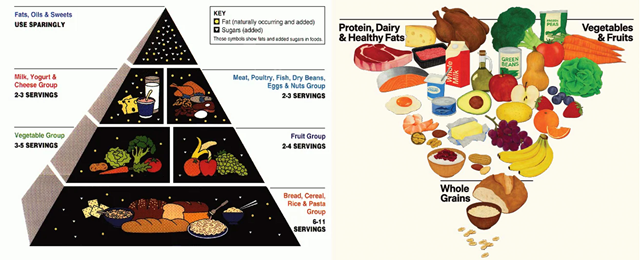
The original food pyramid became “MyPlate” in June 2011. The pyramid has returned and it’s been flipped upside down, as it was in a South Park sketch. Secretary Kennedy tweeted the clip in case you missed the 2014 classic.
The new guidelines are concise, readable and quite revolutionary, but there’s a big but…
Let’s start with the good news – and there is a lot of good news in the eight guidelines, three boxes and the “Special populations and considerations”:
- The eight guidelines prioritise high-quality, nutrient-dense protein foods (and protein intake recommendations have been increased). Animal sources of protein (eggs, poultry, seafood and red meat) are cited ahead of plant sources (beans, peas, lentils, legumes, nuts, seeds and soy).
- Consume dairy, is another message – and not just dairy but full-fat dairy. Three servings a day are recommended and the new pyramid has a carton of whole milk, a pot of unsweetened yoghurt and butter, yes butter.
- The healthy fats section mentions olive oil, butter and beef tallow. The entire 2025 report has no mention of seed oils. Contrast this with the 49 references to oils in the 2020 guidelines, which heavily promoted canola, corn, safflower, soybean and sunflower oils. The long overdue demise of seed oils just happened.
- Grains are way down the list (and at the bottom of the new upside down pyramid). Serving goals are two to four per day – far from the six to 11 servings of beige starches which formed the original pyramid base.
- “Limit highly processed foods, added sugars, refined carbohydrates and alcohol” rounded up the common sense.
- Breastfeeding is emphasised. The toddler diets (one of which was vegetarian) in the 2020 report are gone.
- The section “Individuals with Chronic Disease” has the unprecedented words: “Individuals with certain chronic diseases may experience improved health outcomes when following a lower carbohydrate diet.” While this may seem niche, as the opening statement from the Secretaries notes: “More than 70% of American adults are overweight or obese. Nearly one in three American adolescents between the ages of 12 and 17 has prediabetes.” That’s the majority of Americans now eligible for a low carb diet, therefore.
- The document closes with warnings for the nutritional deficiencies that are likely to arise from vegetarian and vegan diets. So much legacy nutritional nonsense has gone.
- By its absence the 30% cap on total fat has gone. The new guidelines make no mention of total fat or the “Acceptable Macronutrient Distribution Ranges” which dominated guidelines from 2005 to 2020.
However, the saturated fat cap remains: “Saturated fat consumption should not exceed 10% of total daily calories.” This is the huge ‘but’, because all the good news in the guidelines is incompatible with that one preserved guideline.
We need a couple of facts about fat at this point. First, all foods that contain fat contain all three natural fats (saturated, monounsaturated and polyunsaturated), there are no exceptions. Second, virtually every food (except sucrose) has at least a trace of fat. Hence virtually every food contains saturated fat.
Because fat approximates to nine calories per gram and protein and carbohydrate approximate to four, fat content adds up quickly in calorie terms. While a lean steak may have only 2.1g of saturated fat per 100g, the 18.9 sat fat calories comprise 12% of the total 154 calories. That’s red meat off the menu if the sat fat cap is to be followed. I repeated that exercise for common foods and oily fish, eggs, cheese, whole milk and even low-fat milk are all off the menu. So is olive oil. Fake food passes the sat fat test, however (biscuits, muffins, white bread, donuts, cakes etc.) because natural saturated fat has been replaced with cheap plant fats. Seed oils pass the cap, of course.
This is the gaping inconsistency – the huge flaw in otherwise astonishingly good, concise, revolutionary new guidelines. If the 10% saturated fat cap is followed, all the good advice to eat real food (red meat, oily fish, eggs, dairy, olive oil etc) cannot be followed. If the good advice to eat real food is followed, the 10% saturated fat cap cannot be followed
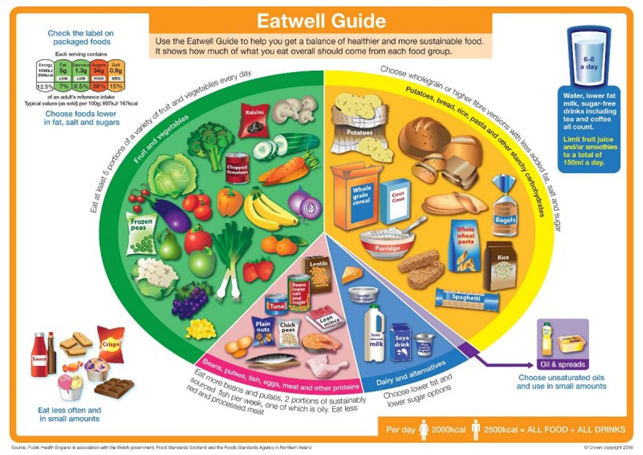
We don’t yet know how this contradiction might get resolved. Even with this anomaly, the new South Park pyramid is infinitely better than the UK dietary advice. This is called ‘The Eatwell Guide’. I have always called it ‘The Eatbadly Guide’. Our terrible beige, starchy, commercial dominance looks even worse alongside MAHA’s bold real food bounty. Make Britain Healthy Again!
Dr Zoë Harcombe has a PhD in dietary guidelines. A longer version of this article with full references has been published on her website.
To join in with the discussion please make a donation to The Daily Sceptic.
Profanity and abuse will be removed and may lead to a permanent ban.
Just 50 years to admit we got it wrong. Whats next on the long list of ‘things that don’t work, but we’re told its the only way’..?
The useless statins. The most blatant example of Big Pharma capture of the medical profession ever — one huge scamalot on the British taxpayer, which has been going on for decades. GPs in England (I assume in Wales & Scotland, too) get PAID EXTRA for putting patients on statins — an almost unbelievable conflict of interest. Zillions of Brits on statins, all at huge expense to the taxpayer. Cui bono ? Big Pharma (surprise, surpise — NOT). And they are worse than useless, with alarming side effects for many. Don’t be conned. Read the great Dr Malcolm Kendrick’s books on the matter of statins, clots and heart disease. My GP wanted to put me on statins (natch) – I gave him the Kendrick books – never heard another squeak from him on the matter.
See : https://www.carter-ruck.com/news/the-mail-on-sunday-apologises-and-pays-substantial-damages-to-doctor-and-academic-in-statins-case/
What no Jelly Babies?— Just Kidding—–I recall going to my Gran and Grandads in the seventies. My grandad had this huge garden full of “Real Food” (Brussel Sprouts, Cabbage, Lettuce, Potatoes, Turnip, Carrots etc etc etc). My granparents also ate a lot of stew, mince, black pudding, bacon etc etc. and full fat milk and butter ——There was hardly any cakes , biscuits and chocolate and no Jelly Babies.——PS They lived till they were 85
I think the next big question is Palm Oil and Rapeseed Oil, both of which can only be produced by convoluted and heavy processes. .
No no no! Concerns about seed oils are a far right anti-science MAGA conspiracy theory!
Funny.
ALL seed oils, bar hand pressed
Take a look at how “healthy” low fat, high in polyunsaturated spread are made. The start point, hydrogenated vegetable matter, is also the point for shower gels and shampoos.
Avoid all seed oils. Palm oil appearing in many foods. Read the labels.
This neatly summarises my previous comment, but with the addition of dripping on toast for supper!
Happy to slather it in butter but dripping is a step too far! 🤢
You have no idea what you are missing. Born 1951, every mum had a bowl of dripping and a bowl of lard in the pantry. Bread and dripping a huge treat, especially if it had blobs of super beefy bits.
My wife are carnivores, so cook only with lard, tallow and butter. Love it.
lol… I know exactly what I’m missing, my father was a big fan!
Early sixties baby, me, but also brought up on hot toast with beef dripping liberally applied and just to make it really healthy and tasty, a good sprinkling of salt on top. Delicious
I think I will carry on in exactly the same way I have been for the last 80 odd years.
This is fantastic news. I’ve been preaching the low carbohydrate diet for ages. (Not hard-core keto or anything like that, just move away from bread, pasta, rice and potato as your staples)
People have been seriously misled. They think having cornflakes for brekkie, sarnies for lunch and pasta for tea is healthy. It is not, you are wearing out your insulin receptors!
My diet is not rocket science. Meat and veg! (and salad, cheese and eggs!)
What about the evidence against saturated fats? Without refuting that all this is useless.
It can easily be refuted. It was based on poor and conflicted studies. We have been consuming those forms of fats for centuries, unlike the toxic seed oils that are not fit for human consumption.
If you believe that saturated fats clog your arteries (because they solidify at room temperature), think about how cold your body would have to be for this to happen inside you. You’d need to be a long time dead. Yes, high quantities in your diet can increase your ldl cholesterol, but again, this is far more complicated than the official narrative suggests.
There is plenty of material out there – Nina Teicholz and Zoe Harcombe (the author of this piece) on saturated fats and Dr Malcolm Kendrick on cholesterol.
This will also be an eye opener (published in many journals about 10 years ago, but often under a pay wall) https://jamanetwork.com/journals/jamainternalmedicine/article-abstract/2548255
Only last week my GP said that my cholesterol level was too high. When I said that I did not want to take statins, he asked why. I explained that I had read Dr Malcolm Kendrick’s book The Great Cholesterol Con and was happy with my cholesterol level. He was gracious enough not to press the matter further. I highly recommend the book for its content and its easy reading style.
Fully agree about Dr Kendrick’s book The Great Cholesterol Con. His book Doctoring Data is good too. When justifying my decision to refuse cholesterol lowering drugs (not just statins) I prefer to mention Uffe Ravnskov, the spokesman for THINCS (The International Network of Cholesterol Skeptics). I was concerned that too many mentions of Kendrick might get him in further trouble with the GMC. Now Kendrick has retired I probably don’t need to worry so much. I started taking a statin in 2008 and began to experience joint and muscle pain. After a year or so it was such that I could not tuck my own shirt in at the back or shake hands with someone without pain. I then read about such side-effects from statins. I asked my GP about this and he suggested taking a two-week ‘holiday’ from the statins to see if things improved. They didn’t – but I realised that my GP was not bothered about tapering off or tapering back on to the drug, so I decided to take a longer statin holiday to see what would happen. The pain gradually went away. I did not do the logical next stage of the experiment and restart… Read more »
Hear, hear, about Doctoring Data. If you are looking for another eye-opening read, try “Vaccines, Amen” by Aaron Siri. Makes my blood boil, no matter what my cholesterol level is.
Well, obviously, saturated fats could not clog arteries unless injected. No doubt the question of the effects of foodstuffs is complicated. Probably too complicated for the human mind to grasp. Dietary advice goes in the blue bin. If the existing advice is so wrong, why should any advice be right?
None.
https://bjsm.bmj.com/content/51/15/1111
“Saturated fat does not clog the arteries: coronary heart disease is a chronic inflammatory condition, the risk of which can be effectively reduced from healthy lifestyle interventions “
Just had a Full English, it’s good to eat more healthily than I did when I had a Full English the other weekend.
Regular Sunday brunch after a 4 mile dog walk.
I was always told at school that margarine was “the healthy choice”. We always had butter at home, but I remember once being fed margarine sandwiches for lunch at a friend’s house. Instant vomit. From that point on, I only went there for the SNES, and politely refused the “food”.
My mum did it right. These days I have to arrange her meals, and the good folks at Wiltshire Farm Foods serve it up properly.
Margarine really is the most awful goo! I was stupid enough in the 80s to have 100% bought into low fat dogma. I used to spread something called Outline on my toast. It tastes absolutely horrible, so how I thought this was doing me good, I don’t know! Since then I have given up both the Outline (swapped for Kerrygold butter) and the toast.
Didn’t you know? If it tastes horrible it must be good for you!
I think that’s actually what i believed in those dark days.
And fat and carbs together are the “Randle Cycle”
https://en.wikipedia.org/wiki/Randle_cycle
The body can use fat and carbs for energy. But both at the same time, it gets confused, doesn’t know which to use so stores them as visceral fat. Think “fatty liver”. You don’t want it.
And that as most now live on processed food, which have fats (usually filthy seed oils), carbs and sugar is the reason for the insane amount of obesity we now see.
Carnivore or Keto fixes all that.
Evidently, the perfect storm is the ‘sweet spot’ manufacturers strive for, where the balance of refined sugar, fat and carbs is, apparently irresistible…
Atkins reckoned he could trace back obesity in America to the mass production of doughnuts, I believe?
Some have also said that American obesity is caused by the massive amounts of GROWTH HORMONES fed to American cattle and other livestock.
Or perhaps just the relatively large size of servings for all sorts of things. I noticed that on my first visit across the pond back in 1994.
Saturated fats were never the problem, but its looking more and more likely that pretty much everything they told us was bad for us wasn’t, but its really a matter of detail. Eating the excess fat on a steak, on bacon, or other meats is almost completely saturated, but its not particularly healthy, its an overload of fats. The fat within the meat, streaking for instance is healthier eaten with the meat, and gives meat its flavour. Lard, dripping and tallow are healthy in moderation. I do recall as a child eating and enjoying dripping on toast, but these fats are best used for cooking. A major issue with cooking with fats of any type is taking the fat beyond its smoke point, at this point the fat is being converted into toxic triglycerides, olive oil is not good for high temperature cooking as it has a low smoking point, so not suitable for a chip fryer. Cholesterol is not dangerous it is absolutely essential, our brains are pretty much composed of cholesterol, however, much like anything we eat, excess is not good either. No-one should be taking something like a Statin to control high cholesterol, reducing intake of foods… Read more »
I mostly agree, but animal fats such as lard and tallow can be taken to an extremely high smoke point and are beautiful to cook with. I don’t believe in moderating saturated fats either, as they are so satiating, they kind of self moderate so you don’t overeat.
Sorry, I didn’t mean to suggest lard and tallow had low smoke points, but Olive Oil does.
Woody Allen, Sleeper.
Most of the cholesterol we have is manufactured locally, via our digestion and our liver. Either from imported cholesterol in the diet, or other sources that are available, such as sugar or animal fat. This one might be interesting: https://www.massgeneralbrigham.org/en/about/newsroom/articles/how-is-cholesterol-produced
“…we didn’t know that 55% carbohydrate intake was safe, let alone healthy.” We did know it was not safe or healthy – anyone who studied biology at school knew. ALL carbohydrates – whether sugars, starches, or others are reduced in the body to glucose as an energy source. The glucose not immediately used is converted to glycogen and stored in muscles and the liver ready for quick conversion back to glucose when needed. If the muscles and liver stores are full, the glycogen is converted into fatty tissue and stored. People who are not particularly energetic, that’s lost people these days as jobs have got less arduous, more work in offices, or use machines, or just don’t work and sit around, are not going to use that glucose or glycogen at much of a rate so they WILL get fat. The problem is decisions and policies are made by bureaucrats and politicians that are as thick as mince, and don’t understand science. They rely on captive “experts” who do their paymasters’ bidding to provide the “science” to support their policies. The original “research” on saturated fats and heart disease, was very poor, full of confounding factors that were ignored. There… Read more »
The problem with removing fat is that it affects the flavour of food and so to compenate sugar is usually added. Low fat ready meals therefore have more calories than normal ones.
And they are usually more addictive and a lot less nutritious. It’s not all about calories – fat has more calories per gram than protein and carbs (about double the amount), but is satiating and our body needs it.
RFK will go down in history for saving millions of lives, by overturning “established science” in food and vaccines.
Well done to Dr. Zoe Harcombe for discovering these truths during her PhD research.
May I put in a good word for SALT, as well? We’ve all been warned about too much salt, and millions were put on low-salt diets by doctors, only to continue dying of heart disease.
Salt is good for you, especially sea salt with no additives, and makes everything taste better, so sprinkle it on as much as you want.
Absolutely! Those who eat lots of processed rubbish get the nasty stuff included in their food anyway, but if you eat foods mostly as nature intended, you should definitely supplement with good quality salt and as liberally as taste allows (healthy bodies pee out any excess anyway).
Literally Hitler and a crackpot anti vaxxer may well end up improving millions of lives immeasurably, and will probably not get much credit for it from the TDS sufferers.
RDK was I think a lifelong Democrat but clearly he and Trump both worked out they could work together. But apparently Trump
is stupid and not an astute politician.
I am not overly keen on “public health” but at least if you’re going to do it, get it right.
I applaud the overall sentiment, but that does come across as a bit incoherent.
You mean the new pyramid is incoherent, or the article, or my comment?
I meant the comment – sorry. The new pyramid isn’t perfect but a huge step in the right direction. I totally agree with your last sentence though
What bits didn’t make sense?
I have long suggested that ‘dieticians’ were invented to make homeopathy look good.
Yes, this happened a week or so ago. Associations like the American cancer society, the American heart association and the American cancer society’s advice on healthy eating has been tossed out of the window. Probably too late for many, but an aid for the younger generations.