
Here Endeth the “Superflu”
Before Christmas, we pointed to the “Superflu” Contradictions, the utter untrustworthiness of the mainstream media and the change in box thinking that occurred on December 19th when the narrative didn’t fit the panicked messaging.
The latest surveillance data shows the “superflu” has ended; that is, for now.
During week 52, ARI and ILI activity decreased across all age groups.
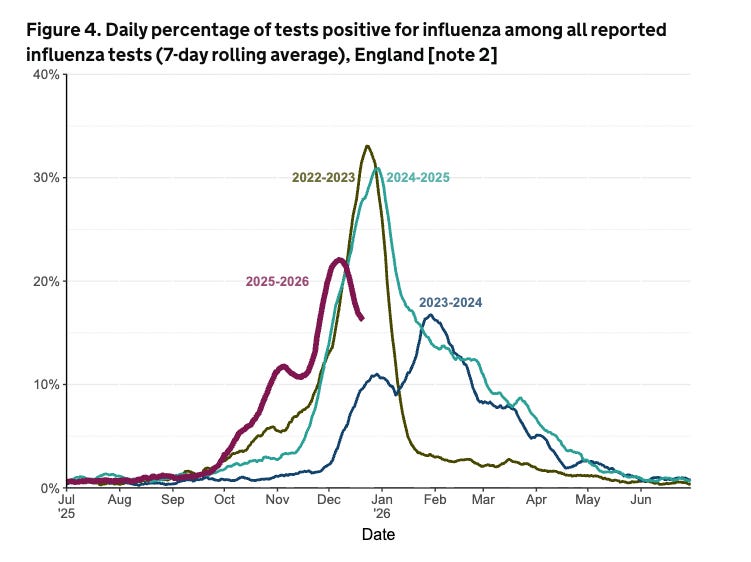
The so-called “superflu” didn’t vanish by magic. It burned itself out, like these things always do, once it ran out of easy pickings. Viruses aren’t clever strategists; they follow biology, not press conferences.
The data showed admissions peaking slightly early, then dropping steadily, even before the latest round of hand-wringing advice: no masks, no restrictions, no grand interventions required.
The trouble with the “superflu” predictions wasn’t the virus; it was the pundits. Every spike is now considered “exponential”, every winter “the darkest yet”, because fear makes better headlines.
When the data shifted, the media quietly dropped it without acknowledging it. No appetite for uncertainty, no patience for boring downward trends. And heaven forbid anyone says, “We got it wrong.”
When people look back at Sir James Mackey’s “superflu” predictions, the main criticism will be his bad assumptions.
The isolated asterisk appeared in the BBC on December 7th and was used by Mackey to make worst-case oracle-style predictions, treating a fragile input as a settled fact.
He said that by the end of next week, there could be anywhere between 5,000 and 8,000 beds occupied by “flu” patients.
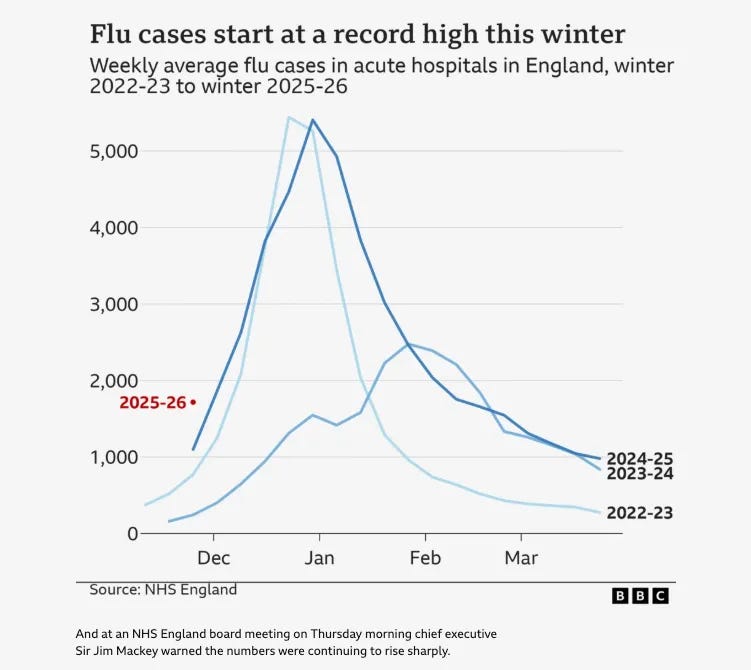
Even worse was Meghana Pandit’s, the NHS National Medical Director’s, prophecies.
She painted a picture of winter as a biblical deluge of “superflu”, yet official figures show that pressures were already high and part of a longer trend of busy A&Es and ambulance demand, not just this “flu” wave.
Pandit’s warnings also sounded like “worst-case scenario” talk rather than measured context, adding to the hype rather than grounding it in normal NHS winter strain and rising attendances for minor issues.
Pandit echoed the idea that “flu” alone was pushing hospitals over the edge, but the deeper, chronic pressures (staff shortages, long waits for community care, A&E performance below targets) were the real background problem.
Pandit chose sensationalism over sober explanation, and that’s why many readers ended up shaking their heads rather than trusting the experts’ soundings and the media rantings.
To regain credibility, Mackey and Pandit should have responded when the evidence shifted, admitting that earlier assumptions didn’t hold. That’s how trust is built. They should also stop focusing on raw case counts. Focus on severity, age mix, length of stay and capacity impact. A thousand sniffles aren’t the same as fifty serious admissions or 100 hospital-acquired infections.
Reaching straight for Ferguson-style worst-case models every time a “flu” wave coughs into view is how you turn yourself into a punchline. Worst cases have their place: in planning rooms, quietly, with the kettle boiling. The moment they’re used for publicity, they stop being science and start being theatre. And once that happens, nobody sensible is surprised when trust drains away faster than the crisis ever did.
We need less drama, more data, and a bit of institutional memory. We’ve all seen winters before.
This post was written by two old geezers who warned their readers as early as October that the bureaucrats were cooking something to distract the great unwashed.
The two old geezers would like to offer some parodied Bob Dylan lyrics: “Where are all the serious folk gone? Far far away…”
Dr Carl Heneghan is the Oxford Professor of Evidence Based Medicine and Dr Tom Jefferson is an epidemiologist based in Rome who works with Professor Heneghan on the Cochrane Collaboration. This article was first published on their Substack, Trust the Evidence, which you can subscribe to here.
To join in with the discussion please make a donation to The Daily Sceptic.
Profanity and abuse will be removed and may lead to a permanent ban.
You know the forecast will be political campaigning rather than real medical effort when everything is blamed other than the inefficiency and incompetence of the NHS, especially the better paid ones, among whom these forecasters are often to be found, methinks.
Reminder/revelation: Britain had a national health service established by the end of the 19th Century with nearly all the hospitals we have now, being established between the 14th and 19th Centuries, then 75% of the population was covered by private private insurance, the uninsured cared for by the voluntary sector, and community funding.
In 1948 the national health service – 2 753 hospitals, 480 000 beds was nationalised to become the State-run money-pit and sacred cow the NHS, the achievements of which are to have reduced the number of hospitals to 1 600, the number of beds to 145 000 and enlarged the waiting list from 400 000 in 1948 (0.75% of population) to 7 million today (11% of population) and staff it with cheap imported labour of dubious quality. We are told immigrants have made the NHS what it is today. No argument there.
Bang those pans.
The GP service has by now met its target set two decades ago to have at least 50% female doctors for political reason – now more than 50%. There is a chronic shortage of GPs – actually shortage of GP availability rather than numbers.
Any connexion, I wonder?
Almost all GP’s are not NHS employees, they are independent contractors working for the NHS. So for some reason, we don’t seem to be able to attract enough of these contractors to service the NHS workload, or the money is not attractive enough… or something else…
Pandit? Another Indian Oracle from the black hole of Delhi. Send it back. Tired of the hectoring from the reverse colonisers.
Flu season never existed before 1945 when the first quack shot came out.
Viruses? Try again. You don’t catch something that is fiction.
Sick from the shot and blame it on the ‘recombinant dead RNA in the plasmid case from a pig which mutates, flies, invades….?’ Bla bla bla
Aren’t strawberries sold in pandits – or is it punnets?
Any language pundits out there know?
Professor Panjit seems to be very well qualified indeed, having been an obstetrics surgeon and going onto management degrees to a high level. Unfortunate, like many other highly qualified people, she apparently knows naff all about public health, viruses, stats and modelling. It would help if these highly paid managers sorted out the shambles that is the Soviet National Death Service first, before screaming ‘we’re doomed’.
It’s always:
1.) Unprecedented.
2.) An especially dangerous new variant.
3.) Putting exceptional pressures on the NHS.
And it will be again.
It’s always…
Complete Bullshit.
It’s marketing and job justification… or BS as someone else rightly pointed out
dangerous variant, very dangerous variant, especially dangerous for the doomsayers and scaremongers whose predictions will not be fulfilled.
But how are they going to get more money out of us miserable plebs?
“If you would control a populace, first make them afraid”
I have not had a bad cold or bout of flu since COVID days, so what has changed? I started taking vitamin D supplements, and have continued with it, no thanks to the govt.
Never mind, there’s always next year’s super-dooper ‘flu to look forward to. Just like every year is “hottest evah!”