
The Screaming ‘Super Flu’ Headlines vs The Data
The latest headlines suggest we’re heading for a doomsday scenario: ‘NHS ‘facing worst-case,’ says the Guardian. ‘Super flu strikes during perfect storm,’ headlines Sky. A “tidal wave” says the Independent, and health chiefs have warned there’s “still no flu peak in sight“, reports the Mail.
Putting aside the media drivel, what do the data say?
The surveillance data up to December 7th paint a very different picture.
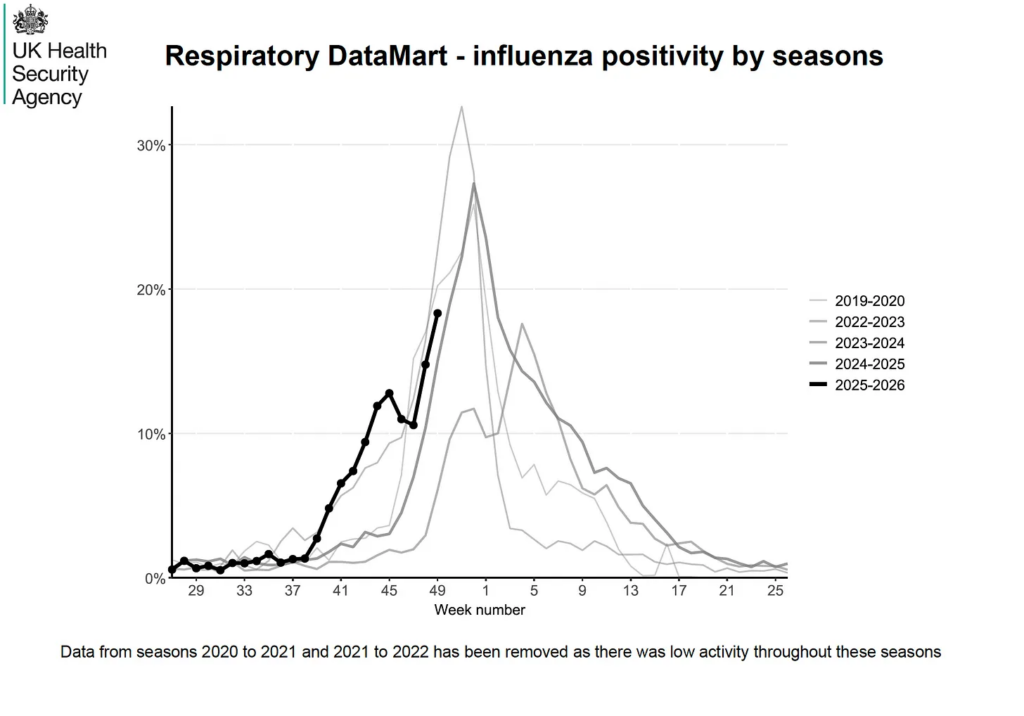
While many headlines are screaming that the ‘flu’ has come early, comparisons with the last two years indicate that it is within the range of previous years if you go back a little.
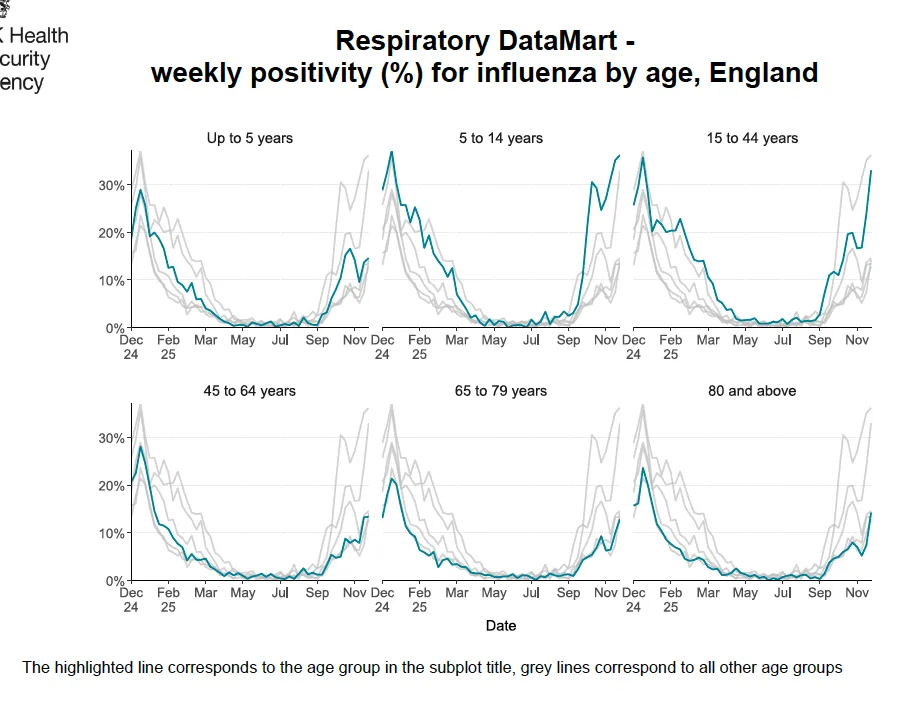
Looking at the data by age shows that the 5-14 year-old age group is the only one with positivity above the five-year average.
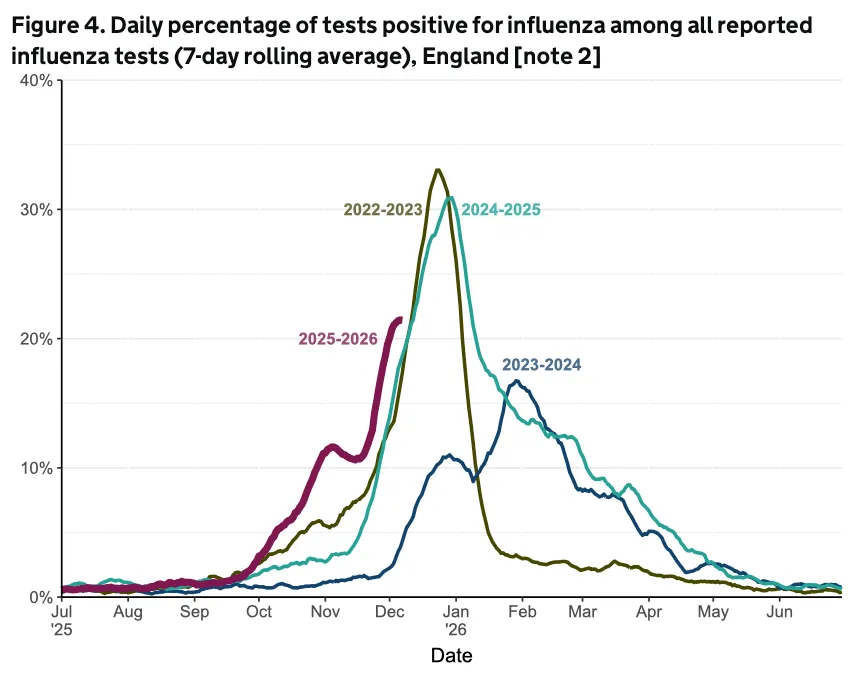
So, what about the end in sight that the NHS chiefs can’t see? If they examined the data, they might see that influenza positivity is flatlining. Students of Farr’s Law will know that what goes up must come down.
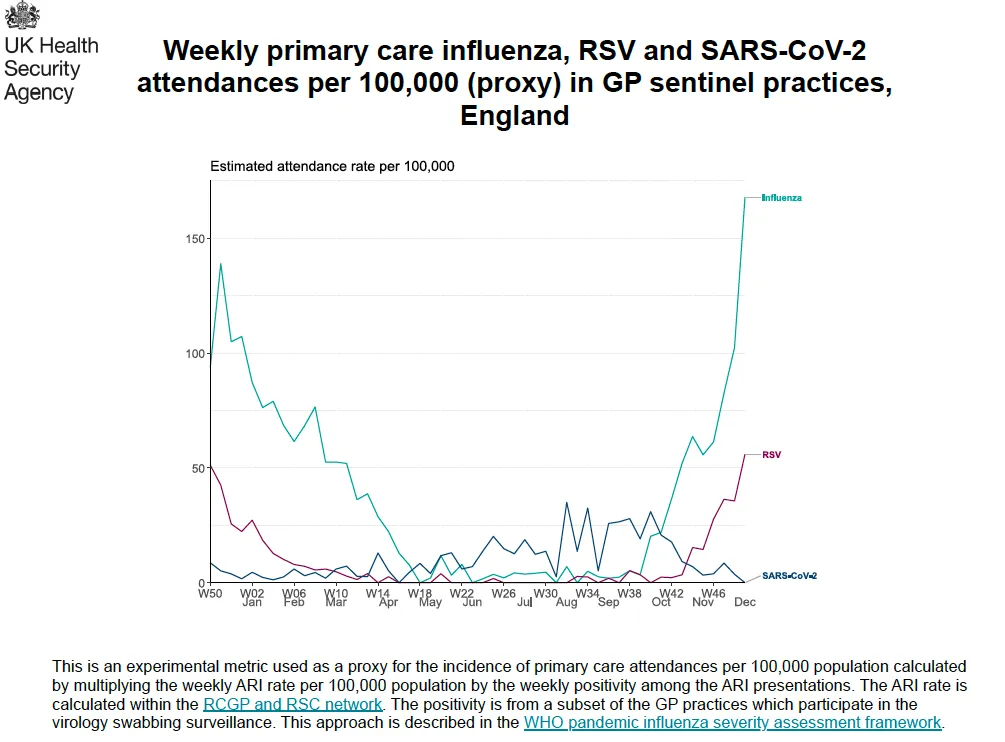
Weekly primary influenza, RSV and SARS-CoV-2 attendance data, per 100,000 people, provide a snapshot of community activity.
Within a specific GP sentinel system, very high consultation rates (more than 400 per 100,000 per week for influenza-like illness) serve as an operational signal of high activity – an epidemic. Current levels for influenza are well below this, around the 170 mark.
In Fleming’s ‘Lessons from 40 years’ surveillance of influenza in England and Wales‘, he presented weekly ILI rates per 100,000 from 1967 to 2007. From 1967 to 1986 there were six epidemics in which the weekly incidence rate of ILI peaked above 400 per 100,000. In the next 20 years (1987-2006), this rate was exceeded only once, in 1989-90.
Fleming’s surveillance work reported to us “that influenza activity is seen every winter, but its timing varies considerably”. Fleming notes that in the prior 20 years to his 2007 publication, some of the more serious epidemics peaked well before Christmas (1989-90, 1993-94, 1995-96).
Finally, as we turn to the hospital data, the situation becomes less clear. We’ve asked NHS England what the term ‘flu’ means in its hospital admission data. We’re still awaiting the answer. Our best guess is it’s a smorgasbord catch-all for respiratory agents and ‘influenza-like illness’.
The BBC reports “the numbers in hospital with flu is at its highest level at this time of year since records began – although they only date back to 2021”.
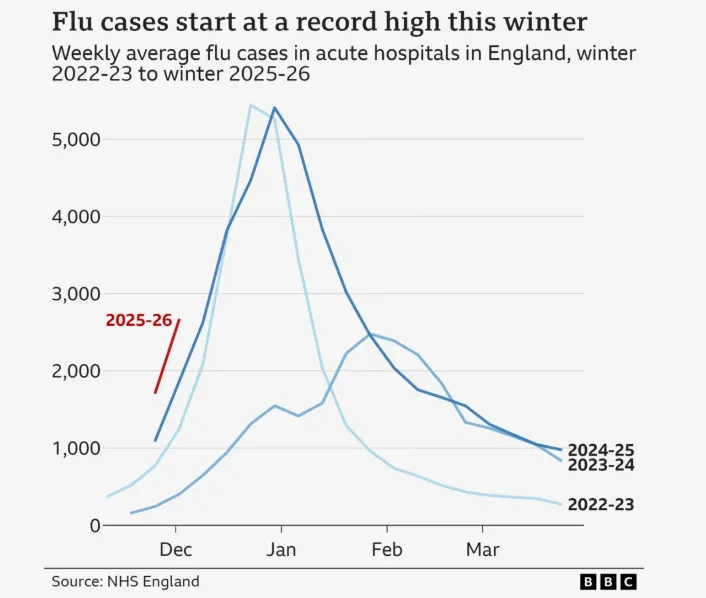
Oh dear, despite data dating back to 1969, ‘flu’ data began in 2021.
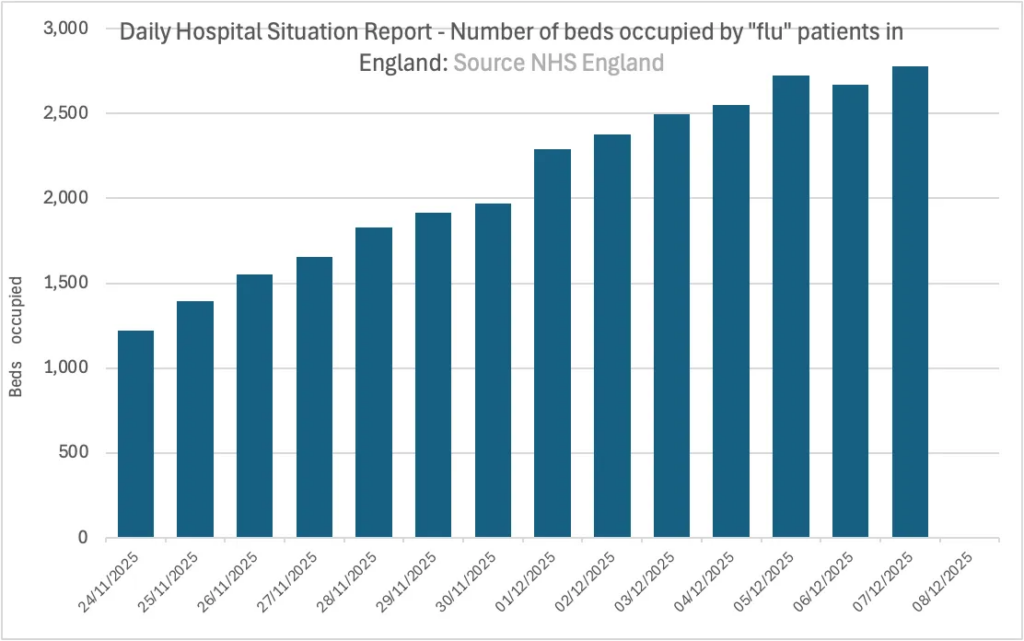
The latest data to December 7th shows that 2,781 patients were occupying beds with a label of ‘flu’.
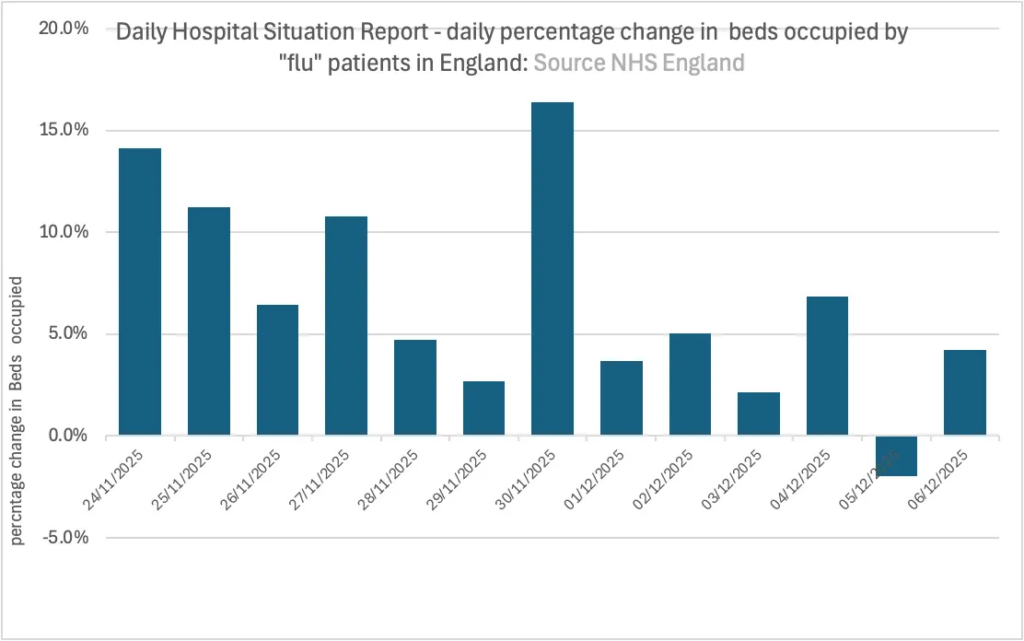
The key metric is the rate of change: values above the line indicate an increase in occupancy; values below it indicate a decline. At the moment, the rate of change doesn’t suggest anything concerning.
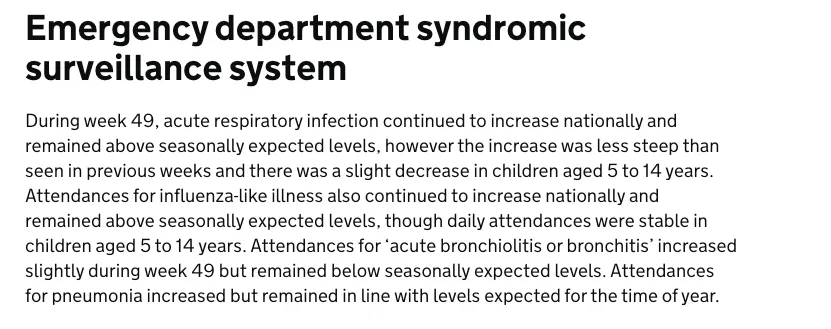
The latest syndromic surveillance data mirror this reflection:
The problem now, though, arises from how well hospitals can cope. Overcrowded, open-bay wards will ensure that hospital-acquired infections soar. As the community’s inevitable decline occurs, hospital data will lag, and cases will rise due to the inability to prevent transmission within hospitals.
This post was written by two old geezers who have serious problems reconciling the screaming headlines with the Government surveillance data.
Dr Carl Heneghan is the Oxford Professor of Evidence Based Medicine and Dr Tom Jefferson is an epidemiologist based in Rome who works with Professor Heneghan on the Cochrane Collaboration. This article was first published on their Substack, Trust the Evidence, which you can subscribe to here.
To join in with the discussion please make a donation to The Daily Sceptic.
Profanity and abuse will be removed and may lead to a permanent ban.
What goes round, goes round – 11 years ago to the day:
Hospitals struggling as winter hits…
https://www.bbc.com/news/health-30433575
“…With winter just getting under way, pressures are already reaching record levels.”
SMS – Short Memory Syndrome.
The trouble with annual flu emergencies is that they happen once a year.
…yet still surprise those that run the NHS.
Surprise? More like “give us more money”.
… which makes it damned difficult to see them coming and being prepared.
Much is made every year about the ‘flu’. I don’t doubt that there are admissions to hospital every year for diagnosed flu. But also mentioned in the article are ‘influenza-like illnesses’, many of which are self-diagnosed as ‘flu’ by the general public when in actual fact they are heavy colds.
You have a point, but I doubt (hope?) they’d not be in hospital
80:20 rule. Only 20% will be genuine.
Thank god for Drs. Carl Heneghan and Tom Jefferson. In addition to their wise words, you may want to follow Drs. Claire Craig and Karol Sikora. Both willing to explain the current flu situation in a calm and clear way, with the science to back it.
Hear, hear!
My daughter is a qualified nurse and she tells me that all hospitals are busy this time of year with seasonal flu. EVERY YEAR.🙄
Thank you DS.
It’s so refreshing to read something sensible each day.
There is a clear pattern of October to March peaking around early January, diminishing through the rest of January and February to very low level of activity by early March. This is the well-known, typical behaviour of seasonal respiratory viruses in the Northern Hemisphere – year after year it follows this timetable and trajectory. Two observations:- This is precisely the same travel of the SARS CoV 2 virus, meaning taking any action at all after, say, mid-January was superfluous. Lockdowns, etc in March was locking the stable door after the horse had bolted. Similarly starting a vaccination programme in January/February 2021 then claiming “success” as infection rate ebbed was just a lie. Given the known frequency of the Winter virus season, why are no preparations made ready to cope? There used to be isolation hospitals all closed by 2000. It cannot be so difficult to prepare temporary facilities each year for the duration in the same way the military establish temporary field hospitals. Maybe the military should be given the job. The problem is the cost. The Stare-run, State-funded Nationalised Health Service was never affordable, never practical. Time to abolish the NHS – replace it with private insurance and provision… Read more »
Nothing much ever seems to change. It’s that time of year again… The “media-driven scare story” season. Don’t get too close to the front page of the Guardian, you never know what you might catch!
Nothing new then…