There’s a Reason Britain’s in the Doldrums — but We Don’t Talk About It
Britain’s Covid hangover is wrecking courts, schools, NHS and wallets – and nobody’s really talking about it, says Josh Glancy in the Times. Here’s an excerpt:
As a society we have done our best to forget the pandemic, a trauma about which it is almost impossible to tell an interesting story. Yet with almost every dominant issue of today – from welfare spending to court backlogs, NHS waiting lists, school absenteeism and the national debt – the pandemic’s aftershocks are at or near the heart of the matter. …
Unless we stare back into the abyss of the pandemic, we miss something important about our current predicament. Covid did not create most of our problems, but it put rocket boosters under almost all of them, amplifying and accelerating longer-term trends.
Just look at the numbers. At the end of 2019, the backlog in crown courts was 38,000. By 2021 this was more than 60,000. It is now touching 80,000 – which is why some jury trials are now on the chopping block.
Persistent absence in British classrooms doubled during the pandemic, a problem that has now become chronic. Last week, Ofsted revealed that about 39,000 children in England are now entirely absent from education and a further 166,000 are “severely absent”, meaning they miss more than half their classes. …
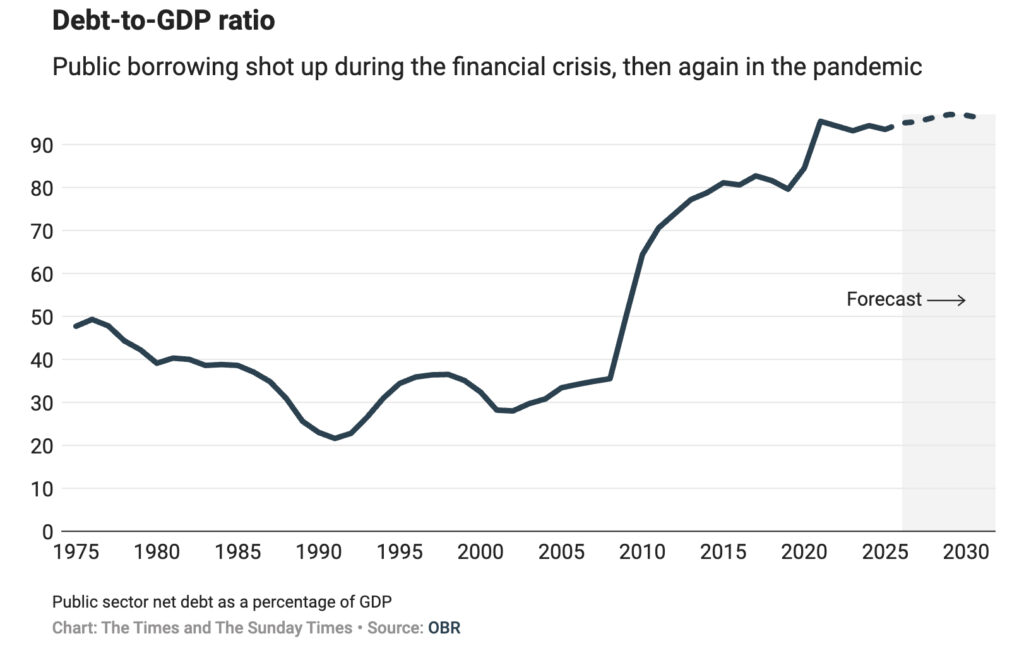
The impacts of Covid were also everywhere during the recent tax-raising budget, and yet barely mentioned. To pay for joys such as the test-and-trace scheme, Britain borrowed almost £300 billion more than usual. National debt as a percentage of GDP ballooned from 80% in 2019 to more like 95% by the end of 2021, where it has remained. As a result, we are paying £10 billion or so a month just to service the interest on it.
The soaring cost of disability benefits is perhaps the most alarming Covid aftershock. According to the Office for Budget Responsibility, the number of people newly claiming personal independence payments rose almost 100% from 2019 to 2022, from 175,000 to 348,000. New claims for incapacity benefits rose by even more in the same period, 111%, from 252,000 to 533,000. As of February of this year, 4.4 million people were claiming some kind of sickness benefit. …
During Covid, comparing ourselves with other countries became a national obsession. So it is also worth noting that some version of all the trends noted above has affected our international peers too. But on balance it seems Britain came out of the pandemic slightly worse off than them. Why?
Covid revealed that our state was in poorer shape than we had acknowledged, riven with co-morbidities and built on a vulnerable just-getting-by model; the NHS went into the pandemic with one of the lowest rates of hospital beds per capita in the developed world. …
There are two paradoxical conclusions that can be drawn from Britain’s Covid hangover. One is that we left our country far too vulnerable to external shock. The other is that we have become excessively attached to safety and too afraid of risk. …
Despite the pandemic’s continuing effects, it stays firmly lodged in our collective unconscious. But we should not leave it there. To paraphrase Carl Jung, until you make the unconscious conscious, it will direct your life — and you will call it fate.
To join in with the discussion please make a donation to The Daily Sceptic.
Profanity and abuse will be removed and may lead to a permanent ban.
22 Comments
Oldest
NewestMost Voted
Inline Feedbacks
View all comments
Claphamanian
4 months ago
This is surely in need of correction.
‘Covid’ caused none of these things. All this damage was the result of what the geniuses in government and their advisers chose to do and ‘get away with’. Otherwise you might as well assert that inflation is caused by the flight of birds over the Bank of England; or impaired infant speech development by polar bears shifting their position on the ice floes.
Very tiring but most of my friends just seem to want to forget the period. Talking and learning about it gets derision and rolling eyes. Much like it did during the “pandemic” if you questioned the narrative. I still say a horrible period of human history that’s going to keep PHD students busy for years.
For our great leaders the COVID Scam is the gift that keeps on giving. For example – court backlogs – where the “only answer” is to restrict jury trials. How convenient for our leaders.
But one has to look at the bright side of life.
Thanks to millionaire Sunak, the number of Billionaires in the UK went up from 147 in 2020 to a record 177 in 2022 before falling to 156 in the 2025 Sunday Times Rich List, partly due to a new non-dom tax status regime that prompted some wealthy individuals to leave the country. One of the top winners was Dr Charles Huang of Innova (sole supplier of rapid lateral flow tests for a time), who made about $2 billion in profits from UK Government contracts (though this has been subject to legal disputes and scrutiny over value for money).
I am looking forward to The Times next Rich List with their names.
The state sector caused this and their backlogs should be fixed by them. Overtime payments are not due because they all had an easy time when the private sector was laying off workers.
The private sector has no scope for backlogs. Any delay in meeting state imposed deadlines results in penalties.
I hasve a minor variation app[lication with my local authority but no reply since 19 September (Planning Portal says 6 weeks). My son has a pre-application with an East London borough which should take 2 weeks but no reply after 6 weeks, meanwhile he cannot invoice his client.
The country is a mess and widely depressed. All due to politiucal decisions taken over the past 15 years.
Gezza England
4 months ago
I would contend that the real reason we are in the dumps is because of years of socialist government.
On BBC radio 4 in July 2020 was an interview with a Ugandan Nurse. Here is a part transcript: Nick Robinson (BBC): It’s not very long ago that we were told that the coronavirus pandemic could have a terrible impact on Africa, a continent that has suffered terribly from the effects of Ebola and AIDS, but so far it has not turned out that way. First the picture on the ground in Uganda. A country that has so far recorded no deaths from COVID-19. I’ve been speaking to a nurse in a General Hospital in the Rakai district of Uganda; Maria Nekalanda: Maria: We really haven’t seen many patients of the symptoms of Covid. Like we have the measures in place, we do have the tests for outpatients that are coming in, but actually we have not recorded anyone. Nick: So, is it turning out to be nothing like as scary as maybe you thought it would be a while ago? Maria: Well, in the start we actually panicked. We were thinking, Oh my god, we are going to be the next dead people and it turned out that over time we stopped panicking and understood that probably this whole… Read more »
Covid didn’t create them …. the tyrannical response to a low-risk, respiratory illness did it. And the Tyrants did it deliberately.
Dnacam
4 months ago
All true of course, and all in pursuit of a virus which of all potentially fatal illnesses in medical history, took from its victims the lowest toll in life-years. (After some humming and hawing, ChatGPT admitted they could find no evidence to contradict this.)
But there is another, more serious, ongoing reason for our self-impoverishment: never in world history has a nation flourished relative to its competitors, without having access to cheap reliable energy, whether it be from human, including slave, labour or from fossil fuels. Mad Ed is of course beyond the pale, but he is encouraged in his lethal madness by the knowledge that there is still widespread support for the delusion that what he is doing is virtuous and right – only maybe we shouldn’t be doing it QUITE so fast.
“Covid did not create most of our problems” No Covid did not “create” anything it was a con. It was deliberate unnecessary and pointless government polices that created all the problems we have today. Why do we have to keep on pointing this out even in the Daily Sceptic? It’s very very frustrating.

To join in with the discussion please make a donation to The Daily Sceptic.
Profanity and abuse will be removed and may lead to a permanent ban.
This is surely in need of correction.
‘Covid’ caused none of these things. All this damage was the result of what the geniuses in government and their advisers chose to do and ‘get away with’. Otherwise you might as well assert that inflation is caused by the flight of birds over the Bank of England; or impaired infant speech development by polar bears shifting their position on the ice floes.
Quite so. So many of my discussions about the legacy of COVID-19 involve me saying “not the virus, the lockdowns” at some point.
Same here – gets tiring though doesn’t it…
Very tiring but most of my friends just seem to want to forget the period. Talking and learning about it gets derision and rolling eyes. Much like it did during the “pandemic” if you questioned the narrative. I still say a horrible period of human history that’s going to keep PHD students busy for years.
Three things?
For our great leaders the COVID Scam is the gift that keeps on giving. For example – court backlogs – where the “only answer” is to restrict jury trials. How convenient for our leaders.
Absolutely and so it goes on and on…..
‘You have to be in it to win it’
‘If you don’t bet, you can’t win’.
Government doesn’t bet, it simply confiscates the stake and keeps it.
“Pandemic”.
Sod off “Glancy”.
A sample article of his from back in the day: “Coronavirus: Donald Trump begins to wake up to the crisis with mass testing“
But one has to look at the bright side of life.
Thanks to millionaire Sunak, the number of Billionaires in the UK went up from 147 in 2020 to a record 177 in 2022 before falling to 156 in the 2025 Sunday Times Rich List, partly due to a new non-dom tax status regime that prompted some wealthy individuals to leave the country. One of the top winners was Dr Charles Huang of Innova (sole supplier of rapid lateral flow tests for a time), who made about $2 billion in profits from UK Government contracts (though this has been subject to legal disputes and scrutiny over value for money).
I am looking forward to The Times next Rich List with their names.
The state sector caused this and their backlogs should be fixed by them. Overtime payments are not due because they all had an easy time when the private sector was laying off workers.
The private sector has no scope for backlogs. Any delay in meeting state imposed deadlines results in penalties.
I hasve a minor variation app[lication with my local authority but no reply since 19 September (Planning Portal says 6 weeks). My son has a pre-application with an East London borough which should take 2 weeks but no reply after 6 weeks, meanwhile he cannot invoice his client.
The country is a mess and widely depressed. All due to politiucal decisions taken over the past 15 years.
I would contend that the real reason we are in the dumps is because of years of socialist government.
Indeed
Lockdowns were a symptom not the cause
Specialist subject missing the b. obvious five years and nine months too late.
Yes I don’t remember him piping up at the time – see my post further down
On BBC radio 4 in July 2020 was an interview with a Ugandan Nurse. Here is a part transcript: Nick Robinson (BBC): It’s not very long ago that we were told that the coronavirus pandemic could have a terrible impact on Africa, a continent that has suffered terribly from the effects of Ebola and AIDS, but so far it has not turned out that way. First the picture on the ground in Uganda. A country that has so far recorded no deaths from COVID-19. I’ve been speaking to a nurse in a General Hospital in the Rakai district of Uganda; Maria Nekalanda: Maria: We really haven’t seen many patients of the symptoms of Covid. Like we have the measures in place, we do have the tests for outpatients that are coming in, but actually we have not recorded anyone. Nick: So, is it turning out to be nothing like as scary as maybe you thought it would be a while ago? Maria: Well, in the start we actually panicked. We were thinking, Oh my god, we are going to be the next dead people and it turned out that over time we stopped panicking and understood that probably this whole… Read more »
To compliment the graphic showing Debt-to-GDP ratio, here is a graphic showing inflation related to the Lockdowns and Russia’s invasion of Ukraine.
They will not stop.
https://www.youtube.com/watch?v=55ry51M1PQ0
WHO launches plan to make the COVID emergency response permanent
“Covid did not create most of our problems,….”
Covid didn’t create them …. the tyrannical response to a low-risk, respiratory illness did it. And the Tyrants did it deliberately.
All true of course, and all in pursuit of a virus which of all potentially fatal illnesses in medical history, took from its victims the lowest toll in life-years. (After some humming and hawing, ChatGPT admitted they could find no evidence to contradict this.)
But there is another, more serious, ongoing reason for our self-impoverishment: never in world history has a nation flourished relative to its competitors, without having access to cheap reliable energy, whether it be from human, including slave, labour or from fossil fuels. Mad Ed is of course beyond the pale, but he is encouraged in his lethal madness by the knowledge that there is still widespread support for the delusion that what he is doing is virtuous and right – only maybe we shouldn’t be doing it QUITE so fast.
“Covid did not create most of our problems” No Covid did not “create” anything it was a con. It was deliberate unnecessary and pointless government polices that created all the problems we have today. Why do we have to keep on pointing this out even in the Daily Sceptic? It’s very very frustrating.