
Petrol Cars Now Cheaper to Run Than EVs After Tax Raid (Unless You Have a Driveway)
Rachel Reeves’s new pay-per-mile tax will make petrol cars cheaper to run than electric vehicles unless drivers have a driveway and can charge them at home. The Telegraph has the story.
Motorists forced to rely on public chargers will be left paying an estimated £290 more per year in running costs and taxes for their EVs compared to a petrol alternative, according to electric car advice site Electrifying.com.
Home charging is now a ‘make or break factor’ for electric car affordability following the planned introduction of Rachel Reeves’s pay-per-mile tax, which is intended to replace fuel duty.
The Chancellor confirmed last week that EVs will be subject to a 3p-per-mile levy starting in 2028.
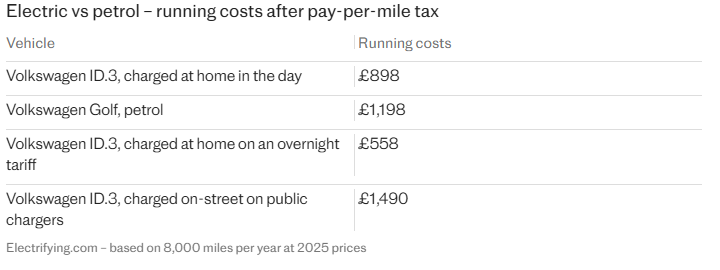
In the wake of the changes, Electrifying.com compared the cost of owning and operating an electric Volkswagen ID.3 with that of a petrol Volkswagen Golf, based on driving both for about 8,000 miles per year.
The electric car’s annual running costs would average about £898, compared with £1,198 for a petrol Volkswagen Golf, based on current prices.
However, drivers without a garage or driveway who rely solely on public charging would see their annual running costs rise sharply, to around £1,490. Approximately 30% of British households do not have access to off-street parking.
Drivers who can access a cheaper overnight rate when charging at home could enjoy substantially lower running costs, at £558.
Many drivers will likely use a mix of public and private charging, meaning they will be charged up to 60p per kilowatt hour (kWh) on public chargers for at least some of their journeys.
Plug-in hybrids, meanwhile, which will be subject to a 1.5p per mile charge from 2028, would become more expensive to run than a petrol vehicle if they are not regularly charged at home.
Worth reading in full.
To join in with the discussion please make a donation to The Daily Sceptic.
Profanity and abuse will be removed and may lead to a permanent ban.
These calculations don’t add the catastrophic depreciation of 70% in three years of some battery cars.
Nor all the other problems of owning and driving them. Nor the fact that – just as with all GREEN tech – most BEV drivers have a second, planet-destroying variety as backup.
Like having to hang around for hours at service stations if trying to go any distance…
Chewing through tyres.
What about TCO? Purchase price plus running costs? Resale value? Insurance? Servicing?
I’ve no idea about the latter two costs but I believe purchase costs are significantly higher? That is, until the quota requirements distort the market.
Then there are disposal costs when an EV reaches the end of its life.
Around £4,500 to “recycle” the lithium battery pack. Someone is going to be left holding the baby, and it is going to be expensive.
I scrapped a 1999 petrol car recently, and the scrappy paid me 80 quid.
Good luck to the first EV owners who have to scrap theirs!
I’m sure we’ll see a statistical uptick in the amount of EVs that mysteriously catch fire just before their owners needed to pay a fortune to scrap them… if not before!
Labour – for the many, not for the few
Just been taken from resort to airport in Mexico in a gigantic air conditioned gas guzzling Ford 🙂
I asked the driver about EVs. He doesn’t rate them and said not many people have them here
How long until TV adverts “Have you been missold an EV car ….” start appearing
I am looking forward to the adverts ‘Were you missold a government….’
Oh dear well we cannot have that then in the Socialist Republic of Britannia can we? We must always appear to be saving the planet harder and faster than everyone else and pretty soon the petrol and diesel cars will have more phony GREEN tax chucked at them, and ofcourse by the time we get to 2029 we will all be hammered with pulverising planet saving extortion.
Government idiocy shines through. Why charge EVs per mile and, presumably, have to set up a whole new bunch of expensive pen-pushers, when there’s an existing established system called Vehicle Excise Duty?! Just charge EV owners £360 a year (3p on 12k miles)
The reason is obviously to set up a system where we are all charged per mile. Yet more Government overeach. Yet more unproductive beauraucrats.
We have a 4 year old eC4. A doddle to drive. The real range on a very cold day is 112 miles.
We use it for local runs (which is the great majority of uses for a car).
We live 50 miles from a big city but wouldn’t use it for that as any delay/diversion would be a nightmare. We are lucky enough to also have a trusty old diesel.
I think our situation is the only sensible way to have an ev. However I have yet to find out the cost of replacing or getting rid of it.
“Home charging is now a ‘make or break factor’ for electric car affordability…”
The assumption here being that there will not be a special tariff introduced for home chargers. When I applied a couple of years ago for a new electricity supplier, one of the questions was did I have a home charger.
The roll out of “smart meters” or installation of specific metering equipment for home chargers makes this entirely possible.
However if – repeat if – home EVs and heat pumps do take over, local low voltage cabling and distribution equipment will not be able to handle the load, so it is likely local load-shedding will be required particularly at night when battery charging and heat pumping will peak.
That means batteries may not be fully charged ready for the next day.
There is a complete lack of looking at the whole picture regarding “decarbonised” electricity supply – the focus is entirely on replacing current fossil fuel generated capacity, not increasing deliverable capacity and distributing it from power station to point of use.
Add in the additional taxation for the luxury of buying a brand new ICE vehicle that costs more than 40k (every decent vehicle), we have just finished paying the excessive additional tax on a bought new Audi A5, hardly a ‘luxury’ vehicle, the whole pay per mile strikes me as red tape move, making vehicle use as bloody minded as general taxation, over complicated, confusing and always punitive!
Are we talking here of total running costs or just fuel? The costs of insurance, servicing and repair work, not to mention initial cost of purchase, are also a big factor in owning a car.