
In Praise of BBC Four – TV From When it Was Good
I have few vices left these days, but I will confess to just one that is of interest. Over the last year or so I’ve had an increasing attachment to BBC Four. Now, it might be my age, or a growing nostalgia (though I’ve always had that), but I think this is more a realisation of an objective truth: the programming of the past was simply better. Nothing radical there, as I’ve always (rightly) argued that about music, but I think my enchantment with BBC Four runs parallel with my disillusionment with the modern world, and particularly with what’s left of television.
By way of example, I’ll start with a travel programme from 1995 that I watched on Four recently. In it, the comedian Victoria Wood travelled by train from Crewe to Thurso, and then back again. 1995 was only 30 years ago, but it looked like a lost world. However, it was the presentation of the programme that confirmed just how must has changed in a few decades: dry, observational humour, no tension music, no politics, no agenda, just a well-made, intelligent and informative travelogue. The producers didn’t feel the need to constantly recapture the viewers’ attention, and the whole thing was a joy to watch.
In my capacity as a university lecturer I taught a course covering Britain from 1945 to 1979. I had long included a session where I covered the popular culture of the 1970s: literature, film and music. In terms of television, I looked with a vaguely humorous eye at children’s shows such as The Wombles (its early eco credentials duly noted), before playing it fairly safe with a section on the classic era of Morecambe and Wise and references to The Sweeney, The Good Life, Fawlty Towers etc. I also talked of the unifying effect of TV on social cohesion – the fact that everyone watched it in real time, had something to converse about the next day, rather than viewing in our individualistic, atomised pods like these days.
However, after increased viewing of Four, I began to develop the television stuff a lot more, launching a session I named ‘In Defence of the 70s’ and mounting a full-on celebration of the viewing of the era. Alongside the rightly lauded ‘golden oldies’, I pointed to a number of the great series of the era – Ways of Seeing, Jacob Bronowski’s landmark The Ascent of Man, Life on Earth, Play for Today, James Burke’s Connections – all monumental series, and educational, thought-provoking television for all, accessible, informative and entertaining. I would discuss David Attenborough’s tenure as controller of BBC Two from 1964 to 1972 and the programmes he commissioned in that time. Shows such Man Alive (sociopolitical documentaries), Chronicle (popular archaeology), The Old Grey Whistle Test (underground, album-based popular music), Monty Python’s Flying Circus and The Money Programme all flourished in the 1970s.
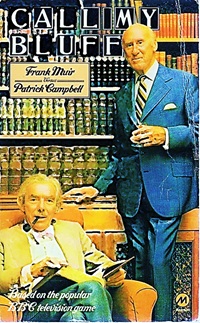
But it is Call My Bluff, the long-running panel show where two teams compete to earn points by identifying the correct definitions of obscure words – another Attenborough-commissioned show – that really excited my BBC Four obsession. I duly recounted it to students as an observation on the difference between then and the present day. But I also think that outside of the lecture room, there are lessons and observations here for all.
At nine o’clock on Monday nights, Four repeats classic episodes from the mid-1970s, occasionally wandering into the 80s. Presented by the unflappable Robert Robinson, the show is like looking through a window onto an old world inhabited by seemingly lost traits such as manners, erudition, wit and character; team captains Frank Muir (sporting a marvellous bow tie each week) and Patrick Campbell were two wonderfully humorous personalities, and the guests that appeared with them were equally funny and intelligent (recently I’ve very much appreciated appearances by the likes of Tom Baker, Jonathan Miller and Angela Rippon). All were well spoken, and no one talked or shouted over anyone else. Surely, these are qualities to aspire to? It is the anthesis of its contemporary descendant Would I Lie to You where every ‘bluff’ is predicated on a personal anecdote, with noisy ‘wacky’ interjections from other panellists. In comparison, Call My Bluff is a model of understated entertainment and, God forbid in the present day, maturity.
It is followed by selected episodes of the wonderful Face the Music, which ran from 1966-79 and was presented by pianist and broadcaster Joseph Cooper. A panel game show entirely devoted to classical music, it saw notable figures (rather than ‘celebrities’) set a series of challenges, all of which revolved around identifying musical extracts. In recent repeats, the likes of Attenborough, critic Bernard Levin and a young Arianna Huffington all took part.
There were several regular rounds, such as the crossword puzzle with musical extracts as clues. Another one was the video clip question where an opera was accompanied by music from a different opera and the guests were asked to name both. But my favourite is where the panellists had to identify a piece that Joseph Cooper played on a silent ‘dummy piano’, with only the sound of the clunks to work with. Could you imagine such a breadth of knowledge now? I saw a celebrity edition of The Weakest Link recently and one contestant couldn’t even answer the question “who was the British Prime Minister in the 1980s?” correctly, let alone identify Chopin’s Nocturne in D flat major played on a soundless keyboard.
Such ‘highbrow’ programming would now be considered inconceivable. The learned sophistication of the show would now be seen as too self-assured. But compared to the 1970s, our cultural content is narrower, simpler and far more concerned with the individual than a broader, collective content. Classical music was in fact far more prevalent 50 years ago; consider that in 1975 the Daily Mirror chose a showing of a Monteverdi opera (composed in 1640) as its TV choice for the August bank holiday. Or on a lighter note, who could forget Andre Previn’s appearance on the Morecambe & Wise 1971 Christmas show?
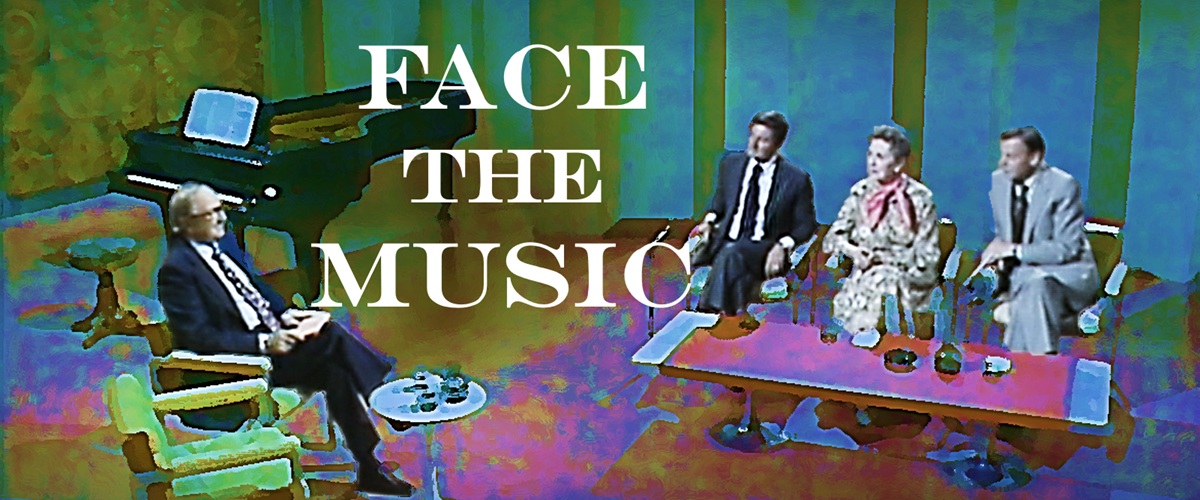
What has happened since with the ‘democratisation of culture’ is that anything considered ‘too clever’ or ‘elitist’ has been discarded and replaced by bland, conforming, populist viewing. But programmes such as Face the Music didn’t assume that the audience needed talking down to; the recent reruns have seen people recall memories of the show, impressed by the intelligence and knowledge on offer, and reminding us of a time when high quality cultural programming was the norm and not the exception.
The same is true of recent BBC Four scheduling. This autumn, the channel has shown many classic episodes of the documentary strand Arena; it is still broadcasting J.K. Gailbraith’s epic series on the history of economics, The Age of Uncertainty from 1977 and the wonderful 15-part Great Philosophers (1987) hosted by the great Bryan Magee. Magee was a philosopher, broadcaster, author and was also elected as a Labour Party MP for Leyton in the February 1974 UK general election – just the sort of character whose ideas I thoroughly agree with; he wholeheartedly believed in bringing education, particularly philosophy, to a popular audience through the medium of television.
Most recently, the channel has been broadcasting serious high-quality drama from the vaults. On Wednesday nights it has been rerunning the Screen Two series (a 1980s/90s continuation of Play for Today) with particularly enjoyable short introductions from producer, directors or actors involved with the original series. Notable titles that are thoroughly recommended (all are still available on iPlayer) include The Blue Boy (1995) featuring Emma Thompson, and The Firm (1989) with a young Gary Oldman delivering a virtuoso performance in Alan Clarke’s gripping drama about organised football hooliganism.
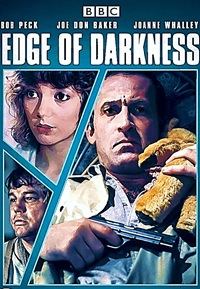
I also reserve a particular affection for Troy Kennedy Martin’s taut crime drama/political thriller Edge of Darkness (recently repeated on Four), featuring the late Bob Peck, Ian McNeice and Joe Don Baker. I remember it when it was originally screened, with its brooding score by Eric Clapton, and the esteem in which my parents held the series. Over the years, I’ve rediscovered it on DVD and consider it to be one of the greatest TV series ever.
Originally broadcast on BBC Two in November-December 1985, it achieved a viewing figure of around four million (roughly equivalent to the audience that watched the BBC’s coverage of the 2024 UK election), but when it was repeated in double episodes on BBC One, over three consecutive nights later that December – the fastest time between original broadcast and repeat in the BBC’s history – it doubled its audience to eight million viewers. And again, it’s hard to imagine such an involved drama being so popular in the present day. Viewers’ expectations have changed; it would also be considered too slow, too wordy, too un-diverse for a contemporary audience. Luckily, we still have Four to challenge these assumptions.
So, are these the ramblings of an old nostalgist, a paean to BBC Four itself, or a robust defence of education and good culture for all, à la Richard Hoggart or some such well-intentioned figure of yesteryear? The answer is yes to all. There has been (for many reasons) a change in viewing quality over the years; the internet and ever-increasing competition has seen programmers place ratings above anything else, and we have gone from four channels to an infinite number in a relatively short space of time. The adherence to ‘diversity’ etc. hasn’t helped, but nor has a cultural shift that promotes the individual, placing emotion and sensation over the erudite and cerebral.
But we are lucky to have BBC Four. If we find ourselves confounded by the present day, if contemporary programming is vapid and dull, there is an oasis that runs from 7pm to around 4am every night, a window to the old world, and a quiet treasure trove of glories, even if they are just former ones. I’ll meet you there later and bask in yesterday’s triumphs.
First published on Lion and Unicorn.
To join in with the discussion please make a donation to The Daily Sceptic.
Profanity and abuse will be removed and may lead to a permanent ban.
I’m reminded of this:
”There are dignified and excellent ways to behave and there are undignified and base ways to behave, and people who regularly do the former are better than people who regularly do the latter. And unless you believe that you’re going to have a vulgar society.”
https://www.youtube.com/watch?v=KvttIukZEtM&feature=youtu.be&t=2439
The late, great Justice Antonin Scalia on our age of vulgarity. Worth watching in full as is almost everything I’ve seen featuring him.
I often watch some BBC Four programmes as well. A lot of the content was made when there were only three broadcast channels, and with less than 24 hours transmission as well.
Archive footage made in house is probably good value for money, from their position, no doubt.
It likely is – how much have they made from classic comedies made in house on a shoestring budget, before too many accountants / highly paid consultants got involved and said we’d better outsource all that to ‘reduce risk’
I thought it was just me!
once a week I go through and set some records for interest bbc4 content, it’s the best of BBC from the past as discussed… it so much easier / more relaxing to watch programmes without lots of background music and a jump cut every 0.75 second to ‘keep the kids attention’ – long form YouTube is similar on some channels I subscribe to as well – quality content vs fluff and padding.
YouTube via the tv, with a 100% ad blocker, perfect – can get lost for hours
I remember waiting in keen anticipation & tension for each episode of Edge of Darkness when it first came out. I’ve recently also been gripped again by the repeat – we just don’t have that quality of TV writing, programming or production any more – or at least I’ve stopped even trying to find anything as it’s all too tedious & predictable & lightweight. The original House of Cards with Ian Richardson was pretty good too.
Both classics – Yes Minister another favourite, so true to life it’s scary
Perhaps one of the attractions back then was that ‘tele’-vison happened some safe distance away but you could view it in your own home, with others around you.
Nowadays we have ‘peri’-vision where the broadcasts are designed to draw you into the action and inspire immediate emotions and reactions. You could argue that with headphones or ear buds and a screen on your lap for broadcasts, films, and music many people are entertained with no link back to the outside world.
You’ve reminded me of the Bruce Springsteen song: ’57 Channels and Nothing On’.😁 Because that’s like the contrast between now and back then. I vaguely remember before Channel Four existed. Three channels and we always had stuff we enjoyed watching. Way before cable TV entered our lives and everything.
I used to really enjoy creepy stuff like Tales of the Unexpected, The Twilight Zone and Murder, Mystery and Suspense, when I was a kid. Those were the days before TV remotes, when you had to actually get off your bum to change channel or turn the volume up, though.
Also when Springsteen wasn’t a virtue signaling leftie twat!
To require the BBC to replicate those quality programmes would cause a major problem. The address books and university friends the current programme editors and producers have woiuld not include people of such ability.
The BBC has the same contact list as the Guardian and the Prime Minister: left, shallow and globalist.
As an example of how far the BBC have been captured by woke ideology a couple of days I watched the first episode of “civilisations: rise and fall” about the sacking of Rome by the Goths in 410 A.D. I don’t know enough history to say if the program completely rewrote history or just gave a very one sided view of it. The basic thesis of the program was that the Goths were unfortunate refugees who were allowed to settle in the Roman Empire but only on very poor quality land in the Balkans where they were treated as second class citizens which led them to rebel and ultimately sack Rome. The other thesis was that this was partly due to Honorius being a weak emperor and society becoming increasing unequal as the 1% accumulated most of the wealth and managed to find ways to avoid paying taxes. The BBC even went as far has having someone from a UN refugee agency as an “expert” as part of the program alongside the historians that always feature on these types of programs. The obvious alternative conclusion to draw from the known facts was that the Goths were invaders with their own… Read more »
An interesting and insightful article, with which I fully agree, and I shall even try to get over my aversion to the BBC and iPlayer in order to watch Edge of Darkness again. Just one small, very picky point: the first episode of Dr Who was first broadcast on Saturday 23rd November 1963, and was repeated the following Saturday: wouldn’t that make it “the fastest time between original broadcast and repeat in the BBC’s history”?
You can download a copy from a BitTorrent site – that way you can avoid BBC altogether. If you don’t want to get involved in the tech of that, buy a dvd copy from eBay for next to nowt and a cheap dvd player… no ads, you own the content and it just works… old skool 🙂
There are some great channels replaying shows from back in the day and sometimes giving you quite a shock. On RewindTV I came across a panel game show for comedians that included Les Dawson and David Nixon, and chaired by Barry Cryer. During the programme Barry Cryer was smoking a cigarette and there was an ash tray in front of David Nixon. More shocking to me than blacking up.
And Talking Pictures TV is great too for a trip down memory lane. Doomwatch was so phophetic for its age, and all the Gerry Anderson series take me straight back to my childhood.
I too have thoroughly enjoyed watching the old episodes of “Call My Bluff” and (especially) “Face the Music”. Grown up television.
There was a horrid series on BBC in 1970s called something like “Survivor” with the survivors living in the tube tunnels. Really unpleasant. Does anyone else remember it?
Agree, but Morecambe and Wise never did it for me, even in the seventies
I share Ben’s enthusiasm for BBC4’s exploration of the “back catalogue” from the 1970s. As he says, the programmes exhibit the sort of wit and intelligence aimed at a grown-up audience, that is just seen as too elitist for the main channels today.
However, I would like to speak up for some of the channel’s newer output too. BBC4 is generally the only place where I can find a “proper” documentary, starting with a brief exposition of the programme’s aims and objectives, then working through the evidence, before providing some kind of summary or conclusion. This simply doesn’t happen elsewhere, where factual programmes leap from one subject to another and then back again, presumably because the audience cannot be expected to concentrate on any one idea for more than two minutes. This, of course, brings with it all the necessary reminders of what we were told ten minutes ago, and the involvement of the general public in tests and experiments to add more entertainment.
Thank goodness BBC4 still has programmes for people who like to exercise their “little grey cells”!