
The Damning Moderna Audit Report That We’re Not Allowed to See
A recent UK regulator’s report on the culture, governance and compliance framework of pharmaceutical company Moderna has revealed “numerous and varied issues”. Is this company still a suitable choice for a multi-billion-pound mRNA vaccines ‘strategic partnership’ with His Majesty’s Government? Should it have been chosen in the first place? Why all the secrecy?
Earlier this year, the UK’s pharmaceutical industry’s self-regulatory body the PMCPA (the Prescription Medicines Code of Practice Authority) ordered a mandatory audit of the UK operation of the pharmaceutical company Moderna. The audit team was told to focus on the company’s “culture, governance and compliance framework” This audit was imposed following several months, indeed years, during which Moderna had been found guilty by the PMCPA of breaking the UK pharmaceutical industry’s Code of Practice on numerous occasions. These breaches came to light as a result of complaints about practices relating to the development and promotion of its mRNA Covid vaccines and communications with healthcare professionals and the general public about those vaccines. Many of these breaches were very serious indeed. They not only include multiple findings of misleading claims about the safety and efficacy of their vaccines, but also of permitting the offer of inappropriate payments to healthcare professionals and targeting advertisements at children. Also included were several findings in which the breaches were so egregious as to be deemed to have “brought discredit on, and reduced confidence in the pharmaceutical industry”.
Things came to head earlier this year when the PMCPA judged that Moderna had permitted the offer of illegal payments to children for participation in a COVID-19 vaccine study. The self-regulatory body subsequently discovered that Moderna had also misled it in the statements it had submitted in its attempt to defend this behaviour. Around the same time the PMCPA had also found Moderna guilty of concealing its involvement in newspaper and online articles written by a previous government vaccines minister Nadim Zahawi, extolling the virtues of how the Covid pandemic was handled and praising the role of the COVID-19 vaccines (the articles were co-written by a Moderna employee who was previously a member of the government’s vaccine taskforce). As a result of this litany of breaches of the industry code, earlier this year the PMCPA decided that enough was enough and took the unusual step of imposing an audit on Moderna. The audit was commenced in July this year and the top-line results have just been published as an addendum to PMCPA case 0316/10/24. Here are those top-line results from that audit. (I say top-line results; the truth is that the detailed results of the audit are unlikely to ever see the light of day in terms of being available for public scrutiny. Furthermore, the PMCPA is not a public body and therefore does not have to respond to Freedom of Information Act requests for information.)
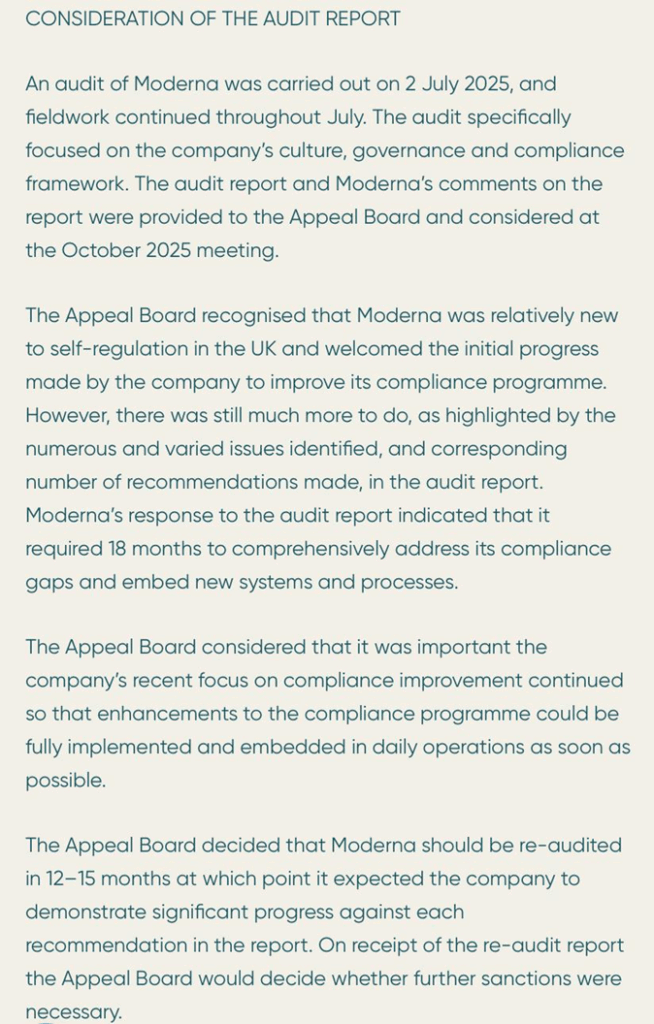
These Moderna cases and the audit findings are interesting in their own right, and particularly so for those of us who are still seeking to understand what exactly happened to the world during those Covid years and to learn from the experience. However, they are particularly interesting when one considers that Moderna is the UK Government’s chosen principal partner for the development and commercialisation of vaccines based on mRNA technology. Back in 2022, Moderna and the Conservative government trumpeted this new 10-year “strategic partnership” as a “major boost for vaccines and research”. However, anyone looking for more details as to exactly what this partnership entailed was going to be disappointed. The government press release announcing the agreement on the DHSC website concluded with the words
NOTES TO EDITORS: the details of the strategic partnership between the government and Moderna are commercially sensitive.
This partnership, entered into by Rishi Sunak, has been enthusiastically embraced by our current Labour Government. Earlier this year, Moderna and an impressive array of Labour politicians, Government advisors and civil servants lined up with Moderna Directors and employees to celebrate the opening of their new state-of-the-art mRNA facility in Harwell, Oxfordshire. Unfortunately, the secrecy surrounding the details of the arrangements between the government and Moderna remains impervious to enquiry. I myself have made an FOIA request of the DHSC for information about how much taxpayers’ cash and how many non-financial government resources have been promised to Moderna. I also asked for information on any regulatory concessions given to Moderna as part of this deal. The DHSC response was to admit that it had some of the information but refused to supply it, using what is called a section 12 exemption on the grounds of excessive costs associated with the search. When I significantly reduced the scope of my request and resubmitted, it was nevertheless still refused, again using a section 12 exemption.
Whilst the UK Government is stonewalling information requests, we may be able to get an idea of the kind of concessions which might be on offer to Moderna if we look beyond our shores. The UK is not alone in entering into partnerships with Moderna. Similar deals have apparently been struck with the governments of Canada and Australia. Last year, concerns were raised in Australia when it was revealed that, as a result of a deal with the Australian government, Moderna’s mRNA vaccines will be exempt from assessment by the country’s Pharmaceutical Benefits Advisory Committee. The switch to a seemingly parallel approval system just for Moderna, which had not been publicly explained, apparently raised concerns in the health sector. The Australian Moderna deal is currently the subject of an ongoing Australian National Audit Office probe which was announced in November 2024, the report of which is expected shortly.
Back to the PMCPA’s audit report. Even with an attempted gloss of mitigation due to a lack of experience of self-regulation, the PMCPA’s conclusions about Moderna are stark and damning. “Numerous and varied issues” were identified, and apparently Moderna’s response to the audit report indicated that it required 18 months to “comprehensively address its compliance gaps”. Eighteen months! That would put Moderna halfway through its 10-year deal with the Government. So, half of the timeframe of the deal will have been spent with the Government’s chosen partner having “compliance gaps” requiring significant improvements. What are the public to make of any outputs from Moderna in general, and Harwell in particular, during that time? Is our Government not worried by the damage these findings have done to the credibility of its ‘strategic partnership’? When it comes to this secretive deal, why should we now believe a word either it or Moderna says?
Although we are apparently not to be told exactly what they are, surely many of Moderna’s shortcomings in terms of culture, governance and compliance, which were identified in this report, should have been apparent when the UK government did its due diligence in advance of entering into this partnership with Moderna. Even if this was not the case, the company’s behaviour over the next few years, as evidenced by the number and seriousness of the PMCPA findings described above, should have triggered a whole parade of red flags for the government, and particularly the UKHSA which is supposedly responsible for managing this partnership on its behalf. The PMCPA’s Appeal Board decided that it did not want to wait 18 months for Moderna to close its “compliance gaps” but that it should be reaudited in 12-15 months, at which point it expected the company to demonstrate “significant progress” against each recommendation in the report. Notice that Moderna only needs to have made “significant progress” (what that means we have no way of knowing) and not to have fully achieved the required standard (but again, we have no way of knowing what that is either). On receipt of the re-audit report the Appeal Board will then decide whether future sanctions are necessary. What those future sanctions might be is not stated.
The British public now deserve to know more details about our Government’s deal with Moderna if both the Government and Moderna expect us to have any trust or confidence in anything coming out of Harwell once it starts conducting its clinical trials and trying to sell its mRNA vaccines (possibly as early as next year). This is particularly true when we now have a report – limited though it is – of a recent detailed audit, conducted by Moderna’s own industry self-regulatory body: a report which throws into question whether that company is, or ever was, a fit and proper commercial partner for His Majesty’s Government.
Dr Alan Black is a retired pharmaceutical physician, having worked in and for the pharmaceutical industry for around 30 years. Prior to that he spent a number of years in laboratory and clinical medicine.
To join in with the discussion please make a donation to The Daily Sceptic.
Profanity and abuse will be removed and may lead to a permanent ban.
I don’t care what Moderna do. I just don’t want them colluding with the government to set up yet another extorsion racket. We live within a massive network of mafias and enough is enough.
I’ve never had an mRNA vaccine and have no intention of ever having one. How many people will take the product given all the known side effects from the Covid ones?
A good question, but I fear we are not being told what goes into any jab, nor do we have any powerful voice on our side looking into them.
What amazes me is the number of medics taking these jabs.
I had occasion to briefly discuss vaccines a couple of years ago with a specialist practice nurse who was doing the annual review of my medication and health assessment, and had been tasked with the job of pushing the then new shingles vaccine. I declined and asked whether, as I had heard, increasingly all seasonal vaccines were now being manufactured under the mRNA technique. She reluctantly confirmed that just about all of them were. I have declined all vaccines since then.
A Google search indicates flu and shingles Vaccines are not yet produced using mRNA technology. However the mRNA versions are in clinical trials.
Animal “v a c c i n e s” too, both for pets and farm animals, or so I understand.
So don’t take them. The death toll for 2020 was exzctly what you would expect for a bad ‘flu season. Which is what it was.
Well, 90% of NHS staff have refused both the Covid and Flu jabs.
Financial services businesses regulated by the vindictive FCA have to be compliant at all times and from day one of registration. There is no honeymoon period. There is no reason a business in pharma should be allowed to breach regulations “because it was relatively new to regulation in the UK”. I am sure they have the resources and familiarity with not dissimilar regulations in other jurisdictions.
Just how long were they in breach – was it a few weeks or even months and did they act to rectify past breaches when they had become familiar with what was required in the UK?
One would have thoight that the risks from out of control pharma businesses were greater than a few errors in the provision of services on financial matters. In the latter case the Professional Indemnity insurance would kick in if losses were incurred by customers but ewrrors by pharma cannot usually be repared for any amount of cash.
FCA? Don’t make me laugh. Just ask anyone who lost money in Lindy, Funding Secure or other P2P platforms “regulated” by the FCA. Mutual back-scratchers.
That should’ve been “Lendy”, but the edit button has disappeared.
“trust or confidence in anything coming out of Harwell”– say no more, given the history of certain things that were developed in that location.
Well perhaps this article will make people who complained that organisations like the National Institute of Health and Clinical Excellence (NICE) and the Scottish Medicines Consortium (SMC) prevent the availability of ‘life saving medicines’ will realise that they in fact protect the British public from exaggerated claims by some in the pharmaceutical industry. Sadly they don’t review vaccines and we are paying the price for that.
The UK medicines regulator is the MHRA.
How does the ‘self-regulatory body’ PMCPA fit into this?
What authority do they have and by whom are these powers granted? To whom are they accountable?
As good as this is, we know from very bitter experience in the “Covid” era, most people don’t seem to care whether a treatment is safe or effective, they just need to be told it is, and that they must take it or die.
Dr black I was just wondering where you were when the unsafe and ineffective moderna vaxxes were released? Those doctors and scientists that did speak up at the time, lost their jobs, had their medical licenses removed. Did you speak up at the time when people were getting injured and dying pist vaxxes?
Who’s employed by Moderna these days – Witless? Unbalanced? Handcock? None would be a surprise.