
Ofgem Caught Using Climate Armageddon ‘Worst Case Scenario’ for Energy Planning
Are you familiar with the Peep Show episode when Jeremy whacks up the thermostat to 29°C?
Jeremy: I’m freezing. Let’s whack it up to 29.
Mark: 29 degrees, are you insane?
Jeremy: I don’t actually want it to be 29, but you’ve got to give it something to aim for. It’ll get hotter quicker.
Mark: No, it won’t, it’s either on or off. You set it, it achieves the correct temperature, it switches off.
Jeremy: Oh sure, you set it to 23, it’ll be pootering along, ‘Oh yeah, 23, easy. Yeah, nearly there.’ Wouldn’t you rather ‘Fuck! 29? Christ, let’s get cracking, got to generate some serious heat!’ Then when it hits 23, we’re suddenly all like ‘Click. Sorry. Already there.’ And the boiler will be like ‘What the fuck?’
Mark: You want to try to trick the boiler?
I only ask, because Ofgem, the UK’s energy regulator, appears to be using Jez’s logic as the guiding principle behind the targets it’s setting for the Distribution Network Operators (DNOs, the companies that distribute electricity around the country) in the public consultation that forms part of the ‘price control’ mechanism for 2028-33 and sets the charges associated with network costs for that five year period.
Comically, Ofgem requires the DNOs to develop their future plans under the assumptions of RCP8.5.
RCP8.5 is the IPCC’s worst case future climate change scenario. Back in June, Chris Morrison, of this parish, wrote a comprehensive demolition of its continued use by climate alarmists despite, as Roger Pielke has noted, even the Biden Administration abandoning it back in 2022 on the grounds that it was ludicrous.
As Chris Morrison points out, RCP 8.5 assumes a 4°C increase in temperature by the end of the century, despite temperatures barely rising by 0.25°C over the past 25 years. Additionally, RCP 8.5 anticipates dramatic rises in world population (which isn’t happening), substantially higher GDP growth than we’re seeing and dramatically increased use of coal, coupled with precious little adoption of renewable energy. As the table below illustrates, these concerns are alarmist nonsense.
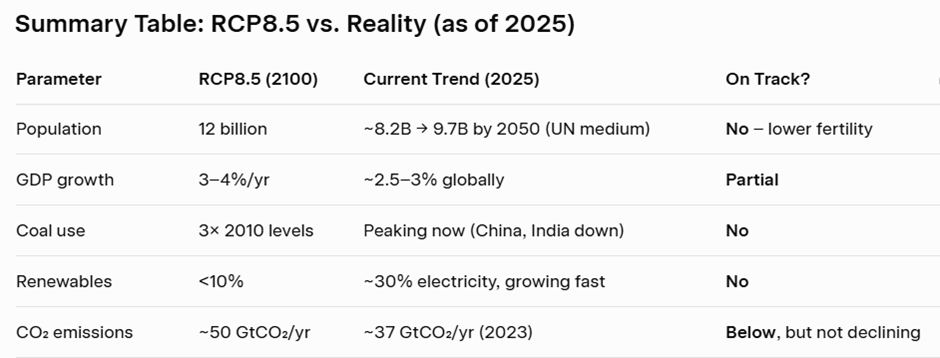
Maybe Ofgem is right to follow Jez’s approach? What could be the downside to gunning for the unrealistic targets of RCP8.5? Well, increased upfront costs is one such downside. Pylons have to be made sturdier, the cables strung between them more robust, infrastructure on the coast must be moved further inland or uphill to avoid inundation, and there must be mitigation of theoretical storm damage.
Ofgem recognises that RCP8.5 looks increasingly improbable as trend lines refuse to do the climate alarmist’s bidding. However, the justification boils down to over-erring on the side of caution. But, of course, it’s us, the tax- and bill-payers who have to stump up for the inflated costs.
However, it isn’t only in landing us all with higher infrastructure costs that Ofgem seem to be acting in a cavalier way with our money.
The five-year period running from 2028 to 2033 covers one year prior to the 2029 General Election and four years afterwards. Given that the current Labour Government is plumbing new depths of unpopularity and that its main rivals, Reform and the Conservatives, have both promised to undo much of Ed Miliband’s Net Zero strategy, wouldn’t you think that Ofgem would require the DNO’s to come up with a ‘plan B’, one that lays out how its strategy could be unwound at the lowest possible price should government subsidies be scaled back?
While no government should be able to tie the hands of a future administration, it seems that Miliband’s Net Zero zealotry may result in long-term contracts being awarded that commit both the contractor and the taxpayer being on the hook for years to come, regardless of likely changes to government policy.
In the event that our monthly utility bills under a Reform or Tory administration continue to get lumbered with the costs that are earmarked for the myriad subsidies and other payments to bring about Net Zero, I suggest that such costs are clearly itemised on each householder’s bill and labelled as ‘Labour legacy charge’.
Once billpayers recognise the proportion of their energy bill that is propping up Miliband’s (and May’s, Johnson’s, Sunak’s) vanity projects, the prospect of a return to the path to Net Zero may recede even further into the future.
The consultation is open until December 17th 2025, and Ofgem tells us that it’s keen on getting responses from members of the public. I for one would encourage you to respond to the consultation suggesting it tones down its climate alarmism and not make it any more difficult than it already will be for the next government to slow down the job-destroying, bill-inflating pursuit of Net Zero. Governments are supposed to serve the people.
To join in with the discussion please make a donation to The Daily Sceptic.
Profanity and abuse will be removed and may lead to a permanent ban.
“…long-term contracts being awarded that commit both the contractor and the taxpayer being on the hook for years to come, regardless of likely changes to government policy.”
My understanding is no contract can be enforced if a Court deems its provisions to be unreasonable or detrimental to one of the parties. (Any lawyers out there care to comment?)
However. Reform UK could cancel the contracts and say, OK sue the Government. The unreluables, unsustainable supply brigade would then have to explain in Court they need the contracts and their taxpayer subsidies and inflated above-market prices pushing up consumer bills to prevent them going bankrupt, and their shareholders losing their investment.
Now wouldn’t that go down well in the court of public opinion? You the public must continue to be robbed to fill our shareholders’ pockets.
However electricity generators operate under licence, so wind/solar licences could be cancelled. And, currently gas and nuclear are required to withdraw from the grid in those periods when wind/solar can supply.
Gas and nuclear can supply demand, so if that condition were removed, wind and solar would not be required or able to sell to the grid as they both cost more.
If Reform cancel the contracts that wind/solar farms have and scrap the guaranteed minimum price it’s bound to end up in court. A lot of the time the personal views of judges seem to be more important than legal details so there’s no way of telling what the outcome will be.
Reform will have to remind woke judges/continually ram the point down their throats, that Parliament makes the rules not the courts and be prepared to ignore numerous high/supreme court rulings on environmental issues and immigration.
From Jan 2020 just before the world went to shit.
https://www.bbc.co.uk/news/science-environment-51281986
The worst-case scenario for emissions of CO2 this century is no longer plausible, say researchers.
A perfect example of what Thomas Sowell warned of over 20 years ago. Polices based on ‘fashionable exaggerations, ideological zeal and self righteous ignorance’.
I clicked on the ‘consultation’ link and it gives you links to lots of documents…. As a normal pundit I would not know where to start.
They do say they like to hear from consumers. Do we just send them an email?
So I sent them an email, based on my limited knowledge as an energy consumer….
”Dear team,
Since you asked for views from the consumer, I would like to respond.
The current energy bills are eye-wateringly high. Some of this is caused by fixing prices rather than following market prices and some of this is caused by adding subsidies for renewable energy on the basis of the idea that climate change is caused by the use of fossil fuels.
The problem with renewables are that they are unreliable and don’t give us energy when there is no wind or sun. Further problems are the lack of energy storage (current battery technology) and the need for back-up systems.
In my view the whole NetZero needs a major rethink and the idea that prices will be fixed on flawed assumptions into 2033 fills me with dread.
I would urge you to closely look at the basis for these prices and also make sure we maintain flexibility rather than fixing prices long into the future.
Kind regards,”
Every day I feel more like a ‘lady who writes letters’…😂
Well at least the Conservatives or more likely Reform will when they get into government be able to truly state that high electricity prices are “due to the previous government” and their approach to lumbering us with unaffordable energy prices to keep the phony planet savers at the UN happy and to make sure our standard of living plummets in line with UN/WEF Sustainable Development goals. —In short our own government is hanging us out to dry, forcing millions into energy poverty, and trashing the Industrial Base. It is infact a SCORCHED EARTH ENERGY POLICY
“Due to several previous governments”. Starting with Tony B.Liar and his fellow travellers in George Soros’ pocket.