
The False Temperature Claims That Underpin the COP30 Alarmist Agenda
The next two weeks of COP30 will see three favourite climate scares relentlessly broadcast to promote the fast-fading hard-Left Net Zero fantasy. They are: breaching a 1.5°C global ‘threshold’ leading to runaway temperatures; human-caused tipping points producing unimaginable natural disasters; and attribution of single-event bad weather to the use of natural hydrocarbons. The 1.5°C figure is a meaningless number invented by politicians and activists to concentrate Net Zero minds; tipping points are climate model codswallop; and ditto attribution crystal ball-gazing. None of them are backed up by credible scientific evidence and observation. Which of course is why political elites have trashed the scientific process of inquiry, banned and cancelled any dissenting discussion and declared the matter ‘settled’.
The foundation scam is temperature. The world is said to be warming dramatically, leading to tipping points and worsening extreme weather. Changes are said to be occurring at unprecedented rates and are caused primarily by humans increasing atmospheric levels of carbon dioxide. In fact the temperature rise is small, about 1°C over 200 years (making allowance for all the fake temperature estimates and urban heat-ravaged measurements) and similar rises are commonplace in both the historical and paleo record. The recent ‘hottest evah’ rises have been seen in the past – sudden changes in temperature are caused by sudden local events such as volcano eruptions. As it happens, the underwater Hunga Tonga volcano released vast quantity of water vapour into the upper atmosphere in 2022, a ‘greenhouse’ warming event that would have been helped along by a recent strong El Niño oscillation. Recent accurate satellite measurements show the overall global temperature has been falling during 2025.
Don’t take my word for all this natural movement. Professor Mark Maslin is a Professor of something termed Earth Systems Science at UCL and one of the authors of a recent tipping point report timed for COP30. This particular computer model-based bilge suggested that warm water corals may already be crossing their “thermal tipping points”, despite the fact that coral has been around for hundreds of millions of years and survives in waters between 24-32°C. This would appear to be the same Mark Maslin who as a humble geography lecturer in 1999 wrote a paper that said possibly most of the large climate changes involving movements of several degrees occurred at most on a timescale of a few centuries, sometimes decades, “and perhaps even a few years”. These days he whines that “Earth is already becoming unliveable”, while climate change politics helps build “a new political and socio-economic system”. In 2018, he was one of a number of eco-activists who signed a letter to the Guardian saying they would no longer “lend their credibility” by debating climate science scepticism.
No wonder people like Maslin – needless to say a BBC regular on all learned climate Armageddon matters – walked away from climate science debate. Tying CO2 levels to rising temperatures to make Left-wing political capital relies on observations from just a few recent years. Widen the observations out to hundreds and then hundreds of millions of years gives a different picture. Sometimes temperatures rise and fall at the same time as CO2, sometimes not. Sometimes even CO2 levels rise before the following temperatures, more often than not they don’t. The simple explanation that warming gases such as CO2 become ‘saturated’ once they pass certain concentrations, with heating falling off a logarithmic cliff, is a scientific hypothesis or opinion, but it has much to offer when past observational evidence is considered.
Let us consider some of these observations starting with the long term record over 600 million years. The graph below shows wide temperature-CO2 divergence.
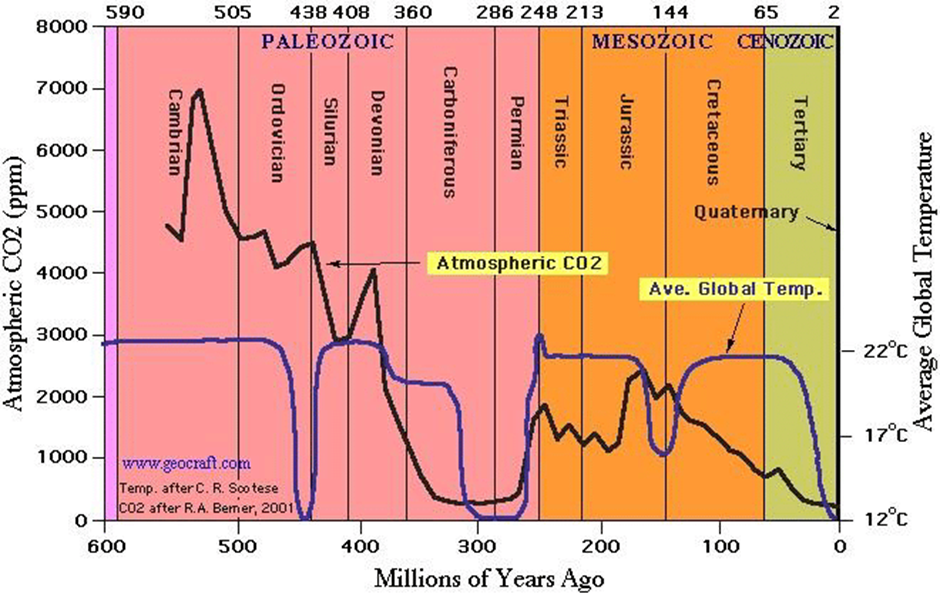
Over 600 million years it is difficult to observe any general lockstep connection between temperature and gas. It might, however, be noted that over 600 million years, CO2 has generally been declining in the atmosphere to the near denuded levels seen today. As we have seen over the last 40 years even small rises in CO2 lead to significant planet-wide biomass growth. All that CO2 was good for the dinosaurs who roamed the Earth until 66 million years ago, with levels more than three times higher than today. The little extra has also been good for humans since recent crop yields have soared and helped to alleviate naturally-occurring world famine.
These records of course are very long term and are compiled from proxies with accuracy only to a few thousand years. In the more immediate record we find additional and conclusive proof that CO2 is not the main climate thermostat. Temperatures in medieval times were similar to today, possibly slightly higher in the Roman period and often 3-4°C higher in the Holocene thermal maximum around 8,000 to 5,000 years ago. During these periods, CO2 was remarkably stable around 260 parts per million, a mark that is in fact dangerously low to sustain life on Earth. The notorious Michael-Mann-1,000-year temperature ‘hockey stick’ removed the linking problem by abolishing the medieval warming period and the subsequent little ice age that ran up to around 1800.
Remarkable recent scientific evidence has emerged to suggest that abrupt rises in temperature have been a feature of the global climate going back to the iceless Jurassic period over 150 million years ago. Dramatic temperature changes based on 1,500-year cycles, as the younger Maslin can testify, have been known to have occurred in Greenland and the North Atlantic. But a group of French scientists led by Slah Boulila from the Sorbonne found large temperature hikes going back millions of years across the globe. The scientists noted warming up to 15°C within a few decades, “pointing to abrupt and severe changes in Earth’s past climate”. The 1,500 year cycles are often called Dansgaard-Oeschger (DO) events after the scientists who discovered them. Some scientists have downplayed the initial DO findings and suggested the short term temperatures rises of around 1.5°C were caused by specific northern hemisphere oscillations of ice sheets and surrounding waters.
However, the French scientists note: “The 1,500-year cycle is documented in both hemispheres, in other oceans and in continents.” Their work is said to support the global nature of DO-like events, and in particular that their potential primary cause is independent of ice sheet dynamics. Meanwhile, scientific evidence continues to grow indicating much higher temperatures a few thousand years ago. One recent paper found the plant Ceratopteris had grown 8,000 years ago at 40°N in northern China, suggesting winter temperatures 7.7°C higher than today. Another found types of molluscs surviving in the Arctic Svalbard 9,000 years ago that indicated temperatures were 6°C warmer.
The current Net Zero fantasy rests on catastrophising tiny temperature rises that frankly are not even measured properly, demonising CO2 boosts that are helping Earth return to a more healthy biosphere and atmospheric balance, inventing ‘tipping points’ using junk computer models and insulting the intelligence with untestable tales claiming humans are making the weather worse.
And they call us sceptics the ‘deniers’.
Chris Morrison is the Daily Sceptic’s Environment Editor. Follow him on X.
To join in with the discussion please make a donation to The Daily Sceptic.
Profanity and abuse will be removed and may lead to a permanent ban.
The global average for 2024 was just over 15C. The graphs appear to show a natural limit of 22C. We have a long way to go before we start to trouble that, and life has thrived throughout .
The global average (temperature) is a meaningless piece of statistical fiction. Temperatures vary wildly over all of the planet depending on location, season and still mostly unpredictable local weather events.
An increase in global average temperatures means “it was warmer somewhere¹” not “it was warmer everywhere.”
¹ In some place where this happened to be measured. In reality, only a very tiny subset of the surface of this planet is covered by temperature measurement stations or satellites at any given time. This means we don’t even know the temperature of most places on earth, have never known them and likely, will never know them.
And being an average, not only can it mean it was warmer somewhere, but also colder somewhere too, but balancing off the changes was slightly positive.
Nonsense, not science.
That’s obviously true. But what I was trying to get at is that the average wrongly distributes the one warmer value all over the global (mathematically spoken) despite it was only one value. I’ve intentionally used the most simple case as example for that.
Is there a ”tipping point” tipping point or Peak Tipping point?
What is hilarious, is the raw temperature data is only accurate in aggregate to +/- 5 degree because of the inaccuracy of so many of the instruments, which are not calbrated to a common reference instrument as should be the case in science. Then these temperature are averaged which is sure to introduce fractions, and finally they proclaim derived temperature changes of tenths or hundredths of a degree – the output having gained an accuracy not present in the input data.
It’s science Jim, but not as we know it.
In theory, averaging can increase the accuracy of something which was measured because random errors in the measured values will tend to cancel each other out. But his requires that the same quantity is measured each time and measured using the same instrument. It’s meaningless nonsense for temperatures measured at different times in different locations using different instruments because these don’t all measure the same quantity and thus, produce values which differ only in measurement error.
Very simplified description of the theory behind this: Let’s assume some measurable quantity m is measured. The outcome will be a value m’ which is composed as follows:
m’ = m + Es + Er
That is, the actual quantity m plus some systematic error cause by deficiencies of the measurement instrument (Es) and plus some random error (Er) caused by circumstances we don’t know anything about. As Er is random, it’ll differ for different measurements and will tendencially as likely be positive as negative and hence, Er will tend to disappear/ become smaller the more m’ are added to each other. Because of this, a sum m’₁ + m’₂ + … + m’n divided by n will be a likely be a better approximation of m than the individual m’ were.
Well explained RW.
However, since systematic error, Es, can be of the order of ±2°C to ±5°C it is meaningless to present global average temperature to one or two decimal places.
Another excellent rational article.
Fight! Fight!
Meanwhile our own HRH Midwit is busy impersonating Greta Thunberg in a specially flattened area of the Amazing rainforest. CMTSU
The climate change issue is an easy one for people like Kings, Princes and Popes to be involved in. Those who organise their calendars must see it as a safe area in which they can address their citizens while appearing like anointed ones who are here to save us from ourselves. They are able to get away with this because most of the people are unaware that climate change politics is actually a classic grift.
Arctic ice at an 11 year high.
I heard yesterday that there are 470 delegates going to COP30 from the UK alone – costing us £Ms. This despite the fact that the USA and China (who might presumably be able to make a dint in CO2 emissions even if you believed they are a problem) are not represented at all. COP is a complete waste of time and money, nothing is ever achieved by it except perhaps giving the thousands of delegates a jolly good free holiday and providing employment for locals who serve them with food and drinks.
What makes the climate scam so effective is that it is unchallengeable. A problem gets identified that cannot be shown to exist, and a Political Class comes along and offers a solution. They then provide no evidence that the problem is the crisis they claim and insist the solutions are adopted, with no discussion of cost/benefit, no debate and no vote. Then when all the predictions and projections fail (as the always do) they never review the solutions, they double down on them. The scam works because it pretends to be about the planet, and who could complain about looking after the planet? Anyone who does complain can be easily shouted down as uncaring, and has no concern for future generations and debate is halted before it can start. So what started out as concern about possible effects on climate has now morphed into a global control system. Those who play game are rewarded and those who don’t are silenced, punished and barred. But the scam keeps moving the goalposts just far enough away so no one can know if the misery and impoverishment they are facing is really doing any good. The beauty of claiming something to be a… Read more »