
Oatly CEO Admits ‘Climate Doom’ Marketing Has Backfired as Sales Plummet
Oatly, the Swedish oat-milk darling once hailed as the future of ‘ethical capitalism’, has finally said the quiet part out loud. In its latest earnings call, CEO Jean-Christophe Flatin admitted that the company’s climate messaging had backfired. Years of what he called “doom and gloom” talk about sustainability have left customers feeling fatigued and even hostile to the prospect of purchasing more sustainable products. Sales in the US, Oatly’s biggest market, have dropped considerably. It turns out that terrifying people into buying oat milk isn’t a sustainable business model.
For years, Oatly has treated advertising as a form of activism. Its billboards didn’t sell a product; they scolded a population. “It’s like milk, but made for humans,” sneered one campaign. Others warned of environmental collapse, animal cruelty and corporate greed. It was less about oat milk and more about moral superiority.
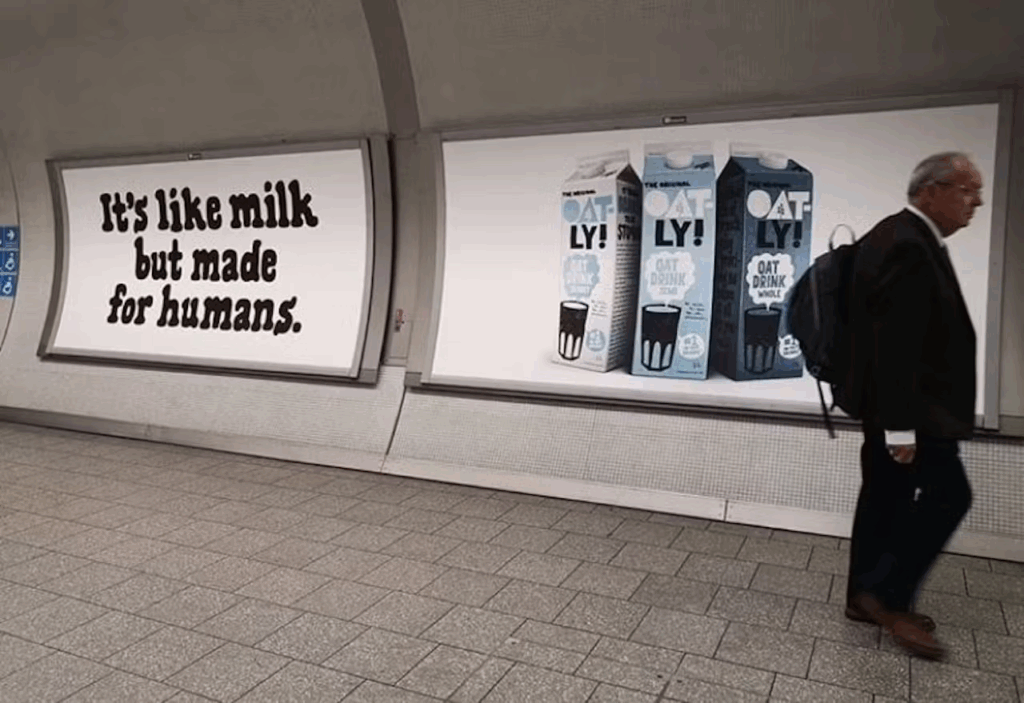
The truth that marketers can’t face: no one wants to be lectured by their latte. They’re tired of the sermons, the hashtags and the ‘save the planet’ self-importance. They just want something that tastes decent, doesn’t cost a fortune and lasts longer than the walk home from Tesco.
And let’s be honest, even if you did buy the moral lecture, you might not survive the product. Oatly is made with industrial seed oils, emulsifiers and synthetic vitamins that your grandmother wouldn’t recognise as food. These so-called ‘plant-based’ concoctions are a triumph of marketing over nutrition. There’s more chemical engineering in a carton of oat milk than in a can of engine oil. Instead of preaching about saving the planet, Oatly might start by worrying about the health of the people drinking its product.
The industry’s justification, of course, is ‘the science’. Every claim about carbon footprints or methane emissions is presented as gospel truth. But science isn’t a religion, it’s a process. It evolves, it argues, it doubts. When brands declare the science ‘settled’, what they really mean is that debate has been banned.

Even within climate science, the data are less apocalyptic than the slogans suggest. Global CO2 levels have risen, and so crop yields are up, vegetation cover is expanding and humanity is living longer lives than ever before. You don’t need to be a climate sceptic to see the disconnect between evidence and hysteria. But that nuance doesn’t sell T-shirts or plant milks, so it gets ignored.
The biggest myth in marketing today is that people buy ‘sustainable’ products out of principle. They don’t. They say they do, in surveys, when they want to sound like good citizens, but when they reach for their wallets, price and quality still win every time. Recent research from Imperial College London supports this: in six studies across the UK, US and Brazil, consumers consistently overlooked environmental sustainability when buying everyday goods, focusing instead on price, brand and appearance. In other words, even when people care about the environment, they rarely act on it.
Even those who still believe in man-made climate change don’t want to feel manipulated. They know greenwashing when they see it. Every brand now claims to be ‘Net Zero’, ‘planet positive’ or ‘ethically sourced’. The words have been emptied of meaning and Oatly’s falling US sales prove it.
The lesson here is simple: brands should stop trying to fix the world and get back to serving their customers. Selling oat milk, razors, shoes or airline seats is not an act of political virtue. It’s commerce. And commerce works best when it’s honest.
If companies spent half as much time improving their products as they do performing moral purity, they wouldn’t need to lecture anyone. The public can smell insincerity a mile off and they’re finally walking away from it.
So yes, Oatly’s crisis is self-inflicted. But it’s also a warning to every other boardroom chasing the next ESG headline. The age of climate preaching is over. The only sustainable strategy left is common sense.
Lee Taylor is CEO and Founder of marketing agency Uncommon Sense.
To join in with the discussion please make a donation to The Daily Sceptic.
Profanity and abuse will be removed and may lead to a permanent ban.
If only, if only. I fear the insanity and brainwashing of the past two or three decades is so deeply ingrained in the boardrooms, PR departments and advertising ‘gurus’ of so many UK companies, that we shall see this sort of brain-dead virtue-signalling for a VERY long time to come yet. Of course, I pray that I’m wrong.
I have the misfortune of needing to use LinkedIn fairly regularly to find contracts and network with clients. It is a sesspit of virtue signalling slugs.
I often see posts about “reminding” or “educating” the public on various non existent crises. They have no respect for the public, after all we are plebs who know nothing, and that they essentially need to coerce us in the right direction.
I suspect that companies like Oatly will just change tack, to remind and educate us in different ways rather than realise the error of their ways. And I’m sure they’ll have some political backing and funding from very dubious left wing sources to remain afloat.
It’s not over.
I find YouTube worse. They’ll put some “the science” banner under a video.
You’re right, having the audacity to link to a Wikipedia page too… though I tend to use “modded” versions of YouTube on devices and various Brave plugins to hide most all propaganda on YouTube and the like on browsers.
I’d delete linkedin if I could find a way to operate without it!
I haven’t watched an advert for years. Cheers, Brave!
LinkedIn generally makes me want to throw up – it’s the self congratulatory nature of it… as well as everyone hiding their actual beliefs so they can promote the current ‘approved’ ones and get a gold star…
LinkedIn = fakebook for older types.
I left LinkedIn. Aside from the vomit-inducing virtue signalling, they also censored me repeatedly during the scamdemic. I finally got peed off, recorded all the details of my contacts and deleted the lot. I used it a lot to advertise my skills and search for and win new jobs, but it’s the principle. Yes, a cesspit.
Me too. Often being asked if I’d like to “follow” Kier Starmer or Rachel Reeves.
*cess
Well spotted. And it’s “change tack”, too (originally a sailing term).
How did I not know that! I thought it was “tact” short for tactic, but tack for sail position makes sense.
Actually. Both make sense. But thank you for the correction JM.
Buying in bulk is more sustainable than going down the supermarket but, for some reason, their marketing departments don’t mention this.
Making these so-called plant based foods is an intense, industrial, process which must use more energy and emit more C02 than Daisy munching grass in a field and ambling to the milk parlour every day – which is not an industrial process.
As for “sustainable” – farming is the essence of sustainable and renewable, and it’s been sustaining and renewing – and recycling – for about 12 000 years.
In the stores I use, displays of the plant-based rubbish have shrunk considerably over the last couple of years, and always plenty “reduced to clear”.
Unfortunately these days, Daisy is more likely to be in a factory style indoor milk producing unit, never seeing the light of day.
Unlike most supermarkets, all Waitrose’s milk is from free range cows – if their labelling is to be believed. If I am shopping elsewhere I buy the milk specifically labelled free range, which is usually also organic, FWIW.
Are you sure?
About 90% of UK dairy cows are grazed outdoors because grazing land is plentiful, lots of nice, lush grass, and unsuitable for crops. Cows are taken indoors to be milked, or for shelter from the weather or when grazing is sparse – Winter, fed on silage and cattle cake.
I have seen Waitrose’s “free range cows” labelling which is like saying “air breathing cows”. It wants people to think “free range cows” are a rarity – evidently some people fall for it.
It’s part of their holier-then-thou, saving the planet, sustainable, responsibly sourced, plastic free crap.
I’m instinctively suspicious of any food product that is (a) advertised as ethical and (b) hasn’t been around for at least a few hundred years.
Give me proper full fat milk (I prefer goat’s milk), not some byproduct of the petrochemical industry.
Exactly. Oat ‘milk’ tastes revolting, and the list of ingredients is quite sobering.
The devil tried to make milk, but due to the fact that he has no creative powers and can only mock, pretend, fake and deceive, that was the result. Not even a parody of milk, just some featureless white liquid.
Not even white – grey.
My search has come up with ‘Oat milk is classified as an ultra-processed food (Group 4) on the NOVA scale due to the processing it undergoes, which often includes additives and emulsifiers. This classification suggests that while oat milk can be a dairy alternative, it may not be as nutritionally beneficial as unprocessed foods’.
What is oat ‘milk’? How do you milk an oat? Sounds repulsive.
I saw “nut juice” somewhere….. Grim.
I thought ‘oat milk’ was the woke term for beer.
How wrong you can be.
It is.
It’s muck anyway.
I thought it was just runny porridge.
“How do you milk an oat?“ Always crosses my mind when I see this vile products in supermarkets.
With difficulty.
If you want to stay healthy you need to eat a simple diet. If the packaging contains more than 5 ingredients then it isn’t simple – it is manufactured gunk.
Check out the packaging on vegan and vegetarian manufactured products. They have lengthy lists of additives in order to make them edible; to give the illusion of “meat” and to preserve the gunk they are made with.
There is nothing healthy about them. Manufactured vegan “milk” is vile. Natural, full-fat milk is the healthy option.
Oats are not good food.
Seed oils are filth
Milk – especially raw & fatty milk – is REALLY good for you.
Please expand on your first two sentences – I didn’t know this.
Whilst I generally agree that ‘go woke go broke’ is usually what happens, I think the demise of this particular company is more down to the revolting grey sludge of a product, which hopefully people are finally realising is neither healthy nor ethically produced.
And all the alt-protein meat companies are going bust too.
Hurrah!
Insect protein companies struggling for finance. Double hurrah.
I avoid anything labelled as plant-based as the “plant” is usually an enormous factory plant
It’s not any kind f milk! Even if it wasn’t engineered, it would still be only oats soaked in water.
Eventually the virtue first, profit last business model (ESG) will collapse, but in the meantime we all will suffer from second rate service and second rate products while we pay fortunes for the energy to manufacture them all.