
Surge in House Fires Caused by Solar Panels Sparks Concern Over Miliband’s Rooftop Installation Drive
A surge in house fires caused by solar panels and their batteries is sparking safety concerns over Ed Miliband’s plan for millions more rooftop installations. The Telegraph has the story.
UK fire services faced a blaze involving a solar panel once every two days in 2024, according to data gathered by insurance company QBE, marking a 60% increase in the past two years.
QBE canvassed data from across the UK’s fire services to see how many blazes were caused by solar installations.
It also found fires were rising faster than the rate of installations, suggesting a rise in the number of solar panels could not explain the increase in incidents alone.
Adrian Simmonds, a senior QBE risk manager, said: “Solar is essential to the UK’s clean energy transition but the rapid pace of deployment is raising risk concerns.
“Our analysis shows fires involving solar panels have risen at twice the rate of new installations over the past two years. Safe solar panel installation and maintenance are essential to reducing fires.”
The findings follow a series of disastrous fires linked to solar installations that are thought to have been either faulty or badly maintained.
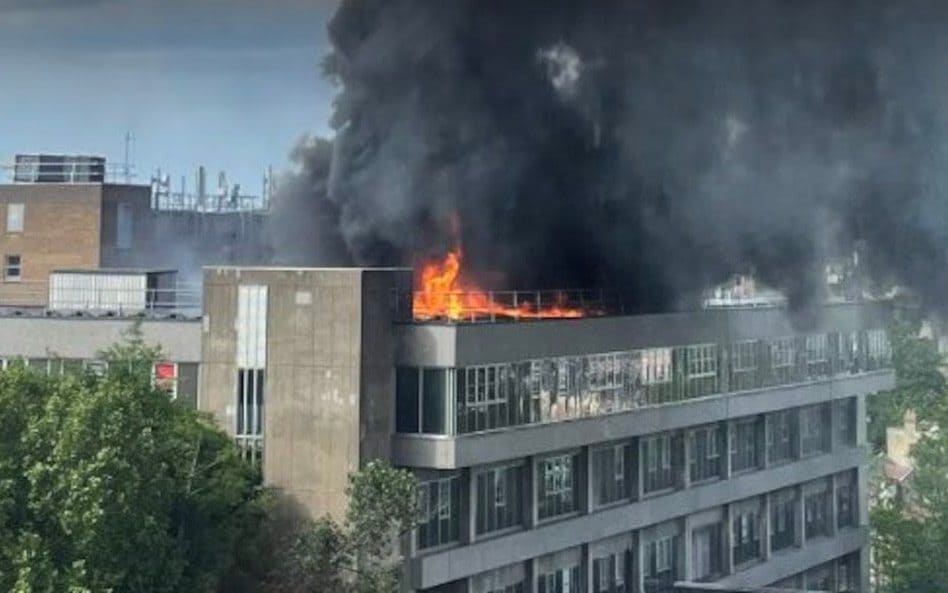
Earlier this year, a blaze caused by rooftop solar panels forced the evacuation of pregnant women and babies from St Michael’s maternity hospital in Bristol.
Another rooftop solar panel fire, in Church Crookham, Hampshire, damaged three flats in 2022.
Mr Miliband is pushing to accelerate UK solar capacity from 18 gigawatts now to as much as 85 gigawatts by 2035, a nearly fivefold increase.
Some of this expansion will be in the form of ground-mounted panels in the giant solar farms that are replacing farmland across counties like Lincolnshire, Norfolk, Suffolk, Devon and Cornwall.
However, Mr Miliband’s recent Solar Roadmap also calls for rooftop panels to be fitted on millions more homes in addition to the 1.5 million already equipped. It also proposes minimising planning requirements, which can incorporate safety regulations.
QBE’s data showed that there were 107 fires linked to solar panels in 2022 when the UK had about 1.3 million solar panels installed. By 2024, by which point 1.7 million panels were installed, the number of fires had risen to 171.
Worth reading in full.
To join in with the discussion please make a donation to The Daily Sceptic.
Profanity and abuse will be removed and may lead to a permanent ban.
In an earlier Telegraph article on the hospital that caught fire, one commenter attributed the fire to nesting pigeons, another to micro-cracks from people walking on the panels and another commenter queried the safety record of devices saving the planet…
“…The panels catch fire, the cars catch fire, the windmills catch fire, the bicycles catch fire, the substations catch fire.”
Ed Milliband’s pants also on fire.
“Stop Burning Stuff.”
Will Miliband fiddle whilst Britain burns?
The key question is ‘what type of solar panels’?
Never was an issue for the first 15 years or so, so reasonable to assume cheaper, poor quality panels are the issue.
That is most likely explained by degradation with use and age. Plastics and other substances degrade when exposed to ultraviolet light, heat and weather.
Solar panels get very hot and are exposed to sudden, severe swings in temperature, and are out in all weathers.
This causes cracks allowing water to enter, breakdown of electrical insulation and other electrical faults.
Leaving an electrical appliance out in all weathers for years on end and not expecting it to fail sooner rather than later, is typical of the lunatic thinking of the Net Zero brigade.
Solar panels should probably be replaced every ten years, if not sooner.
Just like off-shore wind turbines “unexpectedly” are breaking down frequently requiring high maintenance because of the harsh weather conditions and corrosion inside the turbines caused by salt spray.
The working life of wind turbines originally expected to be 20 years is now reduced to 10, maybe 15 if lucky.
Just wait to hear the shriek of heat-pump owners who find they have to buy new ones every ten years or so.
The shorter than originally claimed life is a sever risk for land owners. The companies that operate solar farms, windmills and battery farms are usually SPVs (Special Purpose Vehicles), often offshore and always with limited capital. They are financed by loans from the big name corporate owner/manager.
I understand that a sinking fund to finance the removal of these installations is not begun until year 15. If the site becomes unaffordable before the site has been returned to its former conditioin and suitable for agriculture (typically) then the land owner maybe in a difficult position.
If a major fire or other polluting even happens the SPV may be allowed to go bust and the cost of clean-up may be large. I have enquired and insurance for such an eventuality is not widely available and it has to be bought annually. If losses become significant land owners can expect the proice to rise before the cover is withdrawn.
I have not read the licensing terms but I strongly suspect the sites do not have to be returned to pristine condition and only above ground installations are intended to be removed. Maybe cables less deep than future farming might require.
As an owner of a group of solar PV panels since 2014, it seems to me that there could be problems with the quality of work done on some of the installations. E.g. some of them might have equipment in locations that are not easy to access, or at risk of inflammable junk building up on hot surfaces, like inside an attic. My kit has it’s inverter mounted in the front porch, and is air cooled. When it’s at full output, it churns out around 100W thermal. Most normal attics tend to become quite hot in some seasons with no added heat, so it’s probably a bad idea to install any inverters in there. This year, I had a pair of new panels of the same type, same manufacturer and the same rating as the originals, so it’s possible to measure the degradation of efficiency over the years. They are within the quoted values – about 5% down after ten years. They should be good for another ten at least. That said, a modern trend – at least in my street – is to have gas fired combi boilers installed in an attic (presumably to save space elsewhere). You wouldn’t… Read more »
Worth every penny, destroyed home and shivering pensioner choosing between heating and eating so that Ed Milliband can bestride the world stage like a colossus, proclaiming UK leadership in renewable energy, net zero and billions invested in “carbon capture” that grass and trees will do for free.
And far more beautifully.
I wonder why insurers do not ask about suych hazards when household insurances are renewed. Have they been leant upon or indemnified by HMG?
Adrian Simmonds, a senior QBE risk manager, said: “Solar is essential to the UK’s clean energy transition
Might have something to do with it.
Small solar is better than national solar but, alas, even then it may be of fault my brethren!
I have been born and aware of the fire devil an will no let it be upon my roof!
In my fireplace in will stay, it has served me good for many a decennium !