
Ed Miliband: Wind Power is Worse Than We Thought So We Need to Subsidise Even More of It
At first sight the news that the British Government is reducing forecasts for the amount of energy produced by wind turbines is another nail in the coffin of Net Zero. The Telegraph reports that as a result of “updated modelling” the predicted efficiency of wind turbines is being reduced by more than a quarter. The sceptical might observe a political game being played ahead of the latest annual round of subsidy handouts for future renewable projects. Andrew Montford of Net Zero Watch describes it as “unbelievably deceptive”. The game is one of bumping up the enormous subsidies needed to achieve the Government’s clean power capacity ambitions by 2030 while leaving it to fellow zealots in the media to explain away the future eye-watering electricity costs. Expect therefore organised climate fearmongering to be ramped up, and the large Parliamentary majority currently enjoyed for the next four years by the Labour Government to be utilised to ensure there is no turning back from the Net Zero fantasy.
How can such a plan possibly fail when you have trusted messengers still claiming wind is nine times cheaper than gas? All hope is surely not lost when Fiona Harvey of the Guardian can write a recent story headlined: ‘Wind power has cut £104 billion from UK energy costs since 2010, study finds.’ It might not be a complete surprise that this veteran Guardian headbanger is reporting on statistical modelling from UCL, an academic institution that hardly covered itself in mathematical glory during the Covid pandemic.
In the real world, of course, the further dismal downplaying of wind power is a nail in the Net Zero coffin. It means much higher electricity bills for UK consumers, further deindustrialisation and loss of currently well-paid jobs, increasing likelihood of blackouts and runaway public finances. Nine times cheaper than gas was a Green Blob-funded Carbon Brief hilarity, so how we laughed when a group of top British energy executives told a recent Parliamentary committee that future electricity prices in Britain would not fall even if the price of gas fell to zero.
Chris Norbury, CEO of E.ON UK, laid it on the line for often deluded Parliamentarians. “If I look at the non-commodity costs – policy costs, network costs – then certainly some of the modelling that we have suggests that you could get to a position by 2030 where if the wholesale price was zero, bills would still be the same as they are today because of the increase in those non-commodity costs.” Simone Rossi, Director of Economics at Octopus Energy, highlighted a lack of budgetary control over policy-driven expenses, an obvious reference to £15 billion of renewable subsidies and expenses loaded straight onto UK electricity bills every year without legislative oversight.
By 2030, the hated gas turbines will be running down with no immediate prospect of replacement, while nuclear will also be in short supply until the opening of Sizewell C. Do Edward Miliband and his band of weird wonks at the Energy Department care? Probably not – if your ultimate political aim is command-and-control of the heights of the economy, what are a few blackouts when an elite-ordered socialist nirvana is the ultimate prize? Is it not time to stop routinely calling him ‘Mad’ Miliband, a dismissive insult from his enemies he probably enjoys and even promotes, and start treating his sinister plot with the serious attention it deserves?
Needless to say, the news that energy from wind turbines is nothing like as powerful and plentiful as originally though has been known for some time. In March 2023, the Daily Sceptic reported on a paper published by the Global Warming Policy Foundation (GWPF) noting that “wind power fails on every count”. Even at the time it was charged that governments are ignoring “overwhelming evidence” of the inadequacies of wind power “and resorting to bluster rather than reasoned analysis”.
Written by Oxford University mathematician and physicist Professor Wade Allison – who is also a researcher at CERN and Fellow of Keble College – the short paper concentrates on working out the sums behind natural fluctuations in wind speed. At 20 mph, calculated Professor Allison, the power produced by a wind turbine was 600 watts per square metre at full efficiency. If only the wind stayed at 20 mph all day and night, power generation would be a lot easier. Alas it does not: if the wind speed drops by half, the power available drops by a factor of eight. Conversely, and almost worse, notes Allison, if the wind speed doubles, the power delivered goes up eight times, and the turbines have to be turned off for their own protection.
Want to know why the Miliband zealots are going hell for leather to connect as much wind capacity as they can at whatever price is necessary? Consider the graph below, published in the GWPF paper.
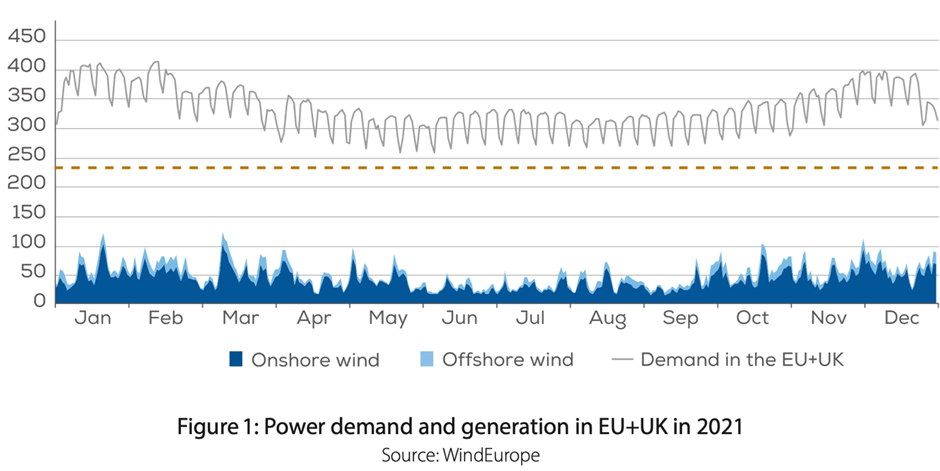
The brown dashed line shows the installed nominated generating capacity in the EU and UK in 2021. This was 236 GW but the highest daily output was only 103 GW, recorded on March 26th. Most other days it was substantially lower.
Professor Allison was doing the sums a couple of years ago and they are the same today since they were based on physics and freely-available information. “Whichever way you look at it, wind power is inadequate. It is intermittent and unreliable; it is exposed and vulnerable; it is weak with a short life-span,” he concludes.
Chris Morrison is the Daily Sceptic’s Environment Editor. Follow him on X.
To join in with the discussion please make a donation to The Daily Sceptic.
Profanity and abuse will be removed and may lead to a permanent ban.
I remember fondly when nuclear power was going to generate electricity ‘too cheap to meter’. But that PR dream faded too.
35 or so years ago I took the kids to the Sellafield Visitor Centre. We enjoyed it a lot. Unsurprisingly there was a lot of stuff about the future of nuclear energy in the UK but when I asked about nuclear fusion energy there were blank faces from the staff. Eventually they dug out a couple of leaflets but they were clearly not expecting any questions like that.
Fusion energy: 30 years away. Always has been. Always will be.
Maybe that will change. Necessity being the mother of invention and all that. We’ll crack generating fusion energy soon after we really need it.
Yes, I know we already use a lot of fusion energy. The sun being our supplier.
In the mid ‘80s, I went with a group of work colleagues to the visitor centre at Dungeness, while Dungeness B was under construction. We were taken around Dungeness A, which was one of the old Magnox type. We could stroll around the top of one of it’s reactors (when the machinery for inserting/removing rods was not in use).
I did the same at Oldbury and Berkeley – a fantastic day out. Reality is fission works and is well established, so for once we should follow the French lead and invest heavily in a rolling, ongoing programme of 10-20 fission stations… keep copying HPC for the next 10-20 years…
Good idea – you want to pay for it? The French taxpayer will pay for those new reactors, just as they paid for the other 59.
So my question is: coal-fired and gas-fired power stations are much cheaper to build than nuclear, need no taxpayer cash, provide low cost electricity and can be built on less land closer to point of use to reduce transmission losses, so why do we want nuclear instead?
I’d happily pay a portion of that yes, as part of a balanced grid supply. I’d certainly rather pay for that than pissing it away on carbon capture!
nuclear is the long term option, wether people like it or not. If we are printing cash like it’s going out of fashion anyway, why not direct some of it to build a long term paying asset?
I wne to the JET at Culham on the night of the 1990 FA Cup Fina replay – yes, it was a long time ago – and it 20 years away 35 years ago.
“The sun being our supplier.”
And quite conveniently and economically stored in batteries – called coal.
Of course it is too cheap to meter (like wind and solar) if you only consider the cost of the consumables.
Add in the capital cost, required rate of return on investment, maintenance and decommissioning costs and it’s a different story.
The Hinckley Point C money pit, has been guaranteed £128 per MWh, inflation-linked, lifetime price because it’s so cheap. When first approved, it was supposed be be providing electricity at a give-away price of £24 per MWh by 2019. Now due to go on line in 2030… maybe.
For reference: gas can do it for around £70 per MWh – less if carbon tax were removed – and “cheaper” wind currently is around £128 per MWh depending on which CfD the wind company signed up to and not including contraint payments.
Thank you, Chris Morrison, for a concise summation of the dirty numerical lies inherent in “clean power.” Energy-treason against the British people.
So we have a Chancellor of the Exchequer who has never heard of the Laffer Curve and an Energy Secretary who doesn’t realise that a million times zero equals zero. Where do they find these people?
They become politicians because they don’t know anything useful.
We also have a Chancellor who has not heard of property rental licences.
He’s a Socialist! The Laffer Curve is capitalist lies.
Leaking out from under a festering rock.
This clearly isn’t working, therefore we need to do more of it.
Great.
They’ve been doing that with the NHS for over 75 years with widespread public approval, so don’t be too hard on the politicians… it is after all the people who elect them.
Right now, according to the polls, nearly half those people support Labour, The Greens and the Lib Dems en bloc, and 30% think the Starmer creature is doing a top rate job.
What is truly astonishing from that graph is how low the offshore contribution is. Those of us who visit the coast can see the miles and miles of turbines, whether off the North Welsh coastline, the Kent, Norfolk, Lincolnshire. There are, apparently, even more of them beyond the horizon – Dogger for instance, currently 6% of capacity – so why do they not contribute more?
I’d be more concerned with how removing all this energy from the wind affects our local weather / climate. There are no free-dinners in physics, if you move energy from one place you impact another… multiply that enough and what does it do for you – warm the land?
Why not? Being in such harsh conditions – who knew how rough and spiteful the North Sea and Celtic Sea are, or that salt spray would corrode the metal in the turbines – they require a lot of maintenance and have a high break-down rate.
Also being so far away from points of use there is a large transmission loss, and they may be joining the grid in places where what they can supply exceeds demand, and so in order to keep the grid balanced, their output at times cannot be used. It’s the same story for on-shore too.
Off-shore is said to be able to proved 40% to 45% of stated capacity (25% for on-shore) but seemingly with breakdowns and frequent maintenance, it is much lower.
It could also be that some of them are not (yet) connected because cabling has not yet been laid to bring their output on-shore.
MPs question value for money of Prince Andrew’s Royal Lodge lease
Yep, I reckon the country will similarly regret signing the CfD contracts.
There is a high chance the Ed the Retard might become PM next year given that in a moment of high celebration in 2024 nobody realised the significance of removing the clause in the Labour leadership rules that a challenge could only be made at conference. Now a challenge can be made at any time such as oh, next May for example, and despite most normal people seeing Ed for what he is, the Labour party membership love him and would likely vote him in. The Labour system is not like the Tory one where the snivelling above themselves MPs decide who the members of the party should vote between. The new Labour deputy leader Dogwhistle Little Trumpet Powell was on the Ed team that beat his somewhat more intelligent brother David. I wonder how the votes would go in a survey between Ed as PM or a Russian invasion?
In a connected story, GB News had an energy supply person on this morning talking about the huge £4.43bn debt owed to the supply companies by customers and a suggestion that the debts owed by those on disability benefits – a huge number these days – should be spread over those of us who keep up with our payment. As I said before, this was the reason they were so clear about the costs of electricity at the Parliamentary committee. They are either looking to shift the debts to people like me who pay up or to move the ever-increasing grid costs onto general taxation.
Those in the know say the downgrading is due to taking into account the fact that turbines lose their efficiency much faster than originally claimed.
It has been assumed their lifetime would be 20 years, but now it is likely to be no more then 10 to 15 years – and off-shore will degrade sooner because of the damage caused by salt spray and harsh conditions.
Wind turbines are expensive. If they have to be replaced every 10 to 15 years, their capital cost has to be amortised over a much shorter period of time.
Prices must be increased to reflect this. Guess who will pay.
What if the Russians used their subs to demolish offshore wind farms? They can destroy undersea cabling already.
I saw this last week in a banner along the bottom on GB News, but have never seen a word about it anywhere, until I notice this article here. —–This is very important. Miliband has insisted the whole time that wind is cheaper than fossil fuels (which it most certainly is not) and that he would bring down bills (which he certainly is not) So now he is finally admitting that he was full of s..t after all ,which is what most people with half a brain and who are not addicted to pretending to save the planet have been telling him for years, even going way back to 2008 (The Climate Change Act)