
The Ban on Controlled Burning of Moorland is Making Wildfires Worse
Newly amended regulations are set to effectively ban the burning of vegetation on peatland with a peat depth greater than 30 cm anywhere above the moorland line. This will ban burning on around 1.6 million acres of the uplands. The Minister listed some alleged benefits of the ban, ranging from more wildlife to the unmanaged vegetation miraculously becoming immune to fire.
It is easy to ridicule the Minister, but whatever we think of her odd claims, it can’t be denied that this is a massive decision. She has brought to an end a form of land management that has been practised since time out of mind. A system that a Saxon Thane would have known, and which was old when the Brigantes ran Durham, will have gone from the land. Does it matter? Wasn’t it just a minor spat between selfish grouse shooters and nice conservationists? Isn’t fire always bad these days? I think that it does matter.
Some definitions
There is an Natural England definition of peatland. It is:
A wetland soil composed largely of semi-decomposed organic matter deposited in situ, having a minimum organic content of 30% and a thickness greater than 30 cm.
Natural England (NE) made an attempt to find some rationale for picking 30cm. That it is a popular number in Europe and the root depth of plants it likes to see in a blanket bog are the ones it favours. It is touching that it bothered. At least it felt that it would be better than ‘Because we say so’.
Defra’s peatlands are above the moorland line and 676,628 hectares (1,671,984 acres) in area. This degree of precision, down to the last eight hectares, creates an impression that someone actually knows. In fact they don’t know. It’s a guess.
So it’s simple. Any soil above the moorland line with more than 30% organic matter and more than 30 cm deep and you can’t burn. Obviously it isn’t simple, but don’t be tempted into thinking that variations in peat depth, or little pockets of plus 30 cm, will be seen as acceptable reasons for transgression. Any complexity will be the management’s problem. Do not expect any reasonableness of the part of the regulator. I would advise anyone with skin in the game to read the new NE ‘Definition of Favourable Conservation Status of Blanket Bog’ because that landscape gardening manual will be what you have to live by.
Why has rotational cool burning been banned?
NE says that, as a result of burning, 80% of England’s peatlands, around 1.3 million acres, are dried out and emitting CO2. This can be reversed by simply banning burning, removing grazing animals and rewetting the peat. When this happens any peat deeper than 30cm will become blanket bog. To quote NE: “Blanket bog is a climax habitat that does not require management intervention.” It will then, according to Defra, be impossible to burn because, to quote, “it will be naturally protected from wildfire”.
Other opinions are available. Many of the people who own, farm and manage the affected land don’t accept that 80% of their land is dried out and emitting CO2. Having already blocked up over 7,000 km of grips, and rewet just about everything, they are unclear what else is even possible, bearing in mind that much of it was never drained in the first place. They don’t believe that 30cm of peat on an undrained slope was or ever will be fully functioning blanket bog whatever you do. They think that NE’s idea that banning burning will “naturally protect against wildfire” is laughable and tragic.
But isn’t this just about grouse?
People who want to keep rotational cool burning in the toolbox include grouse moor managers, but many aren’t. Rotational cool burning is not limited to grouse moors. There are grouse moors that don’t routinely burn, and moors without grouse that do. Big bags of grouse are shot on on moors that rarely burn. Nothing would suit grouse shooters better than to avoid the huge costs of management. They would be delighted if NE’s theory was true, and blanket bog was naturally protected from wildfire. Grouse like blanket bog.
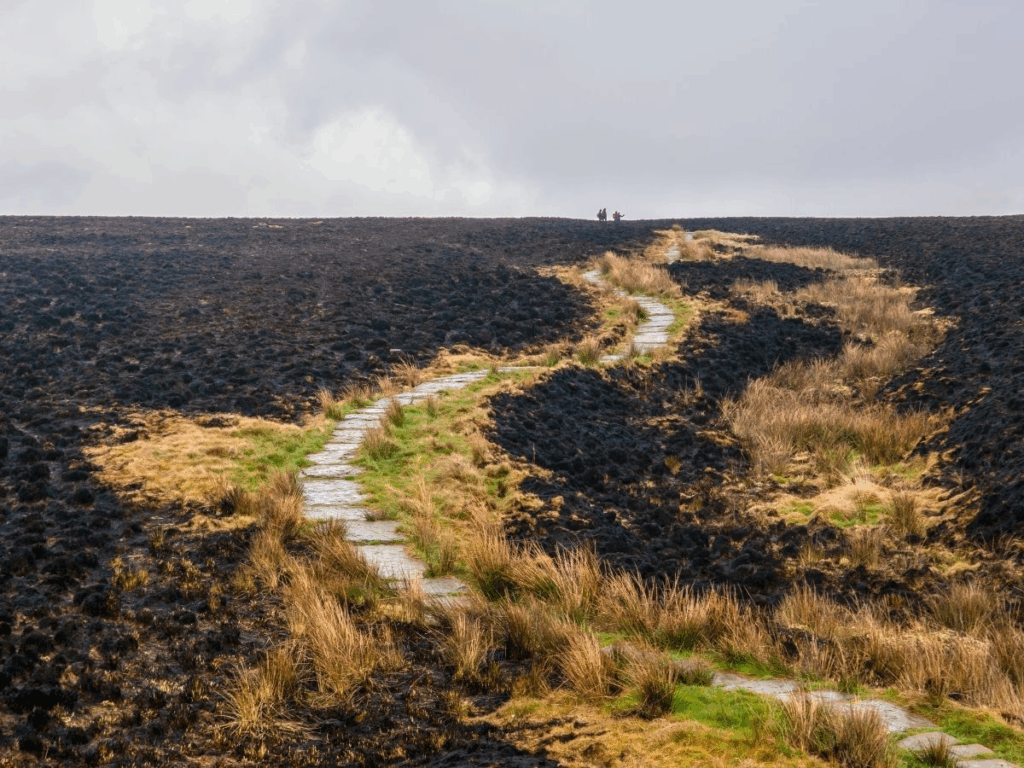
For the people who own and work the moors the big issue is not grouse but wildfire. Wildfires can bankrupt them. Wildfires can, and often do, destroy hundreds, sometimes thousands of years worth of accumulated peat in a few days. The vegetation and the wildlife it supports are destroyed, sometimes forever. People in NE, Defra and the conservation industry think that the practitioners’ concerns about wildfire are just a cover for wanting more grouse. They sometimes half-heartedly deny that this is their view, but there has been too much loose talk for that position to hold.
Wet and Walk Away
Defra and NE say that the system they intend to impose on 1.6 million acres of upland Britain will ensure that the habitat and its precious peat stocks will be “naturally protected”. They claim:
Fully functioning blanket bog is a climax habitat that does not require management intervention. Until the site is fully functioning, management interventions may be needed to fix outstanding drainage issues, inappropriate grazing levels or burning.
That’s it. Block the grips, get rid of the sheep and stop burning, Nothing else. It is what is known as the ‘Wet and Walk Away’ system, because that is what you do.
The miracle of in-combustibility will occur because if you rewet there will be less heather, and if you stop burning then the peat will be wetter so there will be less heather. It is assumed that if there is less heather, and the peat is wetter, the entire habitat will reach a state where it is naturally protected from wildfire.
Unfortunately, unlike the more believable biblical miracles, like raising the dead or drowning the gadarene swine, this miracle is definitely not instantaneous. No one knows how long it will take to transition to a state where things that can burn, can’t burn. After a decade, ‘Wet and Walk Away’ sites are, we are told, still in transition. I should make it clear that, in this instance, ‘being in transition’ is often a euphemism for being on fire.
The ‘Wet and Walk Away’ system is beloved by the new Lords of the Manor. Organisations such as RSPB, the National Trust, the Wildlife Trusts and rewilders are enthusiastic supporters of a system that only needs capital spend to do the Wet bit, and that is normally paid for by the state at heart-warmingly exorbitant prices. The Walk Away bit is even better. There are no revenue costs. If a wildfire wipes the place out, it’s in transition, you were only following orders, and you can always appeal for funds.
The year the scenery caught fire
2025 is our worst ever year for wildfires. In England alone nearly 100,000 acres had burnt by August. Wildfires are a global and national menace, so much so that the UK government signed a protocol at the last G7 summit that committed it to use every means to combat wildfire, specifically including rotational burning. In this year, the year that the scenery caught fire, you would expect that NE would ensure that its review of burning dealt with wildfire in depth.
You would be wrong. The 322 page NE review devotes just four pages to wildfire, and of that, just four paragraphs deal with what it calls evidence. Even those paragraphs say nothing to inform the reader. This is despite the fact that its ‘Wet and Walk Away’ system is not a novel approach. It has been applied for over a decade on conservation industry land where NE has control. It would therefore have been easy to make an assessment of the efficacy of the claim that controlled burning is irrelevant to wildfire, and that ‘Wet and Walk Away’ naturally protects peat over 30cm.
Why is a wildfire worse than a planned fire?
But does it matter? A fire is a fire. Why is a wildfire worse? The first reason is extent. Small, ‘cool burns’ that take place in the winter and early spring enrich the habitat by creating a mosaic of plants of different ages. Big wildfires, in hot, dry springs and summers impoverish the landscape by creating huge single-aged stands of vegetation.
Second, if they burn the peat, as summer wildfires often do, they destroy not only the moss layer, but all the seed from which the existing vegetation might return. When this happens the likeliest outcomes are bare peat or a sea of molinia. Cool winter burns don’t even burn the moss let alone the peat. The keepers demonstrate this by putting a Mars Bar on the moss and burning over it. The chocolate doesn’t melt. There is a modern variation of burning over a mobile phone in video mode.
Third, the cost. Cool rotational burning costs the taxpayer nothing. The costs are borne by the farmer or the estate. Wildfires cost owners, councils and the FRS millions.
Fourth, the health and safety impacts of small burns are vanishingly small. The smoke comes from vegetation, not the peat. The wildfire at Stalybridge on the other hand is estimated to have resulted in 4.5 million people inhaling micro particulates. Wildfires are dangerous. As the vegetation gets ranker with every passing year, the fires get bigger and faster. The day is coming when wildfire will kill someone.
Fifth, wildfires risk the immense stores of carbon already locked up in these moors, something that keepers’ fires do not do. The Stalybridge fire, on land where NE did not allow burning, released 500,000 tonnes of CO2. At RSPB Forsinard a wildfire beat even that, with an estimated 700,000 tonnes of CO2.
How could the NE experts not notice that the scenery was on fire?
It is surely inconceivable that the people who wrote the review and advised the Minister were unaware of the wildfires that have raged across ‘Wet and Walk Away’ peatland? Forsinard, Corrimony, Moray, Stac Pollaidh, Loch Ken, Darwen, Winter Hill, Stalybridge, Saddleworth, Marsden (repeatedly), Meltham, Crowden, Dove Stone, the Goyt, Woodhead, Howden and in the last few weeks the vast fires at Carr Bridge and Dava and Fylingdales and Langdale. The majority on land that was, according to NE and now Defra, “naturally protected against wildfire”.
These fires did enormous damage, burning precious peat stores that will take hundreds or thousands of years to replace and releasing vast amounts of CO2. They destroyed wildlife, cost millions, caused injury and put lives at risk directly and indirectly. There is not a mention of this mayhem in the NE review. The authors, in the four pages they devote to wildfire, would rather talk about ‘Study type and quality’, which gets one and a half pages. About thousands of hectares of moorland going up in flames, land that according to NE required no management to keep it safe, nothing.
But what about all the benefits of banning cool burning?
The problem is that peatland has moved from something only grouse shooters, shepherds, ramblers and poets were interested in to an enormous cash cow. The IUCN Peatland Code documents estimate that it will cost up to £22 billion to repair what they say are our damaged peatlands. With money like that being talked about, and the ability to hold the climate apocalypse gun to the head of any government, no one should be surprised that some wild claims are being made.
To make matters worse, there is very little science, and most of it is inevitably short term. This is particularly unfortunate when it relates to one of the slowest environments on earth. Even a burning cycle of 20 years is far beyond the duration of most research projects, so the entirety of the Holocene is going to be a stretch. People are taking fragments of science that suit their business plan, often ludicrously short-run and site-specific, and treating them like Newton’s laws of motion.
There is no unequivocal evidence that properly conducted cool rotational burning on peatland causes or even contributes to flooding or that it prevents carbon sequestration, makes wildfire more likely or reduces biodiversity. There is no evidence that stopping cool burning will have any significant beneficial effect on anything.
The problem is not lack of knowledge. England’s moorland peat has survived quite well on little more than rule of thumb for millennia. It is people pretending that they know when they don’t that are the problem and always have been. I have lived long enough to have seen governments make one crazy intervention after another into upland management. Pay people to plant pines on peat, pay people to dig them up. Put up fences, take down fences. Burn 10% every year, don’t ever burn. Dig drains, fill up drains. You get the point.
None of the ‘Trust me I’m an Experts’ seem prepared to admit that the 1.6 million acres they are treating as a homogenous mass is in fact an incredibly varied mixture of climate, habitat, geology, culture, wildlife, husbandry and much more. None seem interested in working out what is best for that wildlife assemblage and the people in that place. Instead we get: “We know what is best. Give us the money. Get out of the way and don’t argue.”
How many times do we have to watch disastrous one-size-fits-all ‘solutions’ imposed by central government because it sounds, to someone who has no direct knowledge and experience of any of it, like a good idea?
What next?
What happens when the wildfires start up again? Historically, keepers and farmers have been the first on the scene, using their skill and specialised kit to help control the fire, and staying out in the darkness, when the FRS has had to withdraw, making sure that the last embers are out. If you don’t need specialist kit because you aren’t burning, it won’t be there to use. Even if the skills linger, the next generation won’t have them. People have no conception of how many wildfires are prevented by keepers and farmers. Something that you can stamp out now will be unstoppable in a hour.
Wet and Walk Away has been in use for long enough to see that it doesn’t work. But it’s set to get worse. The fuel load increases year on year. The wetter and warmer winters increase the rate at which vegetation grows and fuel builds. The predicted hotter and drier summers will make the fuel more ignitable and combustible for longer. The remorseless drive to get more people into wild places – to wild-camp and wild-eat – will make ignition more likely. It will no longer be just National Trust and RSPB land. It will be the whole 1.6 million acres. The equipment, and the skills, and perhaps even the willingness needed to deal with the mess that Defra and NE have so carelessly created will be eroding. We are walking into a perfect storm.
Faced with increasing risk and severity of wildfire, other countries are desperately trying to find people who know how to reinstate the controlled burns that they now regret they ever banned. In England, where we still have those skills, and where the old system still works, we are rushing in the opposite direction. I think we will live to regret it.
The Natural England Chief Scientist explains why I’m wrong.
It seems that NE is feeling the heat on wildfire. As I was putting the finishing touches to this article, its Chief Scientist, Professor Sallie Bailey, emerged to explain the magic. Sallie has provided the authorised version. It is essentially as we thought, but she provided some photographs. This may have been a mistake.
Several are of small, wet, moss-filled hollows on Marsden Moor. We are told that they didn’t burn. This is not surprising. but the news that wringing wet moss doesn’t burn has no relevance to keeping 1.6 million acres safe from wildfire. This is particularly the case on Marsden as people have lost count of the number of wildfires: at least seven this year.
Then the photograph of a blocked gully that is said to have stopped a fire, again on Marsden Moor. The gully is so tiny that it is difficult to see, but that is not as difficult as believing that it stopped a fire. Anyone with even a rudimentary knowledge of wildfire would see the idea as laughable.
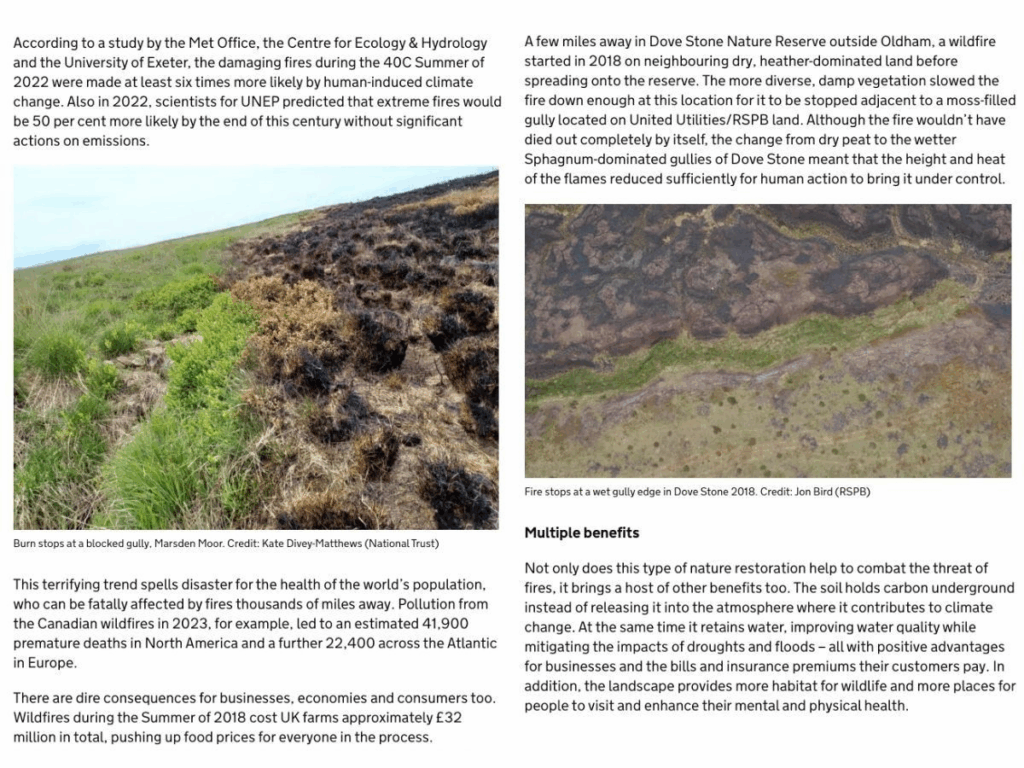
But worse. Worse by far. There is RSPB Dove Stone. This time it is an aerial photograph and this is what the NE chief scientist says.
A few miles away in Dove Stone Nature Reserve outside Oldham, a wildfire started in 2018 on neighbouring dry, heather-dominated land before spreading onto the reserve. The more diverse, damp vegetation slowed the fire down enough for it to be stopped by a moss-filled gully located on United Utilities/RSPB land. Although the fire wouldn’t have died out completely by itself, the change from dry peat to the wetter Sphagnum-dominated gullies of Dove Stone meant that the height and heat of the flames reduced sufficiently for human action to bring it under control.
To be fair, Sallie is repeating what she was told, but it’s not her finest hour. I went up to the place where she says that the wet gully allowed the fire to be stopped, whilst the area was black ash. I spoke to some of the people who had been fighting the fire for three weeks, something I suspect Sallie may not have done.
To suggest that a wet gully a few hundred yards long brought a wildfire that burnt 14 square kilometres under control is ludicrous. It didn’t. The people fighting the fire used a change in wind direction to manoeuvre the fire front to a natural cliff edge where it ran out of fuel. Her claim is not new. It was made by RSPB on television at the time of the fire, and I discussed it when I was onsite in 2018. It is fair to say that some of the people who had put their safety on the line did not think that being told that the RSPB and a wet gully had saved the day was particularly amusing.
Nor is it correct to say that there was any marked difference in vegetation because of the increased wetness. There was no increased wetness. The area burnt had never been drained, and the little dams at the bottom of the RSPB gully had no impact on surface wetness. What did have an effect was that no rotational cool burning had been allowed by NE on the area affected by the wildfire.
It’s really not good enough that NE is simply perpetuating myths in an attempt to justify a ridiculous position. How can it claim that things that we know will burn, simply won’t? For God’s sake, Notre Dame was 90% stone and that burnt. Grenfell Tower was clad in panels that ‘couldn’t burn’. How many times must we be treated like idiots?
Finally, Sallie references the appalling health effects of a Canadian wildfire in 2023, which is calculated to have caused over 60,000 premature deaths worldwide. Why did the vast wilderness not enjoy the “natural protection from wildfire” that she promises? Were the peat bogs of northern Canada overgrazed or drained or subject to cool burning? Surely they must have been. No, it was wilderness. No sheep, no grouse moor management and no draining. Exactly the formula that she says will prevent wildfire. But it burnt.
Ian Coghill is a game shooter, wildfowler and fisherman, lifelong conservationist and author of Moorland Matters. This article was originally published on Scribehound. Subscribe here.
To join in with the discussion please make a donation to The Daily Sceptic.
Profanity and abuse will be removed and may lead to a permanent ban.
Land being managed by bureaucrats in offices who have never lived on the land, never managed the land and all they know about land management they’ve picked up from books and seminars that are more about pushing an ideology than about land management.
What could possibly go wrong?
If they are ‘woke’ bureaucrats then it’s even worse.
Of course!
The UK’s national (small n) health service prior to 1948 when it was taken into State ownerships, was locally managed, with local knowledge, locally funded.
Then management and funding shifted to the White Hall bureaucracy. Over time they have managed to reduce the 480 000 beds taken over in 1948, to 145 000, and the 2 750 hospitals (most established/built prior to the 20th Century) to 1 600.
The output of bureaucracy is bureaucracy, and continually the bureaucrats have to find new markets for their output to justify their existence by increasing the scope and scale of their enterprise.
California and Australia experienced very severe bush fires in recent years. In both cases California and Australia introduced stringent environmental laws that forbid burning dead undergrowth. The Aboriginals have been burning the land for millennia and they do it to replenish the land and to avoid ‘hot burns’ as they call them.
https://www.youtube.com/results?search_query=aboriginal+cultural+burning
Indigenous fire methods protect land before and after the Tathra bushfire | ABC Australia
Portugal has experienced severe forest fires in recent years and this has been due to the intentional introduction of the Eucalyptus tree with grants for the EU. The Eucalyptus tree uses fire to destroy competition – it burns really well and hot and comes back after everything has been burned. Portugal is reintroducing the Cork tree as the bark (cork) will not burn and will only singe – except if a Eucalyptus fire will probably destroy cork trees.
Greece has experience severe forest fires in recent years and the result has been the arrest of tens of individuals. Being Greece probably not all arsonists were caught.
And then there are the Environmentalists that have started wild fires.
Beautifully-reasoned and highly-informative article. “Natural England” is a contradiction in terms – the English landscape is not wilderness but is the outcome of millenia of curation, nous and endeavour.
Another classic case of urban quangocrats, academicians and activismists getting their kicks out of telling people steeped in decades of rural life what to do, in vacuo of real-moorland experience and evidence.
Meanwhile, look up Professor Bailey’s career progression (and personal pronouns) on Linkedin and draw your own conclusions – “Conservator,” “Forestry Commission Analyst,” “District Manager,” “Regional Manager,” “Deputy Chief Advisor,” “Chief Scientist.” Sounds like another Dame of the Realm in the making.
And as a one-time hillwalker (retd), give me a stalker’s path, springy heather and disturbed grouse any day, any season, any weather, over slogging through squelchy peat bog.
Those that can, seek dry ground; those that can’t, jump in feet first.
Saddleworth is not known for wildfires. The fires of 2018 were most probably started by townies from Oldham and surrounds. Dovestones Reservoir above which the moors are situated is now a popular tourist trap courtesty of councils’ promotions particularly for towny scrotes who are fond of a barbie, the sort typically picked up in petrol stations and abandoned when the last blackened sausage or halal chapati has been burnt on said implement. Sadly, the area is now a a shit hole mirroring Oldham itself courtesy of a heavily muzzie dominated, clinging on Labour council.
A grouse shooter isn’t exactly the best person to give an unbiased opinion, anyone can claim to be a conservationist, what has Ian done to justify claiming to be a conservationist?
Ian Coghill conveniently forgot to mention that the spring and summer were a lot warmer and drier than average and this was highly likely to lead to an above average number of fires/acres burned. Blaming the fires on the new rules about controlled burning is as idiotic as blaming them on climate change.
After repeated attempts by the grouse shooting industry to water down or totally scupper the new rules they’ve only very recently come into effect and can’t of been responsible for this year’s fires.
The least people can do is wait for at least 10 years of data to see if the new restrictions are leading to a sustained increase in wildfires.
What benefits are likely to flow from “science” which overturns millenia of real world knowledge? If you cannot understand the dangers of overturning sound land management practices then you have learnt nothing over the last five years.
A grouse shooter knows nothing? Oh no of course not. Anybody who uses the moors for work or hobbies builds up knowledge of this environment and inevitably a deep respect for the people who manage the habitat and inescapably their own body of knowledge.
Helpfully you hi-light your ignorance by referring to “this year,” so that’s case proven then?
And your qualifications are?
The connection between this action by government and the IHT attack on farmers has zipped over your head clearly.
Land managers undoubtedly know the best way to manage their land in order to achieve a desired outcome. This doesn’t mean there aren’t better outcomes and hence ways of managing land.
Try reading http://www.raptorpersecutionuk.org/blog-2/ to learn about how land is managed in order to try and produce large numbers of grouse that can be pointlessly shot for “fun”
Is this really the best way of managing a large percentage or the uplands?
I only referred to data on wildfires for this year because this is the first year since changes to rules about burning came into effect. How does this demonstrate ignorance?
http://www.raptorpersecutionuk.org/blog-2/
Are you treating this as serious journalism? Good grief.
What the above article is discussing is basically BNG, Biodiversity Net Gain – look it up.
I was discussing this article with an architect last night. He has been battling BNG for the last twelve months and describes it as “bonkers” and ecologists he has spoken to state that it won’t work.
So thousands of years of learned management practices are to be abandoned on crap science modelling.
The moors around Saddleworth and Marsden have been planted with thousands of trees. Have you any idea of the primary effects this will have on the landscape?
Let me know.
I was walking on the North York Moors a couple of weeks ago. Patches of heather have been reduced to white sticks due (I believe) to the heather beetle damage exacerbated by the hot dry summer. If anything was a tinder box this was it. If not controlled by cool burning, then once this catches fire, it will be a disaster.
Equally devastating to find in such a wild place was a Met office balloon/weather monitoring device. This included metres & metres of plastic tape – one end attached to the radio transmitter (with a note “this is no longer in use, please dispose of lithium batteries & take to safe waste disposal). The other end was the burst balloon & parachute.
i can’t see how to get the batteries out so I emailed the Met office to ask for a diagram (& gave them a time & location of balloon find). Have I heard back from them? Of course not.
How many balloons go up every day? How many miles of plastic tape are ending up on the land & in the water? Does anyone know? Does anyone care?
How much toxic lead shot is ending up on land in the water every year because a tiny minority of people think it’s fun to blast defenceless birds out the air?
The organisations that claim to represent shooters have constantly campaigned against a ban/restrictions on the use of lead shot even though non toxic alternatives such as steel are available. About 5 years ago they said they’d voluntarily phase out the use of lead ammunition. After this announcement researchers bought a large number of shot pheasants every year and tested them for high levels of lead. 4 years after the announcement of a voluntary phasing out of lead ammunition tests showed at least 90% of birds purchased had been shot with lead ammunition, this year’s barbaric killing spree has only just begun so there’s not yet any data available but does anyone seriously believe that after 4 years of doing bugger all every shooter will suddenly stop using lead ammunition.
How much do shooting moors add to local economies? How many jobs are at risk as a result of this nonsense.
Lead shot in water supplies? What little if any makes it in to any water supplies would have bugger all effect on water quality. Fluoride is a far greater threat to human health.
You are poorly informed and need to start your own research.
Manalive, people should get it by now, there is no logical reason for decisions such as this other to increase wildfire risk and thus wildfires to which ‘they’ can point to carbon and ‘climate’ nonsense. This is a trap, an agenda, the Hegelian dialectic, create the problem, people ask for a solution and you deliver your aim as a means to alleviate public detriment. Very much smoke and mirrors
Correct. 👍
Governments, their departments and agencies provide great job opportunities for morons who would otherwise never be paid so much money.
Correct 👍
Sounds like our equivalent of the wildfires in Australia and California where undergrowth burning was halted and it led to massive fires. They keep claiming CO2 is a pollutant but it’s not, it is probably the most important gas on the planet even more so than oxygen without it plants die and the whole higher ecosystem starves.
Correct 👍
The moors where I live in North Wales are ‘managed’ and fires are a common site in the spring. Often the uncontrolled fires started by graziers ‘managing’ the heather and gorse to provide more grass for sheep and cattle. Graziers light a fire and walk, well drive rapidly, away leaving the moor to burn. Our moors are not like the densely treed forests that produce spectacular headlines, they are scrubby with low level growth, burn rapidly and die out. Burning up here continues up to the end of march, by which time many ground nesting birds are breeding. These nests and eggs are destroyed as are small mammals, reptiles and amphibians. The author doesn’t mention another alternative that has been tried up here successfully and that is cutting the heather and gorse, this can be done in wet weather long before birds and mammals are breeding. This solution is liked by villagers that are not smoked out a few times a year, but not by the graziers and local pyromaniacs that enjoy a good fire. Cutting prevents the spread of fire, is precise, and controlled and gives wildlife the chance to get out of the way. Could Mr Coghill please… Read more »