
Electricity Bills Will Carry On Rising Due to Net Zero, Warn Energy Bosses
Household energy bills are on course to rise by hundreds of pounds this decade because of ballooning green levies, the country’s biggest electricity and gas suppliers have warned. According to the Telegraph:
Senior executives from Octopus Energy, British Gas owner Centrica, E.On, EDF and Ovo urged Ministers to urgently address levies that pay for Net Zero-related costs, which they said are one of the main factors driving bills higher.
Speaking to MPs on a Parliamentary committee on Wednesday, Rachel Fletcher, Director for Regulation at Octopus Energy, said current trends suggest green levies could add around £300 to a typical household’s electricity bill by 2030.
Energy bosses warned that Net Zero levies were becoming so expensive that they threatened to push household bills higher, even if gas and power prices fell dramatically.
Ms Fletcher, of Octopus, said: “If we continue on the path that we’re on right now, in all likelihood, electricity prices for a typical customer are going to be 20% higher in four or five years’ time than they are now.
Ed Miliband has dismissed all of this as “speculation”, but this is not true. His own National Energy System Operator, NESO, told him that bills would rise substantially when it presented him with its ‘Clean Power 2030‘ report last November.
This was the report that looked into the feasibility of Labour’s plan to fully decarbonise the electricity system by 2030. Below is the relevant table from that report:
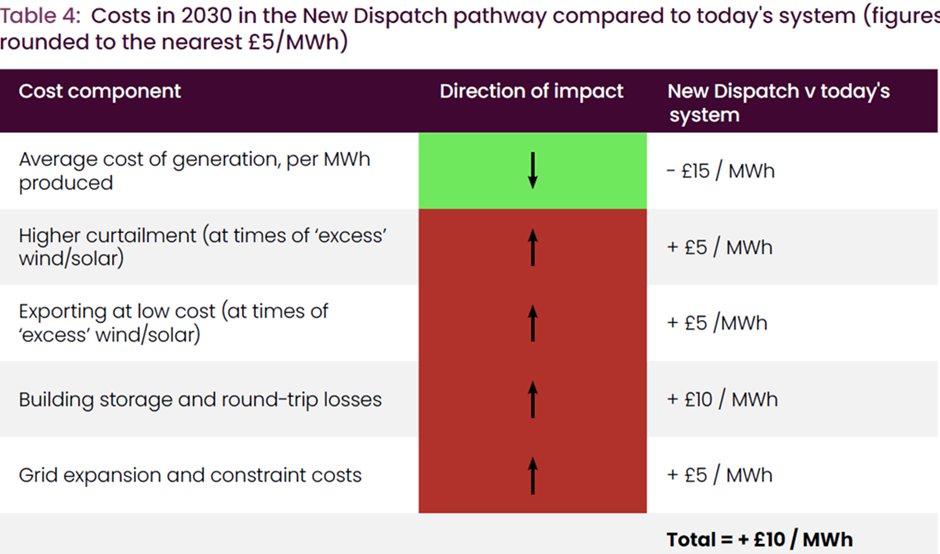
Ignore its claim that generation costs will fall – I’ll come to that next.
But it does say that all the other non-generation costs would rise by £25 per MWh, which is equivalent to a 10% increase on bills or £7.5 billion a year.
Much of this extra cost will go to constraint payments to wind and solar farms, paying them to switch off when there is too much wind and solar power on the grid.
Currently these payments only go to remote wind farms in Scotland, because the transmission capacity is not big enough there to bring all the electricity south on windy days. However, under Labour’s plan to triple wind and solar power, there will be many days when there will be more electricity generated than the country can consume as a whole.
NESO calculates that a fifth of all electricity produced will have to be either constrained or exported to the continent at a huge loss. The latter is unlikely because the Europeans will also have the same problem of too much wind.
On top of constraint payments, tens of billions will need to be spent building storage capacity and expanding the grid to bring power from Scotland and the North Sea to the parts of the country where the demand is. Ofgem has already put a cost of £80 billion on this, all of which is needed to cope with the massive expansion in renewable energy.
Returning to NESO’s claim that generation costs will fall, this was merely deceitful smoke and mirrors. It has assumed that higher carbon taxes will push up the cost of gas power, which in turn appears to make renewable energy cheaper:

Excluding carbon taxes, the current cost of gas power is around £50 per MWh, not the £123 per MWh it claims. Given its own admission that wind and solar costs between £71 and £83 per MWh, it is clear that generation costs will increase, not fall. (Its figure of £83 per MWh is already out of date, as Miliband has offered £117 per MWh for new offshore wind projects in the latest subsidy auction round.)
Miliband’s spokesman ignored these very real issues raised and instead commented:
Wholesale gas costs for households remain 75% higher than they were before Russia invaded Ukraine in 2022, and the main reason energy bills remain high.
The only way to bring down energy bills for good is by making Britain a clean energy superpower, which will get the UK off the rollercoaster of fossil fuel prices and onto clean, homegrown power that we control.
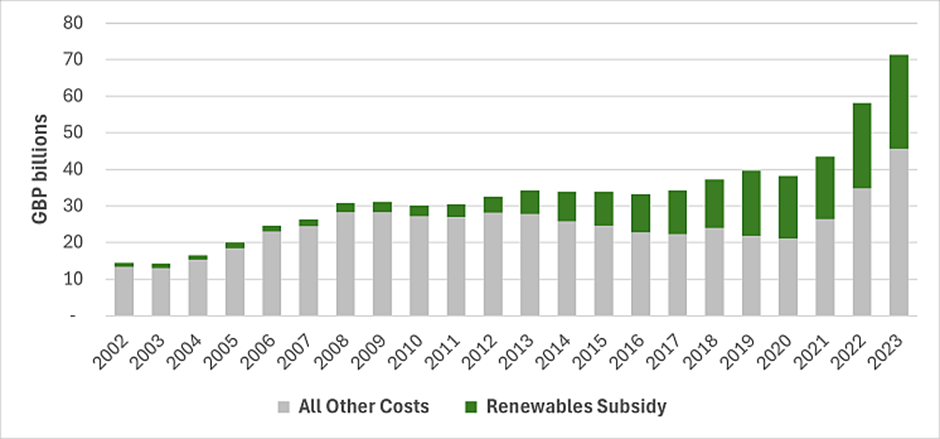
Gas prices are certainly 75% higher than a decade ago, but general inflation has also risen by a similar amount. In real terms, gas costs no more now than it used to. Green levies are the reason why electricity prices are so high, not the price of gas.
As Claire Coutinho neatly described in her conference speech last week, Ed Miliband wants to take out a fixed-rate mortgage at 11% interest, because he does not want a variable one at 4%!
Except that we will pay the bill, not him.
To join in with the discussion please make a donation to The Daily Sceptic.
Profanity and abuse will be removed and may lead to a permanent ban.
Who would you believe – a deranged politician who in days gone by would be in an asylum? Or people from the energy companies who deal with all the costs of supplying electricity? There are a couple of things not being picked up in this issue. Grid balancing costs to avoid blackouts have gone from £200m a year to well over £2bn a year thanks to unreliable wind and solar generation. All added to our bills of course. And from the company side they are looking to get costs taken from their bills and funded from the taxation pool because there is £4.43bn on customer debt on their books as people cannot afford the bills. In 2018 my electricity bill was less than £500 – it has been over £1000 for the last 3 years and heading to be the same this year.
I am, admittedly, a sad, dull man, but I have become obsessed with the live consumption and generation website in recent times. The sun is obviously shining somewhere, but not here, because solar is doing a bit better today. What really fascinates me, and relates in part to this article, is the amount of electricity we buy from Norway, France and Holland and then sell to Denmark and Belgium. Why on earth does that happen? Why don’t they just buy it direct? Equally why is electricity supplied to Northern Ireland called an export?
About NI, because post Brexit, NI is considered part of the EU, by the GB government (because that is what it is now) and the EU.
In 1971 my first job was at a coal-fired power station feeding into the National Grid. We all took as read that to minimise unit costs power stations were best run 24/7 near coalfields and centres of population.
Half a century later, Britain has a Heath Robinson, dog’s breakfast, arse-about-face “National Electricity System” delivering the highest electricity prices in the world.
Progress means change but change does not always mean progress.
Oh, recall the joy for Cameron-Clegg and their parties when coal fired stations were physically destroyed. The Germans were daft but not as daft as these two; they kept theirs and have begun to use them again to replace the cleaner nukes which they turned off to please the left wing greens.
You could not make it up.
Let’s hope the petrolhead boots out the fruitcake of Marxist loins at the next general election. Over to the voters of Doncaster North.
True enough, with places like Drax (as it was then), Ferrybridge, Eggborough, Cockenzie etc, but it fell apart after the NUM strike. E.g. Didcot A used to use Nottinghamshire coal, but then it changed to Columbian coal, shipped across to Avonmouth then up by train to Didcot. The latter case did create some work for some colleagues of mine, as British Rail (as it was then) had to widen out the GW main line between Wantage and Challow to handle it all.
Incidentally, during the strike, transporting imported coal was, err, blacked by the BR unions, and there were convoys of road trucks on the M4 from Avonmouth to Didcot. Later on, the coal dump at Didcot was expanded quite a lot. Normally, in the old days, they used the old merry-go-round system from the pits in Nottinghamshire, and didn’t store too much on site.
Talk about the bleeding obvious. Paying unreliables to turn off when there is too much wind & sun is criminal. Our grid is not & has never been able to carry the unreliables power generated to where it is actually needed. How much will this cost, how much country will be destroyed & when is there any chance of said grid catching up?
i think the contracts for difference are (almost) bribery. And I wish I had been able to jump on the initial domestic solar panel feed in tariffs 15-20 years ago when it was a mechanism for the consumer to harvest money. At our (the bill payers) expense.
I’m a follower of David Turver & Kathryn Porter & I think what is being done by the government is actually wicked.
I too wish I had been able to get in on the Feed In Tariffs when available. Unfortunately my little bit of roof wasn’t suitable. Relatives with much larger houses and much more extensive roofs, several hundred miles to the North, were able to do so and did quite well out of it.
Earlier this evening, there was some pre-budget trailing about this, as part of a report on Reeves participation in the IMF meetings in the US, on the beeb R4. Part of the speculation was that it might be practical to reduce the tax on power supplies. I guess it might be feasible to chop it from 5% to 0 VAT, now that we’re not in the EU (5% was the bottom limit when we were inside). However, the concept of doing that would be contradictory to Net Zero, wouldn’t it?
Something for those who like to bet on the rabbits in a hat at the end of the budget speech, perhaps.
The vat isn’t the point – it’s like negotiating the amount of torture you are happy with. The whole system is a total mess and no fiddling around the edges should satisfy anyone
Net Zero The Evil Costly Con
Why on earth is he still being given power – someone cut him off at his socket now, whilst we still can!
And how does relying on solar power align with the technology that is being experimented on to block out the sun – also in the name of climate change?
What is wrong with this country?