
The Fightback Against Politicised Art Has Begun
Speak to anyone on the street about art being produced and displayed in establishment exhibitions today, and the reply will rarely be positive. Indeed, there is a widespread public apathy to the artists of our age (can you name a single one?) Visitor numbers to major galleries like the Tate Modern are in decline. And just look at the paltry social media engagement generated even by prestigious awards such as the Turner Prize. Is a single normal person interested in this stuff?
Public disillusionment is so pronounced that contemporary art has become the butt of many a TikTok joke or subject to detailed YouTube analysis. At times, the extent of the engagement is by art outsiders is attempting to ‘gotcha’ the artists and institutions involved by taking things out of context.
It has to be said however, that the public has often been at odds with the direction and movement of art throughout history. Think of Alfred Gilbert’s celebrated nude figure on the water fountain at Piccadilly. The statue so ‘offensive’ when it was unveiled in 1893 that it received considerable criticism: that it was nude; it was facing the wrong way; that Eros, the pagan god of love, was not a suitable memorial to Lord Shaftesbury, and it should rather have been known as the Angel of Christian Charity.
The same can be said of Herbert Baker’s redesign of the Bank of England in the 1920s, which featured a number of striking portico sculptures by Charles Wheeler that were lambasted in much of the tabloid press. Today, those Londoners who aren’t ignoring these artistic monuments generally acknowledge them as iconic landmarks of the city.
Was the public wrong to object to these monuments in the past? I would say yes. But does it follow that the public will always chafe against artistic novelty and that they should learn to silence themselves in the presence of their artistic betters? I do not believe so.
Today, it is not just that the masses rail against contemporary art, but against our preening and vacuous contemporary artists and intellectuals themselves. While there are many reasons for this disharmony, artist and aesthetic thinker Alexander Adams points to a combination of the following:
- The complete capture of art institutions by Left-wing ideologues
- The allotment of commissions and money along political and ideological lines
- A debasement of art into mere activism
- A failure of the art education in basic skills
- Art being becoming nothing more than an ‘investment’, rather than seen as valuable in itself
Adams has unpacked these notions in much greater detail and depth than I could, but I do believe there is great truth in what he says. Fundamentally, the system – especially the Arts Council England (ACE), which disburses some £500 million of public money each year towards various artistic projects – does not function to produce good art but rather to siphon money to politically expedient ideas and politically-aligned people. Worse still, for all its so-called ‘progressive’ politics, it’s clear that the current art establishment has in fact become deeply conservative, albeit a conservatism of very recently arrived fashions and ideologies. And the art establishment jealously guards its funds and makes sure to blacklist and push out talent that doesn’t fit within its system.
Happily, the geyser of public money and bad ideas that is the Arts Council England may well be destined for destruction. There is already talk about ‘devolving’ funding powers from ACE to regional mayors as part of restructuring. It seems inevitable that the dreary politicisation of public art will only be exacerbated by this move – why would we expect a mayor to know much of art? My fear is that the art establishment will not meet a swift end, with a chance of salvaging something from the shattered remains, but undergo a terrible, slow dissolving into nothing.
What is to be done then? In his latest book, How to Start a Dissident Art Movement, Adams aims to point the way towards creating something meaningful. As well as his writing, Alex is also a key member of our art group (while never officially named, several monikers have been used for us, with several people putting forward The Vitalists). We all met over three years ago, almost out of the aether, lost souls coalescing together like drops of mercury bouncing around before combining. We had no single style or motif, no shared education or skill; we were simply men longing to fight against the tyranny of the contemporary art establishment. Our primary focus was not the regurgitation of ideology or creating art that would support a righteous cause, but simply to create powerful works that stand out on the merits of their own form and meaning. Works that, we hope, would have the power to be recognised outside of their own time for what they are.
Simply put, our aim is to create art that moves people, both the public at large and the art-educated. To be ‘moved’ by art is a very old idea which reflects a pre-scientific understanding of human nature. Works of art were considered to drive the Passions in man, inspiring and changing them and, most importantly, physically moving them to action. That is what we want to achieve: to drive man into action, to create, to criticise, to change the harmony of the very universe itself.
Personally, as an artist working for over a decade, a researcher and explorer of long-forgotten works and who regularly frequents the exhibitions and shows of London, what I long for is to see an artwork from one of my contemporaries and to have a Salieri moment. To gaze upon greatness with envious eyes, and to use that energy to drive myself to greater heights.
Our latest show, this week in London, is called Power and Intimacy. Rather than criticising the legacy of colonialism in Norfolk, our subject is how these two great cosmic forces have inspired man and ensnared him in equal measure. It is these perennial problems of human existence we hope to explore. Seven artists including me are showing 24 works, from oil and acrylic paintings to sculpture in plaster and bronze, to pastels, ceramics, textiles and prints.
The exhibition runs from the 7th to the 12th of October at 11 Caledonian Road, N1 9DX. No tickets are needed. Most of the works on display are available for public purchase – although they are selling out fast!
We hope that you will take some time to visit the show.
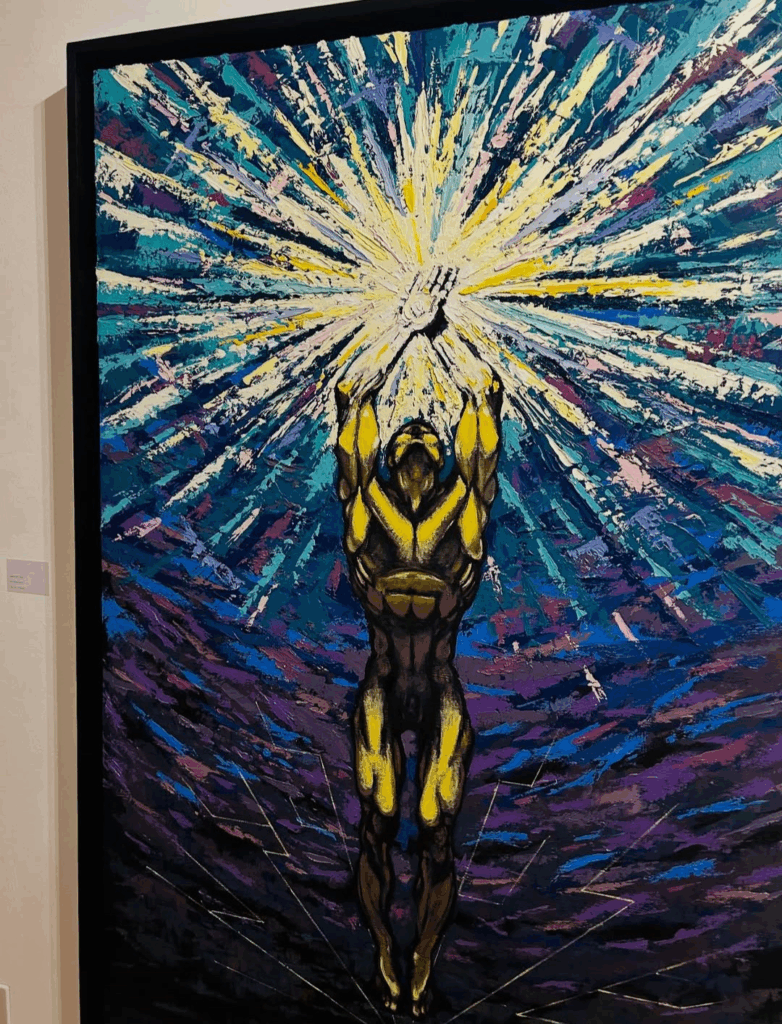
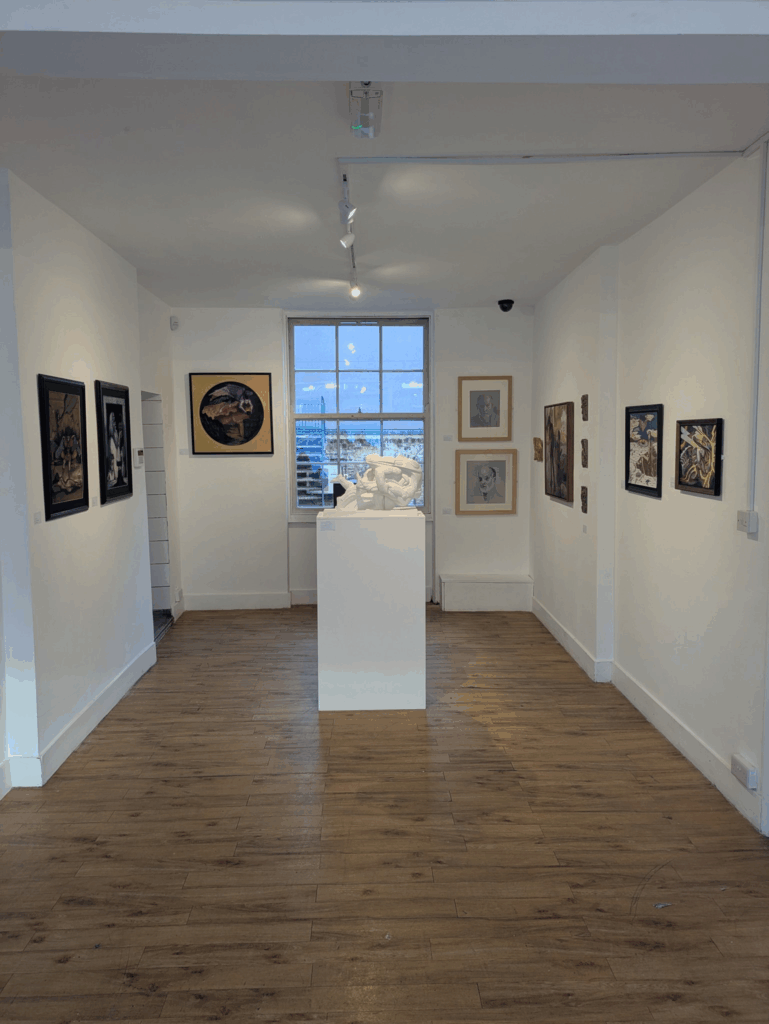
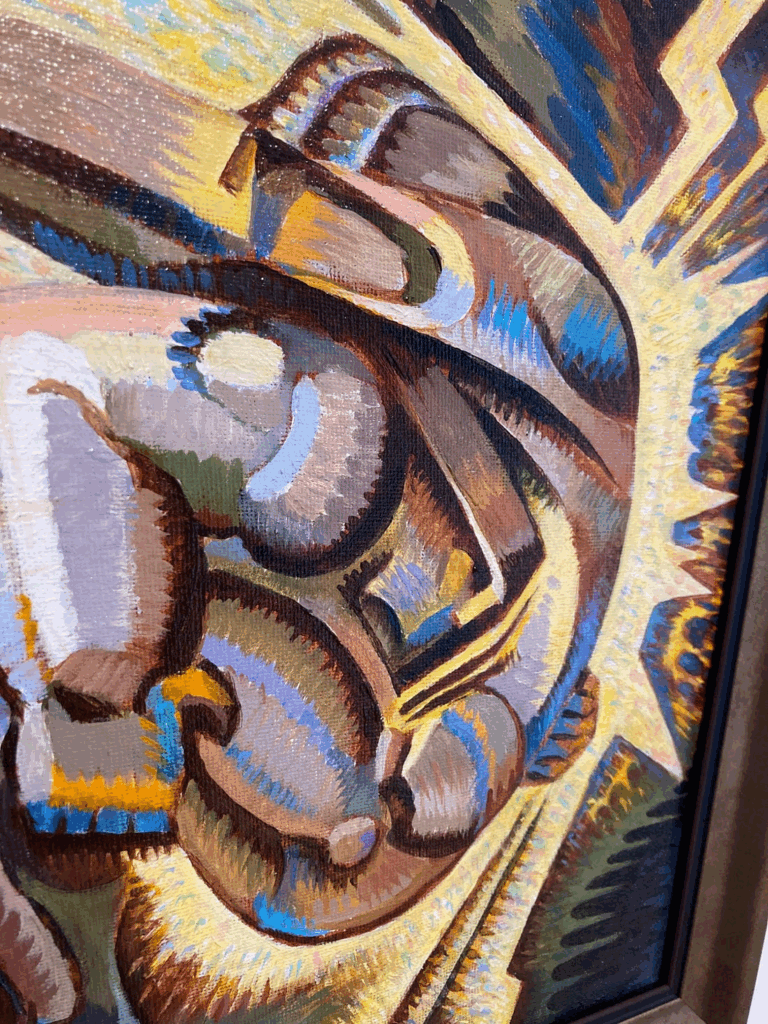
Ferro is a writer, thinker and artist specialising in sculpture, textiles and graphic works.
To join in with the discussion please make a donation to The Daily Sceptic.
Profanity and abuse will be removed and may lead to a permanent ban.
I’ve argued for some time that the Arts Councils should be defunded. Most of what they do feeds the Arts indutry, not peoples’ appreciation of art.
You could also argue that Raise The Colours is a large cooperative Art Installation that didn’t need central government funding… and people tearing the flags down are philistines.
Sorry to be pedantic but the statue in Piccadilly Circus is of Anteros.
You’re hardly being pedantic. The Erotes each are gods of different forms of love and sexual desire, Anteros being that of requited love and avenger of unrequited love.
There is also the linguistic confusion that the singular form of the plural Erotes is Eros.
Indignation was as uninformed then as it is now. One would have thought people would have been universally happy to have the god of requited love stand over Piccadilly Circus. But no, because Naked body! Shock!
At last, somebody writing in the Daily Sceptic, on the dire situation of the visual arts, which have been deteriorating at an accelerating pace for the last 20 to 30 years. I am a painter, and intend to come to your intelligently titled exhibition.
Michael Sangster
https://michaelsangster.com
Lovely work.
Wot, no elephant 5hit?
😀😀
Art? Wow, just what we need to solve the world current problems!
If art makes you look at the world in a different way, then yes, maybe it is.
Why has The Daily Sceptic never publicized the heroic scepticism of David Lee and his art magazine The Jackdaw? Every editorial of Lee’s ought to be here (6 a year).
Yes, the money is in vacuous modern. All part of the project. However, there are plenty of people creating art for zero monies but they rarely get seen. I went to the summer exhibition at the Royal Academy and was surprised that among the dross (the Diane Abbot stamp was particularly memorable), there was some good stuff, often focused on community life of people in the past, poignant and sad but at least it had heart. The one picture that really stood out was Tracey Emins depiction of the crucifixion, who knew the post modern princess had it in her! Well done to this exhibition bringing art with heart to public attention. Art reflects life, it is important.
The saving of half a billion pounds by abolishing the Arts Council will be a great start to reforming public finances. Then it will be back to artists selling their work on the basis of public taste and demand.
Dear Ferro, Mrs Wrinch here. How does one reach out to the non-ideologically poisoned art group please? I’m an artist and have been praying to meet fellow artists who see through the deadening of the art in our time. Humanity needs art that is good, truthful and beautiful again.