
How Representative is X of UK Public Opinion?
Twitter/X is arguably Britain’s most influential social media platform, with numerous commentators having spoken of their ‘addiction’ to the site. For example, BBC Director David Jordan said in 2020 that Twitter “can become almost addictive for some of our journalists”. Likewise, the MP Josh Simons (who was previously a research scientist at Facebook) told the Guardian last year that “he believed the British political class was dangerously addicted to the platform”.
Unsurprisingly, perhaps, Simons expressed particular concern about changes made since Elon Musk took over. “It is totally and completely wrong and harmful to British democracy that the Westminster bubble gets to know each other through a ranking model designed by a man who’s spending his life campaigning for Donald Trump,” he noted.
Simons’ concern may not be entirely misplaced. According to research shared with Politico that looked at the period from July 2024 to January 2025, Reform’s MPs enjoyed vastly more attention on X than those of other parties (this includes Rupert Lowe, who has since become independent). They accounted for about half of all engagement with tweets sent by British parliamentarians, despite representing only 3.5% of the total.
Now, this could be because Elon Musk had tweaked the algorithm in their favour (recall that he didn’t criticise Farage until January 2025). But it could also be a simple consequence of the massive Left-wing exodus to rival platforms like Bluesky.
According to data analysed by John Burn-Murdoch, the number of daily active X users in Britain fell by more than 30% between June 2023 and October 2024, with the reduction being overwhelmingly concentrated on the Left. The numbers in both Britain and the US fell most sharply following Musk’s endorsement of Donald Trump in July of 2024, coinciding with a decline in the platform’s ‘brand health’.
So, how representative is X of British public opinion?
The chart below plots several estimates of the percentage of the UK population that uses the platform. Because they correspond to different questions asked in different surveys, they are not directly comparable. The 2015 estimate labelled in blue comes from a paper published in Social Media + Society. The 2015 estimate labelled in orange comes from a paper published in Research & Politics. The 2019 estimate comes from my own analysis of the British Election Study. And the 2024 estimates are based on two YouGov polls (a simple average was taken).
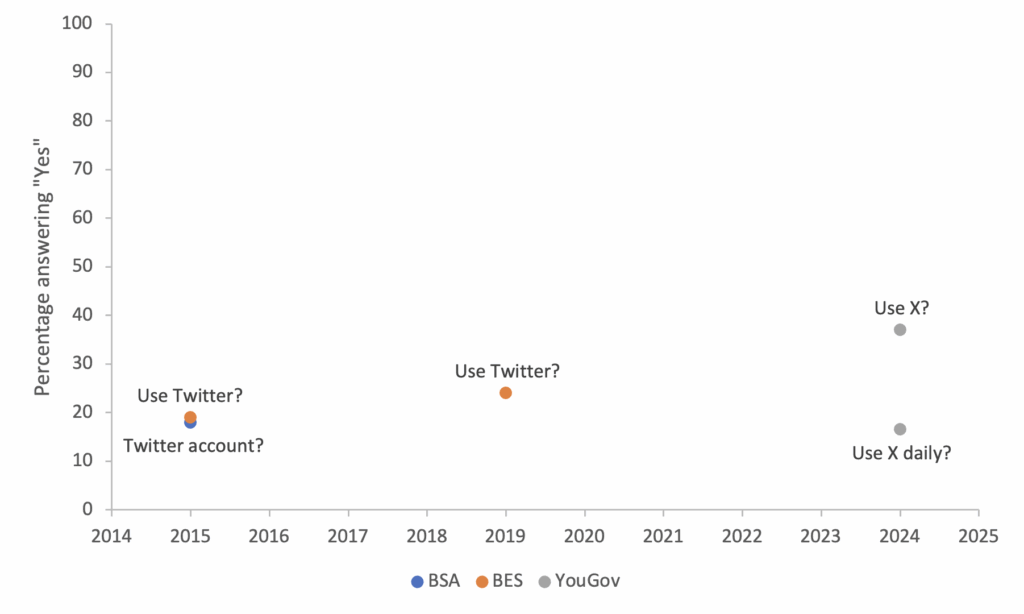
While the percentage of people who say they use X may have trended upwards since 2015, only about one in six people uses the platform daily, as of 2024. This means that over 80% do not.
According to the YouGov polls, supporters of Labour, the Lib Dems and Reform are all about equally likely to use X daily, whereas Conservative supporters are less likely to do so. This is partly an age effect: Conservative supporters tend to be older and people aged 65-plus are far less likely to be daily active users. However, we know that supporters of both Right-wing parties tend to be older (recent polls show a steep age gradient in support for Reform). Which suggests that young Reform supporters are overrepresented among those who use X daily.
Another interesting finding from the YouGov polls is that most British people have an “unfavourable” view of Twitter, including a sizeable minority of daily active users. As you might expect, Labour and Lib Dem supporters are the most likely to view the platform unfavourably. By contrast, almost everyone with a “very favourable” view of X supports Reform.
All this suggests that the content you see on X is not particularly representative of overall public opinion. Of course, this has always been true. The difference is that while the platform was previously tilted to the Left, it is now skewed to the Right.
To join in with the discussion please make a donation to The Daily Sceptic.
Profanity and abuse will be removed and may lead to a permanent ban.
There is plenty of support for hamas on X and plenty of abuse for Brexit. I certainly don’t get the impression that the Leftoids have all walked away.
“Reform’s MPs enjoyed vastly more attention on X”
Anyone that had been following opinion polls in the last year would not be surprised. Furthermore, Labour, Greens, Lib Dems, and Conservatives can’t stop talking about Reform. No need for conspiracy theories about algorithm tweaking.
10%, perhaps? We’re guessing, but it could easily be worse than typical opinion polls. Not worth using as a tool to develop real world policies.
Most people on x I think were not surprised about trump winning the last election, whereas every other media source seemingly was. I think this indicates X to actually be the best representation of public opinion out of all media.
It is only skewed to the right because it’s one of the only places for right wing opinions to be voiced, but even then it is closer to politically central than almost all of the heavily left wing MSM and other social media
Should we be referring to ‘right’ – it’s not really. I submit that what many of us actually want, and we all need, is a lot less government, a much smaller state, some form of libertarianism, which doesn’t have to be restricted by old left/right definitions. Take the Hunting Act for example. Hunting had support from some solid Labour voters, especially in the countryside, and obviosuly from the traditional hunting Tory, Both sides wanted to carry on a way of life and freedom that they had enjoyed for a very long time without politically motivated interference. So ‘less government’ [which is what Brexit should have been about] is what is needed. I may not like everything about Farage and Reform, and Trump is marginally a nutcase, but their instincts seem to push in the correct direction – ‘drain the overflowing, stagnant swamps’
What you describe is pretty much what I want. I think those things have traditionally been more valued by those describing themselves as “right” and I can’t think of a pithier term – the problem is that some people associate “right” with some kind of authoritarian government, which is certainly not what I want.
I don’t think Farage, Reform or Trump are notably libertarian small government politicians, just a tiny bit less socialist than the rest. I can only think of Javier Milei in terms of contemporary political leaders with those kinds of ideas – though there may be others of whom I am ignorant.
The big change on X has been the removal of the censorship by the Far Left of things and accounts they didn’t like. This persists on sites run by Google such as Youtube.
I stopped participating in YouGov polls years ago as the questions were biased and leading, often not reflecting my choice of answers.