
EXCLUSIVE: New Freedom of Information Revelation Casts Further Doubt on UK Met Office Claims of ‘Hottest Evah’ Temperatures
Following a Freedom of Information request, the UK Met Office has confirmed that it calculates the daily average temperature at each of its 403 weather stations by dividing the highest and lowest recordings by two. A small technical point of interest only to meteorologists, it might be thought. In fact, this disclosure, which has never been made clear across Met Office published sources, is the ‘smoking gun’ that calls into question all the claims of ‘hottest evahs’ that the state meteorologist uses to promote the political interests of the Net Zero fantasy. It might even stop the constant demotion of the glorious summer of 1976 in the record league table, pushed down to a lowly sixth place by the more dubious claims of recent summer scorchers.
This is why our exclusive revelation is so important. Over the last 30 years, the Met Office has moved to recording temperature remotely using automatic electronic devices. These are more accurate than the manual glass bulb thermometers of old that supplied a maximum and minimum temperature over a 24-hour period. For their part, the electronic devices can record temperature every few seconds to within five decimal points. But as the Daily Sceptic has disclosed over the last year, almost 80% of the stations in the Met Office network are poorly sited with unnatural heat influences raging through the recordings. In addition, Dr Eric Huxter has recently shown that heat spikes are a feature of many ‘extreme’ claims. Looking at the daily ‘extremes’ declared over the month of last May, he calculated that on average about 0.89°C was added to the maximum temperature by these temporary blips – temporary blips that would never have been picked up by slow-reacting glass bulb devices. Taken across the entire network, this must have a considerable effect by artificially inflating the daily, monthly, seasonal and annual averages. Last summer was said to be the hottest ever recorded at 16.1°C, but was it really any warmer than 1976 with an old-style average of 15.7°C?
The planet has warmed over the last 50 years, nobody denies that. Earth is in an interglacial and also bouncing back from a ‘mini’ ice age over the last 200 years. A rise of around 1°C over that latter timescale is not unusual, and has been observed many times in the paleoclimatic past. But over the last 40 years, the rises have been exaggerated and catastrophised by alarmists. They seek political power by demonising the trace gas carbon dioxide in order to seize control of the economic commanding heights afforded by the simple expedient of banning hydrocarbon use. The science writer Matt Ridley feels the Met Office has been “embarrassingly duped by activists”. Meanwhile, the evidence of temperature exaggeration gets more conclusive by the day. Poor quality data that often differ significantly from natural ambient air temperatures is being used to produce boosted averages that are compiled using simple 19th century statistical techniques.
Case in point. For electronic devices, the World Meteorological Organisation recommends compiling individual average temperatures at any point between one to ten minutes. The Met Office uses the lowest one-minute recommendation. This guarantees that any unnatural heat spike will be captured and integrated into the longer-term record if it should turn out to be the maximum produced over the 24-hour period. The Met Office must know that its network is prone to substantial heat spikes and must be aware that a longer averaging period would at least moderate these important recordings.
Minute records are not freely available on Met Office sites, but the Daily Sceptic can reveal the 60-second measurements either side of the 40.3°C national ‘record’ declared on July 19th, 2022 at RAF Coningsby. Over just three minutes, the temperature both rose and fell by 0.6°C and a subsequent FOI request indicated the presence of landing Typhoon jets.
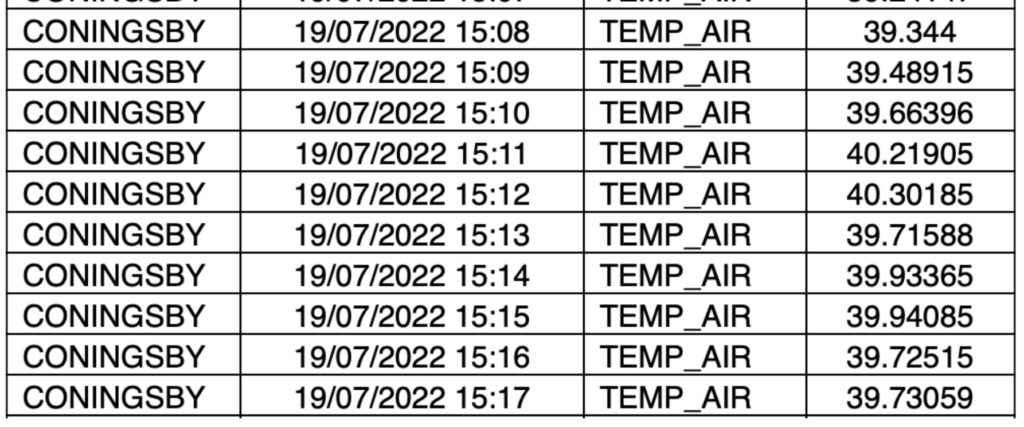
At 15.12 the high of 40.3°C was declared and subsequently publicised across mainstream media. But if an average temperature across five minutes is calculated, this falls to 39.96°C, while at the 10 mark there is a further decline to 39.8°C. Nobody is disputing that the day was hot, possibly the hottest in the 150-year record – it just wasn’t as hot as the Met Office indicated when it promoted a “milestone in our climate history”. But more importantly, the lower 10-minute average, which hopefully took away some of the effect of hot gases that might have been swirling around the runway, reduced the average temperature by 0.5°C. This amount matters when similar heat-spiked data are loaded into the longer-term record. Subsequently, the country data is used to calculate a global temperature in databases such as the Met Office’s own HadCRUT. The published global warming figure, compiled from similarly country-corrupted data elsewhere, leads to the not uncommon cry from alarmists that every tenth of a degree matters on the road to climate Armageddon.
In his seminal work, Dr Eric Huxter opened a window on the possible extent to which 60-second recordings were collecting large numbers of unnatural heat spikes. On May 1st this year, the Met Office claimed that its station at Kew Gardens recorded a temperature of 29.3°C at 2.59pm. This was said to be the highest temperature ever recorded in the UK on May Day. But the temperature was an obvious outlier, since it was a massive 2.6°C higher than that seen at 2pm and no less than 0.76°C above the figure recorded a minute later at 3pm. Temperatures can move around from minute to minute, generally in the 0.1°C–0.3°C range. The Kew uplift was the highest observed, although ‘record’ favourite Heathrow was not far behind on numerous highlighted occasions, as the information below covering April 26th to May 30th shows.
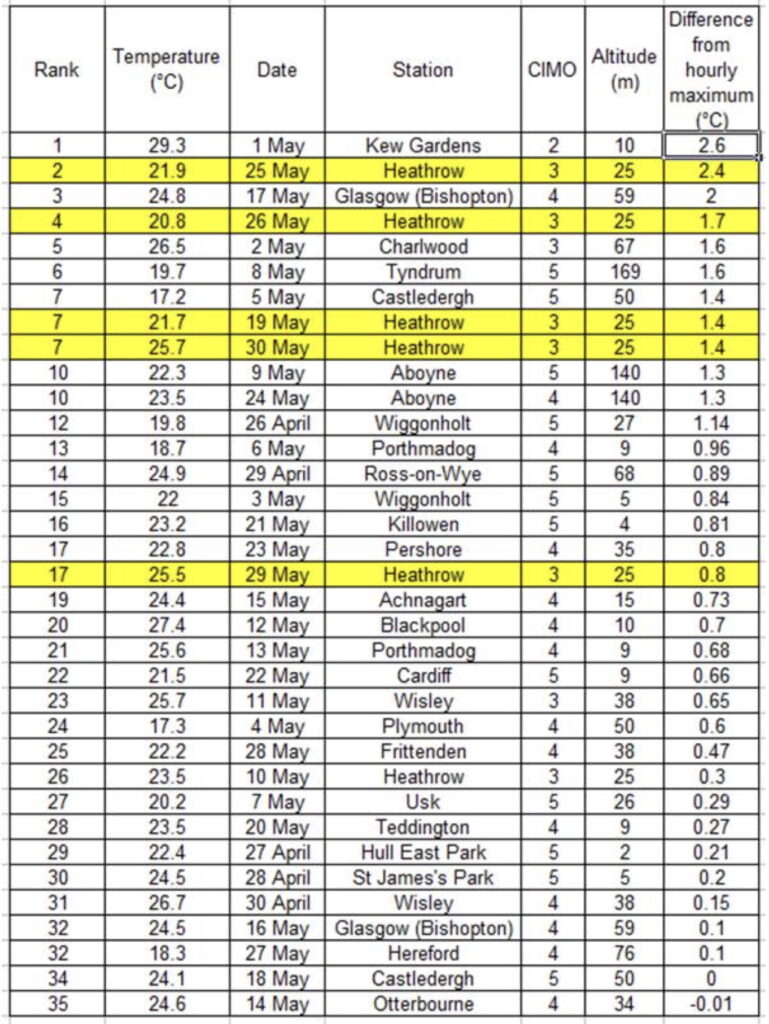
The overall average spike of 0.87°C calls into question the constant ‘hottest evah’ claims of the Met Office. The average of the top 20 sites, including five appearances of Heathrow Airport, is a massive 1.32°C. Met Office Chief Scientist Professor Stephen Belcher calls for Net Zero to “stabilise the climate”, and promotes his political cause by claiming that between 2014–2023, the number of days recording 28°C in the UK had doubled, while those over 30°C had tripled compared to 1961–1990. Trusted media messenger Justin Rowlatt of the BBC adds that climate change is dramatically increasing the frequency of “extreme” high temperatures in the UK. There has been a 40% increase in “pleasant days”, defined as around 20°C, he notes. Presumably just before going for a lengthy lie down in a cool dark place, he added: “These changes may sound positive, but the UK’s shifting climate represents a dangerous upheaval for our ecosystems as well as our infrastructure.”
Around the world, Net Zero is either dying or being ignored and ‘climate change’ is slipping down the public agenda. In Trump’s America, the large federal budgets funding climate alarm, including those at the weather service NOAA, are being annihilated. Not to put too fine a point on it, the general public is getting heartily fed up with the never-ending elite diet of climate alarm and silly predictions that never come to pass. They can smell a political rat when they see it in constant action. The danger for the UK Met Office is that going all in on this fearmongering with data that is not as ‘robust’ as is often claimed will erode hard-won trust in the organisation. Its main role is to warn of genuine weather dangers, not to use every hot, rainy or dry day as an excuse to ramp up mass climate psychosis.
Chris Morrison is the Daily Sceptic’s Environment Editor. Follow him on X.
To join in with the discussion please make a donation to The Daily Sceptic.
Profanity and abuse will be removed and may lead to a permanent ban.
My default assumption is that whatever comes out of the Met Office is a lie. This goes for the rest of quangos, and government departments.
100% agree with you Neil.
Still sort of on the same subject. The Summer of ‘76 was the longest and hottest Summer in my lifetime. What with the amazing weather, amazing fun packed life, I had better leave that one there before I am called names or moderated. And some amazing music. The sex Pistols, I am going to see a John Lyndon show soon but far and away one of the greatest Albums I possess. ‘Frampton Comes Alive’.
Life really was fun then, people were not afraid to say what they thought.
I was out on my bicycle fighting fires across the heathland in my corner of Surrey where they burnt down into the peaty soil and then erupted again. Did this happen this summer after the long dry spell? No.
Apologies, misspelt name. It should be Lydon , aka Johnny Rotten.
Exactly
Very wise.
Great comment and I would add to your default assumption anything preceded by the words ‘”the governments own….” which is along the lines of Ronald Reagan’s famous quip that the nine most terrifying words in the English language being “I’m from the government and I’m here to help”.
So… will the Met Office advise farmers to reap their crops at 14:37 Tuesday, not at 14:36 or 14:38?
The Met Office should refocus on reporting and predicting ‘weather’ in the short term.
“It might even stop the constant demotion of the glorious summer of 1976 in the record league table, pushed down to a lowly sixth place by the more dubious claims of recent summer scorchers.”
The hottest evah claim for this summer is for MEAN temperature, and it was almost certainly due to the warmth of the nights, even in rural locations, in addition to the high number of hot sunny days.
The attitudes expressed in this website are usually couched in scientific terms, but IMO are unscientific. There are always problems with experimental data, science deals with these problems, it does not simply point them out and hold its hands up in surrender, claiming that no conclusion can be reached.
What significance does a small variation in MEAN temperature have?
The hottest evah claim for this summer is for MEAN temperature,
Mean temperature is a statistical fiction.
Summing the max and min and dividing by two seems a bit crude – I would have assumed that something more sophisticated would have been done, looking at the distribution curve of temperatures over time. Perhaps in practice the results are similar. Temperature is very strongly related to time of day, and to place. The idea of averaging temperatures from different places or the same place at different times still does my head in.
Until recent decades the daily max and min was all that was available, so for continuity it is best to continue with simply averaging them.
Average temperature is anyway a bit of a rubbish concept, a desert can have a nice balmy figure of 15C, when its nights are -10C and its days are +40C.
Point 1 – yes that sort of makes sense though continuing with something that is not very accurate is arguably not a great idea. It really depends on whether the results would be all that different.
Point 2 – I agree.
For continuity of the Met office Dangerousest Climate Change Eva! narrative, that’s probably the method to go forward with because it artifically reproduces no longer existing deficiencies of obsolete temperature recording devices.
OTOH, from a standpoint of applied physics, this method is little more than one designed to maximize the effect of irrelevant short-term fluctuation in temperature a more sensible mathematical treatment would seek to minimize instead.
Why even take any notice of the government mouthpiece on fake climate change? They are as honest as the BBC, so just ignore them completely and don’t give them the oxygen of publicity.
The Sun or large volcanic eruptions rule the climate. End of. All cyclical over varying time scales. Entire civilisations have vanished due to drastic changes in the climate. Not an engine in sight.
This method of ‘averaging‘ is more scientifically illiterate than it appears. Temperature is an intensive property: it cannot be added or averaged. Ie if you took a glass of water at 10ºC and added it to a bath of water at 50ºC, you would not get a 60ºC bath of water. The change would be barely measurable.
That is because temperature does not reflect relative volumes. However even using the Met office’s method for a bath and glass of water average you would get 10+50 = 60÷2 = 30ºC. Which is also clearly nonsense.
“…used to calculate a global temperature in databases such as the Met Office’s own HadCRUT.”
It is reasonable to believe that inaccurate/over-stated temperatures, a jumble of very accurate electronic instruments and glass instruments with accuracies ranging from +/- 2C to +/- 5C, are fed in to the databases from all round the World meaning HadCRUT is junk.
The whole climate industry is junk.
Well, here is the good news.
The climate freaks needn’t continue worrying about climate change because clearly these record temperatures are unnoticeable. In fact they feel like years past or even a bit cooler.
So great news: climate change has no discernable effect.
Recording to 5 decimal places is ridiculous and leaves me wondering if they are calibrated and what is the actual accuracy of the devices. I have worked in engineering and testing and I have never used anything that records temperature to 5 decimal places as it would simply be a nonsense. To 2 decimal places would be enough.
Seconded. Does anyone understand that measuring temperature to this display of precision is simply nonsense.
I have returned from a horrible holiday in the South of France where it was too hot for a northern Anglo Saxon. As we arrived at thecoast the car temperature gauge measuring the outside temperature on the road showed 38C. At night it went down to 25C. When my heat resistant better half wanted to go to an art exhibition inland the temperature was 38C leaving and reached 45C. On the way to the hypermarket in the afternoon it reached 47C. Fortunately we had aircon. How would those temperatures be averaged?
And for what purpose?
The Victorians “discovered” the South of France and went there in the winter. 1936 Popular Front Govt. in France gave the workers holidays and the French went there in the summer. Nov. to May it is very pleasant.
“UK Met Office has confirmed that it calculates the daily average temperature at each of its 403 weather stations by dividing the highest and lowest recordings by two.”
“Dr Eric Huxter has recently shown that heat spikes are a feature of many ‘extreme’ claims. Looking at the daily ‘extremes’ declared over the month of last May, he calculated that on average about 0.89°C was added to the maximum temperature by these temporary blips”
Are there corresponding “cool spikes” which would tend to reduce the net effect of “heat spikes” on the daily average ?
Just read up quickly about response times of temperature sensors. For modern electronic sensors the responses vary depending on the size of the sensor, its mechanical packaging and the rate of air flow around it (1 m/s seems to be a standard – roughly 2mph). Response times seeem to vary from 20 to 60 seconds. On a still, hot day I am not sure if the airflow inside a Stephenson screen would achieve 1 m/s.
With mercury thermometers the response time is between 3 and 5 minutes, pretty much invalidating and comparison between now and then, so hottest day evah is more like hottest day in the last few dozen years.