
The Red Flag Over London: How Britain Handed Beijing the Keys to the Kingdom
On the north bank of the Thames, ironically opposite the Tower of London, a fortress is rising. Officially, it’s the new Chinese Embassy. In reality, it looks less like a diplomatic mission and more like the command post of a hostile power. A sprawling, six-acre compound big enough to garrison a small army. Europe’s largest embassy? Spare me. After GCHQ confirmed Chinese state-sponsored hackers have been targeting our telecoms, transport and even military infrastructure for years, only a fool would see this as anything other than a surveillance citadel with a red flag on top. One conveniently parked a stone’s throw from MI6. It’s the diplomatic equivalent of pitching a tent in your enemy’s back garden, then waving from the kitchen window.
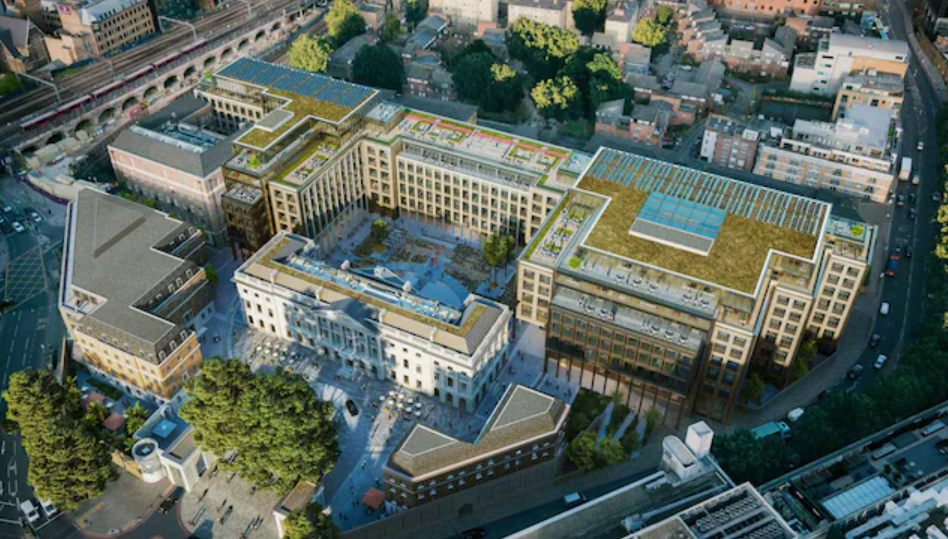
If this were America, construction crews would have been chased off site months ago. But this is Britain, where appeasement is a planning condition and timidity is a national pastime. Our politicians mutter about ‘concerns’ and ‘further review’ while China builds its very own castle in the capital.
It is one thing to let Islamic jihadists stroll through the front door, as successive governments have done in the name of multicultural virtue. It is quite another to wave in megalomaniacal Chinese operatives through the back door, under the respectable label of ‘diplomatic staff’. The jihadists at least announce themselves with slogans and bombs. The Chinese do it with planning applications, architectural drawings and greyed-out floorplans that mysteriously conceal half the site’s true purpose.
The embassy is planned on the site of the old Royal Mint. You could hardly script the symbolism better: Beijing stamping its authority on British sovereignty where our coins of the realm were once struck. The blueprints include “cultural halls”, “embassy housing” and vast subterranean spaces. When asked to clarify the greyed-out zones, Chinese officials told London planners, in effect, ‘trust us’.
This from a regime that trusts no one, spies on everyone and treats international treaties as disposable napkins – a regime with the most advanced facial recognition software and cyber-espionage tools, that lied through its teeth about Covid’s origins, gagged the doctors who tried to warn us, then somehow managed to recast a global plague as a triumph of Chinese discipline.
Angela Rayner, now in charge of levelling-up and planning, has hit pause on the project. Not out of principle but because even Labour’s front bench realises you can’t let China build a surveillance citadel beside your intelligence service without at least asking awkward questions. Yet ‘pause’ is all it is. Britain dithers, Beijing builds.
Trusting China is like trusting an arsonist with a box of matches. Hong Kong was guaranteed ‘one country, two systems’ until 2047. That lasted less than 20 years. The World Trade Organisation was assured Beijing would play fair. Instead it weaponised the rules and gamed the system. In Africa, Belt and Road projects promised development. What arrived were debt traps, corrupt deals and ports pledged as collateral. Yet Britain, home of Bletchley Park, birthplace of parliamentary democracy, is expected to accept at face value that this mega-embassy is a cultural outreach centre. Pull the other one; it’s wired for sound.
Part of the problem is the sheer cowardice of our establishment. Civil servants treat China like an awkward dinner guest. Too rude to challenge. Too important to ignore. Universities and elite public schools suck in billions from Chinese students and shut up about intellectual theft and cultural appeasement. Politicians recite mantras about ‘balancing engagement with caution’. A phrase that translates in mandarin as ‘we’re scared of losing the money’.
Meanwhile, MI5 issues rare public warnings that Chinese agents are operating at scale in Britain, cultivating MPs, infiltrating institutions and manipulating diaspora communities. The United States has expelled diplomats, prosecuted operatives and restricted consular access. Britain, by contrast, has offered Beijing a riverside palace with planning perks.
The truth is brutal. We are no longer treated as a serious country because we no longer behave like one. Nations that command respect defend their sovereignty. They don’t become doormats. This embassy, if built, will not just be a building: it will be a symbol of British decline. Our willingness to trade national security for student fees, short-term investment and the illusion of ‘global Britain’.
Don’t think China doesn’t see it that way. For Beijing, this is about prestige. Why else make it the biggest embassy in Europe? It is a statement: we are here, we are watching, and you are too weak and feeble to stop us.
Here’s a truly radical idea. Bin the entire super-embassy fantasy. Tell Beijing it can have the same footprint as our actual allies, as opposed to handing the biggest threat to liberal democracy and Western hegemony the keys to our capital.
If the Chinese want to build a monolith to Communism, they can plant it beyond the M25 where it can eavesdrop on cows instead of Cabinet Ministers. Subject it to the same planning scrutiny inflicted on a Croydon loft conversion. If the mandarins of Zhongnanhai pout or sulk, let them. Better that than Britain playing accomplice in its own surveillance – like a mug handing the burglar his own house keys and then thanking him for the privilege.
Historians will record this not as a new dawn of diplomacy, but as another sunset in the long decline of a country that once led the world. They’ll write of the Great Wall of the North Bank, a concrete citadel draped in Beijing’s red flag and conclude this was the moment Britain stopped even pretending to be sovereign.
Because sovereignty isn’t snatched in some daring midnight heist. It’s frittered away, brick by brick, while a chorus of cowards, careerists and compromised halfwits clap politely and call it statesmanship.
Clive Pinder writes from the awkward space between common sense and treason. Lapsed executive, writer, broadcaster and equal opportunity offender, you can find his work on Substack.
To join in with the discussion please make a donation to The Daily Sceptic.
Profanity and abuse will be removed and may lead to a permanent ban.
Room for a few “asylum seekers” perhaps? Looks like a big site, and quite close to the Home Office.
Gotta have a local branch of Bank China.
Gotta have a local BYD showroom.
Gotta have a local branch of Communism Central.
The Labour Cabinet have been back and forthing to China, because its their Communist high church, its what the Labour Party wants for this Country and if that means they sell us out to China to bring the revolution forth, thats what they are going to do, I wouldnt be surprised if they ask China to bail us out of the financial mess. Like Wilson was with the USSR, so is Starmer, Milliband etc with the Chinese, only this time they are really going for it, we are already well down the road of the implementation of the Labour Communist agenda.
It’s increasingly clear now that Starmer, Miliband and crew are bought and paid for Chinese assets.
“Tell Beijing it can have the same footprint as our actual allies, as opposed to handing the biggest threat to liberal democracy and Western hegemony the keys to our capital.” Why? That is weakness too. China doesn’t need anything bigger than the Russian’s have in the UK and the location no more prestigious either.
Starmer, Lammy and Reeves all visited China within weeks of the election, presumably to kow-tow to their ideological masters.
The Embassy fits the behaviour, along with the transfer of British jobs to the world’s factory in Beijing.
Carbon Zero, the killing of our energy and the mass production of solar/wind hardware (using coal power!) is a major part of the plan, enforced by Comrade Milliband.
Whilst I agree with most of this article, I do not think it is fair to suggest that the “One country, two systems” agreement for Hong Kong “lasted less than 20 years”. In fact Hong Kong still pretty much has the same system of government, laws, law enforcement, business and so on that it did in 1997, when the agreement came into effect. It has certainly not been integrated into mainland China. That agreement ends in 2047. I do not expect Hong Kong to remain unchanged until then, and then suddenly switch to the mainland system. That would not be in anyone’s interests. Of course, during the period of the agreement, Hong Kong will gradually change to be more like the rest of China, and no doubt that process will continue after 2047. Perhaps the author would point to the National Security Law as a breach of the agreement. But that law was passed in the context of violent demonstrations against Hong Kong being part of China, and in favour of a democracy that never existed in Hong Kong during the period of British rule. It was passed in the context of ordinary Hong Kong people being scared to go… Read more »
I appreciate your thoughtful perspective, but I would push back gently on the idea that Beijing has “adhered remarkably honourably” to the 1997 Joint Declaration. Yes, Hong Kong still has a separate legal and economic system in form — but the spirit and guarantees of “one country, two systems” have been eroded far earlier than 2047. A few concrete examples: The 2020 National Security Law: This was not simply a response to unrest. It was drafted in Beijing, bypassing Hong Kong’s legislature, and criminalised dissent in ways directly at odds with Article 23 of the Basic Law. Its vague language (“subversion,” “collusion with foreign forces”) has been used to prosecute journalists, opposition lawmakers, and peaceful activists — chilling freedoms that were explicitly guaranteed. Disqualification of legislators (2016–2021): Pro-democracy candidates who had won legitimate elections were barred from office for failing a “patriotism test.” That directly undermines the promise of “high degree of autonomy” and free elections. Press freedom clampdowns: The forced closure of Apple Daily in 2021 and the prosecution of its founder, Jimmy Lai, illustrate how the once-free media environment has been curbed. Hong Kong consistently ranked among the freest presses in Asia pre-2019; now it sits far lower… Read more »
I guess that depends what “remarkably honourably” means!
I do think Hong Kong still has a
separate legal and especially economic system in much more than just form.
Article 23 says that Hong Kong SAR itself will pass a national security law. It tried to do that, but was prevented by widespread demonstrations against it. In response, Beijing imposed the National Security Law that is now in force, preventing demonstrations and therefore allowing the Hong Kong government to pass its own legislation to give effect to Article 23, which it duly did.
In fact, I think the “pro-democracy” activists overplayed their hand, effectively forcing a response from Beijing. And let me say once again that democracy did not exist in Hong Kong under British rule.
This is all quite complicated but I am anxious that Hong Kong does not become simply a political football, being used by the West to bash China. The people of Hong Kong deserve better than that.