The ‘Zombie’ Net Zero Levy Adding Billions to Britain’s Energy Bills
A Net Zero levy, hatched under Tony Blair to boost renewables, is still sucking billions from household energy bills even though it closed to new entrants in 2017. The Telegraphhas the story.
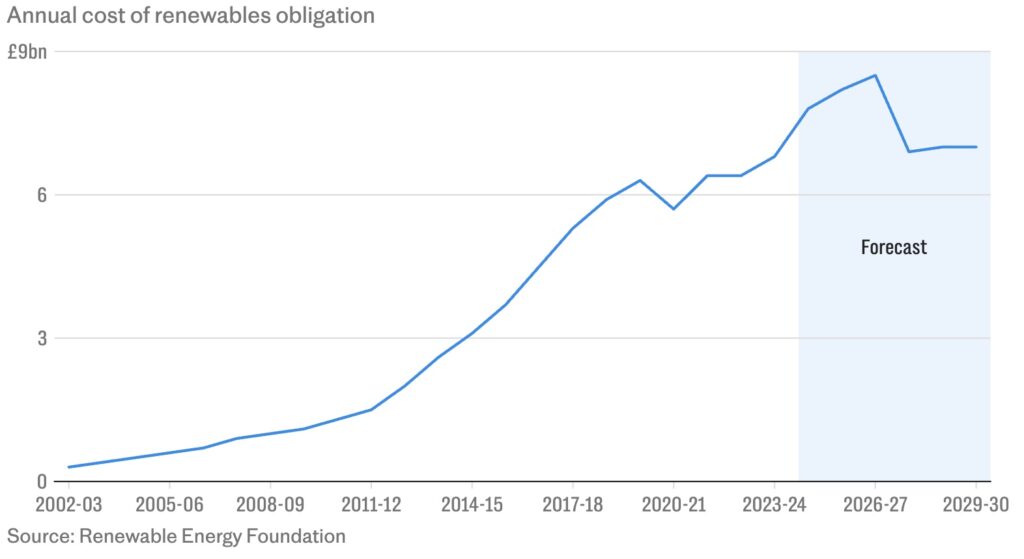
The green energy subsidywas closed to new entrants in 2017, but is still poised to add £38 billion to UK power bills over the next five years, documents from the Office for Budget Responsibility (OBR) have revealed.
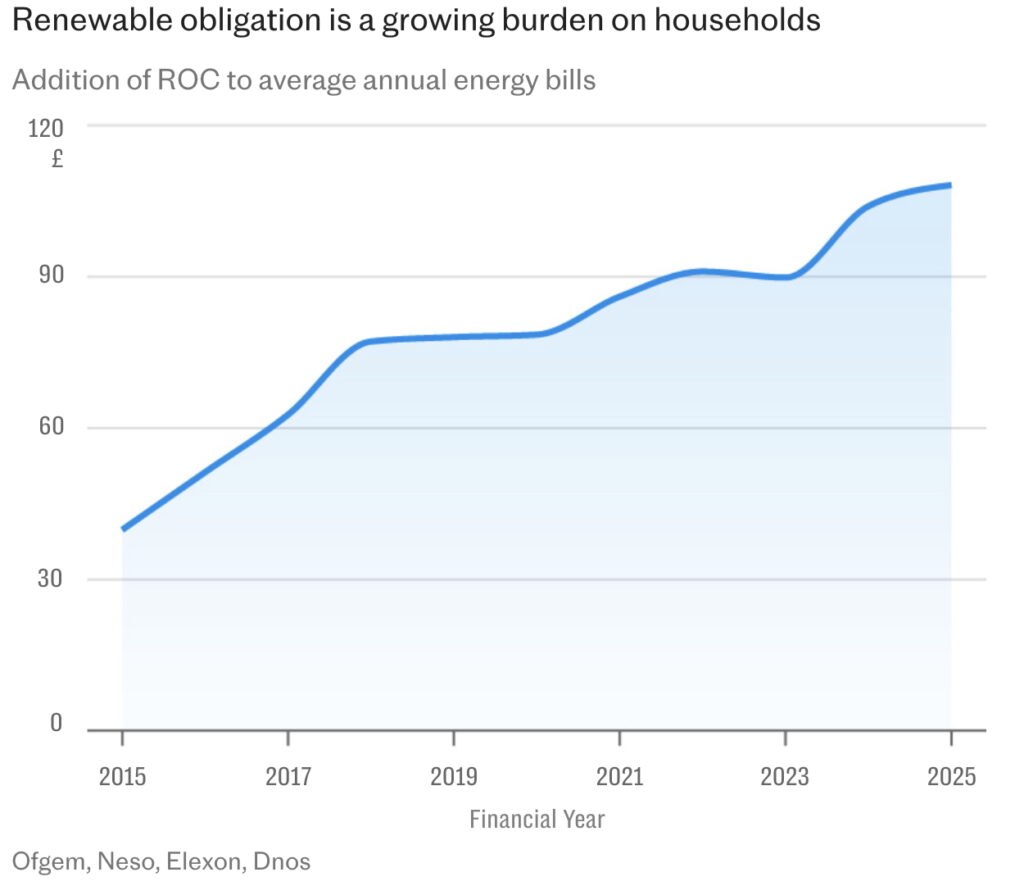
A decision by the Labour politicians who created it 25 years ago means costs are still rising – and it will add an average £108 to every household power bill this year.
The renewables obligation was a scheme set up by Tony Blair’s government to encourage developers to build more green energy generation capacity, such as wind and solar farms, and to push suppliers to buy more clean power.
But a decision to link the cost of the scheme to an outdated measure of inflation has led to spiralling costs, meaning the renewables obligation is now by far the biggest of the six main green levies added to Britain’s power bills.
It has added over £75 billion to the nation’s energy bills between its introduction in 2002 and now – and it will continue rising.
The “zombie” levy cost £6.7 billion in 2023–24, according to the OBR, but this is forecast to jump to £8.5 billion by 2026, a 25% increase.
It implies annual household energy bills could increase by at least another £20 over the next two to three years simply because of the subsidy. …
The origins of the “zombie” levy go back to 2000 and Blair’s first government. Stephen Byers, the then-Business and Energy Secretary, piloted the Utility Act 2000 through Parliament, which enabled the renewables obligation system.
Under the scheme, electricity generators could claim a renewable obligation certificate, or ROC, for each megawatt hour produced from renewables such as wind, solar or hydropower.
Separately, suppliers – the companies that bring power into our homes and businesses – had to hand over a specified number of ROCs to Ofgem, the regulator, each year.
The system immediately created a market for these green energy certificates, with suppliers effectively forced to buy them from renewable generators.
Since the cost of a ROC was close to the cost of a megawatt hour, the scheme typically doubled green energy generators’ income.
Since trading was between businesses, the system wasn’t clearly flagged on energy bills. But consumers were ultimately paying for them through higher power prices as suppliers passed on the cost. bring power into our homes and businesses – had to hand over a specified number of ROCs to Ofgem, the regulator, each year. …
The real damage lay in a single decision: to link the cost of these green certificates to the retail price index (RPI).
Ministers wanted to link ROCs to inflation to ensure they kept their real-terms value. However, economists view RPI as a discredited measure that massively overstates the inflation rate.
The Office for National Statistics agrees and relies on a different measure, the consumer price index (CPI).
The difference between the two is stark. Since January 2002, prices have risen by 88.5% according to the CPI, but on the RPI, they are up 133.4%. …
A second separate decision has amplified the impact. The ROC scheme was meant to encourage development of new renewable generation capacity. But that risked leaving schemes built before 2002 out in the cold. Those built after that date could juice their profits by selling ROCs, leaving legacy generators struggling to keep up.
So they were allowed to join too. About 600 such generators did just that, with the oldest being a hydropower plant built at Kinlochleven, in Scotland, in 1909. …
Ed Miliband reviewed the system during his first stint as Energy Secretary in 2009, awarding offshore wind developers and others extra certificates for each megawatt hour generated to incentivise developers.
That change just increased the costs. By 2015, ROCs were adding £40 to the annual domestic bill and becoming a costly political embarrassment.
Greg Clark, the then-Energy Secretary, closed the scheme to new entries in 2017 and replaced it with the contracts for difference system, a different subsidy scheme also inflation-linked – but to the CPI.
For projects already in the ROC system, however, the bonanza will continue until 2037 – as will the costs to consumers. The impact on household bills rose to £79 in 2020 and £108 this year, about 11% of the average power bill.
Well fancy that, Bliar at the heart of the problem.
A cast iron rule of thumb once a problem is identified in this country is to allocate said problem to the machinations of Bliar, ninety-ninety percent of the time he will be the cause.
I reckon it’s 99.99% in all fairness, and even if that’s not the case he deserves all the blame and opprobrium that there is because of his insane bouffant-haired grinning insanity.

To join in with the discussion please make a donation to The Daily Sceptic.
Profanity and abuse will be removed and may lead to a permanent ban.
https://www.express.co.uk/news/world/2099267/eu-country-stops-migrants-legal-support?utm_medium=Social&utm_source=Facebook#Echobox=1755956536
So we can expect an influx from Germany. Aren’t they kind?
Well fancy that, Bliar at the heart of the problem.
A cast iron rule of thumb once a problem is identified in this country is to allocate said problem to the machinations of Bliar, ninety-ninety percent of the time he will be the cause.
I reckon it’s 99.99% in all fairness, and even if that’s not the case he deserves all the blame and opprobrium that there is because of his insane bouffant-haired grinning insanity.
Cheers.
Happy to accept your 99.99% assessment. 👍