
The False Promises of Electric Vehicles Are Being Exposed
Shipping giant Matson declared last week that it would no longer transport electric vehicles (EVs) or plug-in hybrids on its vessels, citing the fire risks posed by lithium-ion batteries. This decision, effective immediately, followed the catastrophic sinking of the carrier Morning Midas earlier in June. The blaze, which aerial imagery showed billowing from the ship’s stern, underscored the perilous nature of lithium-ion battery fires — intense, almost impossible to extinguish, and prone to reignition.
Lithium-ion battery fires, as seen in incidents like the Morning Midas, Felicity Ace (2022), and Fremantle Highway (2023), are a unique hazard. These fires, driven by thermal runaway — a rapid, self-heating reaction — burn hotter than conventional fires, produce toxic gases and can reignite days or weeks later. In response, some German cities have banned EVs from underground parking due to fire risks, and a Norwegian ferry operator has prohibited them outright.
Matson’s move is a stark symbol of a broader reckoning: the electric vehicle revolution, once heralded as the inevitable future of mobility, has come full circle. Like a Rorschach test, the EV experience has exposed its hollow promises, revealing a deeper pathology in Western society’s obsession with ‘green’ ideals.
The False Promises of EVs
Just a few years ago, the narrative was unambiguous. EVs were heralded as the vanguard of a clean, renewable future, poised to banish the polluting tailpipes of internal combustion engine (ICE) vehicles to the ash heap of history.
Every major automaker — from General Motors to Volkswagen — proclaimed ambitious plans to pivot entirely to electric fleets by the 2030s. General Motors, a leading force in the automotive industry, had “committed fully to an all-electric future”, EV Magazine claimed as recently as August of last year. By June of this year, however, Politico reported that “General Motors quietly closed the door this week on a goal to make only electric vehicles by 2035”.
The shine was coming off the EV narrative even before the onset of President Trump’s energy counter-revolution this year with his ‘energy dominance’ and ‘drill, baby, drill’ agendas to end the Obama and Biden mandates and subsidies for favoured ‘green’ industries including EVs. Sweeping tax and budget legislation approved by Congress in the ‘Big Beautiful Bill’ will end the $7,500 tax credit for buying or leasing new electric vehicles and the $4,000 used EV credit on September 30th.
In March 2024, CNBC published a widely cited article entitled ‘EV euphoria is dead. Automakers are scaling back or delaying their electric vehicle plans’. The outlet’s automotive industry reporter Michael Wayland wrote:
For years, the automotive industry has been in a state of EV euphoria. Automakers trotted out optimistic sales forecasts for electric models and announced ambitious targets for EV growth. … Now the hype is dwindling, and companies are again cheering consumer choice. Automakers from Ford Motor and General Motors to Mercedes-Benz, Volkswagen, Jaguar Land Rover and Aston Martin are scaling back or delaying their electric vehicle plans.
Governments, particularly in the West, fuelled the EV frenzy with hefty subsidies, tax credits and mandates, while environmental activists hailed EVs as the moral choice to ‘save the planet’. To many, the allure was seductive: silent, smooth-riding vehicles that emit no tailpipe pollution with the promise of lower running costs. They offered affluent Gaia worshippers a ‘guilt-free’ driving experience. Yet, as Matson’s decision signals, the EV dream has collided with harsh realities — economic, environmental and practical — that no amount of propaganda or subsidies can obscure.
The EV narrative is built on a foundation of optimistic assumptions which have crumbled under scrutiny.
Take the ‘range anxiety‘ that afflicts many potential EV customers. Despite advances in battery technology, EVs still struggle to match the convenience and reliability of ICE vehicles for long-distance travel. The time required to charge — often 30 minutes to several hours, depending on the charger — compares unfavourably to the five-minute refuelling of a car run on gasoline or diesel.
In most countries, charging infrastructure, while expanding, remains unevenly distributed, with rural areas and even some urban centres woefully underserved. Planning a long distance journey in an EV often feels like a logistical puzzle, requiring meticulous mapping of charging stations and contingency plans for delays or outages. This inconvenience has not gone unnoticed by consumers, who increasingly view EVs as a hassle rather than a liberation.
Every now and then, news of battery technology ‘breakthroughs’ gets reported with hopes of EV nirvana around the corner. For example, a story in CarNewsChina published last month reported that “Huawei has stepped up its ambitions in advanced energy storage with a patent for a sulphide-based solid-state battery that offers driving ranges of up to 3,000 kilometres and ultra-fast charging in just five minutes”. Amateur scientist Willis Eschenbach and expert debunker of magical thinking in energy physics reacted to this story in his inimitable way: “But, as usual, reality is hiding out in the fine print, ducking the spotlight while the PR machine does its victory lap. Nobody wants to talk about physics. Nobody asks how, exactly, you’re supposed to pour Niagara Falls through a garden hose.” He was referring to the impossible physics underlying the claims of “ultra-fast charging” by Huawei.
The economic case for EVs has also faltered. Proponents claimed EVs would be cheaper to own and operate, but the reality tells a different story. Higher upfront costs of EVs relative to ICE vehicles, typically 30-40% higher, were only partially bridged by subsidies such as the generous $7,500 federal tax credit in the US under the Obama and Biden administrations which, as already noted, are slated to end shortly.
EVs depreciate more rapidly than conventional vehicles, with some models losing up to 50% of their value within the first two years. Battery replacement costs can reach $30,000, further diminishing resale value. Insurance costs are reported by some to be exorbitantly more expensive. In the UK as elsewhere, the second-hand market for EVs has collapsed, with resale values plummeting as consumers shy away from used batteries with uncertain lifespans and as car companies keep discounting prices on newer models as sales start to slow. Car rental companies like Hertz have suffered massive losses after investing heavily in EV fleets, only to find them depreciating rapidly and sitting idle due to lack of demand.
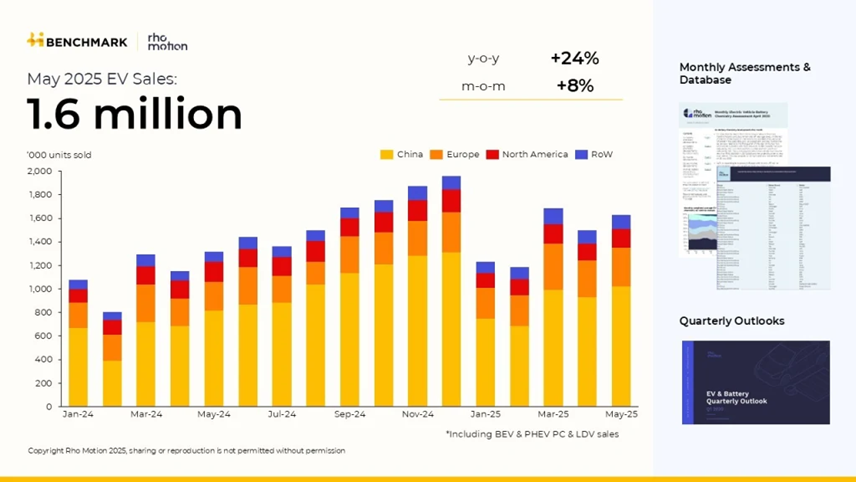
The latest data on global EV sales present a mixed picture. Year-to-date January to May 2025 global EV sales grew by 28% over the same period last year. This might suggest that overall, despite the many news headlines about struggling car manufacturers faced with slowing sales figures, the EV transition to electric mobility is still robust.
Yet, a quick glance at the data by regional breakdowns shows that the EV story is overwhelmingly a China-focused one. Europe bought 1.6 million more cars in 2025 so far relative to the same period last year, or 27% more. North Americans bought only 0.7 million more, or 3%. The ‘rest of the world’ bought 0.6 million more EV units or 36%. China alone accounted for 4.4 million new EV units, logging a growth of 33%. To call what is essentially a China-dominated story a global EV success story is a sleight of hand.
Given the opacity of China-related news, it is not clear what to make of reports about vast ‘graveyards’ of unsold EVs in various cities. A Bloomberg article in 2023 reported that “a subsidy-fuelled boom helped build China into an electric-car giant but left weed-infested lots across the nation brimming with unwanted battery-powered cars”. A report published on Friday warned that “the Chinese auto industry is a bubble about to burst after years of artificially inflated sales and brutal price wars. The scheme involves registering new vehicles in China and then selling them abroad as used vehicles despite being essentially ‘zero-mileage’ cars. This allows carmakers to report high sales numbers even though the market is on the brink of collapse.”
Indeed, inflating EV sales figures is not restricted to China. Geoff from Geoff Buys Cars reveals how EV sales numbers are artificially inflated in the UK. Thomas Shepstone of the Energy Security and Freedom Substack explains it as follows:
Historically, some dealers have registered vehicles to themselves or their dealership to meet sales targets set by manufacturers, qualify for bonuses or clear inventory. This can temporarily inflate reported sales figures, but these vehicles often end up as demo models, loaners or used inventory, not actual consumer sales. … For EVs, the high cost (average transaction price of $56,351 in Q3 2024) and uneven consumer demand could incentivise such behaviour, especially for brands struggling to move EV stock.
As pointed out by David Blackmon is his widely read Energy Transition Absurdities Substack, the other striking take-away from the graph is the much lower sales this year overall from the peak in December 2024. Blackmon states: “What this chart starkly reveals is that the global EV industry has suffered a dramatic drop in sales this year, from almost two million in December 2024 to a bit less than 1.6 million in May 2025. That’s a collapse of 20% in sales in just 150 days or so.”
It might be argued that comparing December to May sales figures may be misleading and that the second half of this year might surprise on the upside. Few would want to bet on this presumption. Certainly, most of the auto manufactures who have the most to lose (or gain) financially, as we have seen, are scaling back.
Dirty Secrets of Clean EVs
The environmental argument, the cornerstone of the EV push, is equally shaky. Advocates claimed EVs would slash CO2 emissions, but lifecycle analyses reveal a more complex picture. Manufacturing EV batteries requires energy-intensive mining and processing of rare earths and minerals like lithium, cobalt and nickel. In countries like the Democratic Republic of Congo, cobalt mining by informal enterprise has led to environmental devastation and harsh employment practices including child labour.
The carbon footprint of producing an EV far exceeds that of an ICE vehicle, meaning drivers must log tens of thousands of miles before an EV becomes ‘greener’ – and that’s assuming the electricity grid is powered by renewables rather than natural gas and coal. In many regions, it isn’t. The International Energy Agency notes that over 60% of EVs sold in Mexico in 2023 and 2024 came from China, where coal-heavy grids undermine the ‘clean’ narrative.
While EVs eliminate tailpipe emissions, their heavier weight and faster acceleration increase particulate emissions from tire wear. Studies suggest that tire emissions can significantly exceed tailpipe emissions, contradicting claims of overall environmental benefits from EV adoption. The smallest tire particles, measured in nanometres, can enter lungs and spread into organs. Various tire components have been linked to chronic conditions including respiratory problems, kidney damage, neurological damage, and birth defects — a particular concern in low-income neighbourhoods adjacent to highways.
There are indirect costs of electric vehicles as well that, while not included in the cost an individual owner pays, are borne by the country. The most significant of these is the additional wear on infrastructure from EVs. Heavier vehicles on roads have negative consequences, and EVs are far heavier than their conventional vehicle counterparts. Heavier vehicles cause more damage to roads and bridges. Heavy EVs also pose a threat of parking structure collapse in older or less maintained carparks.
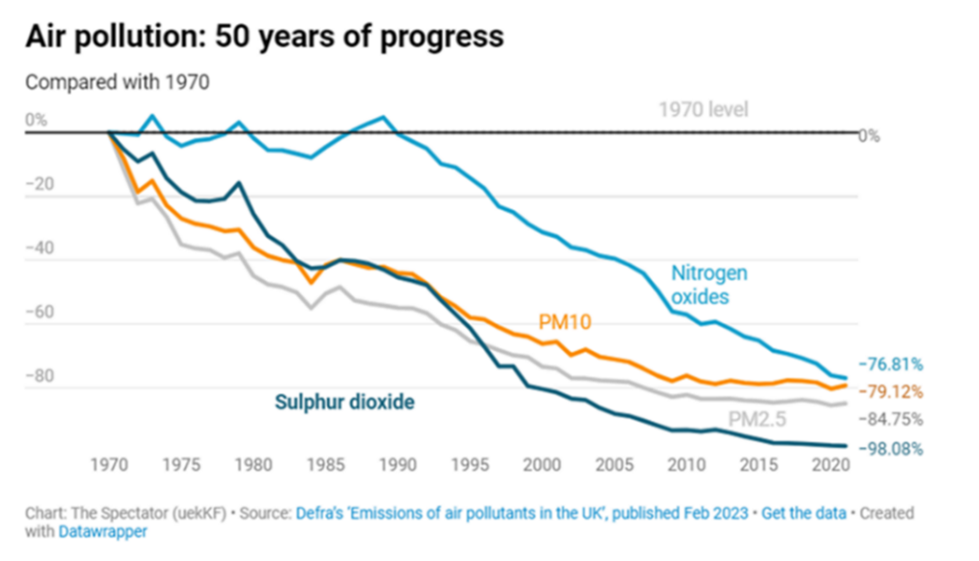
Not enough attention is paid to the fact that ICE vehicles have made remarkable strides over the past half-century in reducing emissions of actual pollutants. Sulphur oxides, nitrogen oxides, lead, mercury and ozone have been curtailed through cleaner fuels, advanced engines and scrubber technologies. Ambient urban conditions have improved markedly from the smog-filled cities typical of the 1950s and 60s. The ‘pea-soup‘ fogs of 1950s London are now a thing of the past.
It is also not widely reocgnised that carbon dioxide, often vilified, is not a pollutant but a trace gas essential for photosynthesis and life itself. The obsession with EVs, then, is less about economics, health or climate, properly understood, and more about a cultural pathology that ignores trade-offs and practicalities.
The Business World’s Retreat
The business world, once all-in on EVs, is now retreating. Major automakers like Ford, General Motors and Volkswagen, which once pledged to phase out ICE vehicles, are scaling back EV investments or halting new projects. In February 2025 it was reported that Ford Model e, the company’s electric vehicle division, had an earnings before interest and taxes (EBIT) loss of $5.1 billion in 2024 after losing $4.7 billion the year before.
A Politico report last month noted GM’s shift in investment focus consistent with a more pragmatic, market‑aligned strategy reflecting a reinforcement of gasoline‑engine investments and a broader step-back from all‑EV ambitions. This includes slowing the conversion of key factories to EV production in response to softening demand. Volkswagen’s CEO admitted in 2025 that the company’s EV push was “overly ambitious”, citing weak demand and supply chain issues. He called for greater flexibility in the European Union’s plan to ban sales of new combustion engine cars by 2035, warning that “the transition to fully electric vehicles may not happen as smoothly as expected”. He urged EU politicians to carry out a “reality check” and assess how fast electric vehicles are actually being adopted across member states.
Toyota, the one major outlier among large automotive companies with its cautious focus on hybrids, has emerged relatively unscathed, its strategy vindicated as consumer preference for hybrids grows. About four or five Chinese manufacturers, propped up by state subsidies, and Tesla are among the few still profiting from EVs. Even Tesla’s margins are under pressure as competition intensifies.
The Trump administration’s energy policy shift has accelerated this reversal, going beyond just dismantling subsidies for EVs and other ‘favoured’ renewables. US regulators have waived fines for automakers failing to meet fuel efficiency standards dating back to the 2022 model year, following a new law signed by President Donald Trump. This move, part of a tax and budget bill, puts an end to fines under the Corporate Average Fuel Economy (CAFE) rules established by a 1975 energy law enacted to address a different ‘problem’ (the Arab oil embargo)
After yanking the ‘pull’ factor (taxpayer-financed subsidies) and the ‘push’ factor (the CAFE standards which became increasingly punitive on gasoline and diesel vehicles), Trump also signed a congressional resolution last month that overturns a California state rule that would have phased out the sale of new gas-powered cars by 2035. The California rule and the decision to revoke it are a major deal for the US auto market. The state makes up about 12% of the US population and its rule has also been adopted by 11 other states and Washington, D.C.
A Rorschach Test for the West
The EV story is a cautionary tale of hubris and misplaced priorities. The promise of a clean, cost-effective and convenient future is seductive, but it ignored the complexities of battery production, mineral supply chains, infrastructure and safety. The environmental costs of mining, the economic burden of subsidies and mandates imposed to ‘save the climate’, and the practical limitations of range and charging have dismantled the myth of EVs as a panacea.
The natural market for EVs, brilliantly exploited by Elon Musk, was always the affluent ‘luxury beliefs‘ class of EV proponents and buyers who could afford having these status symbols as their second or third car. But to be a viable business, EVs had to be embraced by many more in the aspiring middle classes. EVs had to be seen as a rational response to both pollution and a belief that they would actually cost less to run once ‘all the costs’ were accounted for. In the ESG universe, this was called ‘doing well by doing good‘.
But, like a Rorschach inkblot, it now transpires that EVs reveal more about our desires than our realities. It was sold as mankind’s solution to poor urban air quality and man-made global warming – the former affecting the daily health of majority urban dwellers and the latter leading to an impending climate catastrophe for us and our children. Perhaps the love affair with the EV is a projection of Western guilt and idealism in the Church of Climate — a topic for experts on Western ‘mass formation‘ psychology.
As the auto industry pivots back to hybrids and ICE vehicles, and as shipping companies like Matson draw a line in the sand, the EV revolution stands exposed as another climate virtue narrative. The path forward lies not in ideological crusades but in pragmatic solutions — cleaner ICE technologies, robust hybrids and, for EVs, rigorous safety standards and transparent lifecycle assessments. Cars once again need to make sense for sovereign consumers spending their own money, without the carrots and sticks of intrusive government policies supposedly based on ‘The Science’.
Dr Tilak K. Doshi is the Daily Sceptic‘s Energy Editor. He is an economist, a member of the CO2 Coalition and a former contributor to Forbes. Follow him on Substack and X.
To join in with the discussion please make a donation to The Daily Sceptic.
Profanity and abuse will be removed and may lead to a permanent ban.
At last common sense starts to prevail! Along with the myth that men can be women is the myth of EVs being the future of motoring!
Hopefully we will see the climate change crisis being debunked too in favour of climate change revolution, just as it has always been!
The climate change crisis was debunked a long time ago, but nobody took any notice.
I did.
No-one in power that is….
It makes too much money for them to ignore it.
…..and affords the state total control over everyone’s lives.
“… the myth of EVs being the future of motoring!…”
And nuclear fusion is the future of limitless “free” energy; batteries and “green” hydrogen are the future of solving the wind/solar intermittency problem.
What happened to orbital elevators – they were the next thing to replace rockets and make going into space cheap, space stations a reality?
All that is possible isn’t necessarily probable, and all that is probable doesn’t necessarily come to pass.
Are car ferries endangering passengers lives by allowing electric vehicles on board? And what of the Channel Tunnel?
Only one mention of Tesla, the world’s leading EV maker, in this article. This is just another hit job on EVs from the Daily Sceptic. Their hatred of net zero, which I share, blinds them to the future.
Which bits in the article are wrong ? I think electric motors are great btw but EV mandates/subsidies flawed
It’s the enforcement of half baked ideas of those oblivious to the Engineering Principles needed, and their belief that intelligence is a valid substitute for Engineering experience, that is the cause of the problems.
If you don’t have a competent, (which means experienced), person in charge of the whole project, there will be problems. And we have Miliband and, in the past Theresa May, setting the road ahead. QED
Is it a ‘hit job’? If so it omitted a few killer points:
1. EVs are hopeless unless you have a private drive & a dedicated charging point.
2. EVs depend on subsidised kWhs to make their running cost comparable to ICE cars.
3. EVs depend on only paying 5% tax on running costs compared to 55% for ICE cars.
Once EVs run out of company car drivers with their own drives, the low hanging fruit of consumer demand, the next tranche of would-be customers are much harder to woo, especially those spending their own money.
4.If there is enough generating capacity and grid infrastructure to serve them.
There isn’t/won’t be.
Especially when AI demands more and more electricity.
5-.Disposal of old lithium batteries – fire hazards.
Sorry electric reverend but you’re the blind one who refuses to except reality!
EVs are fine for those who want them and should be available to buy just the same as any other product, but with no subsidies or tax breaks, let them sell on a level playing field!
More like electric curate and his egg – rotten but some parts are quite good.
What “future” is this that the DS is blind to?
Hit job? Surely you could have added all the positive benefits to your claim.
Teslas are ugly 😀
I happen to think the facelift Model S looked sharp. But you barely see them now. The rest look like deformed, beached whales – especially the Model X which has completely disappeared from the streets, with its utterly ridiculous gullwing doors. The Model 3 is mediocre but it’s still a horrible EV, so crap. I don’t count the Model Y which was invented so that Musk could claim they made an SUV. Which the Model Y isn’t.
Cybertruck? Don’t get me started.
Robotaxis? Starting to boil…
Flamethrowers? 😂
Boring Company?
SpaceX – aside from some of Musk’s money – has nothing to do with Musk. They all ignore him and try to avoid him, because he is a pretengineer.
Brain implants? Don’t make me laugh.
Plenty of facts in the article which will be available anywhere . Let the whole EV facade collapse ( small ones for city use seem ok ) .Anyway TPTB plans to get us & our ICE vehicles off the road & just have the wealthy Swanning around in EV,s while us plebs scrabble around in our 5 minute S/holes may be about to take a kicking 👍
Tesla is one enormous grift, and you know it, jimfahy. Wake up.
I haven’t just started saying this, either. For the last nine years I have been pointing it out. One of the main reasons Musk bought Twitter was because he wanted to silence TSLAQ, a very vocal group who were calling out all the fraud at Tesla. Both the government-approved type of fraud and the normal, illegal type.
Musk is terribly vain, and that is putting it very, very politely.
Consumers have had a number of years now to come round to the view that EVs are the future…. and so many haven’t. I can see the attraction of a small EV as an urban runaround/cummuter, if you have somewhere at home or at work to charge it. But until a full recharge can be completed, including queueing time, in under 30 minutes, they are too inconvenient for long journeys, to my mind
The availability factor is another consideration. It concerns me when I see an electric van on a charging station during the working day. Is the driver unable to do their work during that time? We had a heating engineer whose company has an all-electric fleet. His colleagues are expected to charge their vans at home. He doesn’t have space to do that, so he spends his own time in the evening driving to a public charging point. That cannot be right.
30 minutes??? 10 minutes is too long for me.
Great as milk floats. Discovered that years ago but we don’t need them now.
Well, well, well… In your future, where will the electricity come from for all the BEVs of the future, and how will it be transmitted from points of generation – we’ll leave aside how it will be generated as that is a distraction – to points of consumption? Where do you see the capital investment, scaling up of copper ore mining, copper smelting production, copper based electrical component manufacturing, ditto lithium and cobalt for batteries – and where will come the labour, construction capability to build the grid of the future to carry, particularly the low voltage, local sectors, and distribute the load? And in your future just what will be the price of electricity? Waiting for my ICE vehicle to complete its service, I read the BEV propaganda. A new model with 65kW battery – which tells us nothing of its capacity, but allegedly can travel 278 miles on one charge – and which can be recharged to 80% in 75 minutes with a 55kW charger. So in the future we have a charging stations where the old petrol stations were… Hurrah! – with 50 x 55kW charging points, a reasonable number… and a power requirement of, let me… Read more »
EVs are the Betamax of the automotive industry and are liked by a few zealots, who know nothing about the harm their redundant bits do to the environment. If you want one, carry on .Trump just wants to give us a choice.
An EV fire in the Dartford Tunnel or on a cross channel ferry, with massive loss of life, would kill the nonsense stone dead.
I don’t wish it …. I am merely making an observation.
Anyone recall the Mont Blanc tunnel fire? And how about the fire on a ferry being on the service to Spain while it is in the middle of the Bay of Biscay?
It gets even crazier as the Brittany ferries have a couple of hybrid ships (no charging infrastructure at the ports yet) LPG and batteries – what could possibly go wrong? Ship and vehicle insurers should take note.
But The System will close ranks. Just as three “British Citizens”* raped a woman, leaving bites all over her body, in a beach hotel in Croatia, any such fire will be a “vehicle fire”.
Those three British Citizens. And bonus points… guess their religion.
In our Court system the oath is to tell the truth, the whole truth, and nothing but the truth because our clever ancestors knew that fork-tongued, slithy toves can tell a lie by telling the truth – just not all of it.
“Automakers from Ford Motor and General Motors to Mercedes-Benz, Volkswagen, Jaguar Land Rover and Aston Martin are scaling back or delaying their electric vehicle plans.”
I think you’ll find that Jaguar are not scaling back anything. They are racing headlong into bankruptcy. Woke idiots.
Jaguar are scaling back on cars full stop. Oh to see their beauties from the past on Sunday. The E-type. Mark II. XK-150. XK. F-Type. Where did they go so wrong?
Aren’t Jaguar setting up in India?
Surely flames are from the bow of the ship in this photo?
Or, midships, perhaps… either way, the picture screams AI to me. I no longer can tell what’s true.
Toyota was the early developer of the Hybrid technique. I’ve been one of their customers for a few years. The hybrid transmission delivers the benefits of electric traction motors, including some regenerative braking, and they have used it to improve the thermal efficiency of the petrol engine. This has been done by emulating the Atkinson cycle, with the maximum power output being on the low side for it’s volumetric size. Alright, not as efficient as a modern diesel one, but pretty good for petrol ones.
This is done by combining the output of the engine and the traction motor when peak power is required (only when accelerating rapidly or on steep climbs).
They are trying to sell a completely electric model (i.e battery electric), but I don’t like the look of it. It is a typical large SUV model that takes up a lot of space in the dealer’s showroom!
P.S. it has been the development of modern electronics that made this practical, such as IGBT transistors for power handling. The actual motor is a variable frequency 3-phase one, with all the clever parts being dealt with by software and electronic kit.
At what cost?
I still think there is a fire hazard with the hybrid batteries so resale value and recycling of said batteries still problematic.
I own a Toyota hybrid, have done for years. No problems. Have there ever been any fires in a Toyota hybrid? Not heard of one.
Ford’s biggest selling truck the F-Series – top seller for 43 years, 33 million sold since 1977.
How many sold in UK, Europe = zero (except a few specialist imports)
Why? Ford did its marketing and found the F-Series had no market here, too big, roads too small, fuel prices high for its big engine to make it economical, purchase price too high.
If Ford had treated the F-Series like BEVs, it would have tooled up to make thousands of RHD for the UK, and tens of thousands to meet EU regs for Europe.
Maybe invested $billions in manufacturing plants in Europe.
But it didn’t. Because it did its marketing it avoided an expensive mistake.
So why did Ford et al not do their marketing for BEVs to avoid their evident expensive mistake? Or if they did and went ahead anyway knowing there was limited market, why?
Businesses that operate on the principle, we have a great product idea, let’s invest £billions, start churning them out and see how many we can sell – fingers crossed – don’t survive.
The politicians said we’re going to ban ICE cars. Ford et al believed the politicians! Huge mistake!
Subsidies and fines?
As I have been saying for years, where is the essential second hand market for EVs? Nobody is going to buy one knowing they face a 10k+ bill to replace the batteries. Pipedream land!
These stories of catastrophic electric vehicle fires always make me think of the rise and fall (as it were) of zeppelins. I still have a cherished children’s science book from 1987 that explained how zeppelins were popular for a time but were retired because they kept bursting into flames; will the 2087 edition say the same about electric cars?
(That book is a joy to reread, by the way, with lots of statistics about 1980s places like East Germany, optimistic predictions about human settlement of space and an acknowledgement of the now-memory-holed theory of global cooling. It’s the Usborne Book of Facts and Lists.)
The world has gone completely mad. Honestly. We’ve reached the point where people genuinely believe that shipping their pollution to someone else’s backyard somehow makes them “green”. I mean… what? Let’s take a minute to appreciate the staggering hypocrisy here. Some bloke in Surrey, clutching his organic soy latte in his solar-powered garden shed, thinks he’s saving the planet — because he’s just bought a shiny new electric car. Lovely. Except — and here’s the bit he seems to have missed — that very car was built in a coal-belching Chinese factory that makes Mordor look like a yoga retreat. And the batteries? Ah yes, those glorious lithium-filled, rare-earth-guzzling batteries. Dug up in vast open mines, smelted in furnaces powered by fossil fuels, and then strapped into your smugmobile so you can whizz down to Waitrose feeling morally superior. Bravo. And don’t get me started on hydrogen. Oh yes, hydrogen! The fuel of the future! Except… where exactly do you think it comes from? The Hydrogen Fairy? No. It comes from fossil fuels. A whopping 15 tonnes of the stuff burned into oblivion just to make a single ton of hydrogen. That’s not saving the planet — that’s setting it… Read more »
You can all whine as much as you like.
Electric cars are here to stay.
New cars from China have batteries that are tested so they do not catch fire. Rules brought in from a tragic accident.
Range on new vehicles in China are already in excess of 500 miles.
new chargers, charge from 5 to 80% in 10 minutes.
I also assume you haven’t driven a new electric car around for any length of time.
They are a pleasure to drive.
driving by a school hospital built up area with no emissions out of the back.