
FES Phantasmagoria
The National Energy System Operator (NESO) has recently produced their new Future Energy Scenarios report (FES 2025).
It reads like the authors have been on an ayahuasca trip and produced this report as a phantasmagoria of hallucinogenic dreams. Their plans are not costed, they want to force consumers to flex demand and rely on uneconomic and unproven technologies.
Money No Object
Perhaps the most alarming aspect of the Future Energy Scenario fever dream is that NESO treats the costs of their pathways as an afterthought, saying on p79:
We will publish cost analysis in a technical annex in summer 2025, including the estimated costs of the pathways and our costing methodology.
FES does not aim to optimise future pathways around costs. It presents a broad view of possible pathways and looks at a range of outcomes across supply and demand. It deliberately includes different options (some of which will be more expensive) to demonstrate the potential range of uncertainty and options in line with each pathway’s core narrative. Therefore, the costings we will present in our technical annex are not estimates of the cost of Net Zero – rather they explore the potential cost implications of the options and choices available to decarbonise Great Britain’s energy system.
Wait, what? They do not aim to optimise costs. They are planning a hugely controversial transformation of our energy system and calculating the cost of this programme is merely an inconvenient afterthought. And note, they are shying away from providing an overall cost of Net Zero.
Demand Flexibility Fiction
The nightmare for consumers does not end there though. A significant part of their plan relies on what they euphemistically call Demand Flexibility, or what we might more realistically call energy rationing. They expect flexibility to more than halve peak electricity demand in 2050 from 151GW to 69GW, not much higher than today’s peak of 61GW or 52GW, after demand flexing, see Figure 1 from p37.
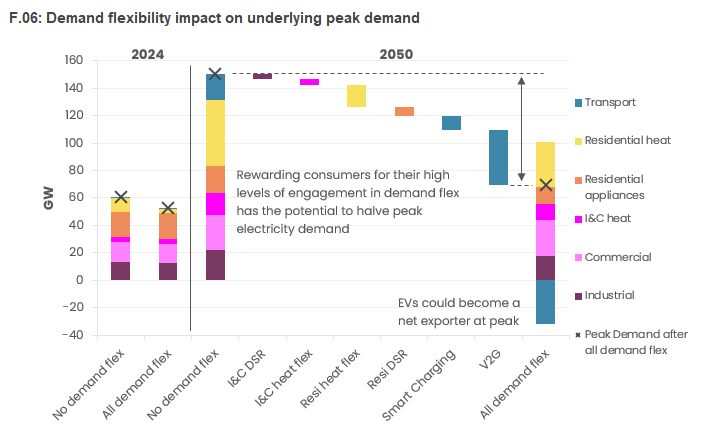
They do not quite explain how in 2024 they managed to achieve 7.1GW of residential heating demand flex, possibly they are referring to Economy 7 and similar tariffs. Digging into the detail for 2050 reveals that most of the demand reduction is expected to come from residential consumers. Residential heating, effectively turning down (or off) your heat pump when you need it most, contributes 16.3GW of demand reduction. Turning off your oven, hob and fridge, called Residential Demand Side Response for appliances contributes a further 6.3GW and Smart Charging, or delaying charging your EV, makes a 10.1GW reduction. Even that is not enough for NESO, they also want 40.6GW of power from Vehicle to Grid (V2G) technology, effectively draining your EV battery. They expect industry to reduce their demand by a total of 8.1GW including asking data centres to reduce cooling demand.
Have they ever asked consumers if they want to regress to an unreliable grid typical of a third world country? Do they really expect us to run our lives around the weather and the needs of the grid, rather than design a grid to meet our needs? This is the stuff of dystopian science fiction.
Curtailment Inconsistency
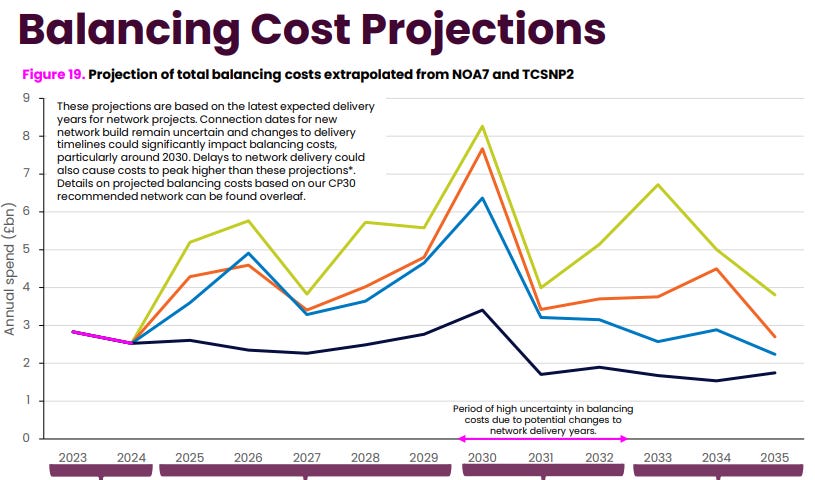
As we have covered before, NESO is predicting the cost of balancing the grid to go up substantially by 2030, then fall back somewhat as new spending on the grid reduces the number of times wind farms need to be curtailed in strong winds. Figure 2 shows NESO’s cost projections from their latest Balancing Cost Report (p31).
FES 2025 recognises that during periods of low demand and high renewable output, generation may exceed what is needed and windfarms will need to be curtailed. As a result, they show a huge increase in curtailment out to 2050, see Figure 3 from their p52.
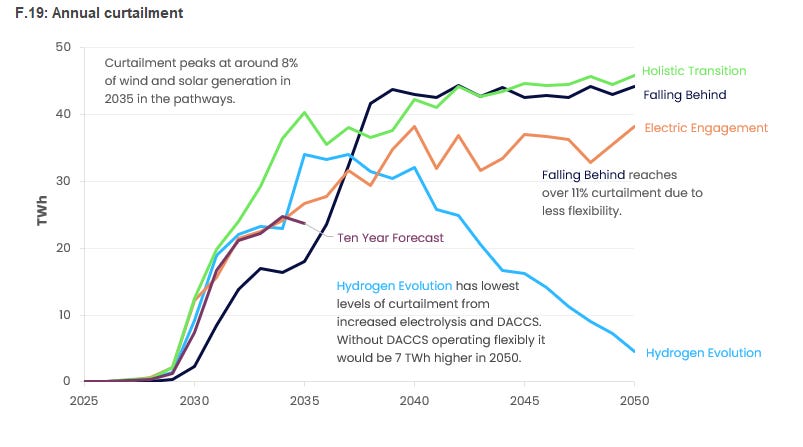
There is an obvious unexplained inconsistency between their balancing report and FES 2025, because FES2025 does not show a reduction in curtailment beyond 2030.
In FES 2025, they recognise that excess renewables add cost to the system but claim “oversupply can play a strategic role in system-wide optimisation”. They dream that the flexible demand, essentially cooking and charging your EV when its windy and running electrolysers to produce hydrogen or unspecified “novel business models” might mitigate the problem.
They claim that flexible demand will utilise electricity when it is at its lowest cost. But here they confuse cost and value. They mean that excess electricity has low value, but under the Contract for Difference regime, we pay the full subsidised cost regardless of the value.
Carbon Capture Delusion
In addition to inconsistencies in grid balancing, the report’s reliance on carbon capture introduces further delusions. They call the section on Carbon Capture and Storage (CCS) “Crossing the Horizon.” The reality is that if we pursue this delusion the UK will cross the event horizon, unable to escape economic oblivion. Figure 4 (from p66) shows us that they want carbon capture to expand from nothing today to between 66 and 90MtCO2/yr by 2050.
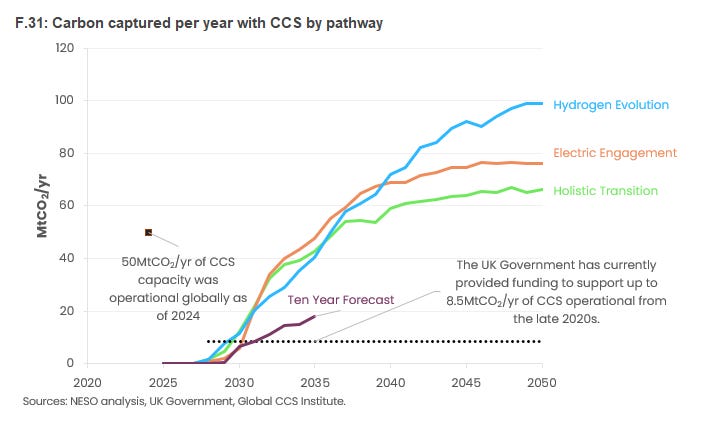
They note that the Government has provided funding for 8.5MtCO2 of CCS capacity to be operational by the late 2020’s. What they omit to mention is that this tiny fraction of their plan is set to cost us £21.7 billion over 25 years.
They go a step further and call for “negative emissions” from Bioenergy with Carbon Capture and Storage (BECCS). However, this technology only delivers negative emissions if the carbon dioxide emitted from burning trees is ignored and assuming the trees grow back over the next half a century.
Interconnector Illusions
NESO envisages that interconnector capacity will go up from 9.8GW in 2024 to 17.9-24.4GW by 2050. They produced this plan despite growing disquiet in Europe about the impact interconnectors have on local power prices. For instance, Norway’s government fell partly because of concerns about interconnectors, Sweden cancelled an interconnector with Germany due to concerns about rising wholesale prices and Denmark is concerned it is not receiving “cheap” offshore wind at times of high generation.
Nevertheless, in most scenarios FES 2025 forecasts that we swing from being a net importer of electricity over the interconnectors to a net exporter. They do not seem to realise that at times of high wind and solar generation, the Continent will also be awash with surplus electricity so it is likely we will have to pay for this surplus power to be taken off our hands. However, if we follow their Hydrogen Evolution pathway, we will be importing nearly six-times more electricity over the interconnectors than we did in 2024, probably costing us a fortune.
Storage Gobbledegook
We all know by now that wind and solar output is variable. Solar generation is high during summer days and zero on cold winter nights. Wind output is highly variable and sometimes we can go for days at a time with little output in periods often termed Dunkelflaute. One way of mitigating this problem is to install storage to bridge the gap between supply and demand.
FES 2025 says that batteries and long-duration storage will play a vital role in ensuring a resilient and low-cost decarbonised power system. Quite how they know it is low cost without doing any cost analysis is not explained. As shown in Figure 5 (from p51), they call for 285GWh of storage from batteries, liquid air, compressed air and pumped hydro by 2050.
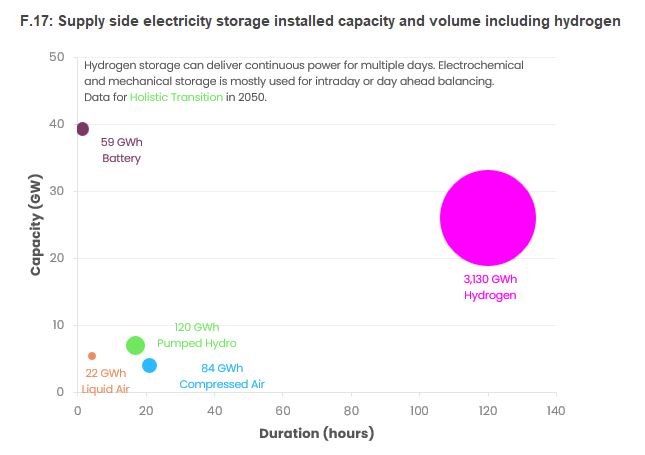
At the maximum discharge rate of ~56GW, this would last about five hours, hardly enough to cover a dunkelflaute period.
They do have some extra storage in the form of 3,130GWh of hydrogen, which could last up to five days.
Hydrogen Bubble
However, their hydrogen plans face a very significant problem. Later in their report they admit that no large-scale hydrogen projects have reached the final investment decision in Great Britain. They say that higher than anticipated costs, lack of off-takers and lack of enabling infrastructure have all limited development of hydrogen projects. In other words, green hydrogen costs a fortune and nobody wants it. Nevertheless, NESO is planning for up to 58GW of hydrogen production capacity by 2050 and up to 30GW of hydrogen-fuelled electricity generation capacity as shown in Figure 6 from p60.
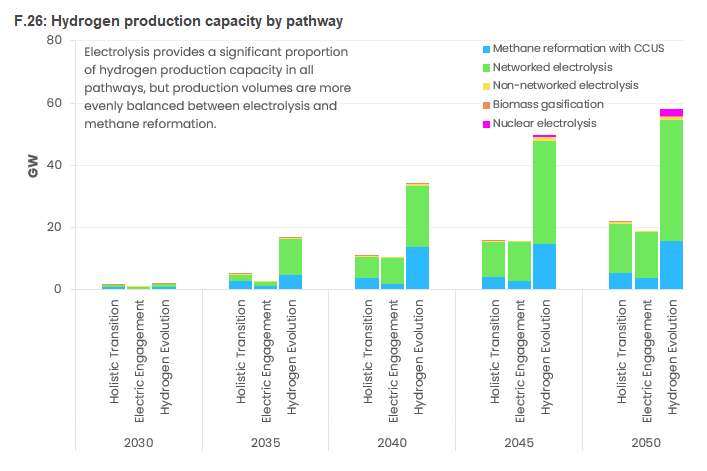
In the NESO world of unicorns and rainbows that takes no account of costs, hydrogen is an ideal candidate to provide backup during times of unfavourable weather.
The other problem with their plans is that they assume a hydrogen transmission network is built to transport hydrogen from electrolysers in Scotland to salt cavern stores in Cheshire and East Yorkshire. This contradicts the Royal Society (section 8.2) who concluded transporting electricity to electrolysers close to the salt caverns would be cheaper than transporting hydrogen in pipelines to storage.
Nuclear Afterthought
Back in 2010, we had 11GW of nuclear capacity that had fallen to 6.1GW by the end of last year. Capacity could fall below 3GW by 2030. NESO forecasts nuclear capacity will rise to 10.4-21.6GW by 2050. They also expect 39-59% of that capacity to be provided by Small Modular Reactors. The cite long lead times, public perception and planning issues as reasons for their lack of ambition. Yet they are quite happy to plan for a massive hydrogen infrastructure by 2050 despite the obvious cost issues. They also overlook the “planning issues” that will arise when the good people of Cheshire find out they want to store many TWh of compressed, highly flammable hydrogen in salt caverns under their county.
Conclusions
FES 2025 is a conceited phantasmagoria of fever dreams and delusions. It is absolutely shocking that nobody in NESO sought to moderate these fantasies by applying some basic cost constraints. NESO joins the ever-growing roll call of the official bodies foisting Net Zero upon us that should be disbanded.
David Turver writes the Eigen Values Substack page, where this article first appeared.
To join in with the discussion please make a donation to The Daily Sceptic.
Profanity and abuse will be removed and may lead to a permanent ban.
You do not need a lot of graphs. So-called renewables are unviable without subsidy and the cost of expanding their use is very high due to transmission costs, loss of food production, loss of amenity and battery backup. Much of this may not even be technically achievable.
Just go back to coal, gas and nukes.
Hear, hear.
Quite so EB. You mention loss of food production. It alarms me how much prime productive farmland is being eaten up by solar farms in our neck of the woods. However, the environmentalists want us to eat locally-produced food as part of their virtuous “circular economy” model, so how does that work? (Good luck anyway with producing attractive and nutritious vegan meals from local produce in a typical UK winter!)
The alternative is to import more food (at higher cost) from abroad, and again this is something that should have been factored into the non-existent Net-Zero cost-benefit analysis. That’s assuming that food imports are not subject to the whims of hostile and/or profiteering foreign powers…
I remember ‘locally sourced’ carrots in the fifties and sixties that needed to be stored for months on end to last through the winter. By the time winter was coming to a close they were stringy, hard and tasted ‘orrible.
I somehow can’t see the pampered generations from the 80s onwards putting up with that – and carrots are just one example.
“cost implications of the options and choices available to decarbonise Great Britain’s energy system.”
What exactly will “decarbonisation” mean?
I thought carbon dioxide was the problem not carbon the hard stuff?
I think that decarbonisation refers to the reduction of carbon-based lifeforms, human beings in particular.
Except the carbon life forms and their cannibalising criminal industries who make money off the net zero scam. Trillions at play. The money will lead you to ‘the science’. It always does.
Why bother to calculate costs? Because Fusion energy will be available for free and soon. And we will have fusion powered everything and rocketships, wars will be a thing of the past, the problems of hunger and diseases will be in the past.
Given that NESO are living in cloud cuckoo land I’m surprised they didn’t assume that nuclear fusion would be a viable technology in 15-20 years time and supplying tens of Gigawatts of power by 2050.
I visited the JET fusion project at Culham in 1990 and it was 20 years away from becoming viable….but that was 35 years ago.
And world peace…..
Fusion is the holy grail. Its been 30 years away for the last 30 years at least. Some progress is being made but I cant help thinking that we might be better off doing something about it, rather than waiting for the Chinese to produce and master it.
Fusion has been 40 years away for the last 40 years. It’s too hot to get the heat out. The pipes would melt.
Currently, a fusion reactor needs a fission reactor, to produce the Tritium fuel.
One weather feature which has not yet been factored in, as far as I can recall, is fog. Even as I read reports of reports, I feel a dense fog enveloping my brain, and I am not sure if I am generating it myself or if it is emanating from the confusing mishmash of uncosted waffle of the Eco-chamber, like the swirling miasma which the Victorians blamed for various diseases. I forecast that we are in for many more foggy days in the future. Pea-soupers ahead.
I seriously doubt they are truly deluded. They have developed a capacity for doublethink or just lying. It’s such obvious utter nonsense that nobody with whatever background and qualifications they doubtless have could think it was a goer. It’s simply the case that saying the whole thing is unachievable is not what they are getting paid to do.
It’s grift. Net Zero is a vast trough of taxpayer plunder, and where there is a trough there will be pigs.
It’s driven by Arts and Humanities graduates, aided by very carefully selected advisors.
A bigger con than covid. Transfer of money, control of the population, tyranny. It’s nothing to do with climate. It’s a plan from the WEF and UN to carry out managed decline of the West.
Covid looks like being more deadly, though.
Just think – before the mental illness of Net Zero took over the cost of grid balancing was in £millions not £billions. Pre-windmill it cost just £200m.
I find myself often quoting this very useful and widely appropriate phrase put forward recently by the new US Secretary of Defense, Pete Hegseth: “We’re done with this sh*t”.
Religious fanatics devoted to their martyrdom, problem is they demand that the rest of us suffer for their cause. My view is that anyone who believes in this stuff, should to prove their devotion be made to live for a minimum of a year in a place where there is land and a basic shelter, however there should be, as they themselves desire for the rest of us a windmill and some solar panels to provide their energy needs, a well for water. They should be provided with seeds to grow food, and manure. A goat for milk, and a sheep for wool so they can make their own clothes. a fishing rod. No access to pharmaceuticals as they are oil derived, no transport except a pushbike, but to be fair thats cheating as oil has gone into its manufacture. They will need to organise a barter system as clearly being employed in traditional industries and modern work involves the use of fossil fuels somewhere in the chain. I think a couple of years of living off grid will demonstrate their belief and faith in the cause. Which will then allow them to suggest how the rest of humanity can… Read more »
I agree, but I would make a slight tweak to your scheme. They want us to go vegan, or derive our proteins from insects, so take away the manure, goat, sheep and fishing rod. Since they think they have superior brains to the rest of us, I’m sure they’ll get on just fine.