
No, the EU’s ‘Disinformation’ Code Has Not Become Mandatory
It has been widely reported that the EU’s Code of Practice of Disinformation, a voluntary tech industry code created under the aegis of the European Commission, became mandatory on July 1st: namely, as consequence of its “integration” into the EU’s flagship regulatory legislation, the Digital Services Act (DSA). This is, however, incorrect and is based on a misunderstanding of what the code “integration” means. The Code of Practice is no more mandatory today than it was prior to July 1st.
Companies that are not signatories of the code, like X, are no more bound by its commitments than they were previously. Not being a piece of legislation and having never been considered, much less voted on by the European Parliament, the code could not be rendered binding by the European Commission by fiat. Rather what the European Commission and the European Digital Services Board (an auxiliary body created by the DSA) have done is to recognise signatories’ reporting under the code as a “benchmark” for compliance with the DSA.
This is all that the code “integration” means. It is not an integration into the law as such, but rather into a “framework” of “voluntary codes” – this is the wording of the law – created under Article 45 of the DSA. The DSA itself identifies “disinformation” as a “systemic risk” that so-called “Very Large Online Platforms” (VLOPs) and “Very Large Online Search Engines” (VLOSEs) are required to address.
Thus, the Commission’s February 2025 press release announcing the forthcoming code ‘integration’ explains:
To be recognised as a DSA Voluntary Code of Conduct, the Code needs to fulfil the criteria set out in the Digital Services Act. The Commission and the Board adopted separate positive assessments in this regard, endorsing the official integration of the Code into the DSA framework.
With its integration, full adherence to the Code may be considered as an appropriate risk mitigation measure for signatories designated as VLOPs and VLOSEs under the DSA. As such, the Code will become a significant and meaningful benchmark for determining DSA compliance.
This is not to say that non-signatories of the Code, like X, thus still have no obligation to limit the spread of “disinformation”. It is to say rather that they have had this obligation all along: namely, under the DSA itself. Since they are not signatories of the code, they cannot use code reporting to demonstrate compliance, but they still have to demonstrate compliance by other means: including their public DSA reporting and periodic audits.
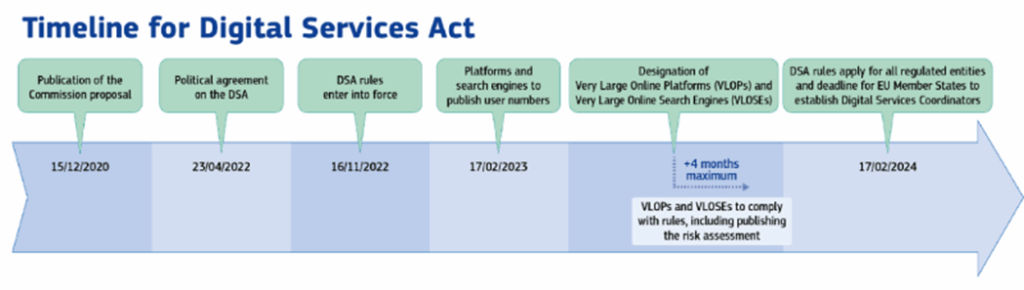
This obligation kicked in, more precisely, for all designated platforms, whether code signatories or not, in mid-2023, four months after their designation by the European Commission (as can be seen in Commission ‘DSA Timeline’ below).
As Commission spokesperson Thomas Regnier told Tech Policy Press – for an article that nonetheless suggests otherwise! – “Compliance with the Code is voluntary. Compliance with the DSA is not.”
John Rosenthal is a journalist specialising in European politics. His writings have appeared in such venues as World Affairs, World Politics Review and Brussels Signal. His new essay on ‘How the US Can Defeat EU Censorship‘ is available in the Claremont Review of Books.
To join in with the discussion please make a donation to The Daily Sceptic.
Profanity and abuse will be removed and may lead to a permanent ban.
The Ministry of Truth building looks foreboding.
That’s pretty much how modern day populations have been enslaved by the state: through compliance with bureaucratic procedures, some compulsory and some designed so that lack of compliance makes things much harder. We’ve been herded with mix of h gentle but firm prodding and hard barriers set up around us.
https://youtu.be/aJyGCGClVjE?si=2J5jkpixz3RTTmmx
This is a video by Paul Thorpe although not about him.
A story of an English gentleman detained on returning to this country from France.
Seriously disturbing !!
As I say. We live in anarchy. The people with the guns can do what they want, whenever they want. (And they sure are going to make sure they’re the only ones with guns.) And for the rest of us the best we can hope for is that we remain out of their radar. And if at any point they taken interest in us, we can either eat our tails, roll over meekly and offer them to scratch our belly or get crushed.
That’s how anarchy works.
If people stay under the radar then you are supporting the work of these repressive systems and the tyrants have already won. The country is now completely corrupt and we must stand up and resist these people no matter what it costs. My father fought for freedom and what he fought for has been crushed by our politicians, I for one owe my past freedom to my parents and all the people who fought tyranny. If people shrink away then the horrors which were suffered by our forbears were in vain and count for nothing.
Im not surprised but it’s still quite shocking that our democracy has been crushed under the jackboot of our corrupt political class and state sponsored intimidation of our own citizens.
He said that he supports the work of the anti terrorist police, well I ask why should we support a clearly corrupt system that uses laws to intimidate us. I would go as far as to say that it is the duty of every decent citizen to resist these people, they have been completely corrupted and are doing exactly the opposite to what they are supposed to do. They are no better than the Stasi or any other repressive state enabled body, they must be resisted at all cost in order to ensure our own people can go about their business without worrying about these corrupt individuals.
This is a bit like the Spanish Inquisition, except the Inquisition was concerned about printed material and the Digital Services Act dealing with the Internet. Addressing the same issue – ensuring that us proles only see information approved by the elite. But it destroys the most important of human activities, innovation and creativity. Without free speech these cannot thrive, and society stagnates with the path to progress blocked off. The Renaissance was triggered by the loosening of control by the Church. The Industrial Revolution was centred on Britain because Europe was hampered by the Spanish Inquisition. Progress depends on people being able to say daft if not plain stupid things, a few of which take root and lead to progress. But many don’t, and at first sight we do not know what is stupid and what is a gem. So tolerating daft ideas is central to human progress.
The wisdom and capability of the market far exceeds that of the most intelligent, wisest, most well-meaning person on earth.
But for reasons I can’t quite fathom people just keep forgetting to trust the market.
Well codes in the hands of corrupted officials can be used to infer guilt. A bit like observing the Highway Code, disobey it and you will be found guilty under any other law they conjure up. So it must be taken literally, infringe the code and you are guilty as charged.