
Iran Threatens Energy Market Meltdown as it “Reviews” Closure of Strait of Hormuz
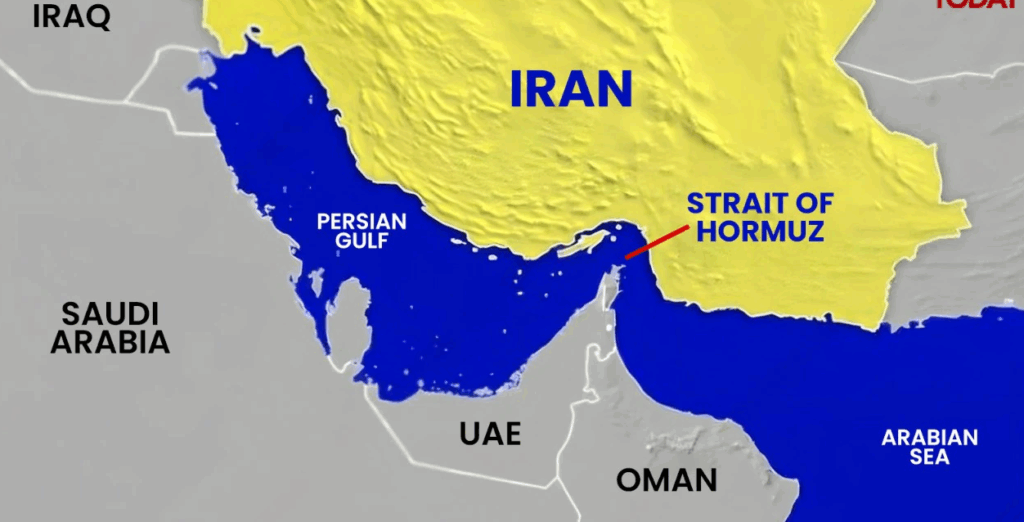
With Iran and Israel in full-on war, the world’s energy nerves are fraying. Central to this anxiety is a narrow strip of water just 21 miles wide at its narrowest point — the Strait of Hormuz. More than a chokepoint, Hormuz is the jugular vein of global energy trade. When Iran’s leadership, in a fit of strategic bravado or calibrated brinkmanship, threatens to block it, global oil and gas markets jolt awake.
For government planners and defence chiefs in Asia, the region most dependent on oil and gas flows through the Hormuz chokepoint, an extended period of the total blockade of the Strait presents a nightmare scenario. Japan’s Chief Cabinet Secretary Yoshide Suga, for instance, stated in May 2019 after the tanker attacks in the Strait that it is a “matter of life and death of our country in terms of energy security”.
The Impact of a Complete Blockade
Iranian officials have often made threats to the security of the shipping, but the Government has never actually attempted to close the Strait. The Strait, thus, has never been blockaded, although shipping traffic was badly affected during the ‘Tanker War’ phase of the 1980-1988 Iran-Iraq war. In the most recent statement from the Iranian Government, Esmail Kosari, a member of the Parliament’s Security Commission, said that the closure of the strategic Strait of Hormuz is “being seriously reviewed”.
In 2024, approximately 20 million barrels of crude oil passed through the Strait every day. That’s around 20% of global petroleum liquids consumption, and about 30% of all seaborne crude oil trade. On the natural gas front, nearly a fifth of the world’s LNG exports — mainly from Qatar and the UAE — navigate these same waters. Together, oil and gas transiting Hormuz power the economies of East Asia, Europe and beyond. This isn’t some obscure regional pipeline; it’s a linchpin of the world economy.
After Israel launched attacks at numerous targets in Iran, crude oil surged as much as 13% — the largest gain in five years — with Brent North Sea oil hitting $78.50 a barrel, its highest since January. In widely circulated media headlines, investment bank JP Morgan stated it “fears crude oil could hit a high of $130 a barrel”. Based on the economics literature, the short-run price elasticity of global demand for oil is relatively low at between 0.1-0.3. The elasticity measures the change in demand caused by a change in price.
Using a mid-point of 0.2, a cut of 20% in global crude oil supply will lead to 100% in the global crude price. This translates into nearly $160/barrel in our example. If lower estimates of the elasticity are used (i.e. the true estimate is less elastic), then even higher prices are possible. At a demand elasticity of 0.1, the price impact would be a 200% increase.
Despite repeated rhetoric, Iran has never actually shut the shipping channels in Hormuz. The reasons for that restraint are as much about self-interest as they are about strategy. For all the anti-Western bombast, Iranian leaders are not suicidal ideologues. The closure of Hormuz would mean cutting off their own oil exports, which still pass through the Strait to reach Asian markets. A blockage of the Strait would undercut Iran’s own revenues — a self-inflicted wound at a time when the regime can ill afford it.
Moreover, such a move would alienate Gulf Arab states — Saudi Arabia, the UAE, Kuwait and Qatar — all of which depend on Hormuz as a vital trade route. These same neighbours have, over the years, maintained a complicated but essential coexistence with Iran, one Tehran is loath to shatter entirely. Iran and Saudi Arabia signed a China-brokered agreement in 2023 to restore diplomatic relations, ending a seven-year dispute.
Ali Al-Shihabi, described as a Saudi analyst “close to the royal court”, said that the Kingdom was sending a message to Tehran along the lines that Saudi Arabia “will not be a conduit in any fashion towards an attack on Iran”. According to the analyst, the Kingdom backed US President Donald Trump’s efforts to find a diplomatic solution and was not in support of a war.
There is also the practical matter of alternative routes. While the Gulf States have invested in pipelines to reduce their reliance on Hormuz, the scale of oil that bypasses the Strait is modest. The UAE’s Abu Dhabi Crude Oil Pipeline, which connects fields in Abu Dhabi to the port of Fujairah in the Gulf of Oman, can handle up to 1.8 million barrels a day. Saudi Arabia’s East-West Pipeline (also known as Petroline), running from Abqaiq to the Red Sea port of Yanbu, can theoretically carry up to five million barrels a day, though operational flows typically remain well below that. Even in combination, these pipelines can only divert around 10 to 13% of the oil volumes currently transiting Hormuz. Natural gas, especially LNG, has no such rerouting luxury. Qatar’s LNG exports, for example, remain entirely dependent on Hormuz.
Will the US take the plunge?
Shortly after Israel launched attacks on Iran last week, US Secretary of State Marco Rubio called the Israeli strikes “unilateral action” and said the United States was “not involved”. However, with fast-paced developments in the conflict, it is not clear whether President Trump will elect to enter the war directly against Iran.
According to the Wall Street Journal, citing “people familiar with US Government deliberations”, President Trump told senior aides that he approved of attack plans for Iran, but was holding off to see if Tehran would abandon its nuclear programme. According to the latest YouGov poll, only 16% of Americans think the US military should get involved in the conflict between Israel and Iran; 60% say it should not and 24% are not sure.
A full closure of Hormuz would likely invite a military response from the United States, together with its Gulf Arab allies. This is certainly known to the Iranian leadership, and it will be reluctant to goad the US into the war to its own detriment.
Some observers point to the religious character of Iran’s leadership as evidence of irrationality. The argument goes: Iran’s clerical regime is guided more by messianic fervour than by material interest, and therefore all bets are off. But this view collapses under the weight of evidence. The mullahs have consistently prioritised regime survival. Furthermore, given the disproportionate influence wielded by extreme religious parties in Netanyahu’s coalition, it’s clear religious extremism is not unique to Tehran.
Neither the US nor Iran wants to initiate an oil price shock. Israel has not attacked Iran’s Kharg Island, a critical hub for over 90% of Iran’s oil exports, likely due to a combination of strategic, economic and geopolitical considerations. Striking Kharg Island could severely disrupt Iran’s oil exports, which account for a significant portion of global oil supply. Such an attack could spike oil prices, potentially causing a worldwide energy crisis. During the 1979 hostage crisis, President Jimmy Carter considered but ultimately rejected attacking the island due to fears of global economic repercussions. Thus, Israel will not alienate its key ally which has historically opposed such strikes to avoid destabilising oil markets.
Strategic Clarity Not Hysteria
Markets and policymakers alike must navigate these narratives with a clear eye. Any closure of the Strait of Hormuz — partial or total — would send oil prices soaring, choke off LNG supplies and reverberate through global inflation rates, currency markets and central bank decisions. But the probability of a full shutdown remains low. More likely are limited disruptions: Iranian naval manoeuvres, the temporary seizing of tankers or the placement of mines to delay traffic and raise costs.
As global leaders grapple with the fallout of Israeli-Iranian hostilities, they must avoid the twin dangers of panic and complacency. The Strait of Hormuz may not close tomorrow — or ever. But its strategic gravity is not going away. Iran’s threats, though not new, remain credible enough to jolt markets. The challenge is to respond with strength and foresight, not hysteria.
Ultimately, the game being played in the Persian Gulf is not one of theological madness but of calculated brinkmanship. Tehran may thunder and rail, but it does so with a sharp awareness of the consequences for its own regime security and for its powerful neighbours in the Gulf. So too must the world listen — not with alarmist dread, but with strategic clarity. In that clarity lies the difference between reacting to every provocation and shaping a durable energy order that can withstand them.
Dr Tilak K. Doshi is the Daily Sceptic‘s Energy Editor. He is an economist, a member of the CO2 Coalition and a former contributor to Forbes. Follow him on Substack and X.
To join in with the discussion please make a donation to The Daily Sceptic.
Profanity and abuse will be removed and may lead to a permanent ban.
And in the meantime, the retail price of petrol a couple of days ago was around 11% less than a year ago at my local place in the UK. Of course, a large slice of it is excise duty with VAT on top, which damps down the open market variation.
Petrol prices are determined by supply from the refineries, plus demand by motorists which varies seasonally – and panic buying of course when motoring organisations and the Daily Mail issue “warnings” of possible shortages due to crises hither and yon.
Oil is bought via future contracts, so today’s prices of oil do not affect the petrol coming out of refineries today. However grades of oil vary and some refineries are set to use particular grades which, if in short supply, can affect the supply and thus price of petrol being refined.
Interesting. but don’t forget that most food imports into ME pass through Hormuz as well. So the ME will run out of food long before the world will run out of oil in case of a blockade
They will certainly take the plunge even though they know that catstrophe awaits. That’s what happens when you whore yourself out. If you promise to do whatever you are asked to do then don’t complain when your paymaster asks you to do something truly nasty and self-destructive. It is macrocosm and microcosm. The fiinal stage of the feeding frenzy when the sharks, having eaten the bodies and even attacked each other in their blood lust. In the final stage they start biting at their own stomachs so overcome are they by the desire to draw to keep feeding.
LOL. A bigger bluff I could not currently identify.
Westerners assume that the whole world has been consuming and has been corrupted by the same baby boomer drivel popular culture that forms the backbone of their worldview. This is how empires die. Looking ridiculuous because they missed the obvious. They missed the obvious because the toxic culture that they fed to their masses in order to keep the empire alive has exhausted its potency. The boomers don’t just look ridiculous they are seen as a toxic generation that poisons the beauty of the world. Thank God they are coming into their dotage. I don’t imagine that they will be handled very well in care homes (boomers outsource their elderly). Nine out of ten workers in care homes come from the global south. I wonder if they hold you in high esteem.
Just stop oil?
Ten up ticks.
I know this area very well. This is the ultimate catastrophic mistake on so many levels. It is horrifying but on another level I understand that it has to happen as part of the process of destroying the empire. Residents of the empire only love war because it has been a spectator sport for eighty years. We are in the maelstrom now. World orders and geography can change very quickly. I understand why you want this war. Kennth Clarke talked about it in his series. How the residents of certain cities were disappointed when the Muslims didn’t invade simply because they had become so bored with their own civilisation. The boredom is a murrain because it can lead you into consequences that weren’t around two thousand years ago. Yes a life without emergency and crisis is very boring. Dostoyevsky said that if we ever created Utopia then we would destroy it in an instant such is our nature. Who talks about that? You would think it is the most vital issue.
On a spiritual level if you are advancing on that path then pay attention to the ‘boring’. Because this is completely true as well in the realm of the spirit. Obviously the spirit doesn’t like boring. I am trying to say that you should listen to any voice that suggests boredom, routine, repetition. We really are living through the lifting of the veil. Don’t hurry it along with your boredom. If you are truly commited to the resistance then you don’t need orders from anybody. The whole world is backing you.
Not everyone watched Diet Coke avberts for forty years. Not every government punished its younger people by ensuring that they never own anythiing. That they could never buy a home or start a family. The same forces that you point at Iran are the forces that you use to destroy your own peopleand ensure that they are desitiute. That is why the whole global population is saying Viva Iran! I agree Iran is now the foremost actor on the world stage andc represents an entity much bigger than itself. I would never normally say that I give my life for a particular cause but in terms of the defence of Iran I give my life. I don’t care
Just don’t talk to me when you life declines precipitously. Spoilt fat westerners who want to pipe in. You dig. A big mistake. Look at Rudyard Kipling- he who takes what the Parsee man bakes, makes great mistakes. I am not going to sit around and discuss the folly of end of empire. All of the youth population all around the world supports Iran. You are the leader you are the future. You will have to endure terrible sacrifice but you are emerging as truly the world leader. You should never forget that.
Iran loves Jews there is a Jewish population in Tehran. If you study world cultures then you will see that he Iranians and the Israelis are very similar people, for better or worse. Dont talk to me about Iran and Israel. Jewsih middle easter culture is basically Iranian. You listen to a Jew and a Parsee speaking they really speak the same language. Iran is a very Jewish culture.
I wonder how Iran would close the straights.
Any marine or coastal batteries can be easily silenced while their stock of longer range weapons must be getting depleted.
Mines and fast motor boats acting as marine suicide bombers
Do Iranians have a history of suicide bombing?
You people are crazy don’t talk to me when things start to hjappen. You really are possessed of a goldfish bowl menatality. There are different ways to live. You are being taught the shallowness of your vain world view. I have to deal with people like you because on an international level you sound like a dangerous imbecile.
Afghanistan (2001): US invasion removes Taliban. ~170k–240k dead. Justification: Al‑Qaeda, Taliban harboring 9/11 plotters.
Iraq (2003): US‑led invasion topples Saddam. ~400k–650k dead. Justification: WMD lies, regime change.
Libya (2011): NATO airstrikes kill Gaddafi. ~30k–50k dead. Justification: Humanitarian “no‑fly” zone.
Syria (2011–present): US supports rebels, bombs ISIS. 500k+ dead. Justification: Anti‑terrorism, humanitarian.
Mali (2013): French intervention versus Islamists. ~10k dead. Justification: Contain jihadist threat.
Côte d’Ivoire (2011): French/UN forces arrest Gbagbo. ~3k dead. Justification: Disputed election result.
Sudan (2003–2019): US pressure, ICC warrant, Bashir ousted. ~300k dead in Darfur. Justification: Genocide, human rights.
Central African Republic (2013): French troops intervene. ~10k–15k dead. Justification: Prevent genocide.
Yemen (2011–present): US/Saudi‑led coalition vs Houthis. ~377k dead. Justification: Restore “legitimate” government, counter Iran.
Pakistan (2001–present): US pressure reshapes politics (Musharraf out, Khan ousted). ~80k dead. Justification: Anti‑terrorism, stability.
Alexa, do we see a pattern here?
Islam is an ideological engine of war
Terrorism is always a problem but the above citations are massive military attacks against countries with large Muslim populations. resulting in masses of civilian deaths.
Which religion you ‘choose’ depends simply on your geographical location. So which religion is your “engine of war” in the above cases: Christianity or Islam?
In 2001, Netanyahu ordered 7 wars/regime changes in 5 years: Lebanon, Syria, Iraq, Somalia, Sudan, Libya and Iran. The five years took a little longer than desired because Iran has only just started but we are getting there.
USA is responsible for so much death and destruction around the world (e.g. https://www.youtube.com/watch?v=5BXtgq0Nhsc), especially when serving its Israeli masters.
If only other Countries not in the Middle East produced oil and gas – for example: Russia, Venezuela, USA & Canada, China, etc.
And oil and gas pipelines from the Middle East.
Blockading ships from Iran would just provide a shooting gallery for Israeli jets, missiles, drones.
Wait for Miliband to jump on this as proof that we need to stop using oil…
Closing down the Strait would be an act of war against all the nations who use this international waterway, giving a good reason for Iran to be attacked by all and sundry.