
Is Britain Really the Most Miserable Country in the World?
In a recent viral tweet, the commentator James Melville posted some figures showing that Britain is the most miserable country in the world. Specifically, Britain was ranked last out of 64 countries on average ‘Mental Health Quotient’ score in the year 2022. (And the 2023 ranking was very similar.)
As to what accounts for this remarkable situation, Melville suggested that it is “the culmination of decades of decline in so many areas in the UK”. Several commenters offered similar explanations. One noted that feeling miserable is a “rational response to watching your heritage dissolve in real time while being told you’re racist for noticing”. Another argued that “it’s not surprising” when the country is “taxed to the hilt” and “abused by illegal immigrants”.
These theories are all well and good. But they ignore something crucial: the ranking makes no sense at all—which calls into question the validity of the data.
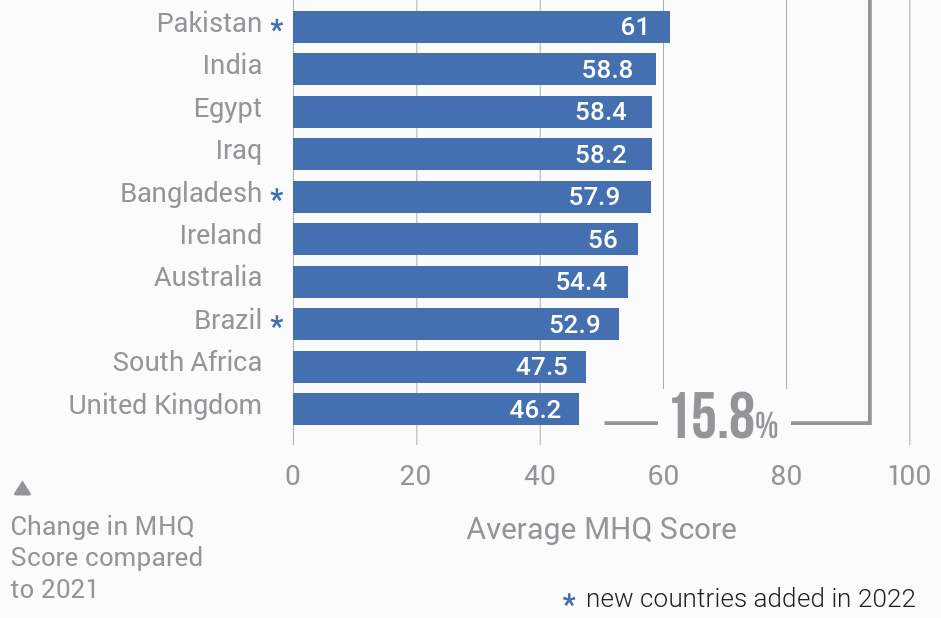
First place in 2022 was Tanzania, with an average MHQ score of 94 (as compared to 46 in Britain). So what is Tanzania getting right that countries like Britain are getting wrong? Well, it’s one of the poorest countries in the world, with a GDP per capita of only $4,000 (as compared to $64,000 in the UK). And it has a life expectancy of only 67, thanks partly to the ongoing HIV/AIDS epidemic there. To boost Britons’ mental health, should the Government try to emulate Tanzania?
There are more oddities. Ranked fifth is Venezuela, whose living standards are lower now than they were in the late 1970s—thanks to decades of economic mismanagement. Ranked tenth is the Democratic Republic of the Congo, where there is an ongoing armed conflict that has claimed thousands of lives. Perhaps the Government should try to emulate Venezuela or the DRC.
Looking at the bottom of the list, Ireland is ranked 60th and Australia is ranked 61st—lower than countries such as Iraq, Pakistan and Yemen. Are Australians really more miserable than Yemenis? I don’t believe it.
Rather than Britons being the most miserable people in the world, it seems far more likely that scores on the Mental Health Quotient do not have the same meaning in different cultures or different languages.
Indeed, the scale itself is needlessly complicated. For example, the first item asks about the respondent’s ‘adaptability to change’, which it defines as ‘your ability to be flexible when faced with societal changes, or changes in your daily routine or environment, and to adopt new ways of living or working accordingly’. After reading the definition, the respondent is required to place himself on a 9-point scale from ‘is a real challenge and impacts my ability to learn’ to ‘is a real asset to my life and performance’.
A simpler measure of well-being is the Cantril Ladder, which requires the respondent to place himself on a 10-point scale, where 10 is ‘the best possible life for you’ and 0 is ‘the worst possible life for you’. When countries are compared on this measure, the numbers make much more sense. Britain is ranked 23 out of 147 countries. And the top spots are taken by Finland, Denmark, Iceland and Sweden. Meanwhile, Tanzania is ranked 136.
The lesson here is that just because some figures are written up in a glossy report doesn’t mean they’re right. And in this case, they’re almost certainly wrong.
To join in with the discussion please make a donation to The Daily Sceptic.
Profanity and abuse will be removed and may lead to a permanent ban.
Does it really matter how close to the bottom you are. If everything is negative, such as bad governance, lawlessness, expensive housing costs, expensive energy costs, overcrowding etc etc etc and many more negatives does it really matter where on the unhappiness scale you are!
The truth is the country has been transformed into a dump in 30 years by excruciatingly bad policies and there does not seem to be a remedy, plenty of platitudes though.
The ‘results’ like most tests depend on the questions asked – and the intentions of the people designing the questions.
The Cantril Ladder appears to be more transparent and the results seem to reflect reality better. In any event the numbers of people crossing the Channel in dinghies suggest that the UK has some ‘better life’ opportunities.
It’s all relative. People don’t know much, in general, about quality of life in other countries. Answers are comparing perceptions now vs. expected. Not a valid poll, IMHO. Interesting, but not valid.
Off-T
“EXC: LAMMY DEAL WITH EU ON GIBRALTAR SCHEDULED TO BE SIGNED TODAY”
https://order-order.com/2025/06/11/exc-lammy-deal-with-eu-on-gibraltar-scheduled-to-be-signed-today/#:~:text=EXC%3A%20LAMMY%20DEAL%20WITH%20EU%20ON%20GIBRALTAR%20SCHEDULED%20TO%20BE%20SIGNED%20TODAY
As I have been posting, it looks like Gibraltar will be given away today.
Falklands next, then Cyprus and possibly the Channel Islands.
Having lived here for 34 years, the general mood in Britain has certainly become more miserable.
Part of it is the general feeling of brokenness – overcrowding, mass migration, expensive housing, congested roads, disfunctional health service, etc.
Part of it is the all-pervading po-faced, hectoring, finger-jabbing, humourless ideology: everything has become political. Think of Starmer – a robotic, empty bureaucrat.
Britain has become an alien country for people like me being brought up after the war. I am certain that in those days there were higher levels of poverty, poor housing and much lower life expectancy. However we were not constantly told about the terrible situation that most people found themselves in. The wireless reinforced the message that that we Brits were the chosen country, being winners of the war (with the Yanks only chipping in at the last minute) and our health service was a massive improvement on prewar health care. Education worked and so did people. After 6 years of extreme limitations, everyone knew what it had been like and counted themselves lucky. These days very few Brits have lived through such conditions and their baselines for satisfaction are much higher. The bar is raised even more by the fact that few people who talk about themselves focus on the best parts of their lives and only report that to other people, so it makes the comparisons even more extreme. The happest acquaintances, of my social group, tend to be the ones who don’t engage in any on-loine social media and who ignore the news broadcasts.They live in… Read more »
I was born in Eastern Europe and my family wasn’t exactly rich. Also, my grandparents’ generation experienced real poverty after the war: shortage of food, housing, etc.
And yet – it was different. I never saw that landscape of desolation that you can see in the run-down areas of Britain: the litter in the street, broken glass, drugs, a sort of low-level menacing feeling of a post-industrial wasteland with dodgy people all around.
Miserable doesn’t even do it justice. Miserable can be comic like Tony Hancock. The feeling here is of deep oppression and demoralisation and a shivering timidity brought about by an assault on many fronts. It has been moving this way for fifty years but it has changed so much since February 2022. The mooder is much darker, people don’t go out anymore and the people you see out look a bit messed up. Less effort spent tidying gardens and less concern about clothes and outward appearance. I have relatives who live abroad and they used to come and visit a few times a year and now they have stopped completely. They say that the country has changed so much recently and the people have changed and not for the better.
To be fair the government does seem to be doing all it can to kick off a civil war, and also to import the Congolese population.
So it’s unfair to complain they’re not doing anything.
I thought this was a fair comment in response to somebody mentioning how this prospect of civil war idea is being banded about but is a bit unlikely in reality. I think it’s just gradual and mass societal breakdown in which more unrest is inevitable; ”That’s a fair point – and you’re right to be cautious about throwing around terms like “civil war.” But here’s the reality: we may not be on the verge of uniformed factions and frontlines – but we are in a form of low-level societal collapse. A slow-motion breakdown where the state protects itself, not the nation. Where violence is selective, order is superficial, and the native population is gradually dispossessed under the weight of mass immigration, legal suppression, and demographic churn. You call it South-Africanisation – and I think that’s the more accurate lens. A two-tier system: atomised natives, hostile elites, politicised police, and imported client groups wielding more cultural power than the majority population. It’s soft tyranny now. But it won’t stay soft forever. You’re also right – there’s no Franco, no Collins. But that’s part of the problem. This regime survives not because it’s strong, but because resistance is disorganised. Atomised. Leaderless. It… Read more »
Well you are right.But civil war is usually promoted by a group of people. Generally it’s not a bottom up process but people who want power cause unrest. In the western case the problem is now caused by governments, particularly in Western Europe. The new structure of governance which has arisen due to the EU does not lend itself to civil war because the new governing system is totally undemocratic, so dissenting “nations” are picked off economicaly by the majority who are governed by a small elite. The electorate in each nation are fragmented by political parties who share power with periodic changes which are crushed by the so-called elites. The uniparty in the UK is about the best example. So I think civil war will not happen until things get much worse. Unfortunately we have accidentally elected a bunch of Commies, so it will indeed get worse. NATO is falling apart, the EU is beginning to show signs of severe structural instability (QED). The coup in Ukraine has caused the death of 1.5 million Ukrainians and the Russians are now making rapid advances. If the war is ever over there will probably be a civil war of a kind… Read more »
The most melancholy thing about the current state is that it is terminal. You can’t bring it back and you can’t bring anything else back. God forbid a mindset not preoccupied with nostalgia. There is no way back and no way forward. You have to absorb and inwardly digest this and contemplate the wasteland in front of you. There is no path towards a future without this understanding and contrition.
The population in the UK is in general very stressed and there is an all-pervading sense of demoralisation.
Everything the Government does seems intended to increase both. They are deliberately effing with peoples’ minds with their constant announcements of ridiculous policies that will never work and will cost an absolute fortune before they fail.
I agree.
Fail to understand any of the government’s policies and have become even more sceptical if that is possible.
Spending as if they have money to spend.
What is the government’s endgame? Do they actually like and fuel the dissatisfaction? Do they want dissent?
How many within the population think they are doing a decent job?
How many within the population are uninformed and do not care?
Plus ca change. W.S.Gilbert wrote a chorus in “Princess Ida” –
Oh, don’t the days seem lank and long
When all goes right and nothing goes wrong,
And isn’t the world so terribly flat,
With nothing whatever to grumble at.
And of course there’s Noel Coward’s “There are bad times just around the corner”. Look up the lyrics and cheer up!
Maybe being poor with a high probability of AIDs makes us happy?