
Is This the Experiment that Started the Pandemic?
Is this the risky experiment that kicked off the COVID-19 pandemic? While many experts agree that the pandemic was likely triggered by the leak of an engineered virus from a lab, the exact experiment that caused it has eluded scientists. But has the mystery now been solved?
Pictured below are the minutes of the meeting of the biosafety committee of the University of North Carolina at Chapel Hill on February 6th 2019 – eight months before the novel coronavirus is believed to have emerged. They show an experiment proposed by leading coronavirus specialist Ralph Baric, whose work has been implicated in the origin of the COVID-19 virus.
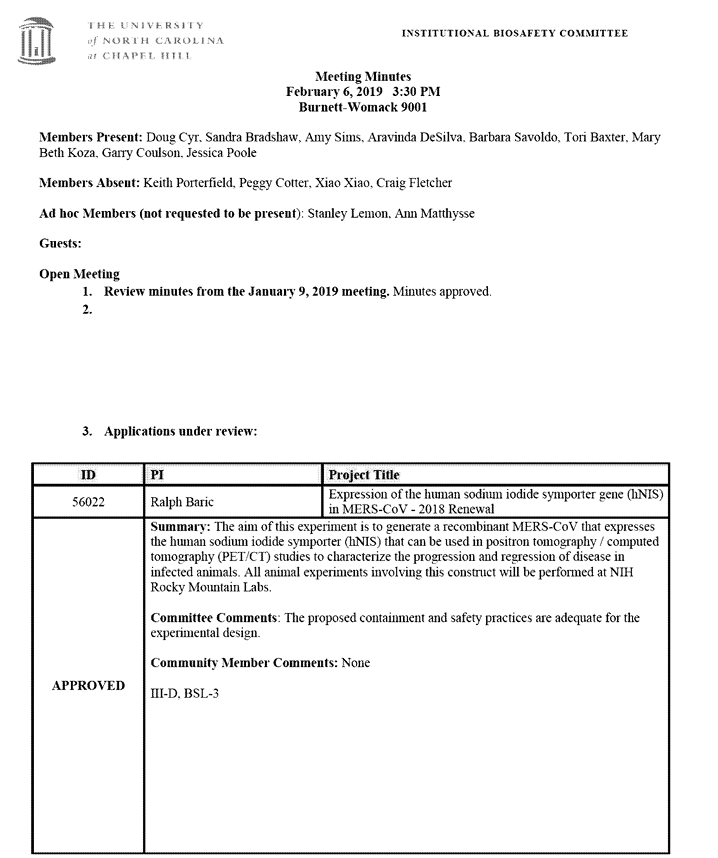
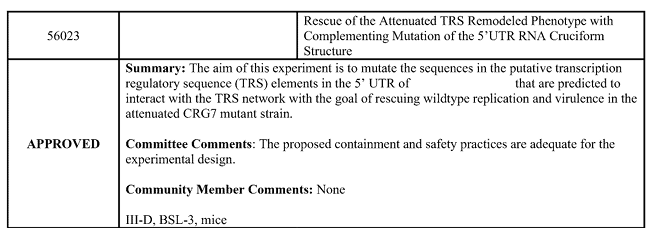
Experiment number 56023 (found on p274 of the FOI obtained by US Right to Know) is the key one: “The aim of this experiment is to mutate the sequences… with the goal of rescuing wildtype replication and virulence in the attenuated CRG7 mutant strain.”
To translate, 56023 is an experiment to see if the interaction of the virus CRG7 with certain mutations in the “transcription regulatory sequence” (a key part of the virus’s genome) of a virus that has been redacted from the minutes can successfully reverse the weakening of CRG7 and restore its original infectiousness and deadliness. The aim is to test the safety of using CRG7 as an attenuated virus-vaccine without it reverting to the full-blooded virus.
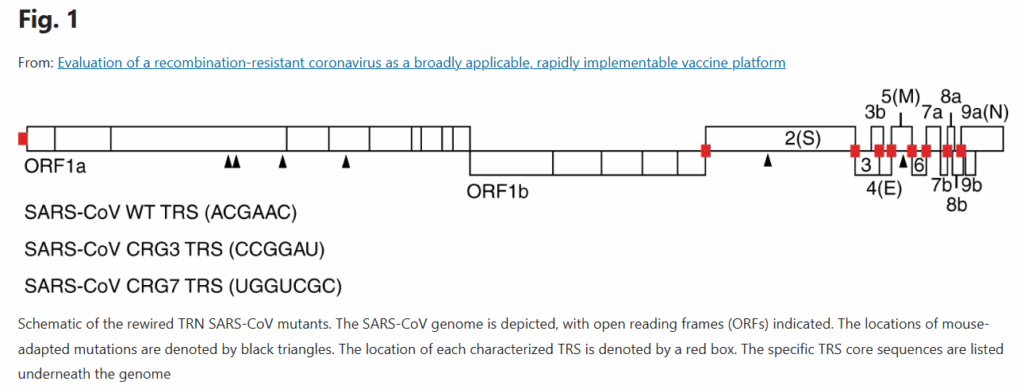
So what is CRG7? It’s a SARS-like virus engineered by Baric and his lab colleagues at UNC – a “rewired SARS-CoV mutant”, as he put it – which first appeared in his 2018 Nature paper ‘Evaluation of a recombination-resistant coronavirus as a broadly applicable, rapidly implementable vaccine platform‘. You can see a diagram of it below.
The full genetic sequence of CRG7 has never been published, even after the pandemic. This is despite SARS-CoV-2, the virus that causes COVID-19, sharing with it a key feature that Baric, in 2018, said was “unique” to CRG7.
What is this feature? Note the letters “UGGUCGC” in brackets next to CRG7 in the diagram. They represent an important part of the virus’s genetic sequence, an insert which aims to improve the safety of the virus (when used as a vaccine) by dramatically lowering its propensity to recombine with other viruses and regain its full strength. As Baric put it: “UGGUCGC… [is] a unique sequence motif when compared with all known coronavirus genome TRN sequences, greatly reducing and likely eliminating the possibility of recombination.”
Was Baric therefore thrilled when the “unique” feature he’d recently added to a virus in an experiment amazingly turned up in a virus in nature, in the form of SARS-CoV-2? If he was, he never said so. Even more remarkable for Baric, his “unique” sequence motif then shortly turned up in two further bat viruses – the two, indeed, that are genetically closest to SARS-CoV-2: RaTG13, the virus discovered by the Wuhan Institute of Virology’s Shi Zhengli in her archives in February 2020 that is a 96.1% match to SARS-CoV-2; and BANAL-52, serendipitously discovered in Laos later in 2020, an even closer 96.8% match.
What are the chances, eh? There was Baric thinking he had added a “unique motif” to his new mutant coronavirus CRG7, and within a couple of years three viruses turn up with it in nature!
Actually, there’s probably no coincidence at all. In fact, RaTG13 and BANAL-52 weren’t discovered in 2020; they were collected some years earlier, but kept secret (or at least not published, a common occurrence with viruses).
RaTG13 was found by Shi Zhengli in 2013 (hence the ’13’ in the name), in a mine in Yunnan province, China. Originally Shi claimed not to have sequenced it until early 2020 when she went to check her records following the emergence of SARS-CoV-2. But in fact, as Matt Ridley and Alina Chan have documented, RaTG13 is one of nine coronaviruses discovered in the years around 2013 and sequenced that were concealed and worked on behind closed doors. A correction was eventually issued in Nature to set the record straight – or at least, straighter.
BANAL-52 likewise was not first discovered in 2020. As Jim Haslam has shown (with a hat tip to DRASTIC’s Billy Bostickson), it was most likely collected in 2017 by US researchers on a Navy-funded expedition, but not published, as the military wanted it kept secret:
In February 2017, a US Navy group from the Naval Medical Research Centre-Asia (NMRC-A) visited a lab in Vientiane, Laos, managed by an American expat. … NMRC-A funded a Laos bat expedition to collect bat samples of local bats. The 2017 collection site was 165 miles south of the Chinese border along the Mekong River. Nothing was published from this bat expedition besides some bat fly research. No bats, samples or sequences were ever made public from this publicly funded project.
However, come 2020:
The same Laos researchers, led by the same American expat, returned to the exact same Laos bat cave. But unlike in 2017, they returned without the NMRC-A funding. In 2020, they collected a similar number of bat samples from the same bat species, but this time, they published them in September 2021.
Presumably, these are the same viruses the team collected four years earlier but were not allowed to publish – but which they really wanted us to know about, to the point of repeating their entire expedition just to bring them into the public domain. If so, it means BANAL-52 – the closest virus to SARS-CoV-2 – wasn’t serendipitously discovered in 2020, some months into the pandemic, but was in fact collected in 2017 and would likely have been available to selected researchers, including Baric.
This brings us back to CRG7. CRG7 is likely what is called a ‘consensus sequence’ – essentially an average of similar viruses, usually created to develop a vaccine intended to work against all such viruses. Baric explained the rationale for this in his 2018 DEFUSE bid – the proposed US biodefence project submitted to DARPA that was leaked to investigators in 2021 and which showed Baric and colleagues aiming to add a furin cleavage site (which SARS-CoV-2 uniquely has among SARS-like viruses) to a ‘consensus sequence’ of bat viruses. DEFUSE wasn’t funded, of course, but experiment 56023 shows that this disappointment hadn’t prevented Baric and his DEFUSE colleague Vincent Munster of NIH’s Rocky Mountain Labs from pursuing their efforts to make SARS-like coronaviruses more transmissible.
A genetics expert working with the World Health Organisation told the Telegraph‘s Sarah Knapton at the time of the DEFUSE document leak that if SARS-CoV-2 had been produced via such a consensus sequence, it would explain why a close match has never been found in nature.
The DARPA proposals, leaked to the pandemic origins analysis group DRASTIC, show the team had planned to take sequences from naturally occurring coronaviruses and use them to create a brand new sequence that was an average of all the strains.
The grant application, submitted in 2018, states: “We will compile sequence/RNAseq data from a panel of closely related strains and compare full length genomes, scanning for unique SNPs representing sequencing errors.
“Consensus candidate genomes will be synthesised commercially using established techniques and genome-length RNA and electroporation to recover recombinant viruses.”
Explaining the proposal, a WHO collaborator, who has asked not to be named for fear of reprisals, said: “This means that they would take various sequences from similar coronaviruses and create a new sequence that is essentially the average of them. It would be a new virus sequence, not a 100% match to anything.
“They would then synthesise the viral genome from the computer sequence, thus creating a virus genome that did not exist in nature but looks natural as it is the average of natural viruses.
“Then they put that RNA in a cell and recover the virus from it. This creates a virus that has never existed in nature, with a new ‘backbone’ that didn’t exist in nature but is very, very similar as it’s the average of natural backbones.”
The source said it was noteworthy that the cut-off for generating such an average sequence was viruses that only had 5% genetic divergence from each other. …
The WHO source added: “If SARS-CoV-2 comes from an artificial consensus sequence composed of genomes with more than 95% similarity to each other… I would predict that we will never find a really good match in nature and just a bunch of close matches across parts of the sequence, which so far is what we are seeing.
CRG7 appears to be Baric’s consensus sequence virus that contains his “unique motif” of UGGUCGC – the sequence found in RaTG13, BANAL-52 and SARS-CoV-2, but in no other known viruses in that location. Duke geneticist Dr Tony VanDongen calls UGGUCGC Baric’s “signature” because it was his novel way of stopping attenuated viruses reverting. The natural conclusion here, of course, is that CRG7 was created by Baric using RaTG13 and BANAL-52 (among other similar viruses, most of which were probably unpublished) in order to achieve this special feature. How else would he have created CRG7’s consensus sequence with this “unique motif”, other than with these viruses?
Baric’s 2018 Nature paper doesn’t give any details about how he made CRG7 – which may not be surprising given what we now know about RaTG13 and BANAL-52 being kept hidden at the time. However, more surprising is that, since the pandemic, Baric has still not published CRG7 or explained how he and his colleagues made it. Why not? He published the sequence of another of his creations, SHC014, in May 2020 to attempt to quell engineering rumours. But of course, SHC014 is not the virus that resembles SARS-CoV-2 in containing UGGUCGC. So why hasn’t Baric published CRG7 yet? The answer appears to be obvious: because CRG7 is SARS-CoV-2 or a close relation to it (perhaps before the furin cleavage site was added). How else to explain the fact that it contains Baric’s “unique motif”? Prove us wrong, Baric.
This isn’t the only evidence that experiment 56023 may be the one that started the pandemic. As Jim Haslam has noted, the fact that SARS-CoV-2 transmits efficiently in the Egyptian fruit bats used in Munster’s Rocky Mountain Labs but not in Chinese horseshoe bats suggests it was trained in the former rather than the latter. This is consistent with experiment 56023, which is part of a series which says (in 56022) that “all animal experiments… will be performed at NIH Rocky Mountain Labs”. (If you’re wondering how CRG7 could have ended up in Wuhan, that story is told here. In a nutshell, Baric and Munster had an ongoing collaboration with Professor Linfa Wang of Duke-NUS in Singapore and his colleague Dr Danielle Anderson, who worked in the BSL4 lab at the WIV and whose role in the DEFUSE proposal was to test Baric’s viruses on Chinese bats.)
What does Baric have to say about all this? When he appeared before a US Congressional committee early last year he managed three times to avoid answering the question of whether he had in his labs anything resembling SARS-CoV-2. He just muttered something about not doing virus “surveillance”. Was this to avoid perjuring himself in case it all later came to light?
Experiment 56023 may not be the precise one that triggered the pandemic. In truth, many experiments don’t come before an ethics committee, either because they don’t need to or because they are just preliminary tests (and the scientists believe they can get away with it).
But 56023 has some key ingredients that suggest it might be the fateful one – not least Baric’s CRG7 virus and its “unique motif” which turned up in SARS-CoV-2.
Dr VanDongen told me: “The fact that SARS-CoV-2, BANAL-52 and RaTG13 contain the signature sequence at the same location is of course very interesting because that sequence links to Baric. Publication of CRG7 would resolve all these issues. And protecting and stonewalling it can only be interpreted as an admission of guilt.”
To clear his name, Baric just needs to open his books and show us what he and his colleagues were working on in 2019 – something he has so far refused to do; he needs to publish the full sequence of CRG7. We’re waiting.
To join in with the discussion please make a donation to The Daily Sceptic.
Profanity and abuse will be removed and may lead to a permanent ban.
Murkier and murkier, the worrying aspect is that these RNA sequences are moved around the world without apparently being subject to much safety analysis.
The real trouble began when the politicians panicked, because they didn’t understand how obvious treatments were forbidden on the back of allowing the experiment to run with the help of Drosten’s react-to-anything PCR test with very high Ct values to ensure the fright factor was maintained.
There was No Pandemic.
Indeed there wasn’t, Drosten’s PCR test was used to create the impression that there was one. You can kill a lot of people by denying them time-honoured treatments for pneumonia.
While the origin of a detected putative viral sequence will keep scientific sleuths occupied for decades, it’s arguably a distraction from two other aspects of The Pandemic That Never Was.
Firstly, did the “Deep State Go Viral,” in other words was the Western response in spring 2020 triggered by security forces perceiving, or creating a narrative of, a viral sequence as a bioweapon?
Secondly, did “The State Kill Granny,” in that scrutiny of worldwide excess mortality data is consistent with a majority of excess deaths deriving not from a deadly virus, but from state-imposed measures to Stop the Spread?
Meanwhile back in the Mao-flu epidemic of 1968-69, schools did not close, “O” and “A” level exams were not cancelled, and, on the third Saturday in April, the club cricket season was not put back three months, due to “the cricket ball as natural vector of disease.”
Each to their own conclusions.
There was no Pandemic. When are DS going to admit this? Until we have honesty on this issue we are stuck on the hamster wheel of pandemic, lab leak, vaccines saved us / killed us, lockdowns were unavoidable and all the rest of the bullshit.
I’m sick of articles such as this.
Agreed – too much wallowing around in No Man’s Land.
I agree though the information might be interesting – for instance could the experiment (if there was one) have been part of a larger plan for a huge “biosecurity” exercise?
Hux, well maybe, bt there was something there elwere lockdowns, there were egregious and unprecedented restrictions on freedom, there were mandatory experimental medical treatments and the western world bankrupted itself.
It is not necessary to argue the toss whether there was some new virus or just a normal flu epidemic with pcr tests showing something else.
The real point is the fascism, the globalist response, including the recent who treaty, and the attempted/essential destruction of western civilization.
This onion has many layers, lies within lies.
https://expose-news.com/2025/05/20/debbie-lerman-exposes-the-real-covid-story/
The covid pandemic response was not a public health response but rather a global operation coordinated by national security agencies and public-private partnerships, following a biodefense and/or counterterrorism playbook.
The response was characterised by widespread panic, lockdowns and vaccination efforts, which were disproportionate to the actual threat posed, and were driven by a global cartel of powerful interests.
Rebekah Barnett interviewed Debbie Lerman about her book, ‘The Deep State Goes Viral: Pandemic Planning and the Covid Coup’ which reveals the underlying networks of control and the shift of power from national governments to global cartels.
Lerman argues that people must stop focusing on short-term political fixes and instead build alternative systems based on local community and human values.
Fortunately common sense is available via outlets such as The Exposé.
Also read Paula Jardine’s articles at the Conservative Woman about the origins of widespread use of mmRNA vaccines and the deranged US ex-military people who drove the various projects.
As a subscriber to TCW I read it daily and Paula Jardine is always an excellent read.
What pandemic?
The Emperor’s New Clothes one of course.
The lab leak hypothesis is meaningless when there’s zero evidence of viral pathogens to start with. Virology uses big words and advanced technology, but their world is completely destroyed by simple logic and the scientific method.
To any believers out there, please present evidence of a viral pathogen that exists in nature i.e not in a computer database, nor an EM image or culture soup) and we can have a meaningful discussion.
I would not say I was a “believer” and I have no evidence. From what little I know, things we can’t see seem tricky – quarks for instance. We can’t see them in any sense that I can get my head around, so they seem more like a theoretical model that some people think is helpful for explaining observable phenomena. Perhaps viruses are similar – just a theory to explain illness.
This article and the other one on 8647 remind me of the flood of “conspiracy theories” on “Who killed JFKennedy?” manufactured by his assassins.