
UK “Shafted” by US Trade Deal
The US-UK trade deal announced today is a clear win for Trump, says Sam Ashworth-Hayes in the Telegraph, leaving the UK worse off than in March and opening up UK markets in exchange only for reducing recently imposed tariffs. Here’s an excerpt.
April’s tariffs were set to be highly damaging, and it’s good that we’ve managed to limit their impact. It’s also the case that we’re still far worse off than we were in March.
The ‘trade deal’ announced today is thin. It doesn’t lift all the tariffs introduced this year, or do anything close. Britain has negotiated reductions to the additional rates on cars and components, steel and aluminium. This is a good thing, to be clear. But it’s also the case that every other additional tariff – including the 10% baseline rate – is staying in place. The tariffs our exporters face when trying to sell to the US will still be far higher than they were just a few months ago.
In practical terms, this means that Britain will be billions worse off. By putting together data on UK exports by subcategory, US tariff rates, and trade elasticities, I’ve come up with a rough estimate of the deal’s effects. It isn’t exact – given the time constraints it can’t be – and I’ve had to make some judgment calls about which tariffs apply to which categories.
But with those caveats out of the way, my back-of-the-envelope calculation is that the April tariffs would have lowered UK exports to the US by around £12.4 billion, and the value of the remaining goods sold by about £250 million. Not all of that would be a hit to GDP – some trade would likely be redirected – but it would certainly have been a blow. The deal on beef is essentially a rounding error, with the UK exporting around £3 million per year.
Today’s deal only slightly cushions it. Cars and automobile parts are a major part of the UK’s exports to the US, so there is some positive impact. But the net effect is that between lower export volumes and lower prices, we’ll still likely be £9.5 billion worse off than we were before.
In exchange, we’ve cut existing tariffs on US beef, offered tax concessions for US tech firms, and apparently agreed to buy $10 billion worth of Boeing planes, in some form or another.
For Donald Trump, it’s a clear negotiating win. He lowered tariffs that were most likely imposed in an attempt to get other countries to fall into line, delivering a synthetic solution to an artificial crisis. In exchange, he won material concessions from Downing Street.
Worth reading in full.
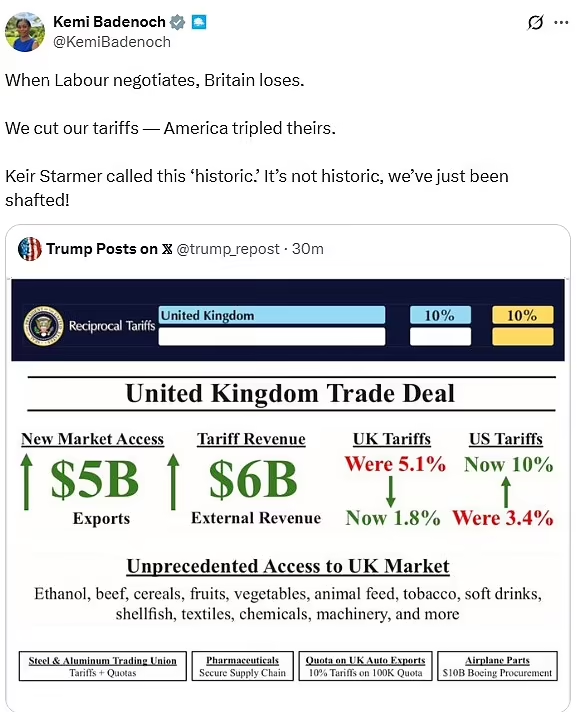
Conservative leader Kemi Badenoch slammed the deal, tweeting that since America tripled its tariffs while Britain slashed ours, we have been “shafted”.
To join in with the discussion please make a donation to The Daily Sceptic.
Profanity and abuse will be removed and may lead to a permanent ban.
Surely you can only be “shafted” if you’re in a weak position to start with? So isn’t what is “shafting” us our weak position compared to the US, and that’s what we should focus on? Why should the US do us a favour?
Human Rights Lawyer negotiates with Art of the Deal – What could possibly go wrong?
Maybe he needs the Supreme Court to tell him what a good deal is!
Two-Tier ” agreed to buy $10 billion worth of Boeing planes”.
Dreadful news, that! A friend of a friend worked as a computer programmer for Boeing for decades, until he and his fellow American colleagues were forced to train their replacements imported from INDIA, and once they were trained, the Americans were all made redundant, and the whole computer programming department was handed over to India.
Ever since then, Boeing planes have been falling out of the sky…
That’s the usual corporate playbook I’m afraid…
Yes, outsourcing should be banned.
I don’t understand why the UK government is buying planes. Is it launching an airline? For the armed forces, in which were they going to spend it anyway?
Quite!
He can’t agree to $10 billion of Boeing planes – there is no State-owned airline (yet) it is up to private UK companies which planes to buy which they’ve been doing for decades.
UK tariffs on US imported goods have been reduced from 5.1% to 1.8% saving UK consumers and businesses in the supply chain money = making us wealthier. US tariffs on imported UK goods up from 3.4% to 10% making US consumers poorer. How does paying less for the goods we consume make us worse off, and Americans paying more make them better off? I blame the schools. Exports are a cost. Imports make is wealthier. Imports are Christmas Day, exports the January credit card bill. Farmers: get rid of EU era protectionist tariffs – like the fake animal welfare crap – and thereby reduce costs to farmers – costs passed on to consumers – so UK farmers are more competitive and food prices are lowered. Tariffs are a tax on consumers. Consumption is the sole end and purpose of all production; the interests of producers is only to be considered as much as it serves the interests of consumers. – Adam Smith. (Paraphrasing) If exports made a Country rush then all that would be required would be for that Country to load everything it produced onto ships, sail them into international waters then throw everything over the side. – Frédéric… Read more »
I’m shocked that our electricity is so cheap that we can make aluminium at a competitive cost.
Wow, the US have a stronger leader than the UK…who knew 🙄