
Orsted Cancels Hornsea 4 Wind Farm – and Kills Miliband’s ‘Clean Power 2030’ Agenda Dead
Today, Orsted has announced that it is pulling out of its flagship 2.4 GW Hornsea Project Four offshore wind farm that was granted a contract only last year in AR6. It said:
After careful consideration, we’ve decided to discontinue the development of our Hornsea 4 project in its current form, well ahead of the planned FID later this year. The combination of increased supply chain costs, higher interest rates and increased execution risk have deteriorated the expected value creation of the project.
Orsted’s statement comes just a day after Ed Miliband announced the results of his consultation into Contracts for Difference (CfDs) for Allocation Round 7 (AR7) and committed to changes to deliver more offshore wind capacity. The DESNZ announcement said that 31 GW of offshore wind capacity has been constructed or contracted and at least 12 W of offshore wind capacity needs to be secured in AR7, AR8 and AR9 to meet its 43-50 GW target by 2030. Now 2.4 GW of that 31 GW has been removed from the pipeline.
Hornsea 4 made up the bulk of the 3.4 GW of the new offshore wind capacity awarded in AR6, so its removal is a big blow to Miliband’s Clean Power 2030 plan. In fact, the NESO target for offshore wind in 2030 is 50.7 GW, so until today almost 20GW was required from the new allocation rounds. Now 22.1GW is required. Moreover, as we discussed last month, Miliband is already falling short of his target.
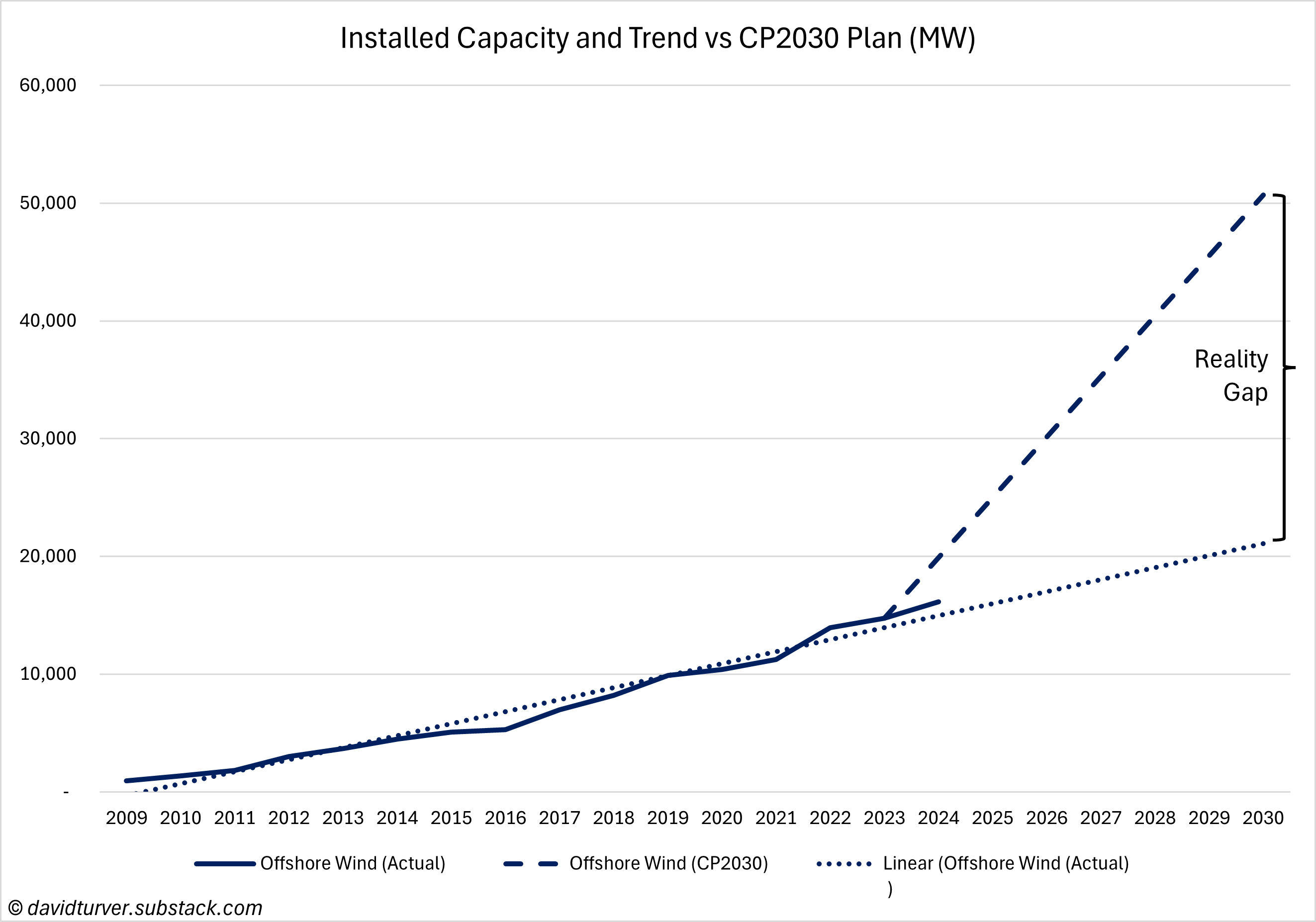
Miliband has agreed to publish the budget for AR7 much later than normal and is giving himself powers to see anonymised bid information on prices and capacity before announcing the budget. It is interesting that he made no announcement about the proposal to increase the contract term from 15 to 20 years and there is still no news on the Administrative Strike Prices.
However, today’s news from Orsted means he cannot rely upon projects getting built even if he awards contracts. And of course, this news comes after Norfolk Boreas was cancelled last year after being awarded a contract in AR4 in 2022. Moreover, parts of other AR4 projects were rebid at higher prices in AR6, such as Moray West and Inch Cape. Orsted’s Hornsea Project Three has even been awarded contracts for more capacity than is being built.
If we cannot rely upon either the capacity being delivered nor the price being honoured then the whole Allocation Round process has become a farce. It is time for Miliband to declare that his Clean Power 2030 plan is dead. It is no more, it has ceased to be, it’s expired and gone to meet its maker.
David Turver writes the Eigen Values Substack, where this article first appeared.
To join in with the discussion please make a donation to The Daily Sceptic.
Profanity and abuse will be removed and may lead to a permanent ban.
“The combination of increased supply chain costs, higher interest rates and increased execution risk have deteriorated the expected value creation of the project.”
Code for, “We think the gig is up and we want out before it sinks us.”
I fear they’ll re-bid it in AR7 for a far higher price – even if that is against the rules.
Could it be a coincidence that the new political masters of that part of the world are somewhat sceptical of renewables?
Perhaps they heard the words from Tice, who said the gravy train would be coming to a rapid stop when Reform gets in.
Exactly and those were my first thoughts too.
Translates as ‘we cannot make money at the price so pay us more or no windmills’
We need more tax payer subsidies or we’re not playing! Pluff, dummy out
Lookout to bridge: Reform UK Government ahead! Change course – choppy waters for off-shore subsidy harvesters.
You have to ask the question what is Ed Milliband getting out of this wanton destruction of the UK, who are his paymasters? is it the Chinese? or Bill Gates? there has to be something in this for him, and one would think the Cabinet members that they are complicit in this assured destruction of the UK
Carrying out his father’s wishes?
What does any vandal get out of destroying something? The pure pleasure in the destruction and speighting others.
If we follow Miliband, at some point we’ll have 50GW of installed wind capacity. Not clear how totally dependant on wind he expects us to be, but 50GW is more power than we need, in theory.
However:
Or to put this another way – in order to run the economy on fake renewables we have to run a secondary power system providing 100% of our power needs.
That’s exactly it, deranged reasoning from the mentally ill.
Nailed it Hux 🔨
If you need 100% backup, why bother with the primary?
If, for example, Solar was used to power air conditioning in the Summer, there would be some logic to it, but using Solar (mostly in the Summer) to power Heating and Lighting (mainly in the Winter) isn’t so logical, practical, or comprehensible.
Like having a BEV and towing a petrol engine car for when the battery dies and their are no nearby chargers.
Spain also demonstrated that a stable distribution grid requires a lot of inertia to keep its inherent frequency stable and hence time constants long, as soon as that is not happening then a grid can collapse in seconds. Actually 5 seconds in the Iberian peninsula case.
Spain got lucky that they have an AC connection to France otherwise it would have been a different story restarting their grid. We do not have AC links so have to rely on what inertia plants we have such as Drax.
The more wind you have the more you are likely to pay to keep it off the grid, even more so if the penny drops about increasing the risk of grid failure.
Capacity is not supply. GW is the unit of energy, GWh the unit of supply. Wind installations on average only achieve maximum 30% to 40% of capacity if off-shore, less on-shore, and often less than 10%, due to intermittency. Coal or gas can supply about 90% + of rated capacity. We already have enough installed wind capacity relative to demand, but two-thirds or more is undeliverable. Simply adding more capacity does not overcome intermittency. CfD: a “strike price” is agreed. If the wholesale price determined by market supply and demand is lower, the wind company is paid the difference (which goes onto electricity bills), if the market price is higher the wind company has to pay back the difference, or as seems to be the case, not supply at all. The Orsted project has been “cancelled” because the “strike price” is too low. The fact that there is now a glut of wind power when conditions are favourable means that a lot of wind suppliers won’t be able to sell. They need higher prices to make up for the times they cannot sell. In short: no business is viable if its output is uncontrollable, intermittent and cannot be matched to… Read more »
Maybe the thought of Farage as PM and new taxes on useless renewable energy companies have frightened the horses?
If so, excellent news.
Meanwhile the wholesale price of gas has been heading downwards for months, yet the unit price of electricity is set to increase again in July.
Go figure, Kommissar for Energy Insecurity Edward Samuel Miliband.
iTs pUTiNS FaULt
Yes. Search “tradingeconomics.com”, go to markets, commodities, scroll down to TTF gas. Check out the five year graph.
as Kathryn Porter notes, wholesale is 40% of what we pay. It is roughly flat from mid 2021, so all the increases are subsidies for unnecessaries.
Oh Milibland, Oh Miliwatt, where are your units, Milibrain?
When it comes to offshore wind there is a shortage of cable laying ships out to 2030 so if they do not have a ship booked already any new wind will not be connected until after the ‘by 2030’ and after they have been ejected from government.
😀😀😀
Marvellous.
And there’s a shortage of those very cables! Waiting list at the 4 international companies that produce the cables is 6 years and getting longer!
Dream on – it seems more likely this is just a trumpian type ploy to rip of bill payers even more – they know they’re dealing with the simple shopper and they can ask what they like especially with a chump like Milliband who is so desperate it hurts to watch.
Good stuff but it is harder than it sounds to go back to the old ways. I was speaking with an old man who was involved in power plant construction in the 1970s and he told me that we simply couldn’t build new power plants in this country now because the continuum of the requisite skills has been lost. With high prcision high risk engineering you have to have a living tradition.You can’t consult a textbook and then build the great pyramid from scratch or even a power plant.
I doubt that – there are many great engineers in the UK designing and project managing large power projects all around the world, just not so much here!
I think it would be helpful if Reform announced that it wouild not necessarily honour energy contracts entered into by the present government, as being against the pub lic interest. That would introduce a political risk for any engineering companies tempted to invest in this sort of thing, making them harder and more expensive to negotiate.
I was sent the transcript of Orsted’s conference call and Hornsea Four won’t be rebid into AR7 or AR8.
As I wrote on David’s site, all discussion of energy policy needs to start with the clear-eyed recognition that the trillions of dollars spent on the so-called energy transition have only delivered more expensive and less reliable power with massive damage to the forests and farmlands. Building more windmills will not deliver more power during wind droughts. How hard is that for the British and German authorities to understand? Recognition of wind droughts, wind lulls, or Dunkelflautes, could have averted one of the worst public policy blunders on record, maybe even the worst ever. Mariners and millers would have known about them for centuries, at least at the local level. https://www.flickerpower.com/images/The_endless_wind_drought_crippling_renewables___The_Spectator_Australia.pdf Independent Australian investigators documented the impact of wind droughts on the electricity supply over a decade ago but nobody in officialdom took any notice, at home or abroad. https://rafechampion.substack.com/p/the-late-discovery-of-wind-droughts Dirt farmers are alert to the threat of rain droughts, how come the wind farmers never checked the reliability of the wind supply to become aware of wind droughts? https://open.substack.com/pub/rafechampion/p/we-have-to-talk-about-wind-droughts Wind droughts become an existential threat to thousands or tens of thousands of people when the wind drought trap closes on a windless night during extreme weather conditions coinciding with outages of… Read more »
Excellent concisely expressed links, thank you.
At least the existence of subsidy-backed, return-driven large corporate interest in renewables is now coming into sharp focus, and is seen in stark contrast with the folksy/protesty/loony green front that renewables have no doubt cultivated. Orsted, Vestas, Shell, BP, Drax, even Ecotricity, will invest if the IRR’s are high enough and guaranteed enough – but that tide seems to have turned
A real danger now is that Miliband will replace the sensible corporate capital which has withdrawn from the market with ‘investment’ from Great British Energy [or whatever his useless £8bn outift is called]. He will thereby double down on the renewables scam using – you guessed it – taxpayer dollars. GB Energy wil of course ‘have to go through formal best practise tendering processes‘ which will result in most of its [our] money being spent on foreign-made equipment [China, Denmark, France, Germany, USA, and so on]. He’s already done this with the solar panels he bought in China to stick on schools and hospitals
Never forget: Sun Tsu’s first art of war:
“The supreme art of war is to subdue the enemy without fighting.”
That is exactly what is happening as Western governments pursue self-harming and futile Green Energy policies to reduce or eliminate their CO2 emissions and other Greenhouse gasses.
There is no better way to damage the economies of Western societies than by having themselves render their energy supplies intermittent, unreliable and expensive.
So Green thinking can only be regarded as a very successful branch of the continuation of the “Cold War” intended to undermine the viability of the economies of the Western world.
https://edmhdotme.wpcomstaging.com/analysis-of-renewable-power-de-uk-fr-in-the-context-of-europe-2024/
Excellent graphics, thank you.
Nit pulling out – bagaining chip to get Mad Ed Zeroid to increase the CfD gravy.