
How Ed Miliband’s Net Zero Fantasy Is Deforesting North Carolina
As everyone must now know, it doesn’t matter where the energy comes from in the great rush to Net Zero, only that the source must preferably be invisible to British consumers and voters. It seems that hundreds of acres of forest are being torn down in North Carolina to produce wood-pellets that are then poured into the gaping hungry furnaces of the UK’s Drax power station.
The Mail has the story:
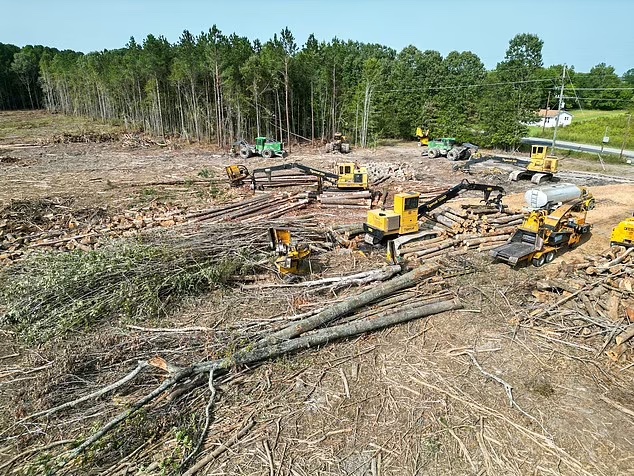
Some 280 acres of once pristine and ecologically-important wetland forest – a mix of oak, maple, hickory, cypress and pine – have disappeared, torn out as if by a marauding monster. All that’s left is a bleak expanse of boggy pools of water and pulverised pieces of wood.
It’s eerily reminiscent of photographs of No Man’s Land at the Battle of the Somme – only with the addition of several large piles of logs that the men who harvested the lumber from this remote north-eastern corner of North Carolina in November 2023 couldn’t even be bothered to take with them and left to rot.
According to scientists and environmentalists, the idea that new trees will replace the old ones felled any time soon is a load of nonsense:
They point out that burning wood is even dirtier in terms of carbon dioxide than coal and, more important, that it takes decades – 60 or 70 years in the case of hardwood forests – for a new tree to absorb the CO2 lost by burning the old one.
That’s precious time, they say, that a warming planet simply doesn’t have, and hardly anyone’s idea of ‘sustainable’ energy.
However, that hasn’t stopped successive UK governments, the world’s most enthusiastic convert to the wonders of wood pellets, from giving billions of pounds in renewable energy subsidies to biomass operators.
Needless to say, the heroic leader of the vanguard to turn Britain into a Net Zero paradise of impoverished and frozen people is out in front to help drive this ultimate example of greenwashing:
This week, Energy Secretary Ed Miliband became the latest politician to keep this astonishing arrangement – described by opponents as Britain’s “biggest green hoax” – on the road when he approved a new funding arrangement giving the vast Drax power station in North Yorkshire (the country’s largest) around £2 billion over four years to keep burning biomass.
Miliband, the architect of the Government’s drive to Net Zero, has been implicated in the Drax scandal since 2008 when he was appointed Secretary of State for the newly created Department of Energy and Climate Change by then Prime Minister Gordon Brown.
Although the new deal cuts Drax’s subsidies in half, given all the Starmer Government has promised about tackling global warming, environmentalists had been hoping for Drax to lose all its subsidy.
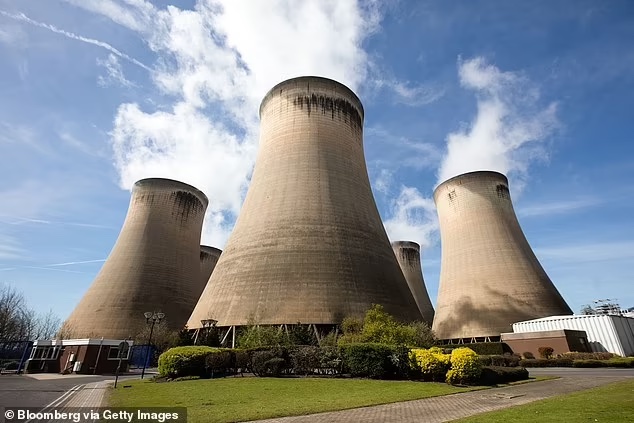
Drax, which ironically shares its name with a James Bond villain who set out to destroy the planet, burns the equivalent of 27 million trees every year and – because wood is much dirtier even than coal – is Britain’s biggest emitter of carbon dioxide, last year producing nearly 12 million tons of the planet-warming gas.
The Mail’s Tom Leonard inspected the site in person with a local guide:
There were no signs of new trees growing, or anyone trying to re-plant, even on one site that was logged three years ago. “This is ground zero for clearcuts – you see them appearing all the time and it’s really sad,” said my companion, who asked me not to use his name as “these people can be mean”.
He used to go out regularly looking for new clearcut sites and then follow the lorries taking away lumber and chipped wood so that he could say with confidence that it had gone to an Enviva pellet plant.
Since it started importing huge quantities of pellets in 2012, Drax has relied on America’s South for most of them, not only because it has vast tracts of forest close to coastal ports for easy export but also because these conservative states impose few of the regulations that protect woodland in the UK and the rest of Europe.
Logging companies traditionally cut down only the biggest trees as they are most suitable for the building and furniture industries, leaving the smaller ones to keep growing. They also left the ecologically-precious ‘wetland hardwood’ varieties such as cypress because they were too gnarled to become planks or tables.
It doesn’t matter what your position on climate change is. The story here is the sheer hypocrisy:
Everyone I spoke to in North Carolina admitted they were slightly shocked that “tree-loving” and climate change-aware Britain, of all countries, had facilitated the biomass industry –adopting renewable energy accounting rules that didn’t account either for the forests being lost in the US or the carbon emissions from burning the wood.
Derb Carter, a senior lawyer at the Southern Environmental Law Centre, told me he had repeatedly visited the UK to explain the situation to government officials.
“There was this assumption that surely the US regulates how forests are managed to protect the public interest,” he said. The Brits were “surprised”, he said, when he explained that in southern states like North Carolina, there was nothing of the sort.
He was disappointed by Ed Miliband’s verdict on Drax this week, saying: “This is not a good decision for our climate and certainly not for our forests over here.”
“We had hoped that a new government would have taken a really hard look at this. When you’re basically cutting forests and hauling them across the ocean to burn instead of coal, it makes no sense.”
Mr Carter believes the fact that the environmental destruction happens out of sight – and therefore out of mind – has been very useful for Drax in winning British acquiescence.
“It’s a lot harder to burn your own forest than someone else’s,” he says. “People are going to be a lot more tolerant if the wood pellets just show up on a ship and you don’t see the trees being cut and don’t see the forest being lost.”
Just like buying solar panels and batteries from China, where the coal power stations providing the energy to manufacture them are conveniently out of sight, and allowing China to gain a chokehold on the UK renewables sector.
The North Carolina story is worth reading in full.
To join in with the discussion please make a donation to The Daily Sceptic.
Profanity and abuse will be removed and may lead to a permanent ban.
Ah, but don’t you understand, Sallust and The Mail, there’s the right sort of Good Carbon liberated by burning wholesome wood pellets, and the wrong sort of Bad Carbon emitted by burning evil coal, oil and gas…
…Which can only be extirpated by expending billions of gigawatts of energy we’ll be desperately short of, and spending trillions of ackers we don’t have, on Redemptive Carbon Capture?
All prostrate and face in the direction of Imperialist College, London, home to the Centre for World Weather Attribution and Voodoo Science.
It would be interesting to read a full analysis of how this works in N Carolina if they are really not replanting the trees or seeing any natural regen because down the line there will be no future crop to harvest. It seems a very short term system that perhaps only works because there are vast swathes of trees to fell and is certainly not how it would be done in the UK. Here if you want to fell any amount above 5 cubic metres per quarter – and you can only sell 2 per quarter – then you require a felling licence. A requirement of the licence will be restocking which can either be planting or if you are fortunate to have a hidden seed bank, natural regen which is of course better than having to replant.
Excellent investigative journalism by the Daily Mail, so often unjustly derided and scorned. And well done to Sallust and the DS for featuring this.
Although it ought to be common knowledge, it’s worth noting that Drax is where it is on account of there being a fair bit of naturally stored energy close to hand; coal. It did not travel far. However some years ago, some of the older coal fired ones, in particular Didcot A, did burn coal from South America, following the 1984/85 strike. Earlier, it used coal from Nottinghamshire.
In the early 1970s, my first job was at a coal-fired power station a few miles outside a North Midlands industrial city. Coal came by rail from mines in the city, thereby minimising transport costs.
At the time, most coal-fired power stations were similarly sited near centres of population. Distribution costs therefore also minimised. The National Grid was then an efficient operation, with inherently lower costs than today’s electricity generated by wind turbines remote from centres of population (along with the extra cost of operating gas power plants as back-up).
Half a century later, Britain consequently has the among the highest electricity prices in the world, burdening domestic users and crippling commerce and industry.
Progress means change, but change does not always mean progress. All down to climate fallacy and energy folly. Bonkers is as bonkers does. China, India and the emerging economies know far better.
I first encountered the name Drax when I worked as a lab tech for a food company in the late 1970s. Waste heat from the power station cooling towers was used to boost yields from fish farms. One of my least favourite tasks was chemical analysis of the nutrient content of the fish.
Reminds me that the use of “waste heat” from local power stations is still used in some countries. Historically, it was actually used in London, from Battersea Power Station.
My understanding is that Didcot A was deliberately configured to be able to import coal directly from secure ports via a secure railhead, and avoid any issues with miners strikes or secondary pickets. Thatcher and McGregor made sure it happened, and well done them
keep telling the story…it is a disgusting scandal, just like the Bird Mincers, Whale killers and Solar panels, that bids mistake for water and crash into…..Wipe those smug grins off the so called eco warriors dumb faces.
Woe to the earth and the sea, because the devil has come down to you, having great wrath, knowing that he has only a short time. That is what it says in the Apocalypse of John about characters of this kind. A sigificant chapter and verse, chapter twelve and verse twelve.
This is the result of ideology. It is claimed that Milipede is an environmentalist: he isn’t. He is an ideologue, totally in the grip of an insane meme. Not only is he a danger to the country, he is a danger to the planet.
It shouldn’t be alarming that we will be consumed in the next two decades. Last time by water this time by fire. The art of living through these times is to accept this not as an attack or a defeat but simply a natural cycle. There has never been a god that prevents suffering. The suffering of the endtimes knowledge can be transmuted into selflessness. All that you love will be carried away and then you will be carried away or cast aside. Obviously you should fight like a cornered rat until it happens but when it does you need to accept it with a sincere smile on your face.
I wish someone would explain to me why it is ok to turn decades or months old vegetation into energy but not materials which are millennia old: coal, oil, gas.
Converting Drax from coal to wood pellet burning was indeed crazy (though that was pre-MilliVolt Tory madness). But we need Drax for the foreseeable future. Wood pellets still burn even when the Sun isn’t shining and the wind isn’t blowing. We can’t afford to lose another kiloWatt of non-intermittent, reliable power generation.
It has always seemed to me that massive, worldwide, deforestation and slash and burn practices that continue to grow in parallel to world population growth has meant a huge reduction in CO2 absorption capability through photosynthesis. Does anyone know if any research been done to relate the two?
Not quite what you’re looking for, but interesting nevertheless…
https://www.nature.com/articles/s43247-024-01313-x
“…Australian human-induced native forest regeneration carbon offset projects have limited impact on changes in woody vegetation cover and carbon removals”
In plain Aussie English – all show and no substance.
Since our own corrupted/brain-dead/eco-lunatic Government refuses to stop this disgraceful activity, we’ll just have to hope that Trump bans the cutting of American timber for pelleting and exporting to the UK.
Come on President Trump …. the ball is in your court.
Further to my earlier post: GOOGLE: Forests cover over four billion hectares of the Earth’s landmass, around 31 percent of total land area. As of 2024, worldwide forest area measured some 4.05 billion hectares, down from approximately 4.24 billion hectares in 1990. So, in around 35 years there was a loss of 0,19 billion hectares = 0.00543 hectares per year. Taking 1924 as a start point, the estimated loss at this rate (100 x 0.00543) means 0.543 billion hectares have been lost since 1924 GOOGLE: According to available data, a hectare of forest can absorb an average of around 5 to 10 tons of carbon dioxide per year depending on factors like tree species, climate, and forest maturity, with the most productive tropical forests potentially absorbing up to 11 tons per hectare annually. Taking these variations into consideration and assuming a one hectare of forest can clear about 8 tons of C02 per year then the loss of C02 absorption capability since 1925 is 543,000,000 x 8 = 4,344,000,000 tons ie 4.3 gigatons. GOOGLE: According to current data, the total amount of CO2 in the atmosphere is approximately 3,341 gigatons, representing a concentration of around 427 parts per million (ppm). My conclusion… Read more »
Pellets from these North Carolina (and elsewhere) forests travel by ship to Hull, on the East Coast, then by rail to the Drax power station.
Its not exactly the most efficient regards transportation.
Its not feasible to now revert Drax back to Coal, and in the current green climate that would not be acceptable.
Drax could maybe be demolished and rebuilt as a Nuclear plant, its a massive site with existing infrastructure for a large scale power station, with all the existing power lines, train links etc.