
Two People Killed in House Explosion After Heat Pump Borehole Releases Methane Gas
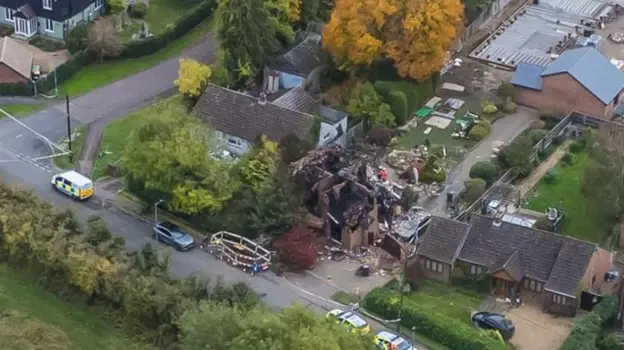
Two people have been killed in a house explosion reportedly caused when a heat pump borehole released methane gas at a nearby property. The BBC has the story.
A 100m (328ft) borehole close to the scene of a fatal explosion and house fire is being filled with cement to ensure it is “gas tight”, according to safety officers.
Eighty-five year-old Paul Swales died in the blast at Cleat Hill in Bedford on October 19th. Julia Harris, 84, died in hospital of her injuries 10 days later.
The Health and Safety Executive (HSE) said a plug of 15m (49ft) had been placed in the borehole and it was “confident the cement is holding the gas back”.
A British Geological Survey team, which has been on site since October 21st, said it was continuing to monitor the area for gas and said that since filling work began gas levels had been reducing.
Bedfordshire Fire and Rescue Service, which has maintained a 24-hour presence at the scene, said it had “yet to determine the exact cause” of the explosion but that investigations were continuing.
The explosion occurred in the same area where, on July 2nd, contractors struck a pocket of natural gas while drilling a borehole to install a heat pump, causing the evacuation of nearby properties.
A separate ongoing investigation is under way into the circumstances of the July leak. …
John Finley, from the Ground Source Heat Pump Association (GSHPA), said: “This is the only occurrence of shallow gas known in over 25 years of GSHP operations in the U.K.”
He said it was a “tragic event” that was being taken seriously.
“Where necessary we will make changes, modify standards and procedures, already in use,” he said.
Worth reading in full.
To join in with the discussion please make a donation to The Daily Sceptic.
Profanity and abuse will be removed and may lead to a permanent ban.
I suppose tapping the natural gas and using it to heat nearby homes or cook with is verboten wrongthink.
Sacrifices have to be made when saving the Planet.
I suppose it would bad form to do the Red Adair joke?
Do tell!
25 years is a pointless measure.
Rather, how many ground source installations have they done, vs how many are expect to be done to meet these stupid net zero targets?
Apparently the heat pump borehole is 335 feet deep and a gas strike of this kind on land has not happened in the UK before. The original gas strike was on July 4th, the house explosion didn’t happen until October so clearly the leak took some time to work its way up in a different spot from the borehole.
Of course you could say that drilling to that depth for a heat pump is rather unusual. I don’t know but it does seem very deep, most ground source coils for heat pumps are quite shallow.
Ground source heat pumps can be a long pipe about 1m (metres, not miles 🙂 ) under the surface, with a typical area needed of 70 ft square, though it can be any shape: so it’s either a biggish lawn, or digging up what’s in the way:
https://www.isoenergy.co.uk/latest-news/renewable-energy-news-from-isoenergy/how-much-land-do-you-need-for-a-ground-source-heat-pump
Here’s another data source:
“On average the surface area of land required is roughly 2.5 times the square meterage of the property. Below is an example:
Detached new build property with four bedroomsHome size = 1582.sq ft x 2.5 = 3,955 sq ft of land required”
Or a vertical borehole can be drilled:
“Boreholes are normally drilled down to about 100 metres where the ground is a constant 10-12 degrees. This makes vertical systems often more efficient as they are not influenced by the changing seasons. Boreholes are usually chosen due to a lack of space or unsuitable ground conditions for horizontal trenches. A vertical system demands enough space for the drilling rig to enter the site which can be difficult in built up areas, but the boreholes are only 20cm wide.”
https://heat-pumps.org.uk/how-much-space-is-required-for-a-ground-source-heat-pump
If they had been fracking this wouldn’t have happened, the technology is proven, reliable, effective, and makes economic sense. As is the other obvious solution – nuclear power
Nuclear, meaning nuclear fission, is the the long term solution, either Uranium or Thorium. But both really do need plenty of time for new designs to be developed as there have been plenty of technological advances that have been made but only incorporated in an ad hoc manner. For example, passive safety mechanisms are better than those requiring Electricity to power them. And Fission is at least a ‘next century’ technology, if at all.
In the mean time, why not use Methane, aka Gas, or Coal. The technology has improved immensely since a Coal-fired power station has been built in the UK, with all that plant food being emitted, it’s a win-win.
You mean “
FissionFusion is at least a ‘next century’ technology”I do! If only to make sense of the post. 🙂
Right by my golf course! The road has been closed for weeks so having to use long detour. Rumour has it that this will carry on at least until Christmas but they’re not saying which one!
Sad that people have to be killed before anyone wakes up about these inefficient and ineffective heat pumps.
And governments are investing billions into ‘carbon capture’? Burying carbon underground? Do they think Nature wouldn’t have a say?
I guess over the last 25 years not too many ground source heat pumps were installed which could help explain why this has never occurred before. Once they become more commonplace they may well prove to be a little more common.
A bit like the numbers of EV fires will go up as more and more are made, there is also the horrendous threat of BESS (Battery Electric storage sites) which if they catch fire will be akin to a major incident see Prof. PAUL CHRISTENSEN Electric Vehicle Battery Fires SUBSCRIBE NOW and Gridscale batteries could cause havoc in urban areas
Meanwhile, when it comes to fracking we “can’t risk” tiny tremors which are only identifiable with highly sensitive monitors.
But fraccing for Geothermal Energy is OK, even when it emits radioactive gas?