
Renewables Subsidies Hit New August Record
The Low Carbon Contract Company (LCCC) manages the Contracts for Difference (CfD) subsidy scheme and publishes data to show how much it costs us. The data is usually published about 10 days in arrears and sometimes is adjusted. Now, we have the full data for August 2024, and it has settled down enough for some reasonable analysis.
Overall Subsidy Levels Rising
The headline is that overall CfD subsidies rose sharply in August 2024, recing a total of £237 million – the third highest total on record and by far the highest level for the month of August (see Figure 1).
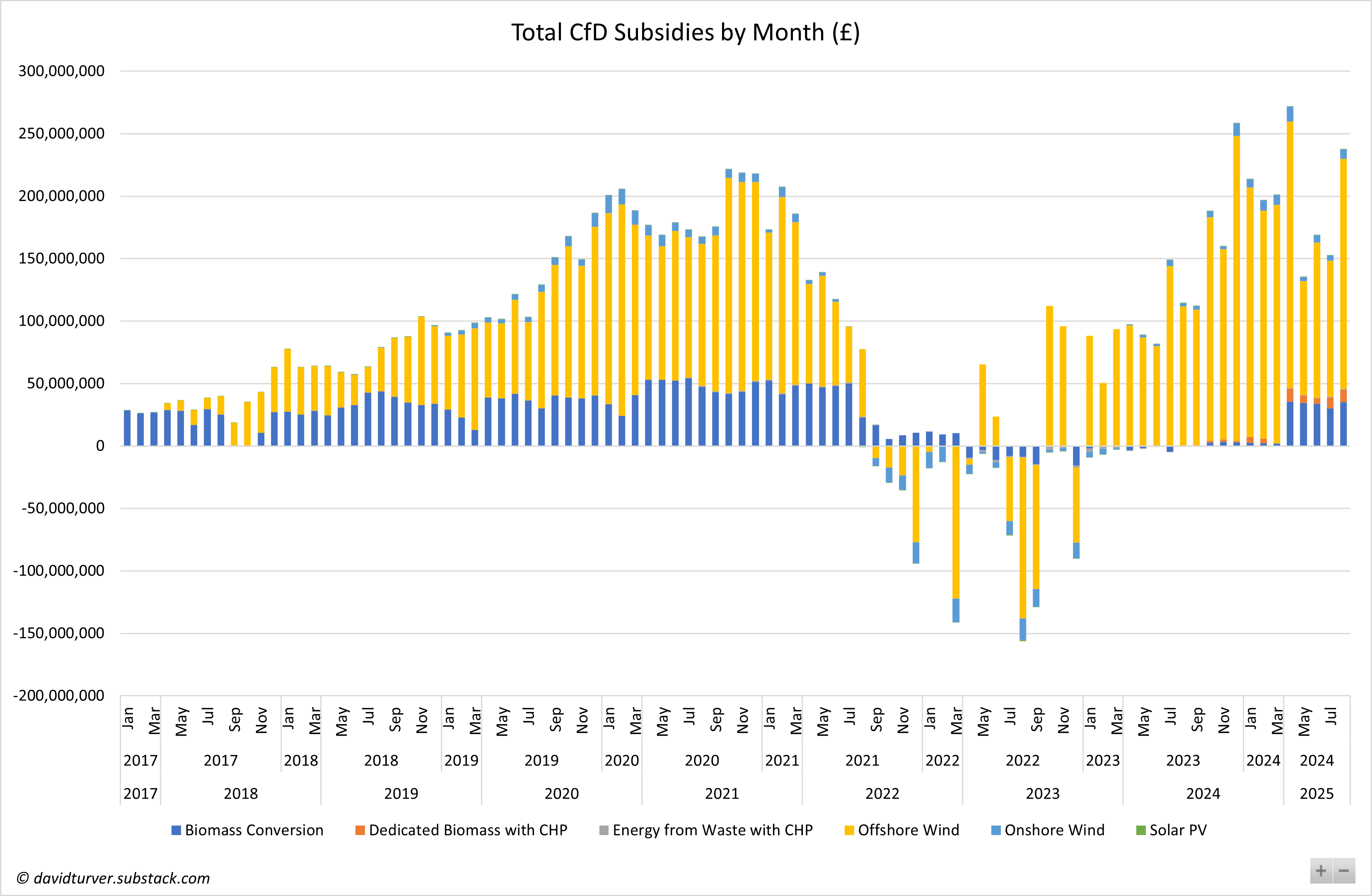
The total is up £84.2 million from July’s total. The main driver of the increase is offshore wind, which is up £74.5 million from a month ago. This August’s total is also up £123.8 million from August 2023. Since August last year, offshore wind subsidies are up £72.3 million, biomass conversion £35 million, biomass with CHP up £10.2 million and onshore wind £5.1 million.
There are several factors driving the increase in subsidy since last year. First and most obviously, more wind farms have now activated their CfDs since last year. Moray East and Hornsea Project 2 offshore projects came online earlier this year, as did the Sneddon onshore wind farm. Moreover, the CfD part of Drax biomass plant was not used at all last August, but it attracted £25.6 million in subsidies in August 2024.
Load Factors
However, the number of turbines claiming subsidy is not the only driver of increased subsidy. Load factors are also up. This means that both onshore and offshore wind farms produced closer to their theoretical maximum during the month (see Figure 2).
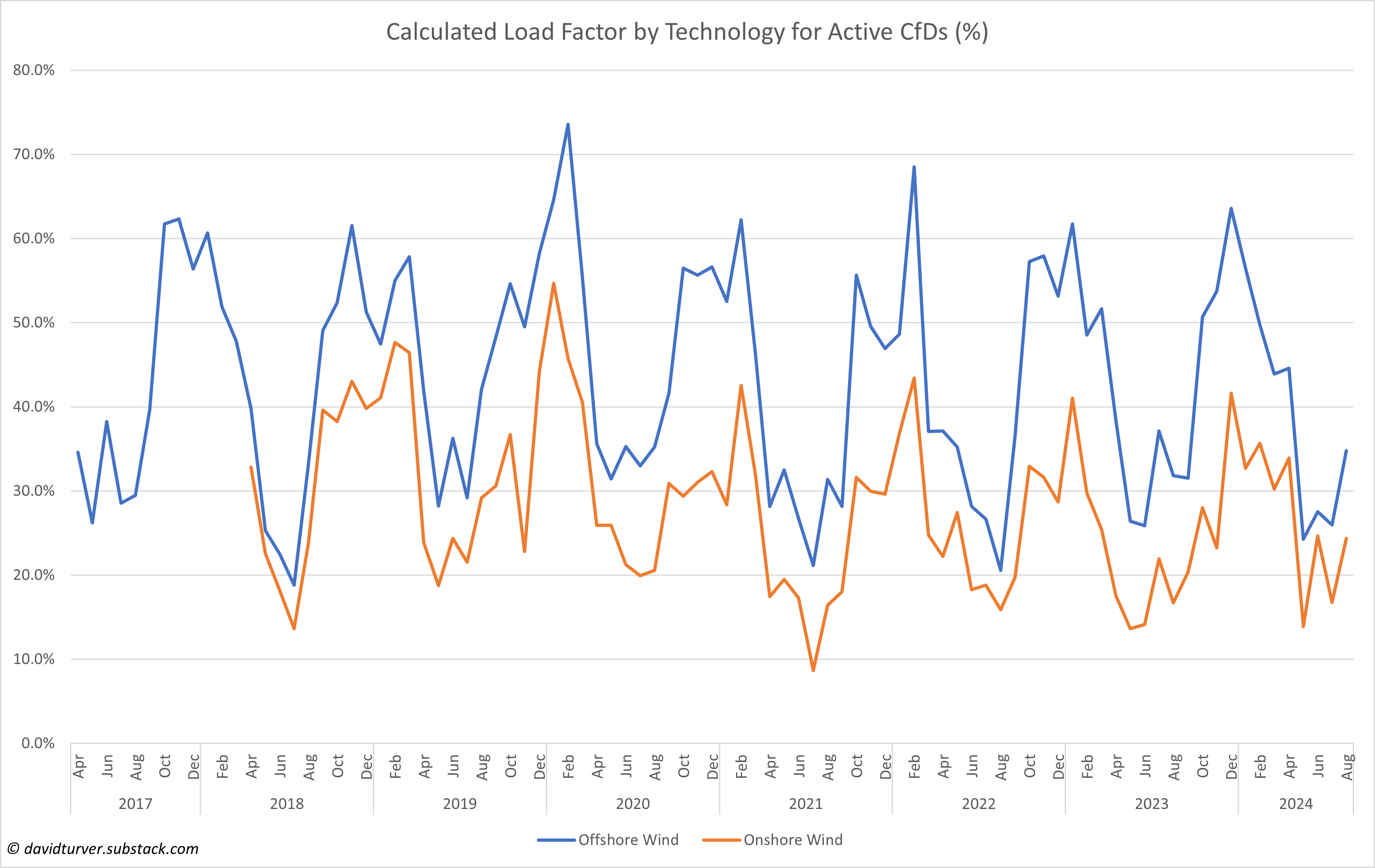
Using the nameplate capacity recorded by LCCC for each installation, we can calculate the load factor for each project and aggregate it by technology. In August 2024, CfD-funded offshore windfarms achieved a load factor of 34.7%, the third highest August on record, the highest since August 2020 and up three percentage points since last year. Onshore wind achieved 24.9%, the second highest August load factor on record and up from 16.7% last year.
More wind means more generation and, other things being equal, more generation means more subsidy.
Subsidy per MWh
The other things that drive the levels of subsidy are the CfD strike prices and the reference price used to calculate the subsidy level. For offshore wind, the weighted average strike price has fallen by £23/MWh from about £178/MWh in August 2023 to £155/MWh this year. This is because of the aforementioned addition of Moray East and Hornsea Project 2, which both have lower strike prices than the earlier offshore wind farms. The strike prices for onshore wind are up a few pounds from last year to £113/MWh, and solar is up £4 to £110/MWh.
However, the Intermittent Market Reference Price (IMRP), which is used as the baseline for the price that renewable electricity was sold for in the market, is down significantly on last year. The average IMRP, weighted by generation, has fallen about £25/MWh from £76/MWh in August 2023 to about £51/MWh in August 2024.
The subsidy per MWh is calculated as the difference between the strike price and the IMRP. The upshot is that the subsidy per MWh for offshore wind is up a bit since last year and is up sharply for onshore wind and for solar power (see Figure 3).
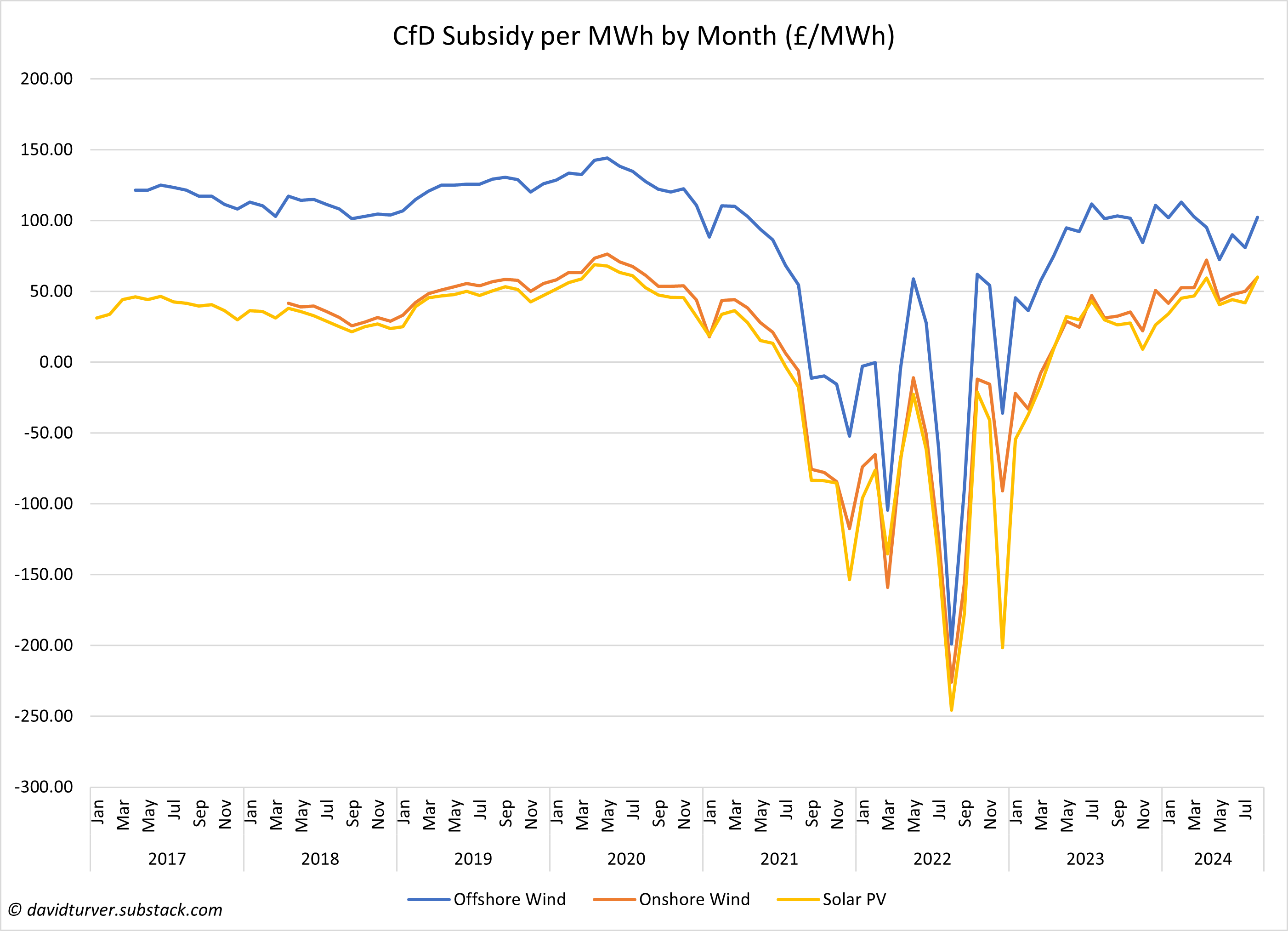
Gas prices are lower this year than they were last, so that explains some of the reduction in IMRP, because gas often sets the market rate of electricity. However, adding more uncontrolled renewable generation can also affect the IMRP. There were two days in August when the weighted IMRP for offshore wind fell below £20/MWh and three occasions when the weighted IMRP for solar fell below £10/MWh. Provided the price stays positive, this does not matter to the generators; they just make up the difference with extra subsidies. If the price goes negative for a time, then some wind farms are not paid curtailment fees.
Conclusion
The addition of the newer, cheaper offshore wind farms has not had a significant impact on the subsidy per MWh. The reduction in average strike price has been overwhelmed by a combination of the indexation upwards in April and cheaper gas prices since last year. Even if gas prices stay at the current elevated levels, we are unlikely to see a significant reduction in the subsidy per MWh because increased generation from renewables pushes down the IMRP, thus increasing subsidies. For the generators it is heads they win, tails the consumer loses. We can expect more record subsidies between now and February 2025 as the seasonal load factors creep back up and Drax is kept running to replace our last remaining coal plant, which shuts shortly.
David Turver writes the Eigen Values Substack page, where this article first appeared.
To join in with the discussion please make a donation to The Daily Sceptic.
Profanity and abuse will be removed and may lead to a permanent ban.
Labour manifesto:
Clean power by 2030Families and businesses will have lower bills for good, from a zero-carbon electricity system.
From the same document:
A national mission for clean power by 2030 is achievable and should be prioritised. We desperately need to end the era of high energy bills, excessive carbon emissions and energy insecurity by accelerating the transition to clean, homegrown energy. Britain can lead on this by treating this mission like the vaccine challenge. We can be the innovators and the implementers, helping ourselves and exporting our solutions worldwide. But if we choose to go slowly, others will provide the answers, and ultimately we’ll end up buying these solutions rather than selling them.”
– Sir Patrick Vallance, Former Chief Scientific Adviser
This is the official version of reality. It has its series of excuses for this ideology being imposed on people and businesses paying the highest electricity in the world. (1) we must save the planet (2) We must get energy security (3) we must be world leaders.——-Each excuse in series covers for the one before.
—– It is not at all necessary that we save the planet unilaterally by 2030. What is the rush for a small country like ours to do this at breakneck speed by 2030, all because it fits in with UN Agenda 2030? It is totally unnecessary as huge countries that make up half the population of the world are not doing that. Excuse 2 says we must get energy security, but no other country depends entirely on renewables as they are simply unable to provide base load, and excuse 3 is simply chest beating nonsense.
“Britain can lead on this like by treating this mission like the vaccine challenge”. You mean like our homegrown vaccine which was withdrawn on safety grounds?
The AZ “vaccine” may have been thrown under the bus to make it look like the “regulators” were doing their job. Probably the side effects were too obvious. I expect Vallance was talking as much about the “challenge” of forcing everyone to take it and then rolling it out. The side effects* of the mRNA “vaccines” seem to take longer to manifest themselves and are probably a bit harder to link directly to “vaccines”, and mRNA is a technology that Big Pharma really wants to succeed.
*Some people think they are not side effects but deliberate. I don’t know.