
Disturbing Differences Between Batches of Pfizer’s Covid Vaccines in the Czech Republic
Some time ago, the so-called ‘Danish study’ swept through the digital underground. The authors showed that Pfizer’s Covid vaccines in Denmark had a suspicious safety profile: A few small batches, distributed early in the campaign, were associated with unacceptably high number of adverse events (almost one in 10 recipients reported an AE), while the later batches showed orders of magnitude less AEs. Even more fascinating than the study itself was the story how difficult it was to get it published.
We could not wait to repeat the study in the Czech Republic. We asked the State Institute for Drug Control (SUKL) for similar data. We reported the results in an article for the European Journal of Clinical Investigation. Our findings are even more disturbing than that of the Danish team.
From the start of the vaccination campaign until the beginning of summer 2023, the Czech SUKL received a total of 14,386 reports of suspected AEs for covid vaccines. This number far exceeds the number of AEs reported for all other drugs combined in normal years.
Incredibly, the SUKL did not bother to link the AE reports with the corresponding batch numbers for almost half of the reported AEs. Even in the case of death after a vaccine (216 reported cases), SUKL did not pair 117 of the deaths to a batch number. This is serious negligence, especially because information about batch numbers is readily available in another state-run database. Both these databases are easy to pair though the so-called “birth number” which is a compulsory state-provided citizen ID in the Czech Republic. What if all the 117 deaths for which the SUKL did not bother to trace the batch came from a single batch of vaccine? How would the SUKL recognise that this batch is a mortal threat to the Czech population and that it is necessary to pull it out urgently, which is its legal obligation?
The very fact that only 216 deaths after a Covid vaccine were reported is also interesting. We know from another government dataset that 1,688 people died in the Czech Republic within a week after a dose of one of the covid vaccines. We believe that death truly is an adverse event, and in the case of an experimental vaccine, all deaths that occurred within a week of the vaccine should have been reported to the SUKL. Even if all the 216 reported deaths occurred within a week of the vaccine (which we don’t know from the data), that would still be less than 13% of all cases. For less serious AEs, underreporting is likely to be much greater. This is a disturbing finding and a rare quantification of the elusive under-reporting factor.
A total of nine specific Pfizer batches appeared both in Denmark and Czech Republic. The AE counts for these batches correlate very well. Batches that had a lot of AEs in Denmark also had a lot of AEs in the Czech Republic, and vice versa. This significantly strengthens the hypothesis that individual batches really differ from each other in some genuine way, and that it is not just a fluctuation in reporting patterns.
The most interesting finding is the relationship between the size and type of the batch, the date of its release, and the number of reported AEs associated with this batch (see the figure below). Vaccines are divided into three panels. The top panel shows Pfizer products, the middle panel shows Moderna products, and the bottom panel shows all others. Each colored dot represents a single batch of vaccines. Individual vaccine types are color coded. The size of the dot shows the number of doses that the batch contained (the scale is logarithmic). The horizontal axis shows the date of release of the respective batch to the Czech market, and the vertical axis shows the number of AE reports per thousand doses in the batch. Note that the lower panel has a different scale on the vertical axis (shown in red) because the AstraZeneca products were really bad (they were also later quietly withdrawn from the market).
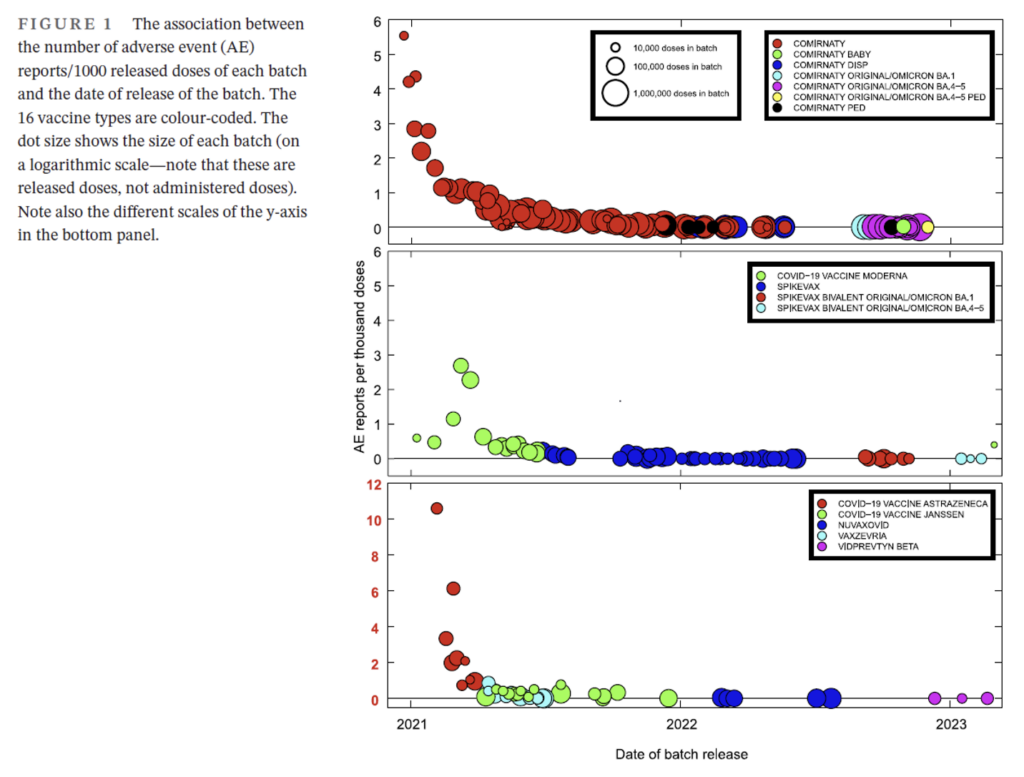
The most striking feature of the graph above is the dramatic decrease in the number of AE reports with the date of release. Batches that were released in spring 2021 showed a much higher number of AEs than batches released in 2022. In this sense, our findings correspond very well with the Danish study – the most problematic batches in Denmark were also the ones used at the beginning of the campaign.
What could be the reason for this disturbing difference among the batches?
- The high number of AEs in the spring of 2021 may be a result of vaccinating people during an ongoing epidemic, which used to be considered a bad idea before Covid. Moreover, the most vulnerable population was preferentially vaccinated at that time. However, this hypothesis is contradicted by the fact that during the booster campaign in the autumn wave of the epidemic (which also included the most vulnerable population), the number of AE reports did not increase.
- The batches from the spring of 2021 were used almost completely (because there was a shortage of vaccines then), while much of the later batches was left unused. So, maybe if we divided the number of AE reports by the number of doses used (instead of the number of doses contained in the batch), the differences would disappear. Unfortunately, we did not have this data. But this hypothesis is very improbable because the greater part of the miraculous decrease still takes place during the first half of 2021, when there was a shortage of vaccines, i.e. the batches were used almost entirely.
- Another possibility is a change in the willingness of people to report adverse events. But in this case, the effect is rather the opposite. While it was almost an act of civil disobedience to report an AE in the spring of 2021, later on – as the pressure to get everyone vaccinated increased – the motivation for people to report AEs rather increased. However, the graph above shows the opposite relationship.
- There remains the last possibility, which is the most disturbing of all. Perhaps the rush was such that the pharmaceutical companies did not have the production process completely mastered. We already know (from the testimony of USC Professor Phillip Buckhaults before the South Carolina Senate) that the technology of mRNA vaccine production changed fundamentally sometime between the registration studies and the start of mass production. The vaccine for which Pfizer received an EUA, and whose efficacy and safety is described in the registration study, is not produced by the same process as the vaccine that was injected into the arms of billions. It is therefore possible that the start of mass production by the new process was not well mastered, and the initial batches were simply not manufactured correctly. The explosion of AE reports in pharmacovigilance databases immediately after the start of the vaccination campaign may have caused minor ripples of panic and may have forced the companies to make some changes in the manufacturing process.
This last hypothesis is quite worrying because it would cast a shadow of doubt on the capabilities of regulators in many countries and – if ever proven correct – would have dramatic legal consequences for the vaccine manufacturers.
Tomas Fürst teaches applied mathematics at Palacky University, Czech Republic. His background is in mathematical modelling and Data Science. He is a co-founder of the Association of Microbiologists, Immunologists and Statisticians (SMIS, smis-lab.cz) which has been providing the Czech public with data-based and honest information about the coronavirus epidemic. He is also a co-founder of a ‘samizdat’ journal dZurnal (dzurnal.cz) which focuses on uncovering scientific misconduct in Czech science.
To join in with the discussion please make a donation to The Daily Sceptic.
Profanity and abuse will be removed and may lead to a permanent ban.
There is at least a 5th possibility.
During new drug development the 3 D’s are of the utmost importance-
Dosage
Duration
Distribution.
These 3 factors were, are and will likely forever be unknowns especially as the modified messenger RNA causes the immune system to produce an unknown quantity of the “desired” spike antigen (but also junk proteins) throughout the body for an unknown amount of time, dependant upon the vagaries of the adaptive immune system.
it is gene therapy.
So faced with these unknowns, bigpharma deliberately alters the recipe and tracks the results.
They know full well who had/has a particular batch.
It is part of bigpharma’s DNA.
Very laudable. Lol.
There is a 6th possibility especially as regards the Pfizer jab.
I recall that initially the therapies had to be kept something like minus 60-80 degrees centigrade.
That soon fell by the wayside?
If it was essential for it to be refrigerated to such a degree then the “active” ingredient ie the mmRNA, would rapidly become inert – leaving the luckier recipients with just a useless gloop, leaving the immune system only having to deal with the other rubbish in the jab-
see para 6 contents –
https://www.gov.uk/government/publications/regulatory-approval-of-pfizer-biontech-vaccine-for-covid-19/information-for-uk-recipients-on-pfizerbiontech-covid-19-vaccine#ingredients
I also remember this emphasis on needing to keep the jabs in cold conditions. However, on having to queue to get a prescription at a local pharmacy, I was amazed to see a walk in jab session in progress with no refrigerated truck and when I questioned the staff they said it was not necessary.
Being a sceptic I concluded they could not risk allowing the Pharmacies to jab the public as they would lose control and this was the reason for all the group sessions.
I also remember them saying you could only jab with the same variety of product yet people were given both Pfizer and Moderna jabs.
Interesting point. I didn’t give it much thought at the time but surely to keep a product at such an extremely low temperature would, I’m thinking, require specialist equipment for distribution from coming off production to the point of use. Of course, we’re talking distribution in bulk and all the necessary logistics to maintain product integrity via the delivery chain. Thinking as I write, I’m wondering whether Pzr is still requesting the same handling protocols. Just a thought!
This was all known ages ago.
Craig Paardekooper used VAERS data – which included batch references – to illustrate very simply and clearly that a small number of specific batches were responsible for the vast majority (over 90% from memory) of adverse events.
It was possible to separate Pfizer’s from Moderna’s.
Pfizer apparently took a phased approach, seemingly very intentional; they started with batches which must have been placebos. Then, suddenly, a massive spike in adverse events for a very short time. Then a pause for a month or two. Then another spike, this time apparently slightly less toxic for it was responsible for slightly fewer adverse events. Then quiet again for the same length of time as the first “pause”. Then a third spike, slightly less toxic again. Then quiet for the rest of the time.
Moderna’s approach was apparently scattered, with toxic batches spread randomly across the months.
Keep shouting, folks. But don’t waste your life praying for justice.
At the time, you could look up the ‘vaccine’ batch number and see how bad that particular batch of poisons was. I copied the link – https://howbad.info/ – but I cannot remember exactly when that was. I see that the website owner has been updating the site since: quite impressive.
I have just found out the website is run by Craig Paardekooper, so the data you were referring to.
Apart from the efficacy of the product, they seem to have lost their reputation for quality control across the board. Who trusts anything manufactured by them now?
Do we even have a regulator in this Country ‘checking’ the products ?
No we have a “regulator” which enables (their own choice of verb).
Clown World
It’s a moot point!
It’s like asking a patient “which would you sooner have, strychnine or arsenic?”
mrna products are no better or worse than any other, they’re all unessassary shyte!
The bad batches were immediately harmful, the “placebo” batches may be harmful in a more subtle and long term manner, with the possibility of a link to heart problems
Exactly, they’re all shyte!