
My Complaint to Cochrane About the Editor in Chief’s Smearing of Our Review
Paul Thacker’s work through a combination of contact with a whistleblower and access to correspondence through Freedom of Information requests has shed considerable light on one of the most disturbing cases of media and lobby-originated distortions of science, and the fragility of the editorial processes.
This morning, I sent the following comment through Cochrane’s editorial system:
The two editorial statements published respectively in March 2023 and June 2024 mark the zenith of editorial mismanagement of our review [‘Physical interventions to interrupt or reduce the spread of respiratory viruses’, which found no evidence for the effectiveness of face masks]. Both contain misleading statements.
The March 2023 statement ostensibly addresses misquotes of our review by third parties. Anyone who has ever published scientific papers of interest to third parties knows that misquotes and selective citations are rife and completely outside the control of authors and editors.
The March 2023 statement was written as a response to outside pressure, both by influencers and lobbyists directly on the Cochrane editorial team. Instead of directing the comments to the standard procedure opening them to author response, the statement was issued without consultation with the authors of the review. The 2022-3 update of the review had passed several layers of peer review, both general and specialist and was considered good by its sign-off editor.
The intention to “engage with the authors” is another blind. The Editor in Chief insisted on meeting one author in the presence of a paid intermediary, not all 12 authors. This is not made clear in the 2024 statement. Further, this statement gives the impression that the PLS was somehow clarified by our response to the numerous statements, introducing the idea that somehow evidence based science is democratic, it is run by a show of hands. This is patently not the case as no changes were made, nor were necessary.
I will provide more background details of the editorial mismanagement and lack of collaboration and its implications for readers and authors of ‘controversial reviews’ in due course.
This is the receipt of the comment:
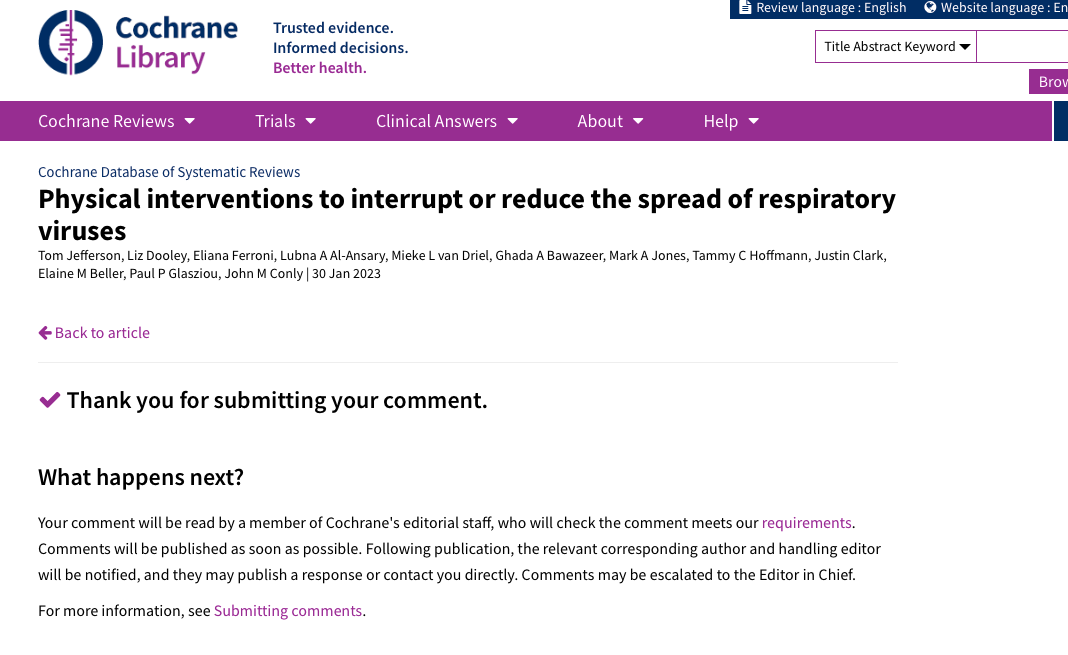
So why am I publishing this? Well, we now have a date stamp for both the comment and receipt: August 7th 2024.
Two complaints addressed separately to Cochrane management board and CEO were dismissed. So let’s see what happens next.
I joined the Cochrane Collaboration in 1994. I was there in 2015 in Vienna when ‘Collaboration’ was removed from Cochrane. The latest editorial mismanagement has further undermined Cochrane’s credibility. The message is sad for all of us who have toiled to set it up or for those who relied on it as an unbiased source of evidence synthesis.
This post was written by an old geezer who has co-authored 17 Cochrane reviews (and many updates).
Dr. Tom Jefferson is an epidemiologist based in Rome and lead author of the latest update to the Cochrane review of physical interventions to interrupt or reduce the spread of respiratory viruses. This article was first published on Trust The Evidence, which you can subscribe to here.
To join in with the discussion please make a donation to The Daily Sceptic.
Profanity and abuse will be removed and may lead to a permanent ban.
The professors have been some of the very few public figures to have emerged from convid with their credibility intact
Sorry Hux! But Elon Musk is doing a better job than most!
Yet another dreadful example of the power exercised by bigpharma.
Which has been gleefully hijacked by politics in order to suit their aim of absolute control of populations by whatever means necessary.
Subservience is achieved through fear and what better reminder than seeing everyone wearing masks.
Hopefully there will be enough refuseniks the next time roiund.
Cochrane has been a pharma shill show for at least 20 years – [although obviously one cannot and must not tar all at Cochrane with the same brush]. Read the quote below from Cochrane author Professor Sir John Grimley Evans and its context: Questions on the Independence and Reliability of Cochrane Reviews Journal of American Physicians and Surgeons Volume 10 Number 3 Fall 2005 Cochrane’s ability to appear above commercial conflicts of interest remains dependent on governmental funding and particularly from British governmental sources. By early 2004 significant changes had taken place. British governmental funding was reduced considerably. Faced with potential reductions in productivity and staff redundancies, Cochrane had to consider commercial sources. The changes were described thus by Cochrane author Professor Sir John Grimley Evans:”Over the next five years, the money to be provided to British Cochrane Groups by the Department of Health, ominously now called core funding, will not be enough for survival.We will all therefore be looking for additional money from people or agencies interested in what we do.To put it in terms familiar to the shopkeepers who, as Buonaparte observed, rule this unhappy country, we have to sell our product.”Cochrane’s policy on financial conflicts of interest… Read more »