
Can Women Be Persuaded to Have More Children?
Female choice is the greatest force in nature. It can make or destroy species – and civilisations.
We live in a period in which the consequences of female choice-making are more significant than they have ever been. This is because it has now become possible for women to choose, to a greater extent than ever before conceivable, whether to have children at all, how many, and with whom – from a potentially almost limitless array of potential partners. Nobody should (I hope it goes without saying) advocate for a moment returning to a time when they were not so free to choose. But we have not yet even begun to reckon with the consequences of this – in historical terms – extraordinary development.
This was brought home to me while reading three discomforting newspaper articles over the past few months. The first, an op-ed in the Telegraph, has a headline that tells you everything you need to know about the article itself: ‘Population decline will destroy the West as we know it’. Our populations are declining; birth rates are jumping off cliffs like lemmings; the result will be deteriorating living standards and the deathly struldbrugism that will flow from political power accumulating in the voting block of the old. The second article, in the Daily Mail, offers us an insight into the “disturbing world of femcels“, an online subculture of women who have given up on romance, dating, marriage, childbirth and so on, either because they consider themselves too unattractive or because they have been totally put off by porn or bad experiences with the disgusting, violent and sexually aggressive behaviour of some man or men. And the third article, in the Guardian, features Daniel Kebede, General Secretary of the National Education Union, describing how the widespread availability of “aggressive hardcore pornography” is fuelling a “culture of misogyny and sexism” among boys and seriously disrupting teaching in schools as a result.
Any fool can see that the three problems are linked. To a certain extent it seems obvious that something about the material or socio-economic conditions of late modernity tend to result in fewer children being born – that trend is evident everywhere. It is probably also true that there is some effect on the birthrate, at the margins, of “climate anxiety” and environmentalist-driven anti-natalism. But it is even more obvious that the conditions in which many people now live are, not to put too fine a point on it, in psychic terms a bit crap. The many problems associated with smartphones are becoming so obvious that they cannot be denied, but the issue is I think deeper and broader than that – young people now often grow up in a cold, unforgiving environment that can only be described as dehumanising in the sense that it is devoid of genuine human connection.
Never mind the apocalyptic effect of the tsunami of extreme pornography which has been unleashed on society since the widespread adoption of the internet – a vast and unspeakable calamity. Never mind the Tinderisation of dating, which has concentrated sexual capital in such a tiny sliver of the population. And never mind the fact that young people nowadays grow up in an atmosphere of mutual recrimination and distrust between the sexes stemming from the pervasive atmosphere of political polarisation, cancellation, cyberflashing, upskirting, and so on and so forth.
Those are really just facets of a more fundamental feature of digital modernity: the reduction of the ‘other’ to a mere avatar or sprite, relevant not because she is a person in her own right, but rather in her constituting a transitory aspect of one’s digital or physical environment. This mode of interaction is fostered by the capacity of the internet to abstract the individual from context – from past or future, from feelings and background – and display him or her as a simple fleeting artefact of the present, soon to disappear into the ether to be replaced by some other avatar.
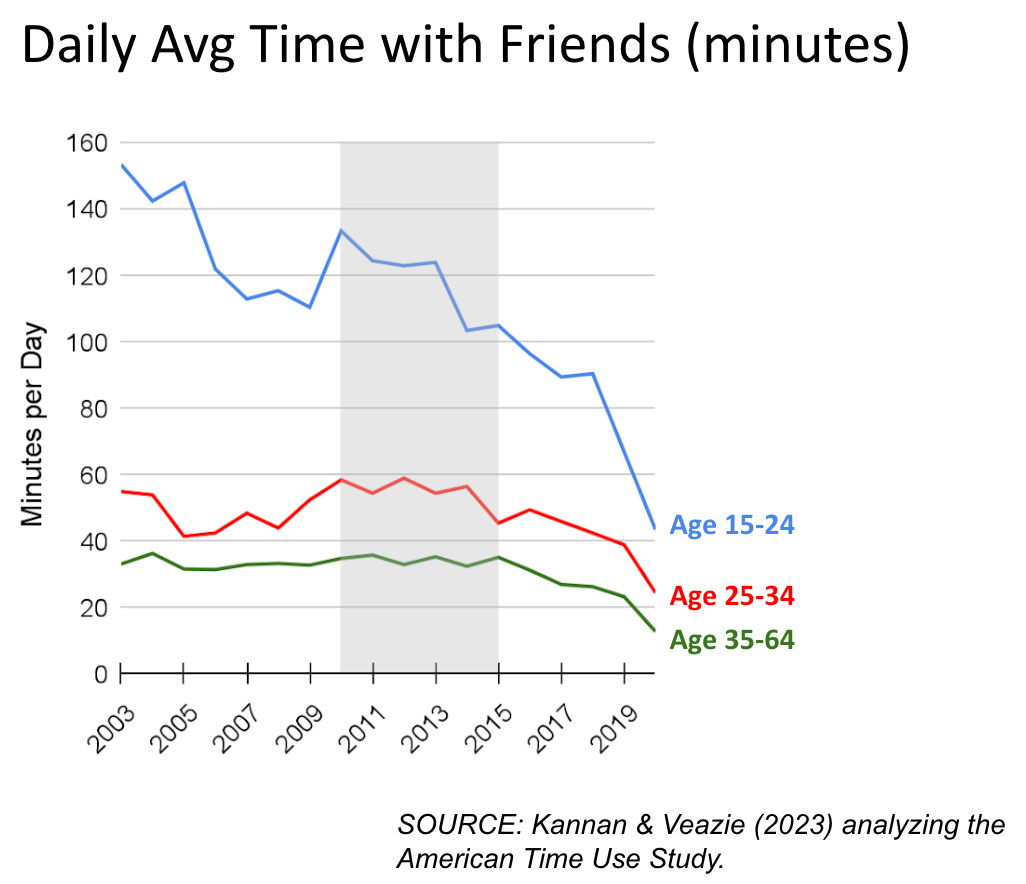
This has two consequences. The first one is a sense of sheer achedia with respect to human relationships in the round – a feeling that human interactions are cheap, superficial and largely as a result superfluous. Why spend the time getting to know somebody now when there are a billion other people one could briefly interact with online instead? Why listen to anybody in particular when there is so much to hear through one’s ear buds? Why understand anybody’s point of view when it only appears in your awareness as a tweet, blog post or meme before disappearing into the online ether? And, it follows, why go to the trouble of meeting somebody, getting to know him and falling in love? Why even make friends? From the article linked to above:
The second consequence is a lack of healthy self-esteem. How must it feel to grow up in a world in which literally everybody you meet – your friends, people in the street, even your parents – are more interested in what is going on in their phone, or on their laptop or tablet, than in listening to what you have to say? How must it feel to have most of one’s interactions with others mediated through a technological interface which is tailor-made to distract any potential interlocutor? This can be nothing other than mildly but relentlessly undermining of self-worth, leaving aside the sense of inadequacy that is bred by the competitiveness of social media in the developing mind.
The result of all of this – not for everyone, by any means, but a significant enough chunk of the population to be itself very significant – is a deep malaise, characterised not so much by hatred of humanity but by a vague lack of interest in other human beings as such, and an inchoate sense of disappointment in what life has to offer. Who, enmeshed in that dispiriting web, would want to bring children into the world?
You are likely familiar with the film Seven. In one scene, the Gwyneth Paltrow character, Tracy Mills, confides to William Somerset (Morgan Freeman) that, although she is pregnant, she is considering an abortion on the grounds that the city in which she lives is an unfit environment in which to raise a child. What we are I think witnessing is a much less dramatic but more pervasive playing out of that logic; a feeling amongst many young people that, since life in the digital age is, to use what seems to be the appropriate term, a bit “meh”, then having a baby is likely to be a bit “meh” for parent and child alike. Why afflict that sensation on either party by going through the rigmarole in the first place?
The Japanese fairy tale, The Tale of the Bamboo Cutter (often referred to in English as The Tale of the Princess Kaguya) sheds a great deal of light on this. (If you have not yet had the opportunity to see it, I strongly recommend Takahata Isao’s wonderful animated version, available on Netflix. Make sure you watch the subtitled, not the dubbed, edition.)
The story is one of the great contributions of Japanese civilisation to world folklore. In it, an elderly childless couple discover a tiny baby girl (Kaguya) hidden inside a bamboo shoot. They decide to raise her as their own, and she quickly grows into a beautiful woman. They also find in the bamboo forest gold and rich gowns with which to give her a life of luxury. She attracts many suitors, to whom she sets impossible tasks in order that they might try (and fail) to win her hand in marriage, and eventually even the Emperor of Japan tries to make her his own. But ultimately she rejects even him, and is in the end spirited away to the moon, which, it is revealed, is her true homeland, from which she was exiled for some unknown crime. Her parents are stricken with grief at her disappearance and, it is implied, then sicken and die.
As is so often the case with these stories, the tale asks us to hold in our minds two competing dispositions – in this case, to the task of giving birth and raising a child. On the one hand, to have a baby is wonderful: it produces something beautiful and vastly enriching. But on the other, to do so is to invite into your life great tragedy: the person that you love more than anything else will by necessity leave you, both in the sense of outgrowing you and in the sense of physically going out into the world. He or she will also, undoubtedly, in turn also suffer. And sooner or later you will grow old and die and your connection to that person will in any case be forever severed.
Having children is, therefore, neither wonderful nor tragic – it is both at once. And one cannot, indeed, have the wonder without the tragedy. Every parent must reconcile him- or herself to heartache; the only real question is just how much heartache there will in the end be.
This makes having babies a leap of faith. It will make you happy, but also make you sad (and, of course, for most of human history it could also quite easily literally kill the mother – making the leap of faith a visceral one indeed). It is hardly surprising, then, that many modern young people, for whom life, as we have seen, is already often rather insipid and pointless, should not want to embrace parenthood, and should indeed view it with trepidation as involving too much potential pain and suffering to be worth doing. Wonder and tragedy do not appeal, because life is not known by these people to contain such things; they are used to inhabiting an altogether more staid, arch and banalified reality, and view anything that intrudes upon it with trepidation and hostility.
As a father of daughters, I am particularly interested in how this all affects girls in particular. The Tale of the Bamboo Cutter, for all that the title suggests it is about the father of Kaguya, is very much concerned with matters of the feminine. Even the Emperor of Japan himself is in the end held to be essentially without consequence when set against the interests of Kaguya. The tale positions her at the heart of the matter. And, in particular, it seems to position her choice-making as the crux of everything. She will choose whom to marry – or not. Her suitors are desperate to win her hand. Even the Emperor wants her. But she will not be moved. Her decision is her own.
In one respect, this speaks to an ancient truth that any straight man reading this will appreciate: the deep and inscrutable mystery that is female decision-making in matters of the heart. Men, when it comes to sex, are simple creatures – we are, rather famously, not particularly discerning. Women are different. This means that, by and large, the choice-maker in such matters is the woman. The result is that young men spend inordinate amounts of time trying to figure out what it is that will make the target(s) of their affection find them appealing. We have a vague idea that it isn’t merely looks. So what is it? Is it fashion sense? Is it success, money, a good sense of humour, creativity, being sensitive, being a bad boy, being friendly, being aloof? Is it being good at sport, or good at playing guitar? Is it shared interests, or will opposites attract? Should I “be myself” or somebody else? What if I was the Emperor of Japan? Would she like me then?
In this regard, The Tale of the Bamboo Cutter has a great deal to say about certain features of male-female relations which seem immutable across space and time. But there is also something deeper going on in the story. Because while Kaguya might be free to choose from her suitors, in the end of course she makes no choice at all. Rather, she – like Bartleby – “prefers not to”. Her decision is to make no decision, until ultimately the decision is forced upon her to retreat from the world and into the heavens whence she came.
It is ambiguous as to whether her reluctance to marry stems from a desire to avoid material attachments (knowing that she must one day return from her exile to Earth) or dissatisfaction with her options. But at root the symbolic message is the same, and seems a kind of foreshadowing or reverse echo of the future we now see quite clearly before us, wherein young women are en masse “preferring not to”, and in many cases indeed metaphorically retreating into the night sky, away from the world with all its anxieties, disappointments and drift. (It is undoubtedly significant that when men retreat from the world they go symbolically or actually downwards, into basements, cellars, caves, chasms, where they become enmeshed in video games, porn and misogynistic online content. Just as men are from Mars and women from Venus, men it seems are chthonic, while women are celestial.) This could be because of a desire to avoid childbirth and child-rearing entirely, or it could be the result of a lack of acceptable options – or, obviously, both.
Female choice matters, the implication of the tale would seem to be – and in truly civilisational terms. Remember that when Kaguya returns to the moon, her parents are stricken with grief – they will never recover and are in any case too old to have children of their own. It is also interesting in this regard that in some tellings, Kaguya sends the Emperor an elixir of immortality just before she leaves – which he then orders burned, since he does not want to live if he cannot ever see her again. When women as a whole come to “prefer not to”, in other words, the results can become cataclysmic. The means by which the civilisation will endure will dissipate in the sense, obviously, that no babies will be born, but it will also suffer a mortal blow in terms of morale: its men will have nothing left to really live for. Even if granted immortality, they will not take it – because why go on if there are no families, no children, no girlfriends, no wives?
I am no reactionary. If anything I lay the blame squarely on men’s shoulders for having so pitifully neglected the raising of good, honest sons who women will find appealing. And I am glad that my own daughters will have choices that would have been entirely unavailable to them if they had been born a hundred or so years ago. I also have no desire to display insensitivity to the many people who would very much like to have children if only they could – or indeed who prefer members of the same sex as partners in life. Nor do I wish to be seen to be implying that childbirth and childrearing are all that women’s lives ought to revolve around.
But, all the same, I look to the future that stretches ahead of us with a sense of foreboding. We have, inadvertently, created the conditions in which love, commitment, and family have either lost their appeal, or are slipping out of reach. The result is that many young women, Kaguya-like, increasingly if unconsciously come to see their life in the world as a mere transition or phase that will leave no trace behind it when it ends – a kind of exile before their eventual return, into themselves and from thence to the moon. They are exercising their choice, and they are choosing not to.
Given the conditions in which they have been raised, and given what is often on offer in respect of the young men by whom they are often surrounded, I do not really blame them. But it is both a tragedy and an incipient crisis. It is a tragedy because a life without love, without family, is for the vast majority of human beings a sad and humdrum affair. And it is a crisis because it means that in the long-term our civilisation will cease to endure. One of the fundamental features of the human condition is that men and women must collectively come to terms with each other’s existence, and join forces against the world together in raising families. Nobody, I hope it goes without saying, has lived any less of a life if he or she cannot have children, chooses not to do so, never meets anybody he or she wishes to settle down with, or is not attracted to the opposite sex. But nonetheless if by and large men and women in a given society do not form long-lasting, loving, mutually supportive relationships with one another in which to raise kids, then that society will, in the most literal sense, not survive. This then is a matter of the deepest, utmost seriousness – one of the many problems we face that simply cannot be resolved by politics, and which increasingly come to seem intractable if our current arrangements continue as they are.
Dr. David McGrogan is an Associate Professor of Law at Northumbria Law School. You can subscribe to his Substack – News From Uncibal – here.
To join in with the discussion please make a donation to The Daily Sceptic.
Profanity and abuse will be removed and may lead to a permanent ban.
Perhaps trans women can set an example.
You sod! You got there before me!
Does anyone know the birth rate of Real Women as against the Pretend Women with Cervixes?
The world average birth rate is 2.27 children per woman. 2.1 children per woman is regarded as replacement rate, the infant mortality rate takes the rest!
This average rate is bolstered by Africa and South America and unfortunately hides a problem with this avearge figure. The birth rate in China is around 1.2 and the population is due to halve before 2100 if there are not fundamental changes.
Immigration into Europe and the USA are also covering up the low childbirth rates which is hjaving a bearing on the ‘indigenous’ folk
I got about a third of the way through this and it seems it bleats on and on about porn has destroyed the birth rate and mobile phones have done for the rest. It seems a rather fanciful article, devoid of any form of reality. The basic fact is that a lot of couples do not want children, an awful lot are responsible and know they cannot afford children and possibly even more know they are too selfish to look after children properly.
As to us all having worse living conditions, well, isn’t that why so many illegals come here? After all they all come here to work do they not?
I suppose we could rely on the Mussies to bring home the bacon but then, when I go through various areas where they have enclaves, none of the blokes ever seem to go to work. Why is that? Do they all work in secretive underground tunnels? After all, we are constantly told the country will collapse without them.
I must agree that this is about couples rather than women. It takes a village to raise a child and there are so many single mothers soldiering on trying to do their best to bring up their children and really they shouldn’t have been left/abandoned for whatever reason.
I do not agree. This article was fascinating and thought provoking throughout and the author is indicating his unhappiness with the way life has changed so radically that there is a breakdown in society where the desires and direction of women has been trashed by a society that does not give any indication of future happiness. So why should women agree to procreation.
I did think that a mention of our growing secular society would have been appropriate given that many of the problems that McGrogan debates, is driven by a declining Christian faith.
Birthrate started to decline when women were forced to go and work for economic reasons. They could have not worked and been content with a fortnight in Blackpool for a holiday, or content to do without a car and get the bus down to the shops once a week and lugg the shopping back in 4 big sacks. Content not to buy their house and instead live in a council showbox whose front door gets painted magnolia every 20 years or when the council feel like it. ——-By the way all of this started long before anyone had porn or phones, except “Men Only” in the newsagent.
—–It is funny though that the Japanese don’t seem to need to bring in half a million migrants every year to make up for their aging population. Instead they adjust the tax code to make it more attractive an idea to have children.
I don’t think the tax code will solve anything. The cost of bringing uona child far exceeds any tax savings one might get.
The family has just been completely devalued in every sense.
A woman today who says she just wants to get married and have children is mocked and considered an abject failure, lacking in ambition. That’s the cultural environment we have.
The tax code can help, as it has in Japan. It is impossible though to have several children and to have the benefit of two good incomes. (Except for the very well paid) I hear all the time people who have children claim that “childcare” is not good enough. But if people have children it is up to them to provide the care, not the rest of us paying for their children’s care.
The bias in the tax system against single income families certainly doesn’t help. UK Governments are happy for taxpayers to fund outsourced childcare, but refuse to value mothers actually caring for their own children with equivalent treatment – such as allowing husbands to use their wife’s unused tax allowance. Babies should be with their mothers, not farmed out to daycare.
I agree that children should spend as much time as possible with parents especially the mother, but economics has made it impossible for a 1950’s lifestyle like that today. Back then we lived in a prefab and my mother was home all day but we had NOTHING.
Grandparents should also be included. It was a suggestion under the last Labour govt. if I remember correctly that grandparents might be paid to help with childcare but the idea was quashed by the childcare “industry”.
Raising the retirement age hasn’t helped, either, as many grandparents are still working.
Like all things in nature, it will find a balance
Nature is in charge, not us
If we are to many then nature will lower fertility to suit!
We have no choice in the matter, we cannot synthesis spermazoa!
Controlled ‘progress’ which starts with the pill and sexual liberation of women in the 60s. From that point onwards more and more women choose career over family. But what starts as a seemingly organic choice, initiated by the state with an economic and social agenda, has slowly morphed into lack of choice – the small handful of women that still choose family over the ‘joys’ of paying government protection money are made to feel less. Far less. Why the lower birth rate? Because everything is designed to discourage women from having children.
Agree entirely.
And the tragedy of it is that it goes against our nature and having a family is among the most fulfilling things one can do in life.
In general I’m not keen on the state trying to nudge me by whatever means. I suppose the state should arguably reward productive behaviour that is helpful to society. Should the state have an explicit policy of encouraging family formation – is that a case where there is a compelling interest that the state should get involved in somehow – tax breaks, parental rights? Maybe.
There are people who claim that the natural way for humans to organize is that people who are closely related to each other form families, families closer related to each other form clans, clans closer related to each other form tribes and tribes closer related to each other form peoples and that each of this aggregate constructs has sort-of individual personality/ culture shared by its members and not shared by those who aren’t. The aggregates also transcend individuals beloning to them with regards to lifetime and it’s further claimed that it would be natural for humans to desire that the ‘ours’ survive, ie that our natural and sane behaviour is that we’d want our family, our clan, our tribe and our nation (I’m unaware of a singular form of peoples in English) to survive and prosper even beyond the limits of our own physcial existenc so that we can, in turn, live on in the memories of those who came after us. Taking this for granted and assuming that there’s a state as worldly embodiement of the abstract nation (volk) a good way to apply its power to is to ensure this continuity of the ours on all levels. NB:… Read more »
I tend to agree
I think some of the men need persuading too
Yes it’s interesting isn’t it? These articles written by men and also the posts…
It’s all on the women isn’t it? So all the men are wanting to settle down and start a family but all the women are like, “no chance, mate. Jog on!”🤔
I guess there’s no such thing any more as a woman who wants children and is looking to settle but she can’t find a man who wants the same. I guess that scenario must be the stuff of fairy tales and an urban myth then. But keep blaming the women…🤦♀️
If Kaguya had married she would have, effectively, become mortal. Her husband could not return with her to the Moon. This is the choice Tolkien gives his heroine Arwen Evenstar. As she is of the Elf race she is immortal, pagan, and animistic. Though the love story between her and Aragorn is only included by Tolkien in the addendum, in his film Peter Jackson makes it central to their dilemma. She begins a journey to the Undying Lands, along with all her people. Only when she sees a vision of her child does she turn back and giving her love to Aragorn renounces her immortality. The alternative to becoming mortal – one which Kaguya would have faced – is expertly depicted by Jackson in the scene where Arwen’s father describes her fate if she should marry Aragorn and remain immortal. “Aragorn will come to death, an image of the kings of men before the breaking of the world…But you, my daughter, will linger on among the fading trees…” The only mortals who can enter the Undying Lands are the ring bearers. In the novel, Sam is met on the shores of Middle Earth by an Elven ship sent to collect… Read more »
The reasons for women ( and men, of course. How come they never get a mention? ) not having/wanting kids are many and varied, so we could talk about this until the cows come home and be no further forward. I would say the top and bottom of it is that society now no longer resembles society, say, in the 1950s/60s/70s. This should go without saying but if you look at teenagers and twentysomethings now compared with then, plus the world in which they live now vs then, it’s like night and day. The sad thing is that I can’t see this ever being remedied, or at least not in my life time. But then there’s many contexts in which we can hark back to when we were in our prime and we’re never getting that sort of life back. What I’ve never understood though, is these same old arguments getting wheeled out by the same moaning, short-sighted people regarding women choosing careers over child-rearing. 1) Get your head round the fact that we ain’t going back to the 1950s, no matter how much you harp on about ‘days of yore’. 2) Who can afford to live on one income… Read more »
2) Who can afford to live on one income *and* expect to have a decent quality of life in this day and age?
An answer could be: People in Ireland because the Irish constitution explicitly recognizes that stay-at-home mothers greatly contribute to society and requires the state to make this possible. Varadkar’s last exploit was to try to get rid of that to enable more conventional economical exploitation of women. Honi soit qui mal y pense …
The way the ‘western’ system works, a child is technically an illness: Women get sick with one, cannot work for a while but soon, they’ll hopefully be back in the create value for others treadmill. Thank God! No wonder that this attitude leads to collapsing birth rates. But – hey – the muslims are thus going to inherit the earth. That’s also something.
[That’s sarcasm.]
This is a good article, thank you. However there are some other significant drivers of this worrying situation – as extensively documented by Louise Perry and Mary Harrington. The sexual revolution in the 60s had some very damaging effects upon women and stable relationships between men & women:
https://www.iwf.org/2022/10/05/louise-perry-on-the-consequences-of-the-sexual-revolution/
In addition, research is now showing even more bad side effects of using the pill:
https://conservativehome.com/2023/03/24/georgia-l-gilholy-women-are-waking-up-to-the-dangers-of-the-pill-and-its-time-society-did-the-same/
This are very difficult problems and there are many competing issues – women having multiple uncontrolled pregnancies in marriage, especially women in poor societies – brings serious consequences to them and their children.
Thanks for the links.
Some factual criticism: As opposed to Louise Perry asserts, monogamous marriage is not a Roman institution. It already existed in classical and even pre-classical/ mycenic Greece, as evidenced the Illiad whose war starts with Paris taking away the wife of Menelaus or in the Orestia. Ancient Germans had it, too, as shown in the Icelandic practice of marriage of someone’s son to someone else’s daughter to cement a formal alliance between two families.
Women are the problem. The author has daughters, so his bias.is to them. They have been taught, by hateful feminist, to dislike and be suspicious of men. And men have been demonised. It is not just about online.porn. and lots of girls debase themselves and their value by dressing like prostitutes and acting like one. Even young girls at school dress like this: just observe how they hike their skirts up. It’s shocking sometimes We have, in many ways, let women get away with this. In the past women were under more societal control and suffered severe criticism for breaking the rules. Bow they can sleep around as much as they want. And then it is mens fault if women suffer buyers regret. And, women are always seen as the good party in any divorce. They get state help and massive legal bias in their favour when a split occurs. This assistance encourages women to get rid of any man that they have a problem with very quickly. We do not promote and support mediation and learning to resolve our problems. Ans, again, men are always seen as the problem when it is both male and female that have adopted… Read more »
Well of course ”women are the problem” when you’re a misogynist who demonstrably hates women and wishes to blame us for the downfall of civilization and everything bad that happens in the world. I guess the men that are in positions of leadership are just our hapless puppets, controlled by telepathy via our hive mind, because we are, after all, evil villains from a Marvel comic book. Men are absolved from all responsibility for their decision-making and actions because there’s always a malicious wife behind the scenes, plotting something damaging to society and pulling his strings, so it’s not his fault when it all goes South. You remind me of one of those masktards. It doesn’t matter how many pieces of evidence contradict your belief, including your own lived experiences and observations, you still cling on to your face nappy and look a complete fool, because reality contradicts your delusion but accepting you’re wrong takes balls, so carry on with your inner narrative you do. I saw one yesterday. If I were you, in lieu of a time machine, I’d consider moving to any country that has Sharia law. Saudi and Pakistan are nice and warm all year round, and… Read more »
I don’t agree with every Grim Ace posted but “sex life society” (the golden calf of the post 1960s) is seriously broken in many ways. Eg, there are far too many women who seem to believe that their vaginas are the black hole at the center of a universe useless and mindless dog-like creatures called men naturally orbit around who wouldn’t and couldn’t do anything else. I can sort-of understand that because ever since they started to grow breasts, they’ve been surrounded by useless and mindless dog-like shouting creatures wrongly called men who do them justice by considering them really just a black hole that’s the centre of all their attention with a useless appendix that’s talking too much and which is best ignored as good as that turns out to be possible. On its own, this whole arrangement of naked monkeys socially grooming other naked monkeys with the not so hidden intent to ‘make’ it to a 30 second romp¹ would just be bizarre. It starts to get seriously unpleasant once the male monkeys are looking for involuntary spear carries to demonstrate their male monkey greatness on, the female monkeys try to set off their male comonkeypatriots to attack… Read more »
I think that the Daily Sceptic is to be commended for running articles like this one from David McGrogan. More people need to think harder about what it is that we are doing to ourselves and society and to ask more hard questions, as McGrogan does.
As the bleak incompetence of the Conservatives is being replaced by the even bleaker incompetence of an unloved Labour Government, we will need the Daily Sceptic to become a more powerful source of discussion; and to continue to provide inspiration in the belief that ideas can change our direction if we take them outside of our own bubbles.
We also need every person concerned about the incompetent decision making in parliament to contact your Mp and express your concern. Do it once a week or everyday, just do it!
If you asked a childbearing aged couple and ask if they will have children, the answer often is “who would want yo bring a child into this world”. Who can blame them? For all of you have lived an honest, down to earth life, did you ever think you would be told “you will own nothing and be happy” and “you will eat bugs”. No, me neither.
“I am no reactionary. If anything I lay the blame squarely on men’s shoulders for having so pitifully neglected the raising of good, honest sons who women will find appealing. ”
——
It takes two to make a baby. I raised two good, hard-working, successful, attractive and honest sons (both heterosexual). Both are now in their ’30s; both are single and have produced no offspring. There seems no likelihood of either a wedding or grandchildren.
I can assure you that my two sons are very “appealing.” I don’t doubt that if they wanted those things they would find a female partner to procreate with fairly easily – although whether she would be one “worth having” is another matter.
The fact is, it takes two to make a baby and many men have decided not to marry and not to procreate because (and I suspect this is my sons’ reason) what’s in it for them? And what might be the outcome in a few years time? A divorce; loss of the home they’ve largely provided and paid for; years of paying maintenance; infrequent contact with the children; a possibly spiteful ex-wife.
A prescient article! My two eldest grandchildren are convinced they do not wish to have children. Hopefully they may come to see otherwise. What will they do in their old age? Where will their support network come from? Who will look after them when they lose independence? The answer is that they will be lonely but hope to be cared for by other people’s children. That is socially unsustainable. The nihilistic option (as in Canada) would be state-sponsored euthanasia – what a future!
In the 1970s the fashion was to predict a population explosion, by assuming the current trends of the day would continue, straight line curve into the future.
The fashion today is population implosion by assuming current trends will continue straight line curve into the future.
Learnt by observation from experience much?
The same straight-lineism is applied and fails repeatedly to all things pseudo-scientific, oil, global warming, Arctic ice melting, economic advance, viruses, etc.
It is what happens when that fatal conceit of men and women who think they have enough knowledge of everything to second guess Nature.
France already had shrinking native population due to reproduction below the replacement rate at the beginning of last century and meanwhile, this has also become true for all other European peoples. A population ‘explosion’ (this is a loaded politcal term for population growth) is also happening, with the population of Earth approaching and unprecedented high of 8 billions (and counting) but that’s due to people who haven’t been “liberated” from their biology by the ingenuity of the pharmaceutical industry and who – by and large – very much resent being liberated from that, still getting chilren in other parts of the world, predominantly, in Africa and in the Islamic states.
BTW, what’s a straight line curve? This looks like an oxymoron to me.
A curve is any line on a graph so could be a straight line
Having and raising children should have more prestige in our society.
Interesting stuff.
How do you explain the modern malaise ?
Democritus’ dialogue between the senses and the mind provides a clue;
Miserable mind, you take your evidence from us and then seek to overthrow us ? Your victory will be your own fall.
We gave grown the status of the informative process in understanding, to the point of automation in AGI. We look there for our meaning, but it is only a system of representational meaning, that becomes wholly representational.