
Suffering From Anxiety and Depression? Try the Low-Carb, High-Fat Diet, Says a Pharmacist and Research Scientist
About 15 years ago, one of the runners in our training group announced that he was going on a carbohydrate free diet. I thought he was mad. Initially, I thought he was just giving up sugar, but when questioned he said he was also giving up rice, potatoes, pasta, bread – basically all carbohydrate. This simply didn’t make any sense; it was crazy. Where was he going to get his energy from? How would he be able to run?
Skip forward about seven years, and I started to hear a lot more about low-carb, high-fat diets. It seemed that quite a lot of athletes were adopting this, particularly those in the ultra-running community. Perhaps it wasn’t so crazy after all. After doing a bit of research, I came to the conclusion that there may well be benefits, not just for weight loss (which I wasn’t interested in) but for improving the immune system and, better still, helping my running. I was keen both to boost my immune system, as repeated coughs and colds had jeopardised training over the years, and keen to avoid hitting the wall in marathons. So, with this in mind, I stuck to a low-carb, high-fat diet for about a year, just to see how things went and how easy or difficult it was. This happened to coincide with a period of plantar fasciitis, which meant I wasn’t able to run much, perhaps a good thing as it was quite difficult to stick to the diet even without the complication of competitive training. What I did find was that I was not troubled by coughs or colds for most of that year, and when I did catch a bug at the start of my summer holiday, I recovered much more quickly than normal and was able to do some light running by the end of the week.
In all my research and during my own travels into the world of the low-carb, high-fat diet, the fact that this type of diet might also help those with mental illness had fallen below my radar. So, I was interested to read a case report in the Frontiers of Nutrition this month about three people who had achieved full remission of major depression and generalised anxiety disorder on adopting this diet (ketogenic metabolic therapy).
Psychiatric conditions such as schizophrenia, depression, bipolar disorder and binge eating disorder, are neurometabolic diseases involving glucose hypometabolism, neurotransmitter imbalances, oxidative stress and inflammation. These disturbances can be modified by use of ketogenic metabolic therapy (KMT), otherwise known as a low-carb, high-fat diet. So, what you eat can directly affect how you feel. I think that, at heart, we all know this even if just from eating too many travel sweets on a long car journey and feeling a bit rubbish for the rest of the day.
Insulin resistance in the brain results in glucose hypometabolism and a vicious cycle of unmet energy needs. Unmet energy needs in the brain manifest themselves in cognitive impairment (mental fatigue, memory problems, confusion), emotional symptoms (irritability, anxiety, depression) and physical symptoms (headaches, dizziness, weakness). Although the brain primarily uses glucose for its energy needs, it can adapt to using ketones as an alternative fuel.
In a low-carb, moderate protein, high-fat diet, there is a shift from using glucose to using ketone bodies as the primary fuel source. The ketones provide the brain with a more efficient energy source than glucose and may be exerting other beneficial effects on the brain. Studies have shown that a ketogenic diet improves mitrochondrial metabolism, neurotransmitter function and oxidative stress/inflammation, while also increasing neural network stability and cognitive function.
low-carb, high-fat diets can be very strict, with the fat to non-fat ratio as high as 4:1. Interestingly, these diets have been shown to have some usefulness in paediatric epilepsy, and reports of this go back as far as the 1920s. But lower fat-to-non-fat ratio diets, which provide more variety, have also been shown to alleviate many mental disorders. There is evidence that they may be effective in schizophrenia, anxiety, autism spectrum disorder, major depressive disorder, binge eating disorder, ADHD and obesity.
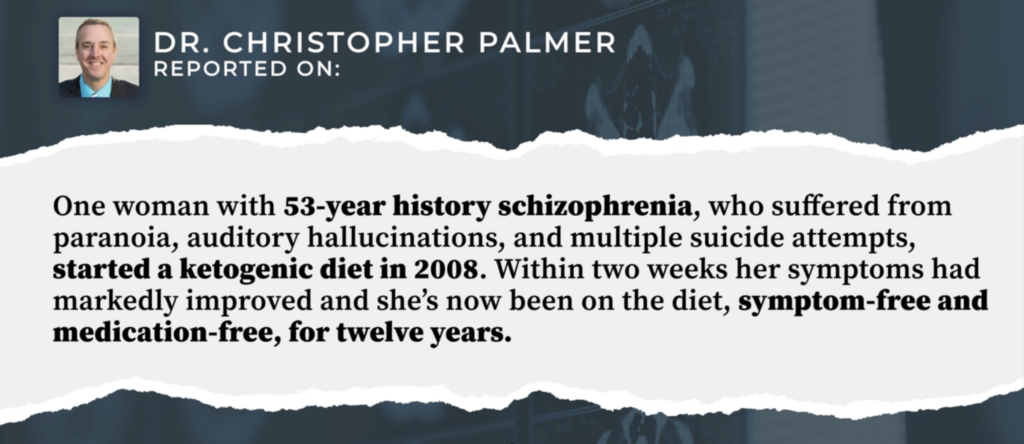
Slide from summary of the Norwitz paper
All three cases in the current study involved complex presentations, including major depression, generalised anxiety, other anxiety disorders, and comorbid psychiatric conditions. The subjects underwent a personalised, whole food, animal-based, low-carb, high-fat diet (KMT) for 12-16 weeks. The treatment plan included twice-weekly visits with a dietician, daily photo journaling and regular blood tests. Additionally, they received support through virtual groups and family and friends. The regimen was complemented by nature walks several times a week, as well as community-building activities.
It is difficult to evaluate how much the added extras in the treatment plan contributed to the results – perhaps if people had more time with family and friends, and spent a bit more time out in the countryside, they would feel a lot better too. The effects of exercise on mental wellbeing can’t be underestimated. In his book Spark: The Revolutionary New Science of Exercise and the Brain, John Ratley details several case studies involving anxiety, depression, attention deficit disorder and addiction, demonstrating the effectiveness of exercise in these cases. So, the walks in nature are a definite plus in this case. However, this can only partly explain the results, which were quite startling.
In case one, the subject reported “increased mental focus, increase energy, renewed confidence and motivation to return to work. Within four weeks of initiating KMT, he secured a demanding full-time position exceeding his previous experience; after eight weeks, he was given additional responsibilities, handled them well and began three online college courses.”
The second case reported “increased mental focus, more patience with co-workers and family and stated he no longer felt a general pull of anger all the time”. While, for the third case, complete remission of depression occurred. After a total of eight weeks of consistent nutritional ketosis, she said: “I don’t have it anymore. I’ve just noticed, I’m happy all the time, which is funny.”
In this study, the participants were very heavily supported, e.g. they got more than a 5-10 min appointment with their GP and a prescription for anti-depressants. However, the time invested was well spent. When I worked as a community pharmacist, I was shocked by how many anti-depressant prescriptions I was fulfilling. On one occasion, hearing that the price of a popular anti-depressant was about to rise dramatically, I purchased the wholesaler’s entire stock. I didn’t need to worry that I would end up with out-of-date stock; those hundreds of packets of anti-depressants weren’t on the storeroom shelf for long. I felt that there must be something wrong if I was dispensing repeat prescriptions for these drugs; either they work or they don’t. The repeat nature of the prescriptions suggested to me that they didn’t work. But at the time, I didn’t know what the answer was; could something as simple as a change in diet be the solution?
Adopting a low-carb, high-fat diet is not easy. If you go down to the shops on the ground floor of our hospital, you will be hard-pressed to find anything that you can buy for lunch if you are on this kind of diet – perhaps a packet of cheese from M&S, but you can’t eat that every day. I found that you had to be super organised (possibly not something that comes naturally to most of us, especially while depressed) and you have to be quite determined, even stubborn, to stick to it in the face of colleagues birthdays (“come on, have a piece of cake”), restaurant visits (“so you want the burger but you not the bun or the fries?”) and family meals (the kids don’t want to eat that kind of food). It was also more expensive than a normal diet and I found it a little difficult to find the variety of things that I wanted to eat. Maybe I should have done what my husband does and just eat more cheese and nuts, but at that time I was the only member of my family adopting this diet, so I found it quite challenging. If there were a bit more support, as the people in the case studies had, then I think it would be a lot easier for people to stick to the diet and see the benefits. It was notable that at times the subjects of the study required some supplements, e.g. acetyl-L-carnitine, vitamin D and magnesium glycinate, and these additions would not be something everybody would necessarily consider if they adopted this diet without support.
This might not be the solution for everybody. As the authors note: “this case series is limited by describing only three patients, which limits the generalisability of our results as well as the inherent selection bias, as they were interested in KMT after failing standard therapies.” Certainly, without support and without the desire to see change, it will be a non-starter. But for those who are determined to beat their mental disorders, it provides a relatively simple, drug free solution.
The “Patient Perspectives” in this paper are well worth reading if you want any encouragement that this can be an effective approach to treating these mental disorders.
Wouldn’t it be better for the NHS to invest in good nutrition rather than investing in drugs that clearly aren’t working? Major depressive disorder and anxiety are neurometabolic disorders. Doesn’t it make sense, then, to treat them with nutrition rather than medication? The NHS might like to start by changing the Eatwell Guidance, where fats are a tiny slither on the chart, instead of >50% of the dietary intake that they probably need to be.
Dr. Maggie Cooper is a pharmacist and research scientist.
To join in with the discussion please make a donation to The Daily Sceptic.
Profanity and abuse will be removed and may lead to a permanent ban.
And the government recommends the opposite, so you know it’s good.
Too damned right.👍
Absolutely – turn the ‘food triangle’ upside down and you will see a much better diet.
The problem with diet is working out what is going on and coming up with the evidence. It is interesting that Dr Mercola, who promoted the ketogenic diet in the USA initially, has gone against it now, at least as a long term solution, but does say avoid vegetable oils at all cost. Is he talking sense? I haven’t the foggiest. One thing I would say is that it seems that stuff pushed as health food, is probably not, and the food industry is not great. eg wholemeal bread is as bad as white bread in most cases.
Who are those down voting l**ns
Seed oil is filth, originally created to lubricate machinery. We cook only with lard, tallow and butter but coconut oil and avocado oil are fine.
Here’s how your sunflower oil is made. And it is highly inflammatory, in almost all processed food and a core reason why were such an unhealthy nation.
She’s right about ‘the cheese from M&S’! :). And this is a good introduction to the subject.
And it looks like Dr Cooper has done this in her own time, especially the stumbling into Reality bit.
There are videos on the subject, made by doctors outside this discipline but, for one reason or another, like couldn’t lose weight, decided to investigate and are heading in the same direction: excess Carbohydrates cause problems and the question is ‘what is excess’. For non-hyper-athletes, it’s not a lot.
Squeezing olives, to make olive oil, is vastly different to the processed oils, and many of the oils in ultra processed food is beyond description.
The problem with so many disciplines, like diet, Climate, Windmills, EVs, NET Zero in general, Statins, Masks, etc, is that useful information, gleaned from many years of trial and error, swirls around with partially true, inexact and the (criminally?) completely wrong. And, if the information is consolidated, the results are misleading, at best. And anything approaching good advice is contradicted by those whose job would lead you to think they should have the better information.
It’s all about ‘Following the Science’ instead of seeking the Truth.
We recently attended an Ivor Cummins session in Ledbury. What a great town Ledbury is, I’d never been before).
We got 3 sessions + dinner for £15! 1 on low carb diet, another on covid & finally some shallow dives down a few deep rabbit holes. Brilliant value, great evening.
He’s been banging the drum about insulin resistance for years. Of course he was largely preaching to the choir. Looking around, all us sceptics & refuseniks were a very healthy looking crowd, barely a spare BMI between us.
We’ve just got back from a 2 week cycling trip. Odd what you say about eating cheese every day. Riding, or walking long distances I always eat a can of sardines in olive oil for lunch. You can’t best it.
Humans ate a keto diet right up to the paleolithic era, that’s 100,000 generations as compared to 5000 generations on modern farmed diets.
Says a lot about the most natural diet for the human animal!
Playing devils advocate here, but i’m pretty sure our life expectancy far exceeds that for our ancestors from the palaeolithic era
Unfortunately food is not the only factor in life expectancy, modern medicine and working practices have made massive differences to our expected years, but, prick you finger whilst hunting back in the paleolithic and it could be a septic death sentence thanks to the lack of a simple antiseptic!
The diet back then was still the more natural one
Carnivore. Not Keto. Until 6k years back and agriculture, it was meat, with seasonal fruit and berries, honey when lucky. Meat, meat, meat. Even the BBC agrees… So we humans have been around c 3 million years they reckon (Homo sapiens 250 to 300k). The huge majority of that time meat (including fish) was our staple diet. Which is why we have a short gut, and why we can digest meat in large chunks (well, you swallow as much as poss when a predator appears, no?) and digest all of it. Try that with a carrot… Also we have very high stomach acid, for better digestion of meat. https://www.bbc.co.uk/news/health-67917294 “It also discovered that humans’ ability to digest milk and other dairy products and survive on a vegetable-heavy diet only emerged about 6,000 years ago. Before that, they were meat-eaters.” Meat is Homo sapiens species adapted diet. No need for plants. No need for fruit. especially high fructose fruits; the pancreas does not detect fructose as a sugar, so the liver ends up processing it, and it causes havoc. Liquid sugar? All that healthy apple juice is anything but. ps – you’ll lose weight for fun if you go carnivore as… Read more »
I find my mental health is much improved by the consumption of a bacon and egg butty.
Of course it would be better for the NHS to invest in good nutrition, but like all health services, public or privatized, it is sponsored by Big Pharma.
Big Pharma doesn’t want a healthy population, it wants an unhealthy, nutritional compromised population, to unload it’s new and expensive drug therapies upon.
Who wants a healthy diet when you could take Ozempic? Why take Vitamin D or Ivermectin for a respiratory infection, when you could take an experimental vaccine, or a super expensive ‘antiviral’ drug?
Don’t blame the Pharmaceutical companies: their job is to keep their customer happy. And their customer is the sclorotic, bureaucratic, NHS, that was created in the image of the USSR!
It’s run so each bodily function is treated in a different hospital department, independently of each other!
In a video, one doctor is wondering how diets can be improved, and points out that, before considering how it should be done, they should remove the subsidy on sugar!
This country a total mess, like much of the West.
I adopted a low carb way of eating two years ago. I do feel much better for it and have lost a fair amount of weight. I find it easy to stick to and most carbs I don’t miss at all. BTW, I think removing all sugar from my diet has had the most benefit. My husband, who is not overweight, decided to join me. After a few weeks of less than 50 carbs a day he had lost so much weight he began to look horribly gaunt, so it doesn’t suit everyone. I had to feed him back up!
Back in the late 80’s there was a book written by an Aussie doctor which was called ‘Eat the fat and grow slim’. One of my patients was in it and lost about 10st. She found it too difficult to follow and went back to her old habits and regained all the weight she lost. With the extra weight all the attendant health problems arose.
I was in the obese category and went on a high protein very low card diet and lost 30kg in weight. I have managed to keep the weight off but do occasionally indulge in chocolate and cake.
Why the Atkins diet was trashed I’ll never know.
There is a very strong collection of evidence that metabolic health and mental health are inextricably linked. Given how effective real food, high fat, low carb nutrition is against physical illnesses such as diabetes, it isn’t surprising that eating a ‘proper human diet’ (as Ken Berry calls it) will result in optimal brain chemistry. The brain is part of the body just like any other organ.
As a starting point have a look at the Metabolic Mind you tube channel where there is lots of information on both studies into this area and the practical use of such metabolic therapies to put mental health conditions into remission in many cases. Even in mainstream medicine ketogenic therapies for treating epilepsy (often in children) are known to be very powerful tools.
Georgia Ede’s book Change your Diet, Change your Mind is on my reading list.
There were some brilliant talks at the Public Health Collaboration conference just over a week ago from the likes of Dr Iain Campbell PHD on metabolic psychiatry and Dr Rachel Brown on the issues with psychiatric medications, but they aren’t publicly available yet. I think they may be made publicly available in the coming months.
Valerie’s story is an example of how powerful, proper nutrition, in this case a carnivore diet, can be in dealing with mental health conditions
https://www.youtube.com/watch?v=5MXvxitRTl0
My wife and I went carnivore some four years back. During that time, this seems to have not only stopped my wife’s “terminal” bone cancer in its tracks (briefluy – breast cancer 2017, dreadful mistreatment by RUH Bath we are certain leading to it metastasising. Skipped annual scan in 2020, around time we started carnivore – Covid and hospitals were utter hell in that time. 2021, terminal diagnosis. 2 and a half years later, every scan shows the same. No more lesions, no change in how they present. She is not alone in this. Add to that, she had been on anti-depressants for 25 years. Going carnivore made the numbing effect they have (they do work, but only for a short time, and the medical profession makes NO attempt to get people off them, or even review prescriptions). So she got herself off them. Found a liquid version of her script, and over 18 months, titrated the dose down by a half when she felt strong enough to do it. Now 18 months off them. There is also ample evidence that vegans (wtf? Deliberately enfeebling yourself with a luxury fad western diet? – not to mention that it is arable… Read more »
I have heard there is now a new eating disorder, compulsive healthy eating, being overly anxious about everything you eat.
My two pennies worth is that a balanced, mainly home cooked diet will be best for most people.