
Why is the WHO Asking Doctors to Lie to Promote Climate Alarm?
Last month, everybody’s favourite intergovernmental agency, the World Health Organisation (WHO), published a “new toolkit empowering health professionals to tackle climate change”. The toolkit is the latest attempt to enlist one of the most trusted professions into the climate war. But not only is this transparently ideological and condescending ‘toolkit’ lacking in fact, it requires ‘healthcare professionals’ to use their authority to eschew science and lie to their patients and politicians. The climate war is, after all, political.
The problem for climate warriors of all kinds since the climate scare story emerged in the 1980s and became orthodoxy in the 1990s and 2000s has been the rapid improvement of all human welfare metrics the world over. On the one hand, all life on Earth and the collapse of civilisation hangs in the balance – that is supposedly the implication of data that shows the atmosphere has got warmer. But on the other hand, people living in economies at all levels of development are today living longer, healthier, wealthier and safer lives than any preceding generation. The era of ‘global boiling’, as UN Secretary General António Guterres put it, also happens to be the era in which unprecedented social development has occurred.
That is a paradox if you accept the green premise that economic development comes at the expense of the climate. The UN, which has staked its authority on being able to address ‘global’ issues such as environmental degradation, is committed to defending the ‘global boiling’ narrative. But, at the same time, actively trying to retard the development of low-income countries risks undermining its authority in the developing world.
The statement made by the WHO’s introduction to its new toolkit epitomises the feeble efforts to square this circle, which try to spin interference in the development of low-income countries as being for their benefit:
Our world is witnessing a concerning trend of warming temperatures, extreme weather events, water and food security challenges and deteriorating air quality. The frequency and intensity of these events are surpassing the capacity of both natural and human systems to respond effectively, resulting in far-reaching consequences for health.
Surprisingly, for a ‘toolkit’ aimed at people such as doctors, who have a proven capacity to understand scientific literature, the toolkit offers little evidence in support of these claims. It says that “changing weather patterns and extreme weather events can reduce crop yields, potentially leading to food insecurity and malnutrition” and that the “breeding window for mosquito-borne disease is broadening due to changing weather patterns”. The reference for both of these claims is given in a footnote, which provides a link to the 2023 IPCC AR6 Synthesis Report, which says in relation to the first claim:
The occurrence of climate-related food-borne and water-borne diseases has increased (very high confidence). The incidence of vector-borne diseases has increased from range expansion and/or increased reproduction of disease vectors (high confidence).
But dig a little deeper into the IPCC’s discussion on vector-borne diseases and you find the following figure depicting mortality risk of various climate-related factors for six regions of the world.
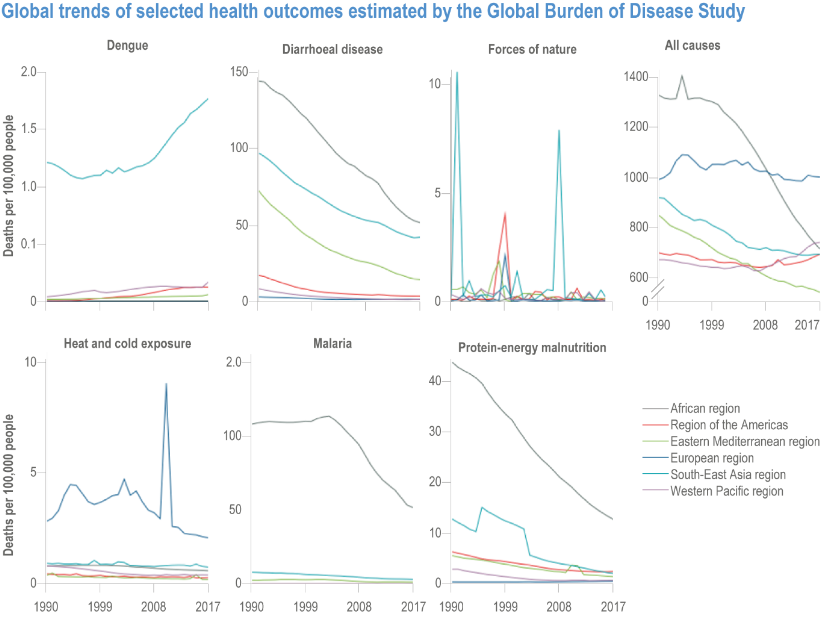
As the data clearly show, since 1990 there have been radical reductions in mortality caused by malaria, malnutrition, diarrhoeal disease, natural disasters and exposure to temperature extremes. The only departure from those trends is dengue, which in any case is of far less significance than the other factors, claiming approximately just 1.75 lives per 100,000 per year, compared with malaria, which claims more than 50.
How do these data compare with the WHO’s claim that “the frequency and intensity of these events are surpassing the capacity of both natural and human systems to respond effectively, resulting in far-reaching consequences for health”, and the “occurrence of climate-related food-borne and water-borne diseases” and the “incidence of vector-borne diseases” have increased? They do not compare. In Africa, deaths from malnutrition have fallen by three quarters between 1990 and 2017. Diarrhoeal disease mortality has fallen by two thirds in the same period. Malaria deaths have halved. Consequently, more than 10,000 fewer infants die in the world each day than died each day in 1990.
This is, or ought to be, all the more remarkable to anyone who tracks developmental data, because of the WHO’s longstanding attempt to link these diseases of poverty to climate change. In the 2002 World Health Report, the WHO claimed that 154,000 deaths were attributable to climate change, almost exclusively in High Mortality Developing Countries (HMDCs) – a figure obtained by estimating climate change’s impact on each of these diseases of poverty. Yet despite the radical progress that has been shown since 2000, the WHO has shown no interest either in revising its understanding of climate change or in developing an understanding of what has driven these improvements in global health, in spite of its name. Instead, it has doubled down on the climate-health narrative.
A similar ‘paradox’ can be shown by comparing the WHO’s statements on food security with other UN agencies’ data. There is no evidence of climate change adversely affecting agricultural production in vulnerable economies.
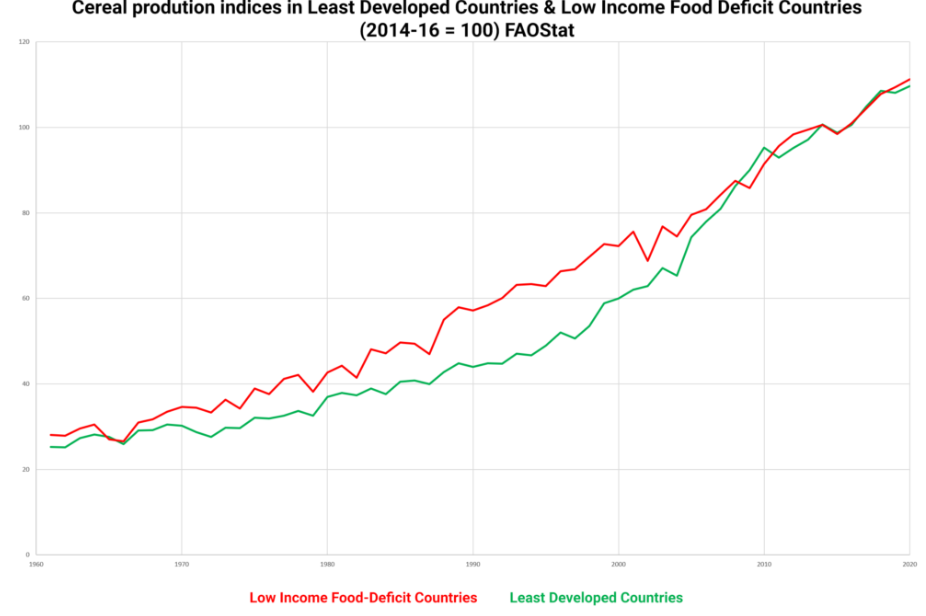
Yet the WHO’s toolkit urges “health professionals” to “communicate” the urgent climate crisis to ordinary people and to use their authority to influence politics:
Things you could say to a policymaker: Climate change is here now, and I am already seeing the impacts on my patients’ health. The health of some people is affected more severely, including children and elderly people, disadvantaged communities, remote communities, and people with disabilities or chronic illness.
People are living longer and healthier lives. Infant mortality is way down. Far fewer people are living in poverty. But the WHO wants doctors and nurses to claim that the opposite is true. And worse than that, the toolkit advises those doctors and nurses not to debate:
Don’t debate the science Don’t get caught up in conversations that question climate science. It’s not up for debate. If conversation veers into this territory, redirect it back to your professional expertise and the links between climate change and health.
But there are no “links between climate change and health”. And if there appear to be, these local or regional health trends run counter to the global trends. Therefore, there must be a better explanation than ‘climate change’. It may well be that extreme weather afflicts a place, or even that unusual weather causes the population of that place a number of problems, as it always has. But ‘extreme weather’ is both rare and as yet not attributable to climate change, on the IPCC’s own analysis. And so, if small changes in weather are coincident with negative economic change or health metrics, the cause is less likely to be meteorological than political in nature. For example, incompetence, especially that of undemocratic regimes’ bureaucracies, is very often the cause of hunger, thirst and the lack of basic services. And in their haste to find politically expedient correlations between weather and welfare metrics, researchers fail to consider alternative causes, despite the knowledge that humans are far more sensitive to economic forces than to nature’s whims.
Don’t believe me? Well, the evidence is extremely stark. Whereas the WHO wants to persuade doctors to ignore science to claim there are “links between climate change and health”, by far the strongest predictor of health is in fact wealth. Accordingly, the WHO 2002 report found practically no climate-related deaths in ‘Low Mortality Developing Countries’ and ‘Developing Countries’. There are no deaths “from climate change” where malaria, malnutrition and diarrhoea are eliminated by rising income levels.
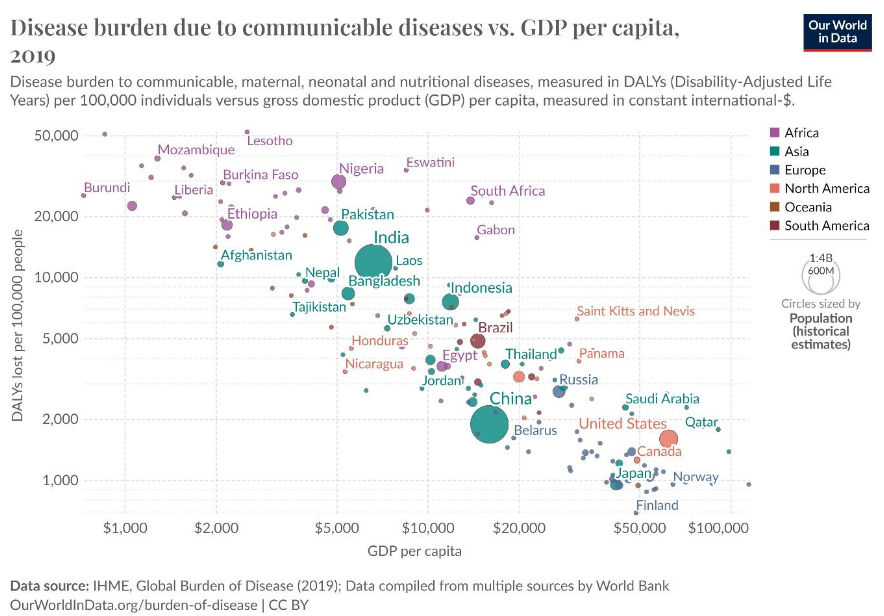
Seen from this perspective, the WHO’s mobilisation of health professionals looks very much like a political campaign against wealth. Only such an ideological – and anti-science – aversion to wealth could put such emphasis on the link between health and weather, because whereas doctors can and should say that income and health are linked, the WHO presses them not to: the best thing that can be given to poorer people is ‘stable weather’, apparently, not higher incomes. The toolkit even anticipates this criticism, advising people how to answer the argument that “climate action is perceived as detrimental to the economy”. According to the WHO, this is “an untrue and unhelpful perception held by some people… which was repeated by some businesses and governments to delay the implementation of climate solutions”. A conspiracy theory, no less, which is supported only by the highly dubious claim that “for every dollar spent on reducing greenhouse gas emissions, approximately $2 are saved in health costs”.
Any doctor who took such an extraordinary and unevidenced claim about a new drug at face value and promptly started prescribing it to their patients would have his or her licence taken away. Britain, for instance, spends around £10 billion per year on subsidising its green electricity transition alone, yet there is no evidence of the NHS budget benefiting by £20bn. An analysis of Germany’s Energiewende estimates the annual cost at €45 billion, yet per capita expenditure on healthcare rose from €3,500 in 2009 to €5,700 in 2021 – an increase of 62%. Moreover, Germany’s green deindustrialisation has come at a heavy price, signalling to the world that not even a first-tier industrialised and wealthy nation can survive such environmentalism, with far reaching consequences looming for similar policies in the rest of Europe. The country’s status as Europe’s deep-green policy champion has passed and now half of Germans believe that lower prices should be put before emissions-reduction policies. German tractors, and for that matter French and Dutch ones as well, aren’t heading to the capital’s streets to protest against green economic and health miracles. The WHO’s claim is simply mad.
The reason the WHO’s toolkit is so bereft of evidence and logic is because it’s just political propaganda. The document credits authors who are not medical doctors and climate scientists, but psychologists at the Centre for Climate Change Communication located at George Mason University, led by Dr. Ed Maibach. As I have pointed out previously in the Daily Sceptic, climate shrinks’ unwelcome intrusion into climate politics does nothing to improve debate and only serves to antagonise increasingly intense conflicts. And their involvement in producing the WHO’s toolkit is no exception. This remote, conflicted intergovernmental agency claims the authority of ‘experts’, but its guidance instructs doctors to eschew science, evidence and debate – it literally advises them not to engage in debate – and instead to promulgate green ideology: the mythical claim that there are ‘links’ between climate and health, that the green ‘transition’ will improve health and that complying with emissions targets is cheap as chips.
The toolkit may give ‘healthcare professionals’ the justification to lie to the public and politicians, but that’s not ‘empowerment’, it’s just fibs. And its recruitment of psychologists to mobilise doctors and nurses as the instruments of a political agenda is yet more evidence of the urgent need to dismantle the WHO, for the sake of billions of people’s health and wealth.
Subscribe to Ben Pile’s The Net Zero Scandal Substack here.
To join in with the discussion please make a donation to The Daily Sceptic.
Profanity and abuse will be removed and may lead to a permanent ban.
It’s a good article but I would take issue with the statement that doctors, “have a proven capacity to understand scientific literature”. If we have learned anything over the last few years it is that doctors, with a few exceptions, either don’t read or don’t understand scientific papers at all.
Probably true. Crucially they have demonstrated that very many of them have a proven capacity to favour expediency, compliance and career advancement/preservation over truth and over the benefit to the patient.
They prefer money. They are paid to issue poisons.
I have zero trust in their professional capacity to understand anything more complex than their compensation calcuation.
I would say doctors have proven to be the perfect vessel to implement policy that is not only unsubstantiated by any verifiable facts but in fact runs contrary to all evidence.
They are part of the over educated intelligentsia that can be relied upon to toe the line. They know the drill. If orders aren’t followed they lose their licence. And god knows those people have invested time money and effort to get those licences.
They are the perfect foot soldiers.
Perhaps the snag from an educational point of view is that they tend to be so specialised that they know nothing outside their field.
Many doctors don’t understand very much within their field either, for example, psychiatrists.
Or as an old boss of mine used to say (and he wasn’t actually talking about doctors but the same applies) they become so specialised they know absolutely everything about absolutely f… nothing.
Doctors have a proven capacity to not understand scientific literature. Here’s proof: December 2021: https://www.thetimes.co.uk/article/antidepressants-stop-dishing-out-pills-for-depression-doctors-told-w8l2xrwht#:~:text=The%20researchers%2C%20from%20University%20College,growing%20—%20prescription%20of%20antidepressants”. ‘Doctors should prescribe fewer antidepressants and for a shorter time, experts said, after a review found no strong evidence that the drugs were effective. The benefits of the medication were uncertain but many patients had side effects and withdrawal symptoms, which could be severe, researchers said. Trial data had failed to show a “clinically relevant” difference between the drugs and a placebo, according to the findings, published online in the Drug and Therapeutics Bulletin. An estimated 7.8 million people in England — roughly one adult in six — were given at least one prescription for antidepressants in 2019-20. Rates were 50 per cent higher in women and the number of youngsters aged between 12 and 17 who were prescribed the drugs more than doubled’ December 2023: https://www.dailymail.co.uk/health/article-12823975/Doctors-stop-prescribing-antidepressants-patients-just-lonely-demand-leading-experts.html ‘Doctors must stop prescribing antidepressants to patients with mild mental health problems to curb the country’s overreliance on pills, experts said today. Antidepressant prescriptions have almost doubled in England over the last decade with 85.6million dished out in the last year alone. Experts blame ‘overmedicalising’ issues like loneliness for the steep rise, with unnecessary drugs putting patients at risk of harm while failing… Read more »
As a doctor, I agree with you. Most of my colleagues behave at best as sheep,with a minority of ravenning wolves.
It embarrasses me. I got more sense from posties,binmen and others during lockdowns.
The WHO wants communist world government.
That’s it go straight for the jugular.
“The frequency and intensity of these events are surpassing the capacity of both natural and human systems to respond effectively”. ————In the real world though according to real data we see no increase in the frequency or intensity of any type of weather event. So how is it possible to lie on such a level as this and get away with it? Probably because it is easy to say anything at all about the climate and as long as it has an air of authority about it and because climate is naturally variable and people see extreme weather events beamed to their living rooms from all corners of the globe 24 hours a day people just accept that it must all be true. ——How many people switch on their TV news after a hard days work to hear about the “climate emergency” and say to themselves “You know what I am going to check the data for myself”? ——-Why would they do that? They would never suspect that there maybe isn’t a climate crisis”, because as my brother once said to me “Why would people say there is global warming if there isn’t”.
“The toolkit is the latest attempt to enlist one of the most trusted professions into the climate war.”
Let’s just rewrite that one…
The toolkit is the latest attempt to enlist what used to be one of the most trusted professions into the climate war.
Perhaps farming has long been enlisted into the climate war, judging from the current board membership. However, the farmers’ motives appear to be simply to be to obtain compensation for climate change under ECHR judgements, rather than trying to convert the general population. The teaching profession was lost decades ago: most teachers just take the Settled Science option, and convince their pupils that Man Is A Cancer On The Face Of The Planet. Any teacher who doesn’t comply is dismissed.
“Surprisingly, for a ‘toolkit’ aimed at people such as doctors, who have a proven capacity to understand scientific literature”
No they bloody well don’t. I know plenty of doctors and medics and not one of them would I consider to be more scientifically astute than I am. Some have knowledge but their understanding is poor and some are downright stupid. The ‘intelligent stupid’ as they are known on here.
Yep most can barely read a double blinded trial paper. They just look at the conclusion and gave no understanding of the stats or likely bias in any experiment design.
👍 👍
I’m not sure scientific papers are really that useful, tbh.
Doctors are certainly good at time management. They probably rightly think that reading scientific papers are a bit of a waste of time. They don’t have the professional freedom to decide how to practice their profession, anyway. They follow orders and guidelines. So why would they waste their time on getting info that (a) is probably questionable or couched in so many caveats that it just leaves them with more question marks and (b) even if it’s useful info in theory they won’t be able to act on it until given the green light by the medical industry overlords.
Agree to an extent, even in the corrupted science in which we live there are still genuine attempts at getting at the truth, however the MSM and establishment will always attempt to move drs generally away from anything regarded as “heresy”. As an example I believe papers were published in the 80s that conclusively showed most stomach ulcers could be cured with antibiotics, whereas even 20 years later most drs were still prescribing medication to reduce acid. Do most drs have the toolkit to understand how biased most scientific literature that they are presented with is? The hiv/aids scam would be an example where 90%+ drs wouldn’t have the intellectual hardware to even comprehend why it might be a scam.
How many doctors even know how much CO2 is in the atmosphere or how much of that is caused by human industrial activity? I would suggest they will know no more than the average person who takes an interest in this issue. I once had a discussion about the issue of climate change with two zoologists who thought they knew more than me because they were scientists and I was not. However two simple questions to them soon dispelled that myth.
Medicine predates science by millennia. Doctors primarily tend to pass on tradition down the generations, science and maths being occasionally interesting but not a major part of their profession. What I find alarming is that in the last fifty years Medicine in the UK seems to have become part of Government: that is, a means of controlling and brainwashing the populace rather than a service which the members of the public may access if they wish. Visits to the GP practice (usually non-doctor staff) provide wonderful opportunities to spot gaslighting in operation. The general nature of the small talk is that “doctor knows best” and specifically the language of vaccination is ingenious: it’s always “oh, by the way [clicking on the mouse], I see it’s time for YOUR booster”, putting the onus on the patient to risk sounding like an idiot by expressing the slightest doubt in current medico-political policy. Computer says…
” Any doctor who took such an extraordinary and unevidenced claim about a new drug at face value and promptly started prescribing it to their patients would have his or her licence taken away.”
No they won’t. I refer Mr Pile to the C1984 rollout.
Presume you mean the “vaccination” rollout. I was amazed to read the author’s claim, he really should have known better. It should read ”Any doctor who took such an extraordinary and unevidenced claim about a new drug at face value and promptly started prescribing it to their patients would be financially rewarded and maybe promoted”.
Terrific article.
Forewarned is forearmed. I look forward to doctors and medics trying this on me.
Some fun and games to look forward to.
Except the chances of you seeing a doctor are very slim so you might not get the fun and games you are looking for.
I was going to include that as part of the comment but didn’t want to tempt fate.
Maybe you can have fun and games with the Nurse Practitioner instead.
My GPs sole purpose in life seems to be to get me on statins….
I wish I got the chance to find out what the sole purpose of my doctor is.
“climate-related food-borne and water-borne diseases”…coming soon, climate related road traffic accidents and climate related knife crime
Where I live the council are even blaming the pot holes on climate change. —–Climate change is the excuse that never stops giving. When you can blame everything that ever occurs on climate change you are relieved of all responsibilities and no one can blame you for anything because it is all the fault of everyone else and the capitalist society that caused all the alleged global warming.
Which is of course why they’re not fixing the pot-holes. A recent study in Krakajikiwhakastan suggests a clear causal relationship between the incidence of pot-holes in the road and the proportion of the country’s energy generated by renewables. It’s the climate that needs fixing, you see!
Let’s not forget climate-related aging. Already badly affects women in Switzerland. Weren’t it for man-made increases in atmospheric CO₂, they’d all still be 29, just as they used to be for the last 50 years.
😎
Doctors have a proven capacity to not understand scientific literature. Here’s proof: The Times December 2021: ‘Doctors should prescribe fewer antidepressants and for a shorter time, experts said, after a review found no strong evidence that the drugs were effective. The benefits of the medication were uncertain but many patients had side effects and withdrawal symptoms which could be severe, researchers said. Trial data had failed to show a “clinically relevant” difference between the drugs and a placebo, according to the findings, published online in the Drug and Therapeutics Bulletin. An estimated 7.8 million people in England — roughly one adult in six — were given at least one prescription for antidepressants in 2019-20. Rates were 50 per cent higher in women and the number of youngsters aged between 12 and 17 who were prescribed the drugs more than doubled’ Daily Mail, December 2023: ‘Doctors must stop prescribing antidepressants to patients with mild mental health problems to curb the country’s overreliance on pills, experts said today. Antidepressant prescriptions have almost doubled in England over the last decade with 85.6million dished out in the last year alone. Experts blame ‘overmedicalising’ issues like loneliness for the steep rise, with unnecessary drugs putting patients at… Read more »
Link to Times article, behind a paywall:
https://www.thetimes.co.uk/article/antidepressants-stop-dishing-out-pills-for-depression-doctors-told-w8l2xrwht#:~:text=The%20researchers%2C%20from%20University%20College,growing%20—%20prescription%20of%20antidepressants”.
Link to article about the Times article, not behind a paywall:
https://richieallen.co.uk/doctors-told-to-prescribe-less-antidepressants-because-they-dont-work/
Link to Daily Mail article:
https://www.dailymail.co.uk/health/article-12823975/Doctors-stop-prescribing-antidepressants-patients-just-lonely-demand-leading-experts.html
I posted all of this comment originally with the links in one post in reply to The Dogman, at the top. But it seems that if you post a comment here on the Daily Sceptic with more than one or two links, conscientiously, it has to be approved, you get a message saying “Awaiting for approval’, which from past experience can take hours and appears when everyone else has moved on.
Let’s see what happens when docs start advising sick, cold, malnourished people to turn off their heating and cut down on food intake to ‘save the planet’.
I always imagine the WHO to be a small coterie of senile unqualified bureaucrats who think they’re scientists, living together on a small island in the Pacific, broadcasting nonsense to the world on pirate radio. Thousands of miles from from any regulation or dissenting voices and just making up rules and definitions as they go along… “So Tedros, what’s to be our policy on masking today? I think we should link it to climate change… Yes! Not wearing a mask accelerates global warming because our out-breaths are emitting carbon dioxide… And global warming affects our health… Tell the world and make it so. We can always change our mind tomorrow!” “I would agree, climate change will definitely bring a pandemic of ‘Disease X’, let’s turn down the heat of the world just a bit. It’s getting a tad toasty. Perhaps trans ideology will help?” But in all seriousness, given the WHO seems to have its sights set on dictating policy concerning lockdowns, vaccine deployment, border closures, and the whole assortment of freedom-denying pandemic policies to the world… and given that it is now seemingly for the first time casting its net to include climate change in the remit of “World… Read more »
The present schtick of the WHO is called One Health and it’s supposed to refer to Health of humans, animals and the planet. And the issue threatening the health of the planet is obviously climate change. Which means the WHO isn’t really concerned with human health in the conventional way at all, it’s just another agitprop outlet for the usual scare stories.
“The toolkit is the latest attempt to enlist one of the most trusted professions into the climate war.”
Trusted? You cannot be serious. The medical profession completely failed us during Covid by going along with the lie
Well said Ben last paragraph is absolutely spot on. The WHO is attempting to go way beyond it’s founders’ remit.