
‘A Kids Book About Immigration’ is as Awful as it Sounds
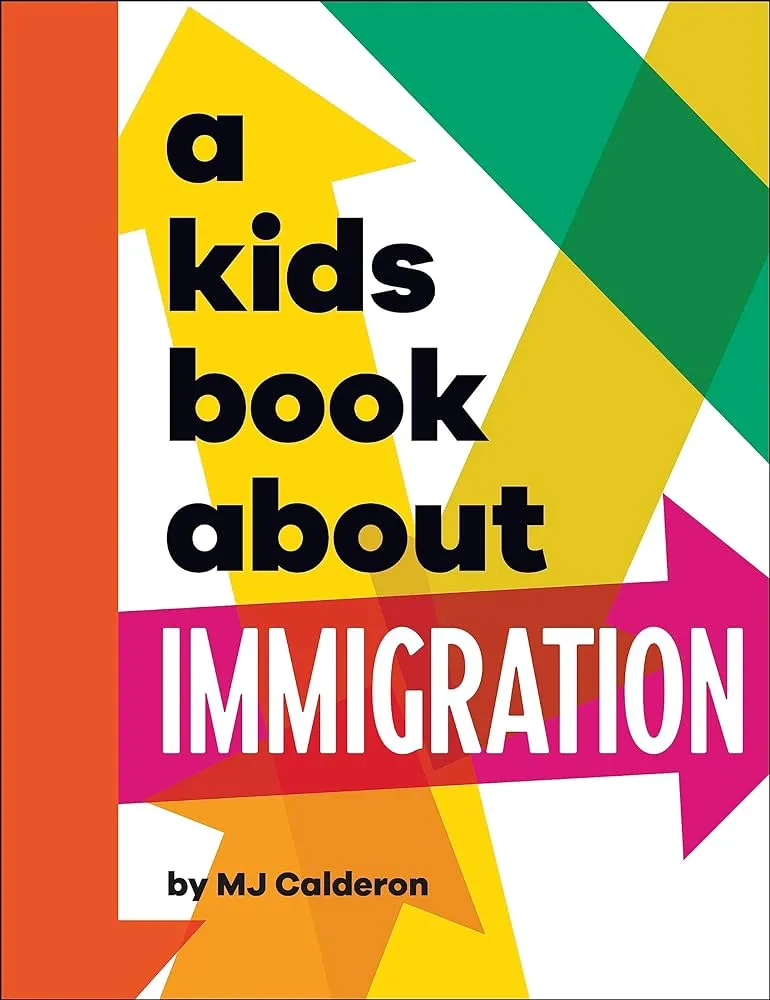
On a visit to my local library at the weekend my eye was caught by a book with a flashy and colourful, albeit grammatically questionable, cover: a kids [sic] book about immigration, by M.J. Calderon. My children are the children of an immigrant; for years I also lived as an economic migrant in a foreign country; and in any case immigration is up there with the most salient political issues of our time. So I decided to take the book out and see what it has to offer its five- to nine-year-old readers.
I don’t really know what I was thinking. I am a father of small children in the mid-21st century West, so I have become accustomed to being disappointed and dispirited by the nakedly didactic drivel that contemporary children’s authors tend to serve up. Why, then, did I allow hope to trump expectation? I’ve no idea. But, in any event, while the book itself is worse than useless as an actual spur to conversation between parents and children about its subject matter, it does at least have value as an aid to reflection on certain currents within contemporary culture, which are not limited to immigration or kids’ (or even kids) books. Of these, I think there are three that are worth commenting on: first, the replacement of the embodied by the abstract; second, the weaponisation of ‘conversation’; and third, the use of the ‘education’ of children as a solvent to the barrier posed by the family against both the state and commerce.
First, then, a comment about a trend in our media landscape which I have noticed and reflected on from time to time, but which I don’t think is sufficiently widely recognised – the death of fiction per se as having the primary objective of telling a story about particular characters imagined as individual human beings in their own right, and its replacement by an understanding of the role of fiction as chiefly being a model through which to imagine an idealised future or to critique an idealised past. And this seems connected in particular to a preference for abstraction over embodiment: a need to break down the act of storytelling itself into its constituent parts – plot, character, dialogue – so as to maximally instrumentalise each. Story becomes significant only because of what it teaches us; character becomes significant only in the sense of what each character represents; dialogue becomes significant only as a vehicle through which good, or bad, ideas are exposed and taught or criticised respectively. The result is a dissatisfying, two-dimensional, modular approach to fiction, in which the enterprise is reduced to a fitting-together of bits in order to achieve an objective: this character has these characteristics, and so it is important that they be seen to be doing this in this particular moment, and important that they say that.
This is not, I think, how fiction writers of the past would have understood their task, because what they were doing was so much more implicit, intuitive and integrated into the whole. Read any interview with a great writer about his or her process of writing, and you will come across, again and again, the same kind of message: fiction is an exercise through which the writer first discovers the story (this is the word that is very often used) through the telling, and then hones and sharpens it until it is fit for public consumption. It is almost as though it is revealed, rather than invented. Of course, what is being revealed is all within the author’s own mind. But it is almost entirely unearthed from the unconscious rather than carefully plotted or worked out in advance.
Anyone familiar with modern storytelling (in books, TV or film) will I think understand my complaint (and regular readers may once more bring to mind Iain McGilchrist). To any lover of literature or film the modern trend is a deeply depressing and alienating one, and indeed it is largely the reason why I have given up on even trying to engage with any work of fiction created since the start of the internet age. And it is no accident that children’s books – which are often the only books that many adults nowadays buy in quantity – should be at the cutting edge of this. I can’t think of a children’s book written after around 2010 that I have read that hasn’t struck me as being primarily a means of transmitting a fairly obvious message (usually that it is the most important thing in life to be yourself, but that if you are a girl it is equally important that you be adventurous, risk-taking and strong, and if you are a boy it is important that you do not display those qualities). Indeed, the ongoing popularity of J.K. Rowling seems to me to at least in part derive from the fact that kids intuit that her main goal is always to tell a great story about these particular characters, warts and all, rather than being to achieve an instrumental goal of some kind.
A kids book about immigration represents the next stage in the process, in that it is a kids’ book that has no story at all, nor really indeed any pictures, and simply comprises a series of statements which the child is supposed to directly imbibe. These photos are representative; this is what every single page of the book looks like:
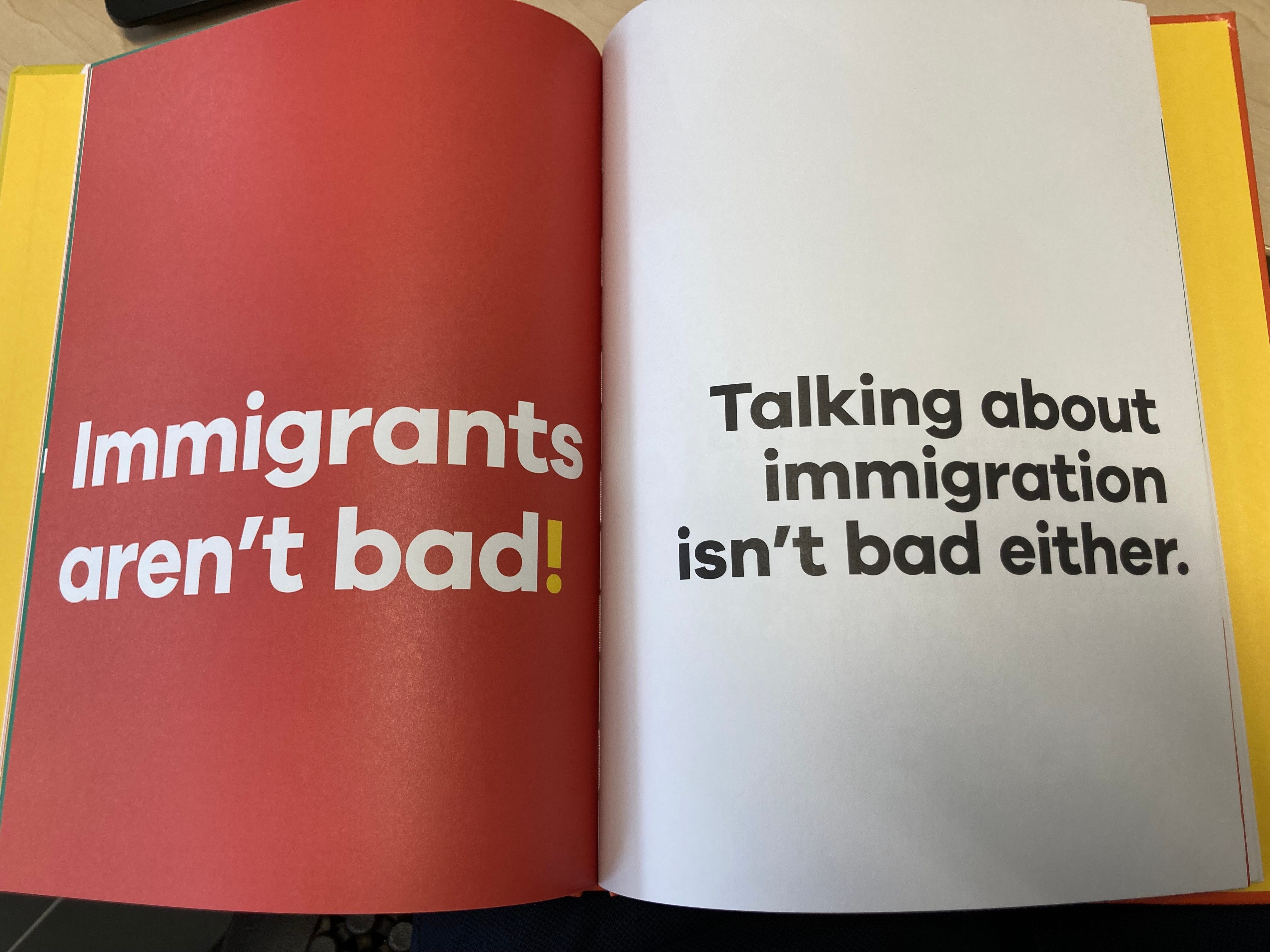
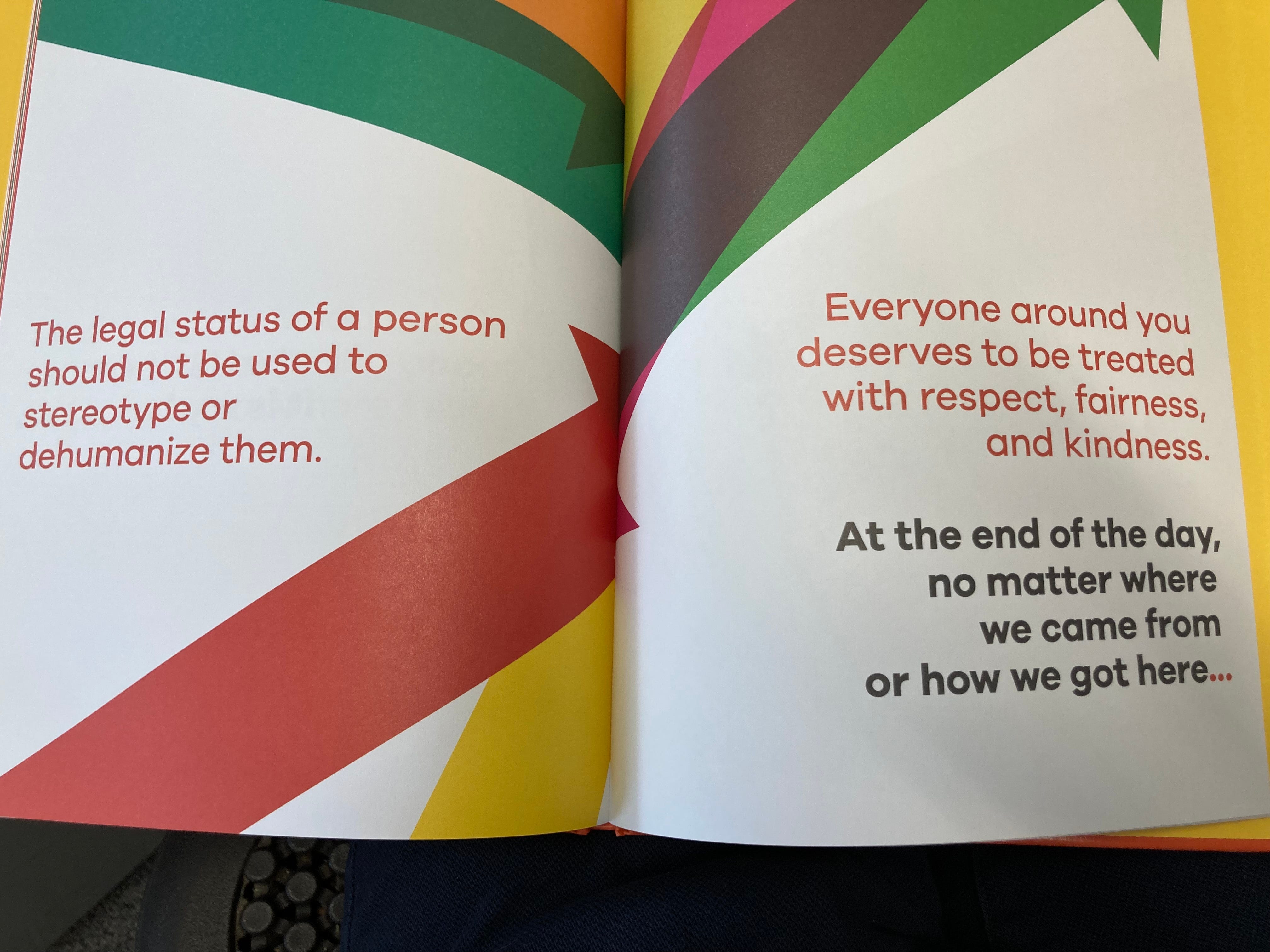
And the reasons for this are, of course, as plain as day. If you know what the Truth is, and you know what message you want your book to bring across, and you know ultimately what it is that the reader is supposed to think – and if your understanding of story is the impoverished contemporary understanding in which fiction only serves to achieve (or stand in the way of) an end – then why bother with story in the first place? Why bother with characters, dialogue, picture, plot? Story is for imparting a message, so just maximise the efficiency of the process and transmit the message in undiluted form. It goes without saying that no child in their right mind would want to touch the result with a barge pole, but since they’re not going to be the ones buying it (teachers, school librarians and über-liberal parents are obviously the primary market) that hardly matters.
The second notable feature of the book – and here we come to the substantive content – is the way in which it uses the concept of a ‘conversation’ to achieve the exact opposite. This is a book which wears the immanent critique of itself on its sleeve: it tells us it is designed to do one thing, but it is transparently an attempt to do something very different. Here’s the ‘intro for grownups’, in full, with important emphases added:
Understanding the world and those who inhabit it is a wonderful, beautiful and sometimes very difficult journey. Which is why grownups tend to make the mistake of tiptoeing around certain topics rather than taking the time to ask questions about their own understanding, listen to questions from kids and then learning together.
Immigration can be one of those topics. It’s complicated. Immigration often involves making hard decisions out of desperation, fear and love. And it’s often a difficult journey that is driven by hope. So the goal of this book is to encourage discussion and to understand that we all contribute to making our countries – and the world – a better place. No matter who we are, or where we come from, we matter.
We are just human beings, after all.
Got that? We need to encourage discussion and ask questions, because immigration is so very complicated. And yet the goal of the discussion makes everything very simple: at the end of the discussion, we’re all going to understand that everybody makes the country they live in, and the world, a better place – in other words, that immigration is basically good and that only a heartless villain would want to make immigration difficult.
Does that sound to you like a discussion? It sounds to me more like a lecture. And it goes without saying that while asking questions is welcomed, this only refers to certain questions, and not others. You’re allowed to ask why people become immigrants (“to protect [their] family from danger, a lack of resources and limited opportunities where [they] were living”), and you’re allowed to ask about the “language, culture or story” of anyone you know who is from a different country. But you are not allowed to ask the troubling, mean-spirited, vexatious kinds of questions that might problematise the central assumptions of the author. For example, off the top of my head:
- Is it really the case that we all contribute to making our countries better? Even, say, Abdul Ezedi, who came to the U.K. from Afghanistan illegally in 2016, committed various sexual offences, and then went on to throw a corrosive alkaline substance at a mother and her two young children, causing them life-changing injuries? Did he make the U.K. a better place?
- Is it perhaps the case that the extent to which immigration makes a country better depends on the overall numbers of immigrants, so that we might for example say that 50,000 immigrants have a qualitatively as well as a quantitatively different impact to 500,000?
- Is it perhaps the case that there is a distinction to be drawn between skilled and unskilled immigrants?
- Is there perhaps a case to be made that while immigration may make a country better for some of the resident population (the middle- and upper-classes) it makes life worse for others (the working classes, who become forced to compete and find their wages get driven down)?
- Setting aside the rights and wrongs of the matter, in a democracy shouldn’t the Government aim to achieve a level of immigration which the demos supports?
You may have other questions. But you get the point. A kids book about immigration claims to be an attempt to generate opportunities for children and adults to talk through a complicated subject. But that isn’t what it actually seeks to do. What it actually seeks to do is to close off genuine conversation and discussion in favour of inculcating a worldview, in which the only problem with immigration (specifically into the USA) is that to come legally is a “really complicated process [which] takes a long long long long long long long long long long long long long long long long long [etc.] time” and that sometimes when people talk about immigrants they use “mean and offensive words” which make it “difficult for immigrants to share their struggles, ask for help when they need it and advocate for [sic] change”. The aim is not to reflect the underlying complexity of the issues. It is to simplify everything to a matter of good versus bad.
This brings us to the third, more oblique, theme which A kids book about immigration raises: the idea that children and adults alike should be “learning together” about immigration rather than the adults taking charge. The implication of this is clear enough, of course: when it comes to understanding the issue of immigration, no parent can be said to possess more authority than the child; true understanding derives from equality between the two. In the conception of parent-child relationships which the book envisages, it is both parents and children who come to the feet of the expert (i.e., M.J. Calderon) to learn what to think about the complexities involved in the issue at hand. The role of the parent is as facilitator of the educational process by which expertise is made known, rather than the one who him- or herself guides the child from a position of experience and knowledge.
This has a great deal in common with a subject – sexuality education – about which I have written at length before (here and here). I noted in one of those posts, citing the former UN Special Rapporteur on the Right to Education, that the role of education is increasingly conceptualised as “the main fundamental tool for combating patriarchalism and generating the cultural shift so necessary for equality among individuals”. As I also noted, this led to a disturbing conclusion, which again was made plain by that former UN Special Rapporteur:
Although fathers and mothers are free to choose the type of education that their sons and daughters will have, this authority may never run counter to the rights of children and adolescents, in accordance with the primacy of the principle of the best interests of the child.
The modern state, in other words, increasingly conceives of the family, and particular parenthood, as a barrier to be broken down so that it can more directly interface with the child so as to secure the latter’s “best interests”, which it presumptively has a better idea of than the parents. What the state desires vis-à-vis children, as I have elsewhere discussed, is to intervene as closely and intimately as possible, in the name of creating the future client class which it needs to legitimise its own Government. One way of doing this, it goes without saying, is to diminish the authority of the parent and to reduce the importance of the parent-child relationship by putting the parent in a position of equality with the child, such that both approach life on the same footing and the same level of expertise. The parent doesn’t know more about a given issue (such as immigration) than the child – far from it. The parent is probably in a position of benighted ignorance and malice, and at best as much in need of ‘learning’ as his or her offspring. The real figure of authority is the ‘neutral’ expert, self-appointed or otherwise.
As A kids book about immigration shows us, however, the undermining of the family is led as much by commercial actors as it is by governmental ones. The state is poised against the family and wishes to break down the barrier between public and private because to do so expands its power and provides it with legitimacy; commercial actors like to do so because convincing parents they lack authority and wisdom causes them to buy books and other products. And at the heart of the storm are people like M.J. Calderon, no doubt totally sincere in their desire to make the world a “better place”, but whose efforts chiefly suit the objectives of both state and market – the baptist to the bootleggers, earnestly working to increase “respect, fairness and kindness”, but facilitating much baser motives among governmental and commercial actors alike.
The punchline of all of this, of course, is not that there are no children’s books to be written about immigration at all (although I certainly think that children aged five to nine are too young to be exposed to matters like this – they should be focused on learning how to navigate school, family and friendship rather than worrying about Big Issues). It is that, in the right hands, we are crying out for books for older children (what we euphemistically call ‘young adults’) which actually present both sides to this and other such stories in a genuine and non-judgemental way. The grim irony of A kids book about immigration is that, in seeking to “break down the complexities of immigration” and avoid “tiptoeing around certain topics” it ends up presenting a glib, patronising and patently false distortion of the issue which serves absolutely no-one. If “kids are ready”, as the tag-line for akidsco, the company that publishes A kids book goes, then they are ready for a real discussion which does justice to the complicated reality, and not for mere propaganda masquerading as debate.
More broadly, what is bleakly emblematic about the approach taken in A kids book about immigration is what it shows us about the nature of public discussion – such as it is – across the West in general. M.J. Calderon’s book, it seems to me, exemplifies the way in which ‘experts’, often self-appointed, reduce complex subjects (immigration, climate change, gender identification, war in Ukraine, lockdowns and so on and so forth) to simple ‘four legs good, two legs bad’ binaries, and then present those binaries to us as the inevitable consequence of whatever public discussion might conceivably take place. “Yes,” the message always seems to go, “in a democracy it is important to debate the issues, but only insofar as this results in the outcome which we, the experts, have ratified in advance.” We may not discuss whether we want a particular outcome; we may only discuss how it is to be implemented, and why the alternative is evil and wrong. Having an “open conversation” turns out in fact to be the most closed one imaginable: “Let’s all discuss what the best approach to immigration policy is, and why it’s open borders,” This is what public debate has come to; not so much discussion as the rehearsal of asinine soundbites, repeated until they get themselves into our thick skulls.
Dr. David McGrogan is an Associate Professor of Law at Northumbria Law School. You can subscribe to his Substack – News From Uncibal – here.
To join in with the discussion please make a donation to The Daily Sceptic.
Profanity and abuse will be removed and may lead to a permanent ban.
It is called political propaganda and ought to be subject to electoral law.
the journey to where we are now was greatly facilitated by the Tories.
Nail on head regarding the Tories also totally on board with it. They have continued mass murderer Blair’s (he of the non existent WMD= war criminal) cultural revolution with total zeal.
There’s principally nothing wrong with someone distilling a certain political position on immigration down to soundbites which can be easily memorized by “5 – 9 year olds”. It’s only certain uses of that which are problematic. Eg, something like this certainly shouldn’t be used as elementary school textbook (despite it’s probably supposed to).
5 to 9 year old readers!
At that age I’m sure immigration wasn’t on my important list, mars bars and thunderbirds maybe! But, immigration, and gender? Not so much
Yes and Mars Bars were huge in those days, or was my mouth just smaller? I also liked those McGowans single toffees wrapped in a green colour paper. We called them “Penny Dainties” because they cost a penny. But I stopped buying them when they up to 2 pence. ————But also in those days there were only boys and girls, and the only immigration I knew of was my aunt uncle and cousin heading off to Australia for a tenner in about 1963
It’s the Marxist brain washing of children, this is what socialists do. Ideally they’d like to overtly sexualise them and mutilate their genitals but they recognise that wouldn’t popular so they are more guarded about that. Under Starmer all this will get the “on steroids” treatment.
Re-title it ‘Immigration for Dummies, (and 5-9yr olds)’.— It’ll fly off the shelves.
Here’s a new topic for them,
A kids book: how to grow up to be a perfect citizen!
By Karl Marx, Joseph Stalin and Vladimir Lenin
Going to be a best seller down at Waterstones
https://www.conservativewoman.co.uk/an-open-letter-to-mps-you-reap-what-you-sow/
A hard hitting piece directed at those polishing seats in the H of C. Sadly it has not been proof read so there are annoying errors but there are some gems.
“...at a scheduled Parliamentary debate on the grooming gangs in February 2021, scandalously only nine MPs attended.
Nine.”
However, I take issue with this comment :
“As a profession, your record is one of near total disgrace. Yes, there were and are honourable exceptions, but they are just that, exceptions. It must be repeated that no one should wish for MPs to be harassed and intimidated, but the grim reality is that due to your collective sins of omission politics is becoming once again an extremely serious, even deadly, matter rather than just the middle-class elite game you supposed it to be.”
Unfortunately, the due rewards for absolutely failing, indeed refusing to do their jobs is harassment and intimidation. I have no sympathy. Those who refuse to stand up for the people paying their ridiculous wages deserve neither kindness nor kid gloves.
Do your jobs or F. Off.
I say they ARE doing their jobs. ——————It’s just that they don’t work for us anymore. They work for the International Community, The UN, the WEF WHO etc etc etc. ——They pretend they serve the British people but infact they have nothing but contempt for us and we are simply a nuisance to these globalist parasites. ——-The ones who still work for us like Braverman and Anderson are removed because their views are “offensive” and “inappropriate”.
Why is it that any time something or someone claims to be ”anti-racist” they always manage to demonstrate they are in fact racist, against white people! See what you think of this 1min ad from Portugal. Yes it’s all about colonialism, obviously..Jeez
https://twitter.com/RadioGenoa/status/1762543248310952204
The ‘amazing’ (if it was genuine) thing about these people is that they’re completely unaware that the supposedly horrifying experiences of the clientele are by no means unique to them. People ask me all the time where I’m really from because of my German accent (I can no more get rid of intentionally than someone else can get rid of his skin colour). I usually shave my head bald because that’s something I can easily do myself (and I hate being physically close to strange people – like barbers – for prolonged periods of time) and some people just can’t help to touching my head because of this. Or rather, they meanwhile can because enough them had a Touch me in ways I don’t like, I’ll touch you in a way you’re also not going to like! experience.
An experience these people also seem to be lacking is Walk past a gang of black yobs (there are plenty of those) without being suitably deferent, get shoved into a wall from behind (anything else would obviously have been too dangerous).
Thank you for sharing. The video from Lisbon in one of the comments below that is more disturbing and depressing but ‘compliments’ the anti-white propaganda precisely.
2mins of Mayor Khant denying that London is less safe now than before he took over as Mayor, despite being confronted by the Met Police crime stats. I don’t think it’s ”extraordinary”, I think he’s a bare-faced lying narcissist.
”This is why people dislike @SadiqKhan
It has nothing to do with “Islamophobia”
It has everything to do with how dreadful he is at his job combined with his stunning arrogance and denial when confronted with facts.”
https://twitter.com/LozzaFox/status/1762745601245024335
Yep Islam isn’t just a religion. It is also a political system. So if it is going to be involved in politics it has to face up to being challenged and criticised. ——-Just as the Tories and Labour are. —-We never hear of Toryaphobia or Labouraphobia do we?
There must be a reason why India is more wealthy and successful that Pakistan.