
Wait for the Blackout
Last week, Jess Ralston, the Head of Energy at the Energy and Climate Intelligence Unit (ECIU), took to Twitter/X to criticise Robert Jenrick for suggesting that if Labour keep their promise to decarbonise the grid by 2030, then we will see power blackouts:
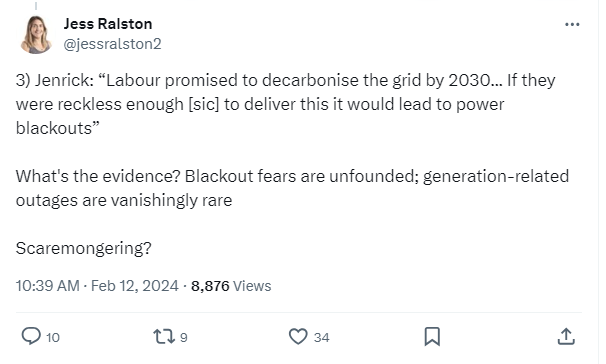
She suggested Jenrick’s fears were “scaremongering” and demanded some evidence. She’s right that assertions without evidence can be dismissed without evidence. So, time to look at the evidence.
Warnings of Blackouts
First, Robert Jenrick is hardly the first person to warn of blackouts. The boss of the National Grid warned in November 2022, that blackouts and power cuts could be imposed during a really cold winter. Last year the National Grid also warned that they “sometimes they need to reduce demand by planned outages to avoid major damage”.
If even the National Grid is warning of outages, then Jenrick’s comments can hardly be described as scaremongering.
Peak Supply from Fossil Fuels and Nuclear
Remember that Labour have promised to decarbonise the grid by 2030, so I thought it would be helpful to see how much we rely upon reliable sources of power like fossil fuels and nuclear power now. I downloaded the supply and demand figures from Gridwatch for December 2023 and January 2024 to determine the peak supply from fossil fuel sources and from nuclear power during that period. There were eight occasions when supply from these sources exceeded 32GW. The peak supply from fossil fuels and nuclear came during the evening of December 1st, 2023, at 32.3GW. At that time, we were getting <1.5GW from wind, nothing from solar, 2.8GW from biomass, 0.8GW from hydro and a net 5.8GW from interconnectors.
Since then, due to a fault on one of the nuclear power stations supply from nuclear has dropped from 4.8GW to 3.8GW.
Changes to Generating Capacity
Over the next few years, the supply from fossil fuel and nuclear sources is going to change dramatically. First, the Government has announced that it plans to phase out our remaining coal power stations by October 2024. Moreover, the Hartlepool and Heysham One nuclear power plants are scheduled to shut down in 2026. In addition, the remaining two Advanced Gas Cooled Reactors at Heysham Two and Torness and due to shut down in 2028. This will leave us with just 1.2GW of nuclear capacity until Hinkley C eventually comes online, now expected in 2031.
DUKES Table 5.11 gives a list of all power stations in the U.K. by type, including the year of installation. Gas-fired power stations are supposed to have a life of 25-30 years (sometimes up to 40 years). Assuming an asset life of 30 years for gas-fired units and the announcements about coal generation and the nuclear power plants, Figure 2 shows what the profile of fossil fuel and nuclear power plant capacity looks like out to 2035 and compares that to the peak power produced by these types of unit in December 2023.
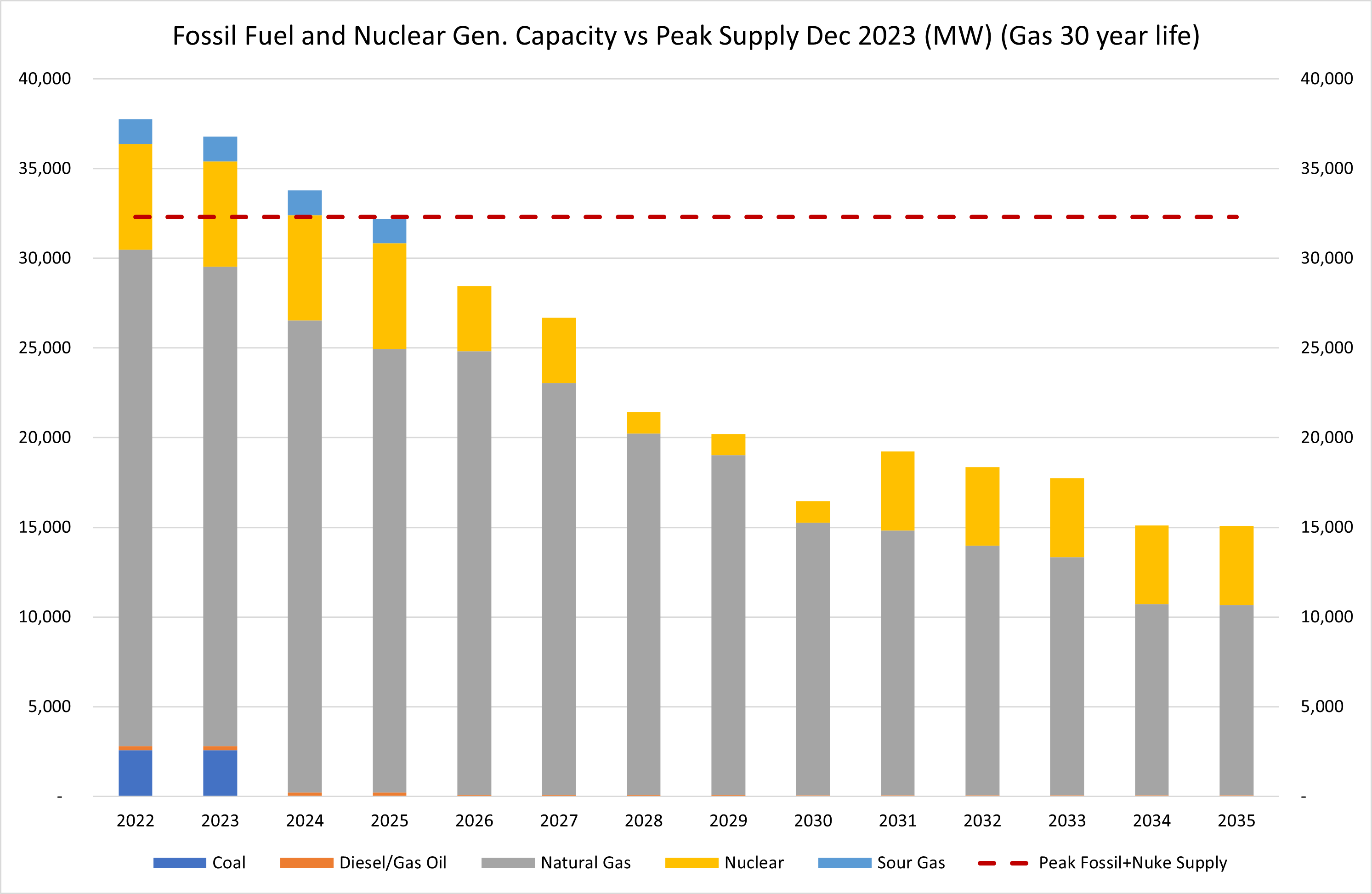
Here we can see we may run into trouble as soon as late this year if there are any unplanned outages or maintenance issues with the power plants. Capacity in 2025 just falls short of peak requirement, with 2026 showing a capacity gap of 3.9GW. The gap then grows to 15.9GW in 2030, closes a bit in 2031 as Hinkley C comes online before expanding to over 17GW by 2035. This does not consider that as the penetration of EVs and heat pumps increases, peak demand is likely to rise, further exacerbating the gap.
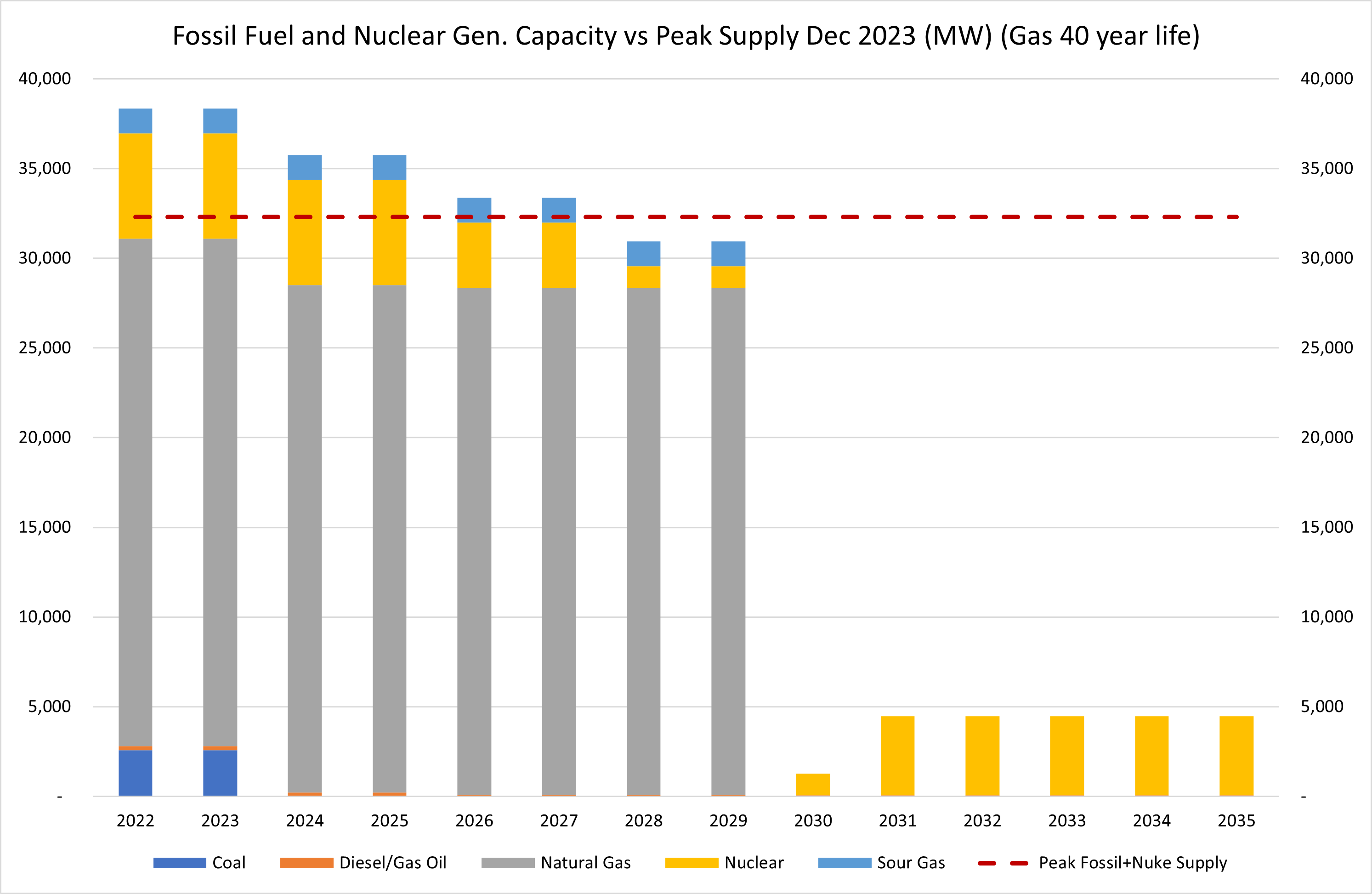
It might be possible to extend the life of these power plants out to 40 years. This begs the question about whether we should be basing our energy security on aging gas-fired power plants that are on their last legs? Ignoring that issue for the moment, extending the lives has the impact of keeping us just above water out to 2027, but there is a 1.4GW gap from 2028 as the remaining AGR nuclear plants close. If the grid is supposed to be decarbonised by 2030, there is then a gaping chasm of over 31GW at that point, as seen in Figure 3.
So, what might fill the gaps? Well, the most obvious thing to do would be to keep the coal-fired plants running and nurse the gas-fired plants into a longer life. To be safe, we should be investing in more new gas-fired plants, but we have not installed a new CCGT plant since 2016.
During those peak times described above, the interconnectors were effectively maxed out already, so there is no chance they can come to the rescue.
The Net Zero zealots have ruled out fossil fuels, so let us look at renewables. We have 1.5GW of natural flow hydroelectric capacity and aside from a few single-digit MW installations, we have not installed any significant new capacity since 2008. Hydro is not coming to the rescue. We also have pumped hydro, designed for fast response, but much of this was already being used at the times of peak demand, so that is not going to bridge the gap either.
We have 3.9GW of bioenergy, most of it being burning trees at Drax. There is no chance of expanding that to meet a 31GW supply gap by 2030, and anyway, where would all the wood-chips come from?
Of course, if we carpeted more farmland with solar panels, it would make no difference at all. This is because the peaks occur when it is dark, so there is no solar power anyway.
That leaves wind. At the times when fossil fuels and nuclear were providing over 32GW, wind was producing 1-1.5GW. It is unrealistic to expect that we can double wind capacity by 2030, but even if we could, we might expect at most an extra 1.5GW of generation on calm cold evenings, or less than 5% of the gap. So even doubling wind capacity is not going to help.
They could retrofit carbon capture and storage (CCS) on to the existing gas-fired plants, but there are several issues with this. First, we do not have a single plant working with this technology today, so the chances of installing this on all the aging gas-fired plants by 2030 are negligible. Second, CCS reduces the efficiency of power plants, so even if they did manage to install CCS, the output would be ~20% lower than it is today, meaning we would still have a significant generation gap.
Conclusions
Robert Jenrick was right. The evidence shows if Labour gets in and pursues decarbonising the grid by 2030, then we are in for blackouts. But before he takes a victory lap, he should consider that his party’s plans call for decarbonisation of the grid by 2035. Under his Government’s plans we will still face blackouts by 2028 at the latest.
I do hope this is sufficient evidence to convince Jess Ralston that our generation capacity is in a parlous state and there is a very real risk we will face blackouts in the not-so-distant future. And while we are on the subject of needing evidence to support assertions, what is the evidence that the “I” in ECIU can justifiably stand for Intelligence?
The inspiration for the title of this article came from the eponymous song by, appropriately enough, The Damned. When thinking about alleged policy gurus, recent, current and potential future energy secretaries, I am reminded of another track from the punk era: Pretty Vacant.
David Turver writes the Eigen Values Substack page, where this article first appeared.
To join in with the discussion please make a donation to The Daily Sceptic.
Profanity and abuse will be removed and may lead to a permanent ban.
Buy a battery for your home that is capable of running your house for most of the day and charge it when electricity is cheap (and available). About 10kWh excluding heating is enough for most homes. Less noisy and smelly than a generator.
Sounds great 👍 how much?
Buy a generator. You can get one installed for less than 3k. It’ll run a home for 72 hours easily.
That’s exactly what I’ve done, a 6k generator for around €800.
But, not everyone can afford anything like this let alone batteries and a space to put them, all costing much more!
Its like evs, just not affordable or practical for the vast majority of people, the vast majority that labour claim to represent, ..my arse!
And all for a gas that doesn’t do any harm to the planet anyway!
Just what you need a lithium ion firebomb in your home.
Taking the Tesla Powerwall as a widely installed example, I have seen no reports of a single fire. The US National Fire Protection Association tested a couple of Powerwalls in 2016 and found them resilient to attempts to set them alight and even under intense heating neither exploded.
Tesla set fire to a Powerpack to test its safety features – the results are impressive | Electrek
This just isn’t a serious possibility for most people!
Powerwall 2 itself is a fairly pricey energy storage unit, at between $9,000 and $13,000
CNET: 2nd Feb 2024
That’s theoretically a good idea, but the Government legislated in the Energy Act to take central control of domestic appliances including batteries. So, it wouldn’t do any good, unless you find a way of bypassing the smart meter.
We had reliable energy and reliable transport. That is being removed under false pretences of a climate crisis for which no evidence exists. —–If people are going to accept having cheap abundant energy removed and expensive unreliable energy foisted on them where they have to fork out endlessly for solar panels, batteries and heat pumps, and have their electricity bills trebled because of how expensive the wind is then they will get the governments they deserve. —–As usual it is the poorest who pay the highest price by being forced into energy poverty. The more affluent may be content to spend hundreds here and thousand there on niche technologies but there are a few million who simply cannot afford this nonsense.
Robert Jenrick seems to be making vaguely sane observations now he is out of government on immigration and the energy grid. He could not have possibly held these views and served in government. If by some miracle Robert holds his seat he’ll again have pretend to believe in unicorn wind because he’ll probably be shadow chancellor. Therein lies the problem we face. I don’t know him but I assume he has been radicalised by the numerous PoS he met that were running the home office.
Will the blackouts affect only facially deformed fatherless white blond families that have their meals on the roof?
And two identical mothers
🤣🤣 love it!
Welcome to “load shedding”. Check out South Africa.
Check out Dominic Frisby’s substack article about where we are heading in general, ie South Africa.
Since most people in the UK under the age of 80 have never experienced prolonged electricity blackouts (other than the Miner’s Strikes around 1970), here is is something from a Time article about the 1947 UK blackouts. The impact eighty years later of blackouts will be far worse!
https://content.time.com/time/subscriber/article/0,33009,778969,00.html
Sounds just lovely. Privileged folks would shrug that right off. Less privileged folks, not so much though.
If and most probably when the power cuts arrive I hope that they will be long enough in duration so the Laptops and mobile phones stop working. No microwaves, TV, heating lighting hot water, all the at the touch of a button, taken for granted items gone in an instant. Perhaps then they will appreciate just some of what fossil fuels have contributed to our lives.
Sounds a bit mean, but I would welcome power cuts if only to stop the relentless stream of s**t that comes from the Internet. I would also quite enjoy seeing the panic on many young people’s faces when they no longer have a screen to look at continually. Perhaps they would wake up and rejoin the real world, instead of wasting their time worrying about what sex they are.
Ref power cuts, a few years ago whilst I was still working we had a power cut in the workshop. The only people working were an equally old colleague and me who knew and were capable of using 1, the brain, and 2, hand tools.
The funny thing was that when the power went off the first thing the rest did was to try and boil a kettle for tea.
No government will survive extended blackouts. The pressure to use the reliable energy they got rid of (coal and gas) will be too intense. ——We will see how many of them harp on about climate change when people are sitting in the cold with no lights on. It is all about priorities, and climate change is not the main one. There are more things in the world than climate change. So there is no need to go faster and harder trying to save the planet than every other country. —What is the mad rush? The cost is in the trillions and we have forced ourselves to do this in law when we have no idea if the technologies required can even be invented and constructed in this short period. ——As for Labour stating they will de-carbonise by 2030, only people with no clue how energy works can make such preposterous statements as this.
According to the ECIU website Jess ‘holds a BSc in Geological Sciences from the University of Leeds and MSc in Oceanography from the University of Southampton’.
So, nothing about power generation then? Instead we have a Gen Z with a qualification in whale hugging criticising a former Minister with a realistic view of U.K. infrastructure. One wonders if Jess (and her whales) could even change a plug, let alone pontificate/adjudicate on the country’s energy needs. Obviously maths is not her strong point either as the Gigawatts in and out appear to be confusing her.
I don’t know the background of the ECIU but it seems to be a joke organisation that is grifting for donations from various European bodies.
All you need to know is how much can you generate and how much do you need at any one time?
If there’s a discrepancy, then you’ll get power cuts! Evidence is one thing but common scientific fact is another!
You need to be able to generate Base Load. ——-Wind and Sun cannot do this.
Oxymoron alert!
“ Energy and Climate Intelligence Unit “
“generation-related outages are vanishingly rare”
The potential problems are not just capacity to generate, but grid frequency stability to keep frequency at 50Hz +/- less than 1Hz which fossil fuel generators can do using inertia from flywheel batteries and turbine rotation which wi d and solar cannot do.
There is also balancing grid sectors to avoid overload ‘where the wind is blowing’, and insufficient supply where it isn’t.
Privileged people will do just fine. It’s the less privileged folks that will not be fine, so of course the government could care less. Net Zero is quite literally the ultimate luxury belief.
Indeed. I can’t imagine this Ralston person cares much either. I think electricity will just become hugely expensive and unaffordable for many – the same with everything else they want to ration like meat.
About 3 years before the Conservatives would do the same.
And this from the party that collectively stole more money, more liberty, more lives than any other in British history.
I am not sure why Jenrick thinks he has the right to criticise Labour as the Government he was a member of had just the same agenda.
We had stable supply of electricity from coal gas and oil. This is concentrated energy that easily supplies base load. The only risk there was of blackouts was due to any industrial action as we had in the 70’s. Since 2008 when we got the Climate Change Act (Miliband) we have moved away from reliable sources of electricity production to unreliable ones (mainly wind) It was known 10 years ago there was a risk of blackouts and I recall the head of the Grid at the time (Steve Holliday) warning “We are going to have to get used to using electricity as and when it is available”. Welcome to the 21st century in the Green fantasy land of pretending to save the planet.—— Because of the increasing unreliability of supply governments have done everything they can to try and compensate by forcing smart meters into property’s to ration use, getting rid of the incandescent light bulbs, they have had insulation schemes and cavity wall subsidies etc etc. Because they know full well that when you rely on the unreliable the risk of not having base load is HIGH. Anyone who tells you otherwise either does not understand how energy works… Read more »
After subsidising so called renewable energy at a cost of billions per year for over a decade, tens of thousands of Victorians lost power last week as their last coal fire power station tripped and had to be shut down temporarily. Did this open the eyes of the renewable zealots that wind and solar cannot replace coal? No, they crowed that the blackouts were due to an unreliable coal fired generator. They don’t realise the coal plant hasn’t had upgrades in a decade because the government is constantly threatening to close it. They don’t realise that all that wind and solar can only provide a fraction of their energy demands and only when the wind is blowing or the sun is shining. “We need big batteries!” they cried. Ask them how big a battery and they wouldn’t have a clue.
“Net Zero” should probably just be shortened to “NERO”.
Surely this is good news? If as widely predicted, team blue of the uniparty are voted into oblivion at the next election, these baked in power outages will hopefully see the demise of team red, thus clearing the decks for something new.
Its not going to be an easy ride, but the only way we’re going to get rid of these self serving parasites is to have a LOT more people wake up from their cosy slumber, and they aren’t going to do so until their lives are directly affected by unpleasant, in their face hardship.
We’re right at the ‘weak men make hard times’ point, might as well get it over quickly, making the pain severe, but hopefully short lived.
It saddens me to see that the term ‘Decarbonisation’ has become a normal word in the English language. The idea that we humans can supposedly control the Earth’s atmosphere by the minutest variation of an atmospheric trace gas, that we all generate ourselves with every breath we take (we exhale 100 times the amount of CO2 we inhale), is so utterly unfounded and arrogant beyond belief.
I really like articles that produce hard facts like this one. As if we didn’t already know! Those that follow the available data on Gridwatch can see it day by day. But who bothers? Well I do as a) I have to pay my bills b) I’m of the generation that remembers the 3 day week and power cuts of the 1970s & was a child who ‘survived’ the 1962/63 hard winter! I think I only really remember the tobogganing and the igloo we built as a family on the lawn that took months to melt (we also went to school in socks and a skirt in those days on the train – no fleecy trousers or closed schools in those days) and c) I’ve had to do some digging on heat supply for a new build (yes I know not many of us get that chance but I’ve been truly lucky). I’m living with an air source heat pump in the rented cottage currently my home. It is noisy, expensive and I’m never warm enough in spite of the massive radiators. The controls are very difficult to navigate and if you turn it off – or down to ‘frost… Read more »
I have a small genny. I used to live in a place that has fairly frequent problems. Enough for lights and to run the gas boiler.
I avidly follow GridWatch. There is no way on God’s earth we can do without gas generation. Wind does make a (sort of) useful contribution but at great cost. We are often importing 20%+ from France and Belgium/Norway at great cost also.