
Global Plant Growth Accelerates Thanks to Higher Carbon Dioxide Levels, New Study Finds
The rate of global greening caused by recent increases in atmospheric carbon dioxide has accelerated during the last two decades, according to important new findings recently published by a group of Chinese scientists. About 55% of global land mass revealed an “accelerated rate” of vegetation growth, compared with only 7.3% showing increased decline or ‘browning’. Global greening due to higher levels of CO2 is an inconvenient fact that is often ignored in mainstream climate science. In fact there have even been attempts to suggest greening has slowed or reversed. Studies showing higher levels of global browning use sources that “should be used with caution”, advise the authors of the new study.
It is known that the planet has been greening since at least 1980, with some estimates suggesting increased levels as high as 14%. In a detailed paper published in 2016 by 32 authors from eight countries, it was noted that there was a “persistent and widespread increase” in growing-season greening over 25-50% of the global vegetated area. Now the Chinese scientists, including Eco-Climatologist Professor Tiexi Chen, state that “global greening is an indisputable fact”.
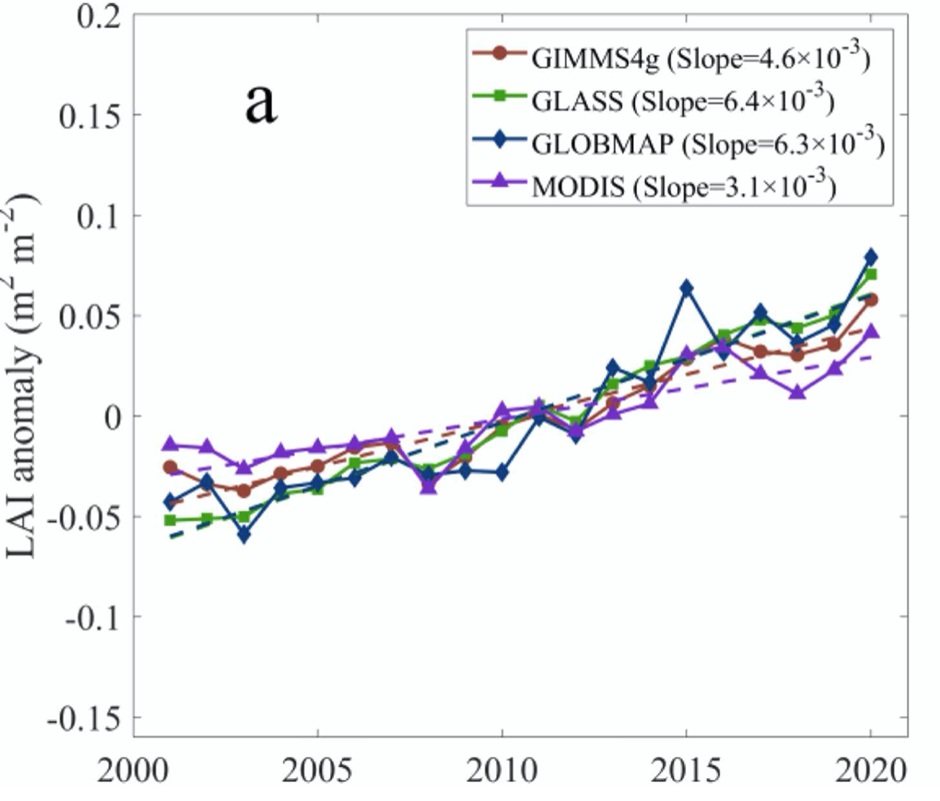
Satellites enable scientists to calculate a Leaf Area Index (LAI) and the four main datasets are plotted above. It was found that CO2 fertilisation dominated the LAI trends that are both rising and accelerating. By monitoring different parts of the globe, the authors found that the “drought trend” only slowed global greening, “but was far from triggering browning”. Climate alarmists, of course, observe drought everywhere – that is, when they are not pointing to biblical levels of flooding.
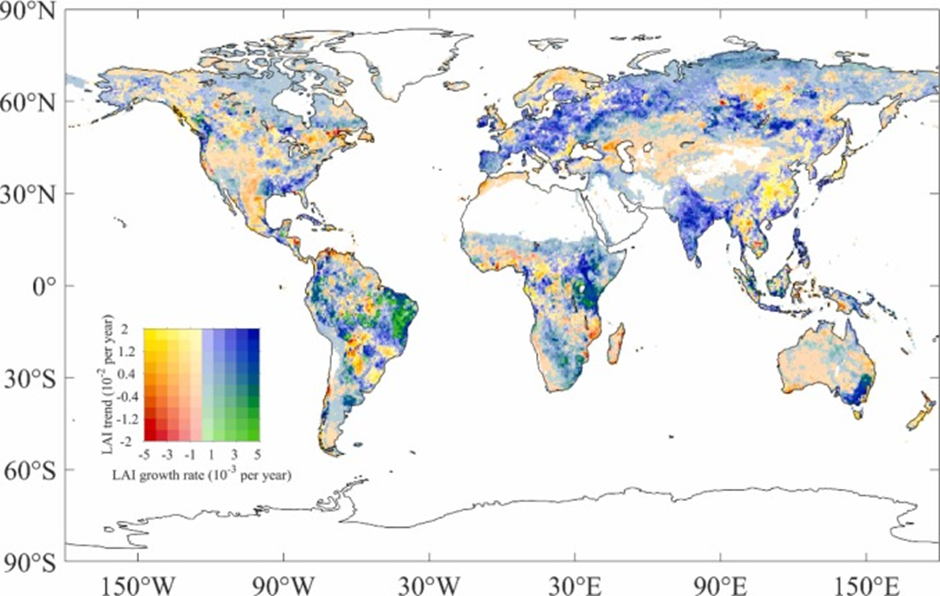
The above map averages information from the four datasets and shows that greening accelerated from 2000 in 55.5% of the globe, among which acceleration in India and the European plains was said to be the most obvious (note dark blue colouring). Healthy growth can also be observed in the Amazon region, equatorial East Africa, southern coastal Australia and Ireland.
It has long been know that higher levels of CO2 are good for plants with plenty of scientific evidence showing that they grow faster as a result of the boost. Dr. Roy Spencer, the former senior scientist at NASA, notes the beneficial effect on plants, adding: “Though CO2 is necessary for life on Earth to exist, there is precious little of it in the Earth’s atmosphere.” Levels of CO2 have been much higher than the present over the 600 million years that life has existed on Earth, and plants evolved when there was more of the gas in the atmosphere. Recent atmospheric increases, whether from natural or human causes, have contributed to soaring crop yields. Better technology, fertilisers and land use have all played a part but higher CO2 has contributed to an estimated annual 2.4-3.8% rise in maize, rice, soyabean and wheat – four staples that provide 64% of human caloric intake. Under the collectivist Net Zero project, there are attempts to stop CO2 entering the atmosphere, bans on fertilisers, cuts of meat production and moves to ‘rewild’ agricultural land. Good luck feeding the world, might be the only charitable response to this insanity.
CO2 greening is largely shunned as a topic of polite conversation in the ‘settled’ climate mainstream because it helps support the notion that the recent small temperature bounce back from the Little Ice Age has been almost entirely beneficial. There is little evidence that natural disasters are getting worse, be they hurricanes, droughts, floods or wildfires. Exploiting hydrocarbon energy has enabled humans to build better protections against Mother Nature and deaths from natural disasters have plunged by over 95% in the last 100 years. Over the last 25 years, the only global warming outside retrospectively adjusted politicised datasets has occurred as a result of small spikes caused by strong natural El Niño effects. Coral reef growth has soared of late, and Arctic sea ice appears to have started on the upward slope of a cyclical trend. It often seems that the only response of alarmists to all this good news is to point out the window and suggest the bad weather du jour is a sign of imminent Armageddon.
One Italian scientist recently estimated that reducing CO2 back to pre-industrial levels would lead to an 18% decline in the production of many basic global foodstuffs. The climate science site No Tricks Zone highlighted two further scientific studies that showed higher CO2 fertilisation effects were driving global greening and enhancing photosynthesis. Current levels of CO2 in the atmosphere are around 420 parts per million (ppm), and a group of agri-scientists suggested there would be a 30-50% increase in photosynthesis with CO2 in a range from 451-720ppm. This would lead to a 25% increase in crop yields. The scientists looked in particular at barley and found an increase in yield of 54% if CO2 rose to 700ppm.
A great champion of the gas of life is Dr. Patrick Moore, who helped found Greenpeace in the 1970s. He has long pointed to the gradual denudation of atmospheric CO2 as various life forms drew down the once plentiful supplies over 500 million years. He looks forward to the day when governments will meet to sign treaties promising to increase their carbon emissions.
Treble private jets all round.
Chris Morrison is the Daily Sceptic’s Environment Editor.
To join in with the discussion please make a donation to The Daily Sceptic.
Profanity and abuse will be removed and may lead to a permanent ban.
The main bi products of capitalism are plant food and reduced poverty. This is why socialists hate it so much, it prolongs life on earth and lower the number of poor ppl. Sick saddos like Blair, Miliband and and yes Cameron /Johnson resent to their inner core that they and their interference in our lives are totally unnecessary.
It makes sense. It’s quite likely that the belief in our contribution to weather variations compared with natural causes is grossly overemphasised, to say the least. In the meantime, short term problems make the headlines, like the current drought in Cataluña, reported on the BBC propaganda radio channel this morning. Similar story here: https://www.bbc.co.uk/news/world-europe-68167942
There’ll always be a flood, drought or storm somewhere. What’s amazing is how stable the last 200 years or so have been. We’ve had nothing in Europe anywhere near as bad as the drought of 1540 where the Rheine essentially dried up.
“Read all about it!”—–Plant food makes plants grow! Who’d’a thunk it?
Reducing world population is the agenda not feeding it. Rewilding farm land and restrictions on agriculture are meant to cut food production. Controling food production is another way to control the masses.
Malthusian Politics.—– The politics that the likes of John Holdren (former scientific advisor to Obama) subscribe to. Their idea that has been blown out of the water by Julian Simon that demand will outstrip resources and the need for population control with one of the major tools for those politics being fear of dangerous changes to climate , the so called climate crisis, for which no evidence exists.
“Controling food production is another way to control the masses.”
As Kissinger was keen to point out.
To all the co2 destroyers, try this easy scientific experiment, you can do this at home!
Grow a plant in a sealed box and give it everything it requires, good soil, fertiliser, water, air
and then remove co2, only the co2!
The plant dies within a week!
Co2 to a plant is like air (N² and O²) to a human.
Simple fact that all these net zero idiots need to be sat down and taught!
The same is even more true of water. That doesn’t mean there is no such thing as too much water.
Plants cannot survive on co2 alone granted, but like water, will not survive without it. The earth’s co2 atmospheric content is at the bottom end of what is ideal for plant growth which I believe is 1200 ppm as apposed to the current 400ppm. Below 200ppm plants really begin to struggle for survival!
Check the one red thumbs down under my comment below this. —-He doesn’t have the guts or the knowledge to answer me back so does red thumbs down and runs away.
Yes but we can easily give a plant too much water. A flood will give a plant too much water. But a plant will not get much more than the “trace” amount of CO2 from the atmosphere. There are no floods of CO2, and unfortunately for your argument there is not anywhere like enough fossil fuels in the ground to cause such a catastrophe. ——-Even a doubling of CO2 is unlikely to cause much in the way of danger as the IPPC recently admitted by saying their worst case scenarios from climate models are highly unlikely. ——–There are more things in the world than climate change. eg There are about 3 billion people on earth with hardly any electricity and a billion of them have NONE. ——Climate policies based on your fanciful nonsense about a “trace gas” are keeping these people in a state of abject misery while you sit on your comfy couch in your cosy house with a laptop on your knee.
Assuming this is true, it is a nice example of how a very low concentration of CO2 can have a very significant effect. So hopefully we can drop the “it’s only a trace gas” argument.
Worryingly 0.04% is only a trace gas, it could do with being a little higher for ‘all life on earth’s’ sake!
Recently read, when plants first came on the scene 800 million’ish years ago, CO2 was around 20% of the atmosphere. Optimum levels for plants is around 800 to 1200 ppm, but if levels are higher than a particular plants requirements that is no problem at all, se we need levels around double or triple what they are now.
It isn’t those who question global warming alarmism that call CO2 a trace gas. —It is science that calls it that.
I am not saying it is not a trace gas. The concentration is one the few mutually accepted facts. I am just saying that the argument – “it is only a trace gas therefore it cannot have a significant effect” is clearly disproved by the example of plant growth.
You are barking up the wrong tree. —–Infact you have planted your own tree to bark up.—— I really don’t encounter many who say “CO2 is a trace gas so it cannot have a significant effect”. (I certainly never have)——–But I see plenty who say that it will have a significant effect on climate, but they are basing that on modelling, not on observations which is what we do with the clearly visible increase in plant yields and greening.
I really don’t encounter many who say “CO2 is a trace gas so it cannot have a significant effect”. (I certainly never have
You can look at almost any article by Chris Morrison and it will make the point that CO2 is a trace gas or only 0.04%. Just remember next time it is mentioned that this is irrelevant – that’s all I ask.
Yes it is only 0.04% of the atmosphere. And that relative to what it used to be in the past is a small number. There were times when CO2 was 10 and even 20 times higher in the atmosphere. So today it is reasonable to say it is “only 0.04%” because that is simply the truth.
I can see that I am never going to succeed in making what seems to me a straightforward point. Yes the concentration is 0.04% but that is not a reason in itself to doubt that it can affect the climate. So it is true but irrelevant.
Ummmm a very minor ability to reflect heat across the wide IFR spectrum – ignoring the saturation factor – compared to CO2 acting with water/ sunlight ie photosynthesis ….. the latter being true and self evident therefore the former MUST be equally true..
“Clearly disproved” is as laughable a comment as I have read thus week – apples and pears…..
I really have no idea what you are trying to say. My point was very simple. It is quite common for sceptics to emphasise the low concentration of CO2 in the atmosphere as though that fact in itself was a reason to suppose it could not effect the temperature. However, low concentrations can often have significant effects and one is the effect on plant growth. So the low concentration is really irrelevant.
Yet you are happy enough it seems though for all manner of exaggeration that occurs regarding the climate change issue. Exaggeration is par for the course. There is virtually nothing that does not get exaggerated in this sea of misinformation designed to scare people into accepting a political agenda and which is being used to support global governance and control of the world’s wealth and resources. You even have the audacity to still claim that the torn to shreds Hockey Stick is still some kind of ultimate truth regarding the global temperature (whatever that is meant to be) of the last thousand years. ——-You clearly have a severe case of confirmation bias. ——-You can easily spot when people try to make the point that CO2 is at historically low levels, but can’t or refuse to spot the blatant lies and distortions coming from the Climate Industrial Complex.
Hopefully you will make a distinction between a gas in the atmosphere and that which is absorbed somewhat lower than that …by thriving plant life …
Stick to promoting experimental GT mRNA drugs…., oh wait a second…
A longer read from Indur Goklany
https://www.thegwpf.org/content/uploads/2015/10/benefits1.pdf
Cheers
This has long been known —–Farmers have put CO2 in greenhouses for ages because plants have evolved to be in an atmosphere richer in CO2 than we have at the moment. So the evidence is clear on this issue as we can see from experiment. But climate change junkies always try to say that those who question global warming science say a little CO2 is not warming the planet but that same amount of CO2 can Green it. —-mmm yes. —–And right on cue I notice the subscriber MFT has tried to make that very point (no surprise there) —— But we can argue all day about science, and whether there will be more warming etc etc and dangerous changes to climate, but while we are doing that the eco socialists are busy getting on with the politics. —-Net Zero is going ahead regardless of all of the uncertainties in the science. Politics cannot wait for scientific truth, and in the physical sciences there actually are no proofs. But although there may be no proofs there are certainty huge uncertainties. We don’t even know if there are positive or negative feedbacks related to increasing amounts of CO2 in the atmosphere.… Read more »
Chris,
You refer in para 5 ‘soaring crop yields’, with a link. The link is to a paper which does refer to increasing crop yields – but the paper has been retracted by the publishing journal – though the precise reasons are not given. Views?