
Gary Lineker Exudes the Midwit Phenotype
Last week, my Substack page News From Uncibal got its 500th subscriber. It is therefore fitting that I should return to the subject which got the whole thing started: Gary Lineker, and his semiotic significance. Lineker ought to be an obscure figure. But he is central to the national debate in Britain, and it is important to make clear why, as he symbolises much of what is wrong with the way things are going – not just across British society, but across the Western world.
How does one explain Gary Lineker to a non-British reader? Lineker is a former professional footballer with a natural poacher’s instinct for goals, who won the ‘golden boot’ at the 1986 World Cup finals and was for a time probably English football’s leading light. He was also famously ‘nice’, having never received a yellow card in his entire career, and he gave off a wholesome, schoolboyish vibe, leavened by a slightly impish charm. After his playing career was over he made a living as the face of Walker’s crisps, a snack company, appearing in a long-running series of humorous TV adverts, and he eventually became the presenter of the Grand Dame of BBC sports coverage, Match of the Day (MOTD).
MOTD, like everything on broadcast television, is a shadow of what it once was, but it still has totemic significance in the national psyche, being screened late on a Saturday night and featuring highlights of the day’s football punctuated by chunks of easily digestible ‘punditry’. The person who presents the programme therefore ends up occupying a position a bit like the captain of the English cricket team or a prominent soap star; people feel as though it matters in some profound sense who has the job.
Lineker is by some distance the most highly paid figure who works for the BBC (though he is technically not an employee), earning something like £1.3 million a year – which he gets basically for sitting down once a week to ask easy questions to former footballers with respect to some football matches that happened that day (and also cackling and braying along to Alan Shearer and Micah Richards’s ‘jokes’ – I use the term loosely – on the appalling Match of the Day Top 10). And this is where the trouble, for most people, begins.
I have no problem, for the record, with people earning whatever amount of salary the market considers to be appropriate – I am not the kind of person to get excited by the issue of fat-cattery in the round. But the important thing to understand about Lineker’s salary is that it is not the product of market forces, because the BBC is not subject to those forces (except indirectly in the sense that fewer and fewer people choose to watch BBC TV programmes). Indeed, every single household in the U.K. which owns a colour TV must – at pain of criminal sanction – pay the BBC £159 a year for the privilege if it intends to watch, or record, broadcast transmissions. It is no exaggeration indeed to say that the great majority of the population of the country is forced by the criminal law to pay a portion of Lineker’s salary – something about which they have absolutely no choice (unless they do not wish to have a TV at all), no control over and no recourse to appeal.
As Kundera once put it, sometimes in life it is the most banal observations that shock us the most, and this is one such instance. Unelected bureaucrats at a taxpayer-funded media company have mandated that a former footballer be paid vast sums of money at public expense in order to front a TV programme that individual members of the public may or may not even watch, with each of them being forced to comply on the basis that if they do not, they will have to pay a fine of up to £1,000 (or be imprisoned).
And we have the nerve to call Tajikistan, Myanmar and Eritrea corrupt.
This should of course be scandal enough, although when it comes to the TV licence – as with the NHS – the British population suffers from a strange variation on Stockholm Syndrome, in which great outrages are forgiven and indeed welcomed on the basis that they are ‘our’ great outrages and we all have fluffy and sentimental associations with them. And if Lineker was able to restrain himself to simply reading out football scores and remarking on how good player X, Y or Z is at finding ‘pockets of space’ and how a particular tackle ought to have been a ‘stonewall penalty’, he would fly completely below the radar and could enjoy his sinecure in peace until he shuffled off the mortal coil.
But of course he is on Twitter (or X, if you prefer). And, like anybody who ends up on Twitter, his brain has been well and truly borked. But it has been borked in a certain, illustrative way. And this has allowed him to take on a role as a public figure whose views on The Current Thing are taken to be of great import by significant chunks of the ‘new elite’. This, naturally, draws the ire of people who tend to disagree with his views about The Current Thing. But it also gives us a window onto a particular character type, very common among the media classes, and highly detrimental to sensible public discourse.
Keen readers may choose to take a break for a moment and listen to Gary Lineker’s 1990 appearance on the BBC radio interview programme, Desert Island Discs. For those unfamiliar with the format, Desert Island Discs involves a public figure of some kind being interviewed by a friendly journalist and being asked to choose his or her favourite eight records of all time, and commenting on what they signify. In Gary Lineker’s case, the records in question, instructively, are about the most anodyne that can be imagined (the most outré is Booker T & the MGs’ ‘Soul Limbo’, for heaven’s sake). But the music isn’t very important here. What is important is the interview itself, which reveals very starkly that Lineker is not the kind of person whose views it is important to take seriously about, well, anything other than football. Because, basically, he just isn’t very bright.
But the thing is, he is bright enough. Reading through his timeline on Twitter, one is struck by the same observation, time and again: this is a person who is not really capable of rigorous thought, but is intelligent enough to identify the right thing to say at any given moment in order to appeal maximally to bien pensant Twitterati with regard to the issue of the day. Here he is, for instance, on Nigel Farage, at the time of the Brexit referendum:

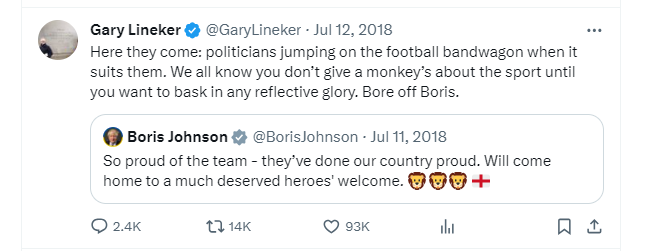
And here he is having a go at Boris Johnson after the English national football team made it to the World Cup semi-finals:
Here he is on the removal of the Edward Colston statue during BLM protests in Bristol:

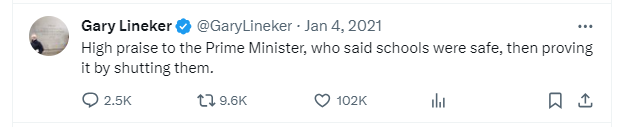
On Covid school closures:
On Donald Trump:

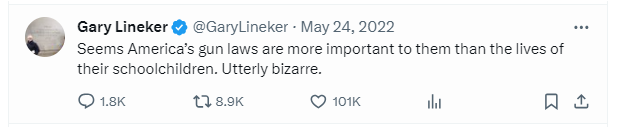
On gun control in the USA:
And finally on Suella Braverman, who spoke recently to condemn mass marches taking place in London in support of Hamas:

Notice how finely tuned are his antennae. How he casts around for exactly the right line to tack with respect to whatever item is on the news agenda, to discern opinion amongst the James O’Briens and Alastair Campbells of the world, and to chime in with an observation accordingly. This is not a man who forms opinions; it is a man who imbibes them from people whom he thinks to be educated and intelligent – the clever people he follows on X – and then simply repackages them as his own. He spouts platitudes, but they are finely distilled platitudes – precisely the right kind of platitudes to garner ‘likes’ and retweets, and generate an ever-growing following. His brain, I repeat, has been borked, and now it functions in an almost purely Girardian way, as a kind of relentless pursuer of mimetic status via social media.
What we have in Lineker then, is a particular spectacle, unique I think to our cultural moment, in which a man who has no discernible applicable talent when it comes to political affairs, and is not really capable of forming independent views, let alone critical analysis, is given a platform by dint of the fact that he has been selected for a role by unappointed bureaucrats, from which the electorate cannot eject him. And he uses this essentially to signal his own adherence to the high-status causes of the day, and thereby cement his own position as a kind of public defender (or launderer) of the views of the higher echelons of society. People like this have presumably always existed, but our age is characterised by their prominence – and indeed their centrality in the public square. And Lineker is in this way highly representative of the Vanity Fair-like tenor of public life in the 2020s, with its apparent lionisation of hypocrisy and superficiality and a concurrent debasement of our public life.
This is in itself obviously to our vast detriment. And this is not even to speak of the demoralising effect it has on a population to go through life having to know what people like Gary Lineker think – to have it printed on the front of newspapers and talked about on the radio and otherwise insinuated into one’s awareness despite the fact that it is inevitably ill-thought through, bland and obvious. That cannot but have negative consequences for our ‘lifeworld’, in the same way that being made to eat nothing but Walker’s crisps every day would eventually have serious consequences for one’s endocrine system.
But the rot goes much deeper than that. Because, of course, the most profound problem concerning the Gary Lineker phenomenon is that he represents, in microcosm, what is going on inside most people’s heads nowadays. Something about the incentive structure of the internet and the innate frailties of the human character combine to turn us all into mini-Gary Linekers much of the time: slovenly dilettantes, knowing very little about very much at all, imbibing our views magpie-like from whatever online loudmouth happens to grab our attention, and convincing ourselves that our opinions are worth airing and taking seriously. The result is a peculiar mixture of breeziness and fanaticism: everybody utterly convinced that they are right and that anybody who disagrees is both wrong and wicked, in inverse proportion to how much they actually know (or really care, deep down inside) about the issues involved.
We are not as bad as Gary Lineker, because we do not behave in the main as if it is holy writ that we should be lavishly funded by a hypothecated tax in order to have a platform to air our oafish views. But we are infected by a repulsive and self-aggrandising Linekerishness all the same. Where we go from here is anyone’s guess. What does Government look like when the population is increasingly comprised of slovenly dilettantes, as I earlier called us, who are incapable of reasoning and know almost nothing about the world but are utterly convinced that they are right about absolutely everything? One thing at least is for sure – we are on our way to finding out.
Dr. David McGrogan is an Associate Professor of Law at Northumbria Law School. He is the author of the News From Uncibal Substack where this article first appeared.
To join in with the discussion please make a donation to The Daily Sceptic.
Profanity and abuse will be removed and may lead to a permanent ban.
Well like the rest of us he’s entitled to his opinion. I would argue that (assuming this is true) the main fault lies with whoever in the general public sets greater store by someone’s views on the big issues of the day just because they are famous and have expertise in some specific area. That’s pretty dumb when you think about it.
The world is full of midwits; the big problem we have now is that midwits want to impose their views on the rest of us, and have the power to do so.
“… and have the power to do so.”
Thats what happens when everybody gets the vote and believes they have a right to each others’ money to live off.
Surely the problem is that Lineker is forced upon the population and wrongly given the space and taxpayers money to parrot his nonsense points of view. Yes Dr McGrogan acknowledges this but he has not suggested that the crisp salesman be taken off air which is what many decent people believe.
The BBC have clearly been given the ok to leave Lineker alone because his schoolboy philosophy serves a purpose. Those running this racket are to be found around Fishy’s desk.
Indeed. The BBC must be privatised.
Or burned.
Yes I would like it to disappear
No establishment party would ever privatise the BBC. But those of us who regard the BBC to have strayed beyond its remit can all play a small part in bringing it to its knees by not paying the propaganda tax.
Interesting view. Thanks to the author…
Who is this Mary Wanaker?
Of course the smug prat is entitled to his opinions. However, what he’s not entitled to is the taxpayer money that gives him the arrogance and status to air his opinions while sticking a middle finger up to at least half of his employers i.e. us, the general public. The woke moron can say what he wants, just not while the public are paying his wages to be impartial.
I honestly have no idea why so many people struggle with this. Nobody is forced to pay it. You have a choice. I choose not to pay (and haven’t done for many, many, years) for the left-wing propaganda that is tearing apart the very fabric of society. If you want to do your bit, then stop funding this machine.
Yup I’m doing the same. I will just have to be ready for their hired thugs.
They never come.
I’ve had one visit in 8 odd years (can’t remember exactly when I stopped paying). Chap turned up, asked a few questions, then toddled off never to be seen again – that was about five years ago. They have no legal right to enter your house unless you give them the authority to do so. If anyone is genuinely worried about being ‘caught’ then just stop watching live television and don’t use the State Propaganda Machine’s On-Demand service. You’re then on the legal side of things.
Nobody that posts their criticism of the state and it’s propaganda apparatus has any right to do so if they won’t make the tiniest of sacrifices to revolt.
I enjoy watching live sport on Sky and I don’t want to break the law therefore I am forced to contribute to Gary Lineker’s salary even though I never watch BBC television.
Can someone please politely inform this TV non-persona that a statue isn’t alive and thus, cannot survive? The people who pulled it down didn’t kill one of their enemies, they just vandalized someone else’s property for symbolical politics point-scoring, ie, basically, to get themselves into the evening news of that day. And this didn’t accomplish anything and didn’t mean anything except “Ecce, herostrati sumus!”
Bristol is the woke capital of England, followed by Brighton.
Bath
But a beautiful city, and has The Raven pub where the landlord told Sir Kier to get lost for supporting Lockdowns and not doing the job of an official opposition.
https://www.globalresearch.ca/spilling-bill-beans-tech-billionaire-spent-113-million-nebraska-farmland/5847042
Billy is still shopping and buying up farms.
So summarising then David, Lineker is a bell end?
😀😀😀
The Crisp Barron.
“Bell” has a better ring to it Ron.
A bell end has a use.
What does Government look like when the population is increasingly comprised of slovenly dilettantes?
It looks like the entrenchment of eurocommunism. The dilettantes mimetically self-regulate with the speech codes, mask mandates, and all the other features used to corral the governed into conforming to modes of living and behaviours from which all else (the family, Christianity, the presumption of innocence etc) has been expunged.
A form of soft totalitarianism well suited to the flattery of the Self, since the self believes that it is the author of all it mimics. Not just in the dark, but impregnated with darkness so as to be identified with it. So derivative as if to be made as if ignorance itself were a substance. The thread of these derivative beliefs having gone through us like thread through a needle; everything we do is stitched in its (rainbow) colours.
You do not have to have a licence if you have a TV, only if you watch or record live broadcasts. I sent mine back three years ago as I did not want to pay for BBC.
Central to what debate in Britain?
And, never debate an idiot, observers might not be able to tell the difference.
Gary who?