
U.K. Health Security Agency Deploys Made-Up Rise of 5°C in 80 Years to Spread Alarm About Dengue Fever Plague in London
The threat of tropical mosquito-borne vector diseases becoming endemic in Britain in the near future made recent headlines in the unquestioning mainstream media, with particular pride-of-place given to the revelation that London could suffer endemic dengue fever transmission by 2060. Of course, like all good sandwich-board climate scare stories, this one has been walked around the park a few times in the past. In 2013, the Guardian reported that “leading health experts” were urging the Government to take action against the growing threat of mosquito-borne diseases, since “climate change could bring malaria to the U.K.”. Back in 2001, the newspaper reported British health officials had warned that malaria could return to southern counties “within 20 years” as the climate warms.
The latest catastrophising report comes from the U.K. Government’s Health Security Agency (UKHSA), led by Dame Jenny Harries. It is highly political in tone with Professor Isabel Oliver, Chief Scientific Officer at UKHSA noting that it “demonstrates the impact that climate change could have on our society if we don’t take decisive action”. It does nothing of the sort of course because, astonishingly, the UKHSA has based many of its headline-grabbing predictions on climate models fed with a presumption that temperatures will rise by 4-5°C in less than 80 years. Since global temperatures have barely moved much more than 0.15°C in the last 25 years, this 4-5°C high emissions pathway, known as RCP8.5, is little more than a highly implausible invention.
“Climate modelling under a high emissions scenario suggests that Aedes albopictus – a mosquito species that can transmit dengue fever, chikungunya virus and zika virus – has the potential to become established in most of England by the 2040s and 2050s, while most of Wales, Northern Ireland and parts of the Scottish Lowlands could also become suitable habitats later in this century,” says the report. Dr. Lea Berrang Ford, Head of Centre for Climate and Health Security at UKHSA, added that “a child born today will be in their working-age years when health impacts may peak or accelerate further, depending on how much we decarbonise now”.
Linking public health in this way using invented future temperature rises is a disgrace. It does a grave disservice to the British public who are entitled to receive timely and realistic advice on current and future health threats, not politically-driven scare stories based on unproven science and garbage-in, garbage-out climate models.
It is particularly disappointing to see the UKHSA, an executive agency of the Department of Health, making such a play of RCP8.5. In its latest assessment report, the UN’s Intergovernmental Panel on Climate Change noted that “the likelihood of high emissions scenarios such as RCP8.5 or SSP5-8.5 [a later version] is considered low”. The UKHSA is using a ‘low likelihood’ prediction to make fanciful, politically-inspired claims of tropical disease epidemics to scare the young, in particular, to follow a collectivist Net Zero agenda. Regrettably, the RCP8.5 pathway is responsible for much of the ‘clickbait’ science that still dominates the mainstream media headlines, from the Gulf Stream collapsing, to all the coral suddenly dying in the oceans. For its part, the UKHSA describes RCP8.5 as a “plausible” scenario.
The science writer Roger Pielke Jnr. has long been a critic of its widespread misuse, noting that we can view it as one of the “most significant failures of scientific integrity in the 21st century so far”. His short explanation for how such an obvious corruption of the scientific process has been allowed to stand for so long is “groupthink fuelled by a misinformation campaign led by activist climate scientists”.
As I noted earlier, the vector tropical disease climate scare is dusted down at regular intervals. But the facts have refused to cooperate – since the U.K. Department of Health and the Guardian first told us in 2001 it could appear within 20 years, malaria has been keeping its long-term low profile.
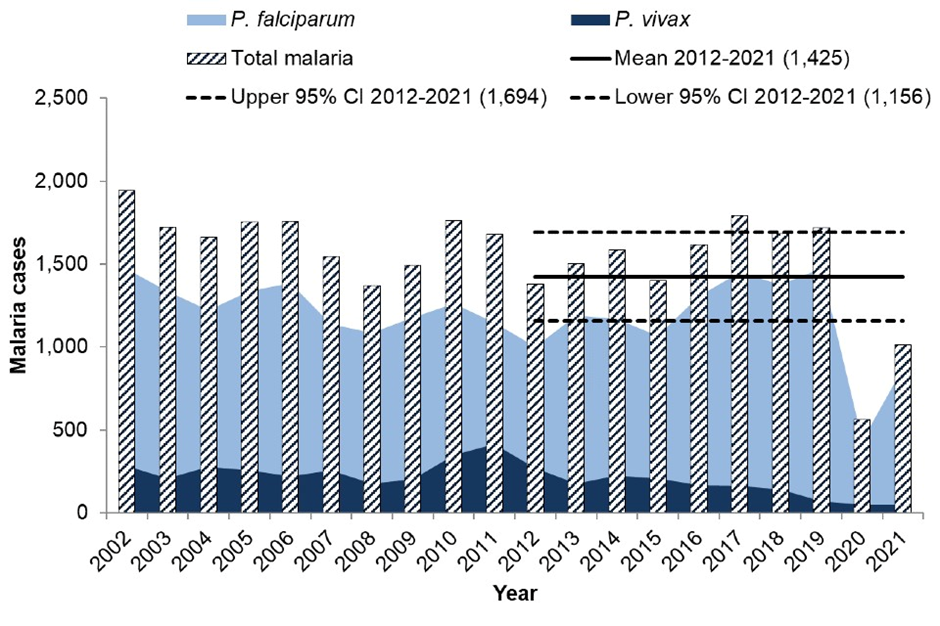
In June this year, the UKHSA issued a more sober assessment of malaria in the U.K. It noted that malaria “is not currently transmitted in the U.K.”, but travel-associated cases occur in those who have returned to or arrived in the U.K. from malaria-endemic areas. The above graph shows cases of malaria reported in the U.K. from 2002 to 2021. It shows they have remained fairly constant over the last 20 years, with major drops in the travel-restricted Covid years.
Chris Morrison is the Daily Sceptic’s Environment Editor.
To join in with the discussion please make a donation to The Daily Sceptic.
Profanity and abuse will be removed and may lead to a permanent ban.
Don’t look at the jabs, look at the mozzies!
we used to have a lot of mozzies splatted on the car on any reasonable journey but they are all gone and don’t see them coming back anytime soon. 5G innit. Jenny Harries needs to be gone.
Note that in twenty years the story has changed slightly, from Malaria to Dengue. Probably because someone pointed out that malaria was endemic in the UK until the early 20th century, spread by a different species of mosquito.
I also love that touch ‘depending on how much we decarbonise now’ – who is ‘we’? The UK has (officially) decarbonised by almost 50% compared to 1990 – it would be interesting to plot that against ‘average global temperature’!
First you would need to determine what is “Global Average temperature”. ——Let’s imagine we take 6 temperatures from various points on earth all at the very same time. It is possible to add these together and create some average, median or mean etc. So let us suppose we do that and we end up with a number. ——What does that number mean? This number is NOT the temperature of anything. It is just a statistic. But actually in climate science (if it still can be referred to as science that is) they do not use the term “Global Average Temperature”, they use “Temperature Anomaly”, which indicates how much temperature compare to the average of a specific period, normally a 30 year period. If this “anomaly” rises does this mean the earth has warmed? If so what caused the warming, and how do we know? Then if we move the 30 year period forward or back 20 years is the number the same or different, and if it is different what does this mean? ——————The truth is that some things lose there meaning when you average them, and temperature is one of those things, because temperature is not an amount of… Read more »
Good point, well made! Also one temperature on the planet may go up whilst at the same time somewhere else might go down. The overall heat maybe the same.
Then ofcourse even if there is such a thing as a global temperature and it rose over a period of time by half a degree, there is the question of determining what caused that rise. But even the IPCC admit they see no human signal in the data at this point. They cannot tell the difference between warming that might be caused by humans and warming that might be as result of natural variation. ——–So where does that leave us? It leaves us with models full of assumptions regarding future warming and a political consensus about what may have caused it. But models and consensus are NOT science.
Yep, if you have your head in the oven and your legs in the freezer your mean temperature is probably just fine, but it doesn’t work like that!
And maybe Malaria, a fairly well used and understood description, doesn’t sound as frightening as DENGUE FEVER PLAGUE ? Arrrrrrrh ,run for your lives!
That sounds more like a lockdown type of pandemic!
The IPCC’s preferred terminology is in itself misleading. “We predict an 8.5 degree rise with low confidence” is better understood as “the risk of an 8.5 degree rise is predictably close to zero.”
Compare “We predeict a nuclear attack with low confidence” with “There’s no evidence for a nuclear attack any time soon.”
London is plagued but not with dengue
Khant mosquitos spreading ULEZ.
Lol. Trouble with a ULEZ infestation? Call Blade Runners!
I made my climate model from an Airfix kit. It is a hollow plastic copy of reality but it doesn’t work at all.
I was particularly amused by the final chart. It shows we can keep malaria out of the UK!
It’s COP 28 pantomime season again!
“The world is boiling!”
“Oh no it isn’t!”
“Oh yes it is!”
“And even if it isn’t how much more money are you giving us to save us from the manufactured crisis”.
Statement of Dr Lea Berrang Ford, head of headless chickens at UKHSA:
a child born today will be in their working-age years when health impacts may peak or accelerate further, depending on how much we decarbonise now
The core of this statements is health impacts may peak or accelerate further [in future].
There’s a lot which could be said about this. I’ll try to restrict myself to a simple case. Dropping the semantically useless peak or from this yields health health impacts may accelerate further [in future], this, in turn, means health impacts will or will not acceleate in future. And that’s a tautology, ie, a statements that’s always true, as it’s, somewhat formalized, identical to tertiam non datur statement: Anything is either A (accelerates) or not A (doesn’t accelerate). This basically means Dr Lea Berrang Ford urges everyone to decarbonise now because she has no idea what will happen future if we don’t.
Considering this, and that I prefer carbonated over still water, I thus urge everyone to carbonise now as I also don’t have an idea what will happen in future and my non-expertise is certainly just as good as hers.
The BBC back in the distant pre covid past.
The worst-case scenario for emissions of CO2 this century is no longer plausible, say researchers
And
Very few scientists realised that RCP8.5 was originally a 90th percentile outcome, not a most likely or business-as-usual outcome.
https://www.bbc.co.uk/news/science-environment-51281986
London is a large urban area and experiences higher average temperatures than non urban areas and may be 5 or more degrees higher, but so what, because Mosquitos require standing water? Talking of UHI, the thermal map below is interesting in that I initially could not make sense of the heat distribution. Hyde Park, Regents Park and Blackheath show up as hotter than surrounding roads and buildings, while Richmond park has both hottest and coldest temps with a 14C difference between the top and bottom of the park. On closer inspection these temperature extremes can be explained by the nature of these open spaces. The warmest parts are short grass and the coolest are either trees or water. it is possible to see the outline of the Serpentine and the woods next to it in Hyde Park. The dark areas in Richmond are trees. In addition other wooded areas are clearly defined, such as Dulwich Woods. Looking closer still the green just on the north side of Dulwich Woods is a golf course, with short grass, but it is not hot. However there is a hot spot just above the golf course which are cricket pitches. Looking at Google Earth… Read more »
Your comment has been underestimated. ——-Most of the scare stories about temperature are agenda driven and in truth temperature increase is mostly to be found in the adjustments made to the temperature record, which has been fiddled about with more than a lady of the night’s undergarments.
You’re such a spoil sport, Chris. I suppose that next you’ll be telling us that there’s no Father Christmas?
Checking Professor Isabel Oliver, born October 68in Companies House, she’s used three identities to register her directorships over the years, this breaches accountability requirements. Identities with past interests are: Isabel OLIVER personal appointments and Maria Isabel OLIVER personal appointments. She is a current director of The Soil Association Ltd Maria Isabel OLIVER personal appointments yet she fails to disclose this in her biography on the Government website; Professor Isabel Oliver – GOV.UK (www.gov.uk). Failing to disclose interests is an offence. Why do you think she’s been hiding this interest from the public?