
UKHSA Pleads Poverty to Get Out of Appraising Lockdown Model Performance Despite £2.4 Billion Covid Budget
Some of you will recall that the U.K. Health Security Agency (UKHSA) claimed not to have the resources to carry out a systematic appraisal of the 100 models forming the backbone of the UKHSA’s mapping review called ‘Effectiveness of non-pharmaceutical interventions to reduce transmission of COVID-19 in the U.K.‘
We have documented its dreadful reviews that include the wrong type of evidence to address the question but still made their way to Parliament as evidence of effectiveness.
So, as we were swimming in cash, lounging by the pool in our villas in the Caribbean, we did the job for them.
We found that the 100 models were not science, but a mass of assumptions and unverifiable statements which reflected the publication frenzy that went off the boil as soon as attention moved away from Covid.
According to Mr. Hancock, when mask mandates were introduced (to please Ms. Sturgeon), there was no strong evidence that they made any difference to the transmission of any viral respiratory agent. This still holds today.
So, the 100 models were retrofitted evidence to try and justify a national policy based on the distortion of the precautionary principle.
We think it likely that a little bit of cash will be found for friends of the UKHSA to find that: “well, maybe, if we do this or that analysis a bit of an effect will be found.”
But does the UKHSA have a few pennies after all to look at the evidence behind a national policy that muzzled most Britons for nigh on two years? Here is a summary of the UKHSA funding for 2022-23:
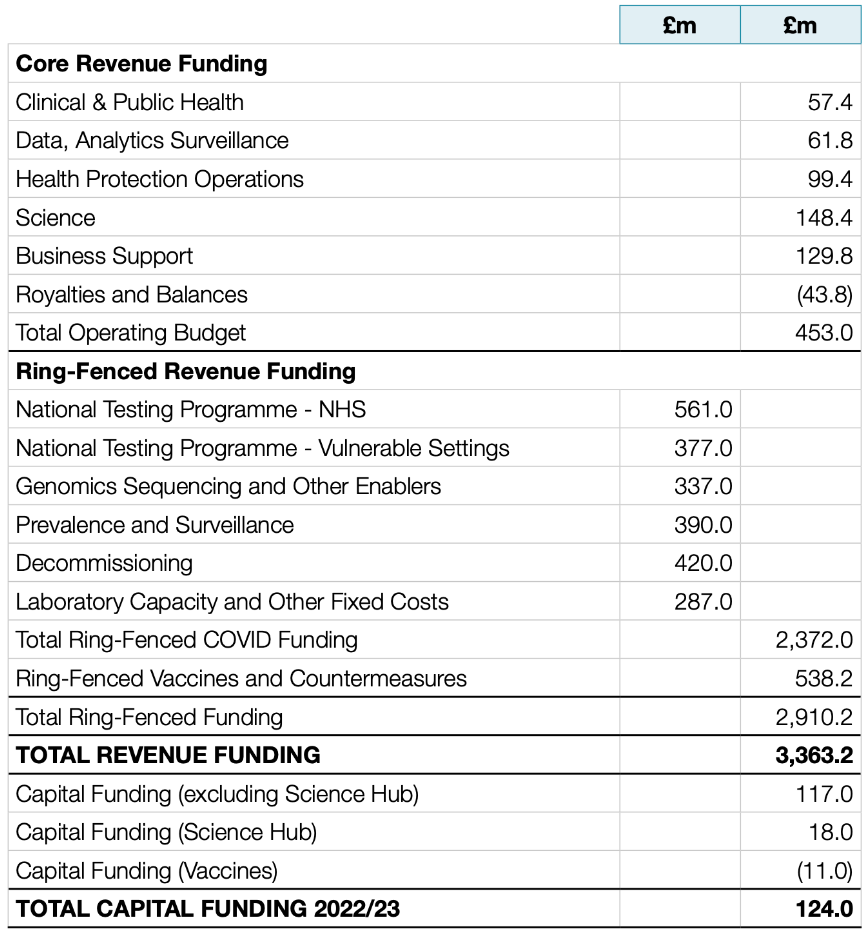
Maybe a few pennies could come from the over £2 billion of ring-fenced Covid funding?
Our previous work showed the UKHSA is no stranger to wasting money: “Hundreds of millions of pounds may have been wasted on a drug for influenza that works no better than paracetamol, a landmark analysis has said.” By 2014, The U.K. had spent £473m on Tamiflu, which is stockpiled by Governments globally to prepare for the dreaded ‘F’ pandemic (flu).
However, we find it strange that there is such a ring-fenced sum for a pathogen which is now endemic, but maybe the UKHSA knows something we do not.
With such a huge drain on the exchequer from the resources provided for evidence-free policies, is everything all right then? Not according to the auditor (page 96 of the report):
DHSC and UKHSA should work with HM Treasury to agree and implement an action plan to get UKHSA on track to deliver auditable financial statements for 2022-23. I understand that work on an action plan has begun. Resolution of the issues, for example those arising from the implementation of the new ERP system, will require additional investment and support for UKHSA’s finance team to ensure they are properly equipped to succeed with this challenge.
1.24 The audit work that I have performed has identified significant shortcomings in financial control and governance which are pervasive to UKHSA’s financial statements. The uncertainties that I have encountered mean that I am not able to report quantifiable adjustments which UKHSA could make to correct the financial statements.
More money is needed then. To fund what? More models?
The report may be interesting if somewhat long at 127 pages. There is a helpful introduction by the Chair of UKHSA, Mr. Peters. Let’s hope he knows a little more about public health than his predecessor at Public Health England, Mr. Selbie, who described his knowledge at the Covid Inquiry as enough to fill the back of a postage stamp. Second class stamp, that is.
Dr. Carl Heneghan is the Oxford Professor of Evidence Based Medicine and Dr. Tom Jefferson is an epidemiologist based in Rome who works with Professor Heneghan on the Cochrane Collaboration. This article was first published on their Substack, Trust The Evidence, which you can subscribe to here.
To join in with the discussion please make a donation to The Daily Sceptic.
Profanity and abuse will be removed and may lead to a permanent ban.
Poverty? I worked there during Rona. It was crawling with every IT firm and consultancy on the planet, like bacteria eating an exploded group of cells. No shortage of cabbage.
Billions spent on useless projects. I saw them first hand (shit sniffers identifying scariants are still a thing there).
Track n Trace, or Trick n Treat for the grifters, grafters and corrupts was $34 bn. I work in IT. You can’t spend that money (not even £1 bn) in 1-2 years. So where did it go?
And they can’t analyse the quackcines of course, no money or ‘science’ for the poison analysis. Never bothered to trace what happened when people were stabbed.
Clown world. And the idiots at the HSA will be at the forefront of the next scamdemic (ready to roll out their ridiculous systems and analysis platforms).
Great post but one can spend 34 bill if yr an arrogant, evil and totally stupid PoS, who can be sold on any technobabble, like Cummings or Gove.
Remind me, who runs the HSA?
Oh yes…….
‘In December 2021, The DT reported that it was understood that (Prof. Jenny) Harries was the source of a contested figure that there was an average 17-day delay between infection and hospitalisation for COVID-19, used by Health Secretary, Sajid Javid.
Former Treasury statistician Simon Briscoe was quoted as saying that the figure seemed like either a “deliberate statistical sleight of hand designed to deceive, or incompetence” and that if deliberate, officials were “in effect trying to buy time, as officials realise that data of rising hospitalisations is needed to justify lockdown”
Hmm, 17 days? I hadn’t heard that one. Oh yes, the difference between the dates of the lockdown announcement and the peak of deaths is 16 days. Brilliant analysis Prof Genius.
Statistically there’s no change for the better in the trajectory of the deaths chart until 19 April. If that was the effect of lockdown it was very minor and gives a lead time of 27 days. If it was not the effect of lockdown then lockdown had no beneficial effect.
A friend’s son worked on a mobile vaccination crew. His job, on £15/hour, good money for a gap year student, was to clean a door handle after every victim.
After the initial burst of enthusiasm, he tells me they went hours without seeing anyone, but still there were dozens employed to direct non-existent traffic. Help non-existent people up stairs. Administer jabs to people who never came. He’s doing a masters in ‘big-data’, if they’d asked he’d have knocked out an indepth analysis before lunch.
Christmas is coming, the goose is getting fat….
It’s likely that other political urgencies have grabbed hold of the cash, with proper work being stuck in the doldrums.