
Climate Catastrophism Really is a Death Cult – and Social Science Proves It
I’ve long since lost count of all the insightful commentators who now take the view that fears about climate change have become ideological, religious, even cultish. Brendan O’ Neill is perhaps the most frequent exponent, and Elon Musk the most famous, labelling modern environmentalism a “death cult” in his recent appearance on Joe Rogan. This view has been very late coming in the mainstream media, but is at long last a welcome counter to the endless litanies of climate doom from practically all authoritative sources in Western society and beyond.
However, despite the obviously cultish antics of Extinction Rebellion and Just Stop Oil, this insight is easily dismissed by the climate faithful as mere opinion – flawed opinion. But just imagine what a difference it would make if we were not relying upon opinion only. If instead we could point to some data and charts which formally prove that there is indeed a ‘secular religion’ of climate catastrophism. And better still, if we could also point to robust measurements of its dominance in public opinion and climate policy alike. This would be much harder to dismiss, especially if the proof did not stem from complex models or sophisticated stats, but from straightforward and publicly available data that any first-year university student could grab and type into Excel.
Happily, we no longer need to imagine this. I have set out these data in my new book The Grip of Culture, and they conform exactly to the above characteristics. The proof is enabled by the fact that the underlying behavioural drivers of all cultural entities (religions, ideologies) are the same.
The data I use come from about 20 surveys conducted by a range of independent sources, including mainstream pollsters, academia, the UN and the EU, which all fit into a single pattern clearly identifying a new cultural entity: the ‘secular religion’ of climate catastrophism. They are social data encompassing 40 series of national attitudes to climate change across 64 nations.
The key to understanding the inherently cultural nature of such attitudes is their very strong relationship with national religiosity, itself a purely cultural phenomenon. This relationship occurs because cultural entities tend to interact if they occupy the same social space for long enough. This has happened for religion and climate catastrophism. Hence national religiosity forms a kind of lens through which we can see the culture of catastrophism across nations; this lens is revealed by plotting the climate survey data series against national religiosity.
Such plots show that national religiosity is a superb ‘social predictor’ for international attitudes to climate change; a multi-modal predictor, in the jargon. Incredibly, this fact has remained undiscovered in the extensive social predictor literature. Researchers don’t seem to have considered the possibility that public attitudes to climate change might be inherently cultural, so have missed the obvious; they offer a plethora of predictors that are poor or very poor compared to national religiosity. I can only assume that this is due to serious bias in the social sciences – bias towards climate catastrophism.
Beyond this revelation, the data show a very clear signature of cultural causation; in other words that public attitudes to climate change are indeed motivated by climate catastrophism. But in addition to the intuition that responses so tied to religiosity are likely cultural, what does such a signature look like?
Firstly, it consists of fundamentally different responses to unconstrained and reality-constrained questions. The former are open-ended, an example is: “How serious do you think climate change is?” Out of several response options, the climate-change most-endorsing one might be, say: “extremely serious”. As its name implies, a reality-constrained question introduces a constraint into the minds of survey participants, such as a relative cost or other priorities. An example is asking participants which are their three top priorities from a list of 12. Climate change or a related policy is an item on the list; the climate-change most-endorsing response would be one where this item is indeed selected. Secondly, unconstrained responses have a gradient that depends on their strength of emotive alignment to the main cultural narrative (in this case, climate catastrophe) and they pivot about a common point (top chart below). Lastly, the reality-constrained responses reduce proportionately to the strength of the constraint; a one of 10 pick from a list is stronger than a three of 12 pick, which is stronger than a six of 17 pick, say. Figure 5 of my book, replicated below, shows all these features (see tables 7 and 8 in the free PDF for question details and correlation parameters).
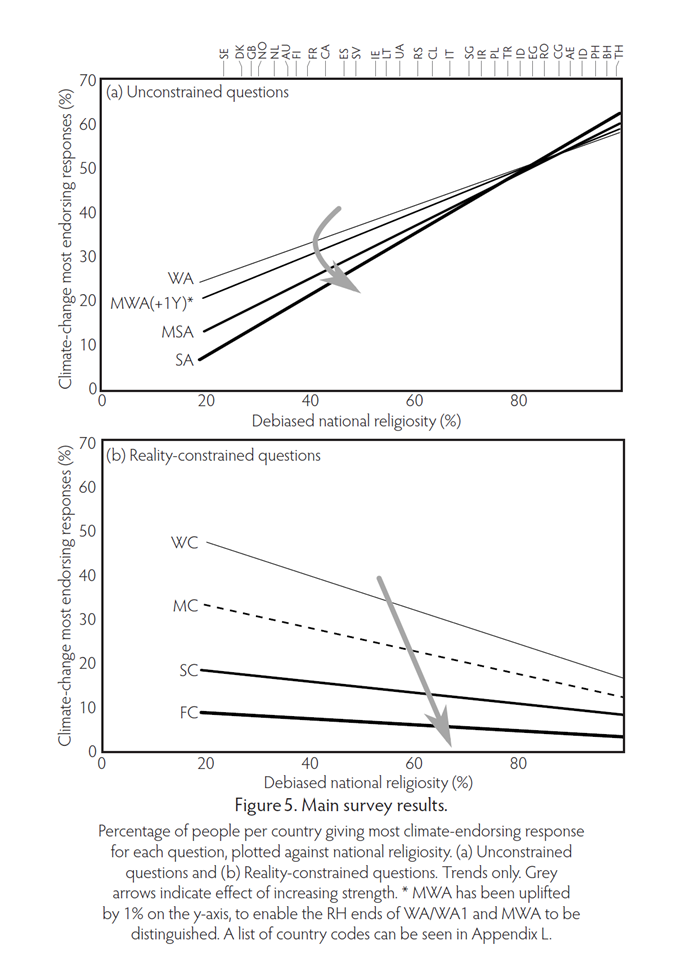
Additionally, we see that national religiosity correlates with unconstrained responses (top chart, the slope goes up) but anti-correlates with reality-constrained responses (bottom chart, the slope goes down) (hence two modes of the social predictor of national religiosity; there are others). As The Grip of Culture fully explains, this is an expectation where a shallow cultural alliance is in play. This is the case between the cultural entities of religion and climate catastrophism; in more religious societies, religious leaderships have formal statements backing catastrophic climate change, so their flocks align to unconstrained narratives. However, when reality bites they aren’t buying. Instead, they revert to older priorities set by the religious culture in their societies and actively resist climate change priorities.
We can think of the unconstrained responses as ‘pure’ virtue-signalling. They’re aligned to the emotion in cultural narratives. As emotive content evoked by different survey questions increases (the grey arrow in the top chart above), the gradient of the trendlines for climate-change most-endorsing responses gets steeper. This is because a more emotive pitch causes even more instinctive acceptance than rejection at the right-hand side of the chart, where there’s already a majority who are aligned, and oppositely at the left-hand side, where there’s already a big majority of rejectors. In other words, unconstrained questions are emotively polarising; this also means that responses to them must share a pivot point.
Reality-constrained questions prevent pure virtual-signalling, but this is not to say that responses to them aren’t largely still cultural. They reflect a compromise between belief and reality, a compromise forced more and more towards reality as the constraint increases (the grey arrow in the bottom chart, above). Cultural entities would never have become a huge evolutionary success if they couldn’t compromise with reality. However, they only make the absolute minimum concessions they have to for any particular reality scenario. Except possibly due to noise where values are very low, reality constrained responses don’t cross over each other; unlike unconstrained responses they aren’t effectively arbitrary, and across all nations they reflect that each reality scenario is different.
These and the other characteristics of a cultural signature are hardly intuitive or obvious. While The Grip of Culture explains the theory behind all of them in detail, as I intimated above there is a way for anyone to easily grasp that the pattern expressed in the above plots of climate survey data does indeed reveal a cultural entity (or ‘culture’, for short).
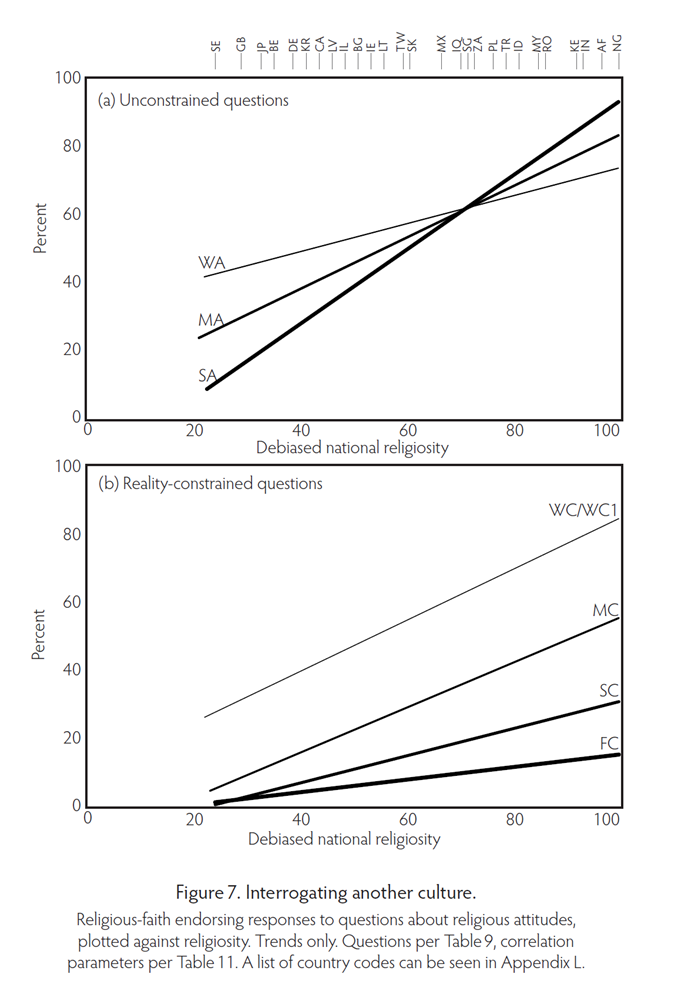
This is by direct comparison. Any cultural entity should leave such a signature, so if we see the same pattern in survey data harvested from something that is inarguably a cultural entity like a religion, this makes it much more obvious that the climate survey data must come from the same kind of phenomenon. Religion is purely cultural, and survey data on purely religious (unconstrained and reality-constrained) questions produces the same kind of signature pattern that we see for attitudes to climate change. Figure 7 from my book illustrates this. The only (expected) difference is that, given there is only one culture involved, and so no alliance, all data must slope the same way. But the two response groups, the unconstrained pivot-point (where the lines cross) and the sinking of the reality-constrained responses with strength, are all fully in line with expectations. (Note: The questions are very basic, so all faiths react to them in the same manner. In both figures the country codes are examples, there isn’t space to fit them all in and different series represent different sub-groups of countries too).
As noted above, signatures of this type will in theory be left by all cultural entities. This includes all religions, all strong political ideologies from communism to fascism to extreme nationalism and modern ‘tribal’ politics such as in the USA, and all other cults and belief systems, including climate catastrophism plus those very new and unruly cultures based upon Extreme Trans Rights (ETR) and Critical Race Theory (CRT). This is because, as the The Grip of Culture explains, the underlying behaviours that enable all such entities are a legacy of our evolution, a system for making large groups of humans act as one, at the (then lesser) cost of rejecting out-groupers.
However, it’s a luxury to be able to plot enough social data to actually see the signatures. For ETR and CRT based cultures, I doubt there are anywhere near enough objective social data accumulated to date to do this, nor could nations across the globe be used as convenient data buckets; these cultures manifest only in a subset of Western nations. For historic cultures such as communism and fascism, their rise and glory days were in a time when far less objective social data was available, while an immense amount of historical baggage and bias also obscures that which researchers need to assess. While religion is old too, far older in fact, it’s sheer size and longevity means it has survived in a major way into an age where enough useful social data has been collected to see the cultural signature in Figure 7 (above). A majority of the world still believes in one faith or another. The situation for climate catastrophism is better still; it has lived out almost its entire life-cycle so far on the internet, it is global in scope so we can use nations as convenient data-buckets, and it is one of the most intensely polled subjects of the 21st century to date. Regarding tribal U.S. politics, although in a somewhat different manner to me, social psychologist Dan Kahan does find cultural signatures (see below).
This data rich situation for climate catastrophism means that, although our view is more limited, we can see its history too. It’s an expectation that before climate catastrophism gained sufficient cultural influence, and also before its current relationship with religion had fully developed (so prior to 2009), international polls of attitudes to climate change should not reveal a cultural signature. As Section 9.5. of my book shows, this is the case. The evolving nature of attitudes as climate catastrophism established itself may be another reason why academia failed to spot the increasingly important role of national religiosity.
Knowing that the issue of climate change is dominated by a cultural entity allows us to apply 150 years of accumulated knowledge about how such entities work, explaining much that otherwise seems bizarre – for instance from Figure 5 (above), the fact that many (very religious) nations are hugely concerned about climate change yet report a very low motivation to do anything about it, while others (very secular) are more motivated to act but express far less concern.
The Grip of Culture explores standard cultural characteristics within climate catastrophism, such as: an evolving population of highly emotive and necessarily false narrative variants, strong narrative policing, the demonisation of anyone who doesn’t culturally conform, aggressive morphing of the legal and moral landscape to the culture’s benefit, its use of children as prophets and proselytisers (along with the resultant psychological damage), and much more. The behaviours underlying this list are not new or somehow enabled only by the internet era, nor unique to the issue of climate change. As the book also explains, they’re a legacy of our evolution – a feature not a bug. We are by nature susceptible to cultural entities because for a very long time they were a large net advantage in our deep past. For instance, religion brought the benefits of mass bonding, including the benefit that civilisation would not have got started without it; mature cultures can still confer a net advantage today.
However, in modern times there is a constant war between ‘rationality at scale’ (democracy, the law, science) and cultural entities, in which raw new cultures that rapidly rise to prominence are particularly dangerous to society. Climate catastrophism manifests such a danger, especially in its blind fervour to implement a crash Net Zero programme – the ‘salvation’ half of the false narrative of catastrophe. This not only harms society in a major way but will likely cause net harm to the environment too.
Regarding policy, the data in The Grip of Culture are again crucial to understanding. For instance, the commitment to renewables across nations clearly follows a cultural pattern. This pattern is thus not related to climate science, the climate or climate exposure of nations, renewables technology factors, or indeed anything rational.
This does not bode well given the direction that the world, and particularly the West, is heading on climate and energy issues. No one should want a culture determining attitudes to these, since its adherents will instinctively devote all possible effort into not solving the issues that they so emotively tout, as doing so would kill the culture. Like viruses, cultural entities relentlessly pursue their own vital agenda – survival.
The Grip of Culture is available as a paperback at Amazon (U.S., U.K.) and electronically as a free PDF. The book is endorsed by Professors Frank Furedi and Judith Curry. Follow Andy A. West on X.
To join in with the discussion please make a donation to The Daily Sceptic.
Profanity and abuse will be removed and may lead to a permanent ban.
Climatism is a cult within Environmentalism which most definitely is a religion: it’s Paganism – the worship and adoration of the gods of the forest, seas, rivers, animals, the elements, Mother Earth, complete with sacrificial offerings and penitence to appease the gods… Human sacrifice too.
Everything in your list up to “Mother Earth” is good for human and planetary health. Everything after it is Death Cult fanaticism. I personally have environmentalist ideologies, but I’m a long way from calling it a “religion”, I think Net Zero is bonkers along with everything it would have to entail to be realized, and don’t even believe it is even remotely necessary. However I do believe in protecting forests, etc, and general ecological health. Humans may be slowly but surely wrecking the biosphere, but we’re NOT doing it through our carbon emissions or fossil fuel usage.
Environmentalism isn’t Paganism, people can be motivated to preserve nature for a whole host of reasons such as enjoying being in nature, wanting clean air and water etc. without worshipping it or believing it has any kind of spiritual dimension. From a traditional religious perspective environmentalism can be seen as taking care of the beauty of creation and destroying what a god or gods have given to us could be seen as sinful.
The obvious challenge is to find a way of protecting as much of the natural world as possible while ensuring everyone has a good quality of life and is free from hunger, poverty etc. This would be ‘humanitarian environmentalism’ and Michael Schellenberger has probably come closer than anyone to showing what it may look like and how economic development, especially in less developed countries is often good for people and the natural world.
You’re saying that environmentalism isn’t paganism. Well, sometimes that’s true and sometimes it isn’t. That’s not really a counter to what JXB is saying; I think he’d probably agree with you. His point, even if he’s not explicit about it, is that environmentalism is very often paganism – which appears to be completely true. You’re not wrong, but nor is he.
The language used is very religious in nature. We are to face an “Apocalypse”. Those not in agreement or who do not subscribe to this secular religion are all “heretics” etc etc. Environmentalism that used to be about genuine concerns regarding pollution from factories and smoke from chimney’s, overfishing etc has now morphed into a cult that relies on faith and emotion which is key to religious belief systems, rather than fact and reason. Religion relies more on the will to believe rather than on any evidence or observations.—— Very poor people in the third world who are being denied access to the fuels that would bring them out of the misery of abject poverty are starting to see this new “environmentalism” as a form of colonialism as eco warriors in wealthy countries hate the prospect of several billion poor people having the same standard of living as them. So the excuse for keeping them poor is the religious cult of saving the planet from all the environmental “sinners”. Climate Catastrophism is therefore a populist faith that is very successful at only one thing——-attracting followers. The cult now apparently worships the “science”. How peculiar when only a few hundred years… Read more »
“So the excuse for keeping them poor is the religious cult of saving the planet from all the environmental “sinners”.”
Up to a point varmint.
The elites also like to keep people poor because poor people work harder. Those rare earth metals have got to be dug.
“The elites also like to keep people poor because poor people work harder. Those rare earth metals have got to be dug.”
And what do “poor people” do when the robots take their “jobs”….?
Keeping people poor because they work harder has always been taking place though. So is therefore not really related to the climate issue. I feel the climate issue is more about an excuse for public policy around the worlds wealth, resources, and energy use. ——There is only so much fossil fuels in the ground. Just as you cannot keep sipping from a pint of Guiness without it eventually running out so to you cannot keep using the fuels in the ground without them running out.—— So at UN level the western world is to wean itself off of those fuels and use wind and sun instead because we can afford to do that, and third world countries are to be given “climate aid” so they don’t use up those resources also. The excuse for all of this is climate change, which from your posts I see you realise is a total scam as much as I do. But out of all of this bleating about the climate from the UN, western governments and media has been created this secular religious cult that this article is high lighting, who have been brainwashed into believing stuff. ——But believing stuff is RELIGION, and… Read more »
I know a real, life living Pagan; she has deep knowledge of what you call “forest, seas, rivers, animals, the elements, Mother Earth, complete with sacrificial offerings and penitence to appease the gods” – no human sacrifices to date AFAIK. Inconveniently for your preconception, she is as deeply sceptical of AWG/CC as anyone I know, with no exceptions.
I have learned more from her in 3 weeks spread over two years than anyone else in 60+ years……..
Seventy thousand delegates are off to Dubai at the end of the month for a talking shop called COP28.
70,000 friggin grifters talking about how they are going to destroy the planet.
70,000 on our money.
https://www.conservativewoman.co.uk/another-climate-talkfest-another-waste-of-time-and-money/
So more than a death cult, it’s a racket in which thousands scam off millions.
I suppose the death cult part are the big proportion of the millions who are cheering on and supporting the scam. That’s not a death cult, though, that’s idiots who just don’t realise they are being scammed
COP28 ——-An economic and political conference, not a climate one. The eco socialists will divvy up the worlds wealth and resources and the poorer countries will seek rent and payment for the western world having used up more than it’s fair share of those resources in becoming prosperous. The ordinary citizens of the wealthy countries need a plausible excuse for this wealth redistribution and lowering of their living standards and that plausible excuse is “climate change”. The biggest pseudo scientific fraud ever perpetrated. Such is the power of propaganda regarding this fraud, people glue themselves to the road clamouring for their own impoverishment.
Up to a point but the ordinary people of the West are given no say in how they are taxed or even how that taxation is spent.
Gilet Jaunes? “Blade Runners”? Dare I mention but in NO way endorse ER/JSO…….”They” are “saying” plenty – latter 2 I have no truck with in any way shape form or virtual reality….
Well but did we ever have a say on anything? Isn’t voting just giving us the illusion that we have choice? It is very hard for ordinary people who don’t have the time to investigate every issue to realise they are being subjected to false information about a climate crisis that is going to and is seriously affecting their standard of living when it is stuffed down their throats on a daily basis by politicians and 90% of the media. It is difficult to against the flow as you and I will often do on this website.
Er…none at all. Most people aren’t swayed by facts and charts, because for most of us our opinions formed by emotion and then justified with facts and evidence, not vice versa.
And with all due respect an article like this won’t convince anyone either because almost no one will get through it.
People will be convinced that climate catastrophism is a death cult when it is in their interest to do so. And then we won’t have to worry about facts, charts or evidence. They’ll come up with their own.
It may not sway minds but it does help those of us concerned about climate alarmism to see it for what it is.
Except only 0.05% of people may read this book while 80% will tune into the BBC or SKY and their “Climate Show”
At the end of the day, Climatism is the belief system created and exploited to remove Man’s mark upon nature. The religion demands that we see ourselves as a society and each other as harmful, and individuals who are wealthy or psychopathic enough use it to promote population reduction as a worthwhile goal.
And the cult members are teaching this to our children with politicians approval! And what does that say about our elected politicians ?
The mere fact that you are asked if you “believe” in climate change gives it away! Patrick Moore’s book exposing Attenborough’s fakery on the BBC should be required reading for the cultists.
I don’t find a statistics-driven approach to sociology or cultural studies particularly enlightening. It would be much better to explore this phenomenon – if it is a phenomenon – from a subjective psychological, philosophical, or moral point of view.